Acceptance Testing vs Smoke Testing in Browser Automation
Smoke tests verify builds are testable; acceptance tests confirm they meet business needs.
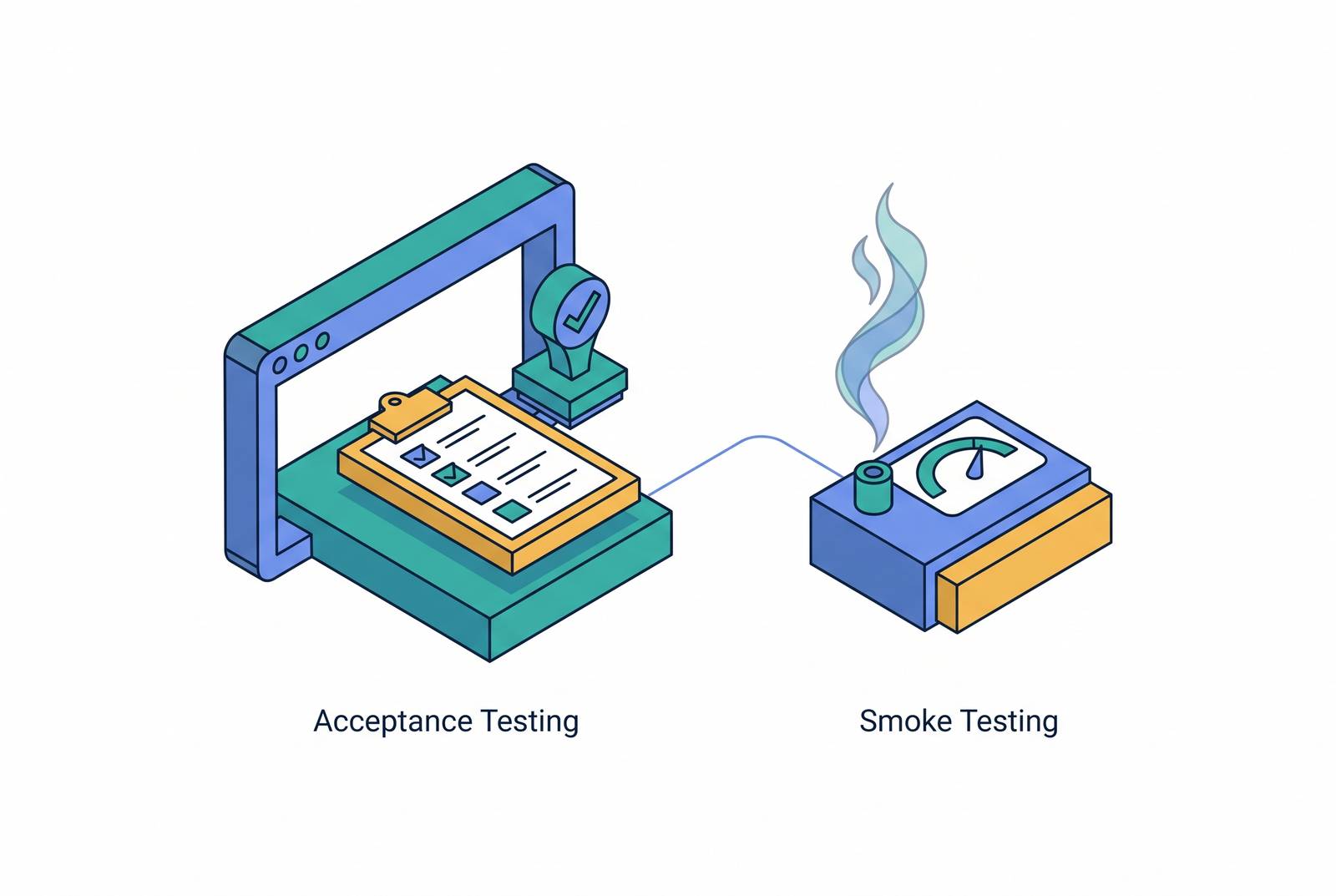
Smoke testing and acceptance testing answer different questions at different moments in a delivery pipeline. One asks whether a build is alive enough to test at all. The other asks whether the software does what the business and its users actually need. Treating them as interchangeable names for the same gate produces slow pipelines, wasted compute, and software that is technically stable but behaviorally wrong.
Why smoke testing and acceptance testing are not interchangeable names for the same gate
The confusion begins with the terminology itself. Smoke testing is sometimes called "build verification testing," which places it near integration and unit checks in the verification family. But it is also occasionally called "build acceptance testing," a phrase that collides directly with "user acceptance testing," the formal process by which a business representative confirms software meets a stated need. Two gates, both carrying the word "acceptance," invite the conclusion that they are variants of the same activity. They are not.
TestMu's smoke testing guide draws the line with unusual precision: a smoke suite answers "is this build worth testing?" not "does this build work?" Every structural choice that follows flows from that distinction. A build that is not worth testing is one whose basic life signs have failed, whose critical paths break before any deeper validation can begin. A build that works, in the acceptance sense, is one whose behavior matches real user intent and business requirements. Those are categorically different questions, and they cannot be answered by the same instrument.
What smoke testing actually checks and why it is designed to be shallow on purpose
A smoke suite is broad and shallow by design. It covers the handful of paths a product cannot ship without, confirms they complete end to end, and stops there. On a banking application, the checks ask whether a user can log in, view a balance, and initiate a transfer. On a video platform, whether a user can sign in, load a video, and press play. At no point does the suite examine rounding logic in the transfer calculation or verify bitrate adaptation in the player. The test confirms only that the path completes.
TestMu's factory car analogy captures the reasoning. Before a new vehicle leaves the factory, someone checks that it starts, that the engine runs, and that it moves and stops. Nobody measures paint depth at that stage, because a car that will not start makes every finer measurement irrelevant. The same logic governs smoke testing. Edge cases, invalid inputs, and validation logic are deliberately excluded, not because they are unimportant but because including them would make the suite slow enough to defeat its own purpose. Shallowness is a feature. A smoke suite that takes forty minutes is no longer a smoke suite. It is a regression pass wearing the wrong label.
What acceptance testing actually checks and why it cannot be reduced to a fast automated pass
Acceptance testing occupies the opposite end of the depth spectrum for a structural reason, not a preferential one. It verifies that the system satisfies real-world business needs and user workflows. It answers whether the right thing was built, not merely whether what was built is stable. Every assertion can pass, every element can be located and clicked, and a payment flow can still fail commercially if it does not mirror how consumers actually behave. The code is correct. The product is wrong.
This is why acceptance testing cannot be compressed into a fast automated pass in the way a smoke suite can. It validates complete user journeys against business requirements, which means it is necessarily deeper, slower, and more expensive. That cost is appropriate for its moment, which is close to release, not on every build. To run acceptance tests at the frequency of smoke tests would be to spend the full depth of business validation on builds that may not even be alive. To run smoke tests where acceptance tests belong would be to ship software on the strength of surface-level checks. Each instrument is calibrated to a different moment.
Why running acceptance tests before smoke tests is a specific and recoverable mistake
The expensive mistake in a CI/CD pipeline is not a broken build. Broken builds are common, expected, and cheap when caught early. The expensive mistake is discovering the broken build three hours into a full regression or acceptance pass. At that point the team has spent compute, queue time, and human attention on a build that was never viable. The failure was knowable in the first five minutes. The structure of the pipeline simply declined to look.
Finding the same bug after running a full regression suite takes hours or days. Smoke testing finds failures when they are cheapest to fix. BrowserStack makes the same point from the resource side: smoke tests prevent the QA team from wasting time and resources on a build that is fundamentally broken. This is not an efficiency preference. It is a structural gate with a directional logic. Failure detected early stops the line. Failure detected late stops the release.
When a build fails smoke testing, the pipeline stops and the build returns to development. No acceptance testing runs against it, because running acceptance tests against an unstable build produces failures that are artifacts of instability rather than signals about business requirements. For teams deploying to distributed infrastructure, this fail-fast sequencing matters even more: an unstable build can generate spurious failures across multiple regions, muddying the signal just when clarity is most needed. The inverse failure is equally real. If you rely only on smoke gates, architectural and workflow defects reach production because smoke tests cover only surface-level critical paths. TestMu states the limitation directly: smoke tests check only critical functionalities and do not cover the entire application, which means less obvious defects can go undetected without a downstream acceptance layer.
How smoke tests integrate into a CI/CD pipeline as an automated gate at every deploy
Automating smoke tests is not optional in modern delivery. A team deploying multiple times a day cannot station a human at every build to click through login and navigation. Manual smoke testing is slow, testers disagree, and no team can sustain it at high frequency. The gate must run itself.
TestMu identifies three trigger points: immediately after a new build is produced, before integration testing, and before any rigorous functional or regression pass. Each trigger point enforces the gate role at a different boundary. The first catches build-level breakage before anything else runs. The second tells you if the build is worth integrating before teams start combining components. The third prevents a regression suite from launching against a build that cannot survive its first pass.
BrowserStack and Abstracta describe three integration patterns. The automated pattern runs in CI after every build, with no human involvement, and catches regressions immediately. The manual pattern suits early-stage projects or builds that need subjective evaluation, but it cannot keep up when you deploy often. The hybrid pattern combines automated checks for stable paths with manual review for areas too complex or context-dependent to automate reliably. Test maintenance is a first-class obligation in all three. QA Wolf is explicit that teams which ignore maintenance end up with flaky smoke tests that fail for the wrong reasons. When a feature changes, its smoke test must change with it. A stale suite generates false passes and erodes the trust that makes the gate worth running at all.
Where acceptance tests fit in the pipeline and how automation changes their role
Acceptance testing runs downstream of the smoke gate by necessity. Only builds that have cleared the smoke check are eligible for acceptance-level work, because running acceptance tests against an unstable build generates noise, not signal. BrowserStack positions acceptance testing as one of the levels at which smoke-verified builds proceed, after unit, integration, and system verification. The ordering is explicit: acceptance testing is a later-stage gate, never a first-stage one.
Acceptance testing can be automated, but you still need human judgment. You need to know that critical end-user journeys keep working after frequent updates. One manual UAT run before a quarterly release cannot keep up with weekly or daily deploys. The automated acceptance suite fills that gap, exercising the journeys that matter most with each release candidate. But even when tests are scripted, you still need to keep automated acceptance testing and true UAT apart. If QA owns and runs the suite, it is acceptance-style testing. UAT in the strict sense requires a business representative or end user confirming the software meets their stated need. Automated scripts can surface failures. They cannot substitute for that confirmation.
Abstracta identifies a third element that sits between the two gates: acceptance smoke testing, executed after a deployment to check whether the application is stable enough for stakeholder review or further testing. This is the practical seam where the two test types connect in a real pipeline. Smoke confirms the build is alive. Acceptance smoke confirms the deployment is ready for human eyes. Full acceptance testing then confirms the right thing was built.
Tooling for browser-based smoke and acceptance test suites, and how Cloudflare's network affects where tests run
Framework selection shapes what each test type can do, and the right tool for a smoke suite is not necessarily the right tool for acceptance testing. A smoke suite needs speed, determinism, and low overhead. An acceptance suite has to handle complex flows, multi-step journeys, and what the screen shows. The requirements pull in different directions.
For smoke testing, Playwright, Selenium, and Cypress are the established browser automation tools, and each can run the shallow, binary checks a smoke suite requires. Playwright's built-in parallel execution and its integration with CI tooling make it a natural fit for the fast, automated gate pattern. Its integration with GitHub Copilot's Coding Agent, which includes Playwright MCP by default with no extra setup, lowers the setup barrier for teams establishing the gate. Suite runtime is a tool constraint as much as a design choice: a tool that cannot complete the critical path suite within minutes undermines the gate's purpose regardless of how well its API reads.
Acceptance testing is more demanding. AI-assisted agents and natural language test specification tools are emerging for acceptance-level flows because they can express intent in terms closer to business requirements. But it is still limited on realistic multi-step live workflows. The current production norm is hybrid: deterministic scripts for stable steps, AI interpretation for exception handling. Acceptance-level tests also have to handle user journeys across authenticated sessions, payment flows, and dynamic content. Security and network considerations apply in ways they do not for narrow smoke checks.
Infrastructure carries real cost at scale. Cloud browser providers charge per concurrent session or per minute of execution. A large acceptance suite with high parallel concurrency costs more than a smoke suite, which is short by design. Where tests run also matters. When browser automation pipelines run acceptance tests against staging or production, that is real traffic through the network layer. Cloudflare's edge handles DDoS protection, bot management, and WAF filtering for that traffic, so a well-configured deployment prevents automated test traffic from being misidentified as malicious and ensures the environment under test is the same one real users reach. Its globally distributed network also lets you deploy test environments closer to your user base for latency-realistic acceptance testing without standing up regional infrastructure.
If you run AI-driven acceptance agents, security at the edge becomes specifically relevant. Giving an AI agent full browser access to a staging environment raises governance questions about what the agent can reach. Edge-layer controls, WAF rules, bot management policies, and Zero Trust access, applied at the network level before the agent reaches the origin, are a structurally cleaner solution than trying to constrain the agent at the application level. The network becomes the enforcement point, which is where such constraints belong.
A practical sequencing pattern for browser automation pipelines that use both test types
The correct sequence in a browser automation pipeline follows a clear order. Smoke tests run immediately on every deploy. Passing builds advance to integration and functional checks. Acceptance smoke confirms the build is ready for stakeholder review. Full acceptance testing validates user journeys and business requirements before release sign-off. Each stage depends on the one before it, and no stage substitutes for another.
Smoke gate design principles fall out of this structure. Cover only the paths the product cannot ship without: login, core navigation, critical service connectivity. Keep runtime short enough that a failure returns a signal before anyone invests time in downstream testing. Fail the pipeline explicitly on smoke failure, with no manual override that lets a broken build advance. Update smoke tests when features change, because a stale smoke suite generates false passes.
Acceptance testing carries its own design principles. Write tests in terms of user intent and business outcomes, not implementation details. This is what separates acceptance testing from extended regression. If QA owns the suite, call it acceptance-style testing and maintain a separate stakeholder sign-off step for true UAT. Automate the stable, repeatable acceptance journeys, and keep manual UAT for judgment-dependent scenarios where a business representative needs to confirm the experience meets their stated expectation.
The hybrid AI and script pattern applies differently to each test type. Smoke gates benefit from deterministic, scripted checks because reliability and speed are paramount at that stage. Acceptance-level flows can incorporate AI agents for natural-language-specified journeys and dynamic exception handling, but only after the smoke gate has confirmed the environment is stable enough for the agent to operate in. An AI agent released against an unstable build produces unreliable behavior that is hard to distinguish from a genuine product defect.
Teams that conflate the two test types tend to make one of two mistakes. They run a slow, deep suite at the smoke gate, making it a bottleneck that gets skipped. Or they rely on smoke passes as proof that the right thing was built, shipping technically stable but behaviorally wrong software. The sequencing pattern prevents both. Smoke first, acceptance after, never reversed.