How AI Agents Change Visual Regression Testing
AI agents triage visual changes, separating real bugs from rendering noise.
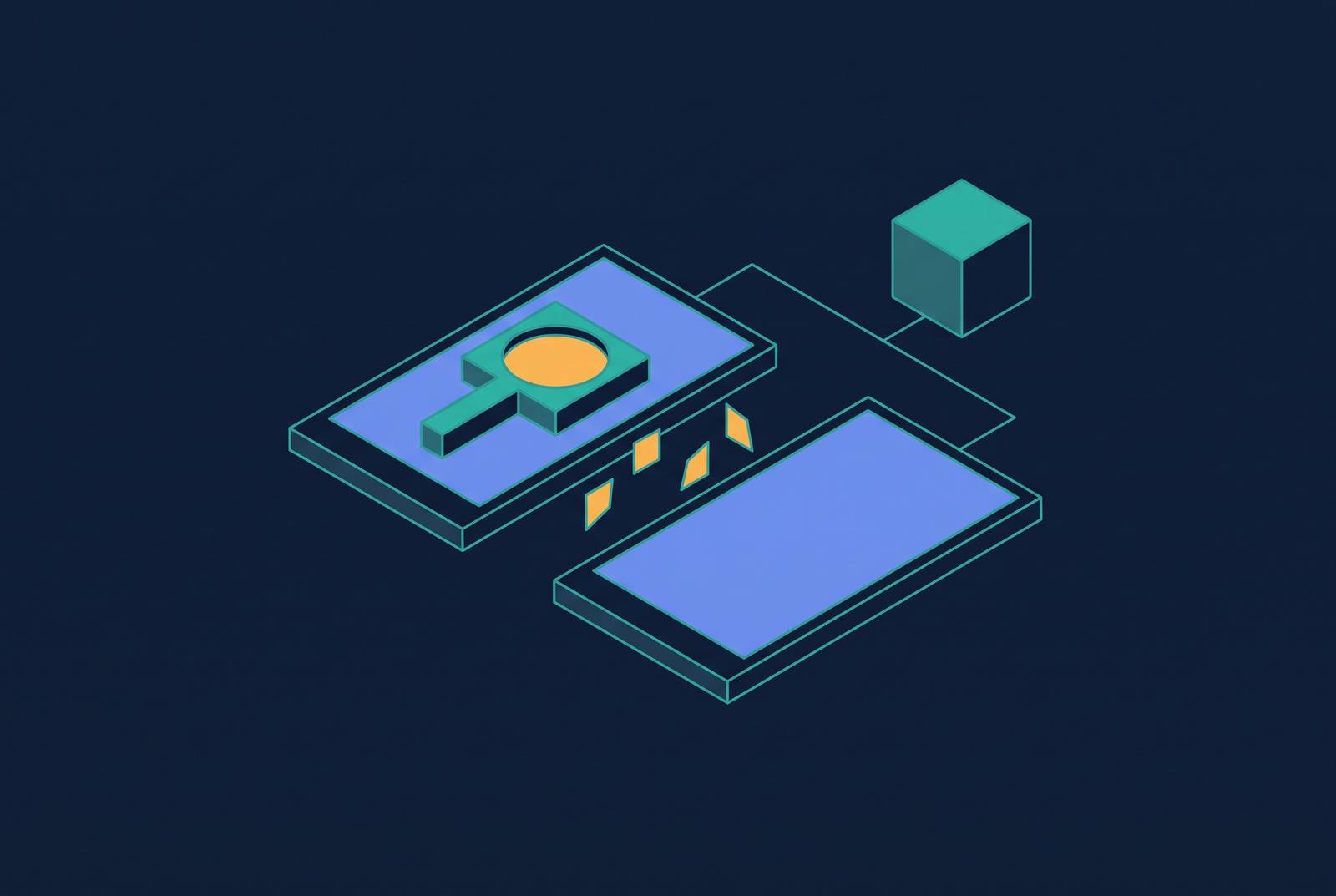
Visual regression testing exists because functional tests measure the wrong thing. A test suite can pass in full while the interface it describes has quietly broken, and that gap, not any single bug class, is what this piece is about: how AI agents are restructuring the loop built to close it.
Why functional tests pass while the UI breaks
A functional test asks a narrow question: does this element exist, and can a user interact with it? An AI coding assistant can write that test, execute it, patch it when it fails, and hand back a green build, all while a button has drifted three pixels out of its intended position. The assertion never asked where the button sits on the page. It asked whether the button is there and whether it responds to a click, and both of those things can remain true even as the layout around them collapses.
This gap is not new. What has changed is the frequency with which that gap gets exposed. Visual regression testing was built to close exactly this hole: capture a screenshot of the current UI, compare it against an approved baseline image, and fail the build once the gap between the two crosses a set threshold. That capture-compare-approve loop is the foundation everything else in this piece sits on, and real release pressure is what breaks it first.
How the capture-compare-approve loop breaks under daily-deploy pressure
The loop itself has not changed in years. What has changed is the volume of review it generates once a team ships multiple times a day across multiple environments, and that volume is what historically pushed teams to turn visual testing off rather than live with it.
Three problems compound into that collapse. A naive pixel comparison still cannot tell the two apart if a browser change, not a product regression, explains the difference. The second is someone having to remember to trigger the tests. Even with basic AI filtering in place, reviewing hundreds of screenshots for what amounts to a small design tweak takes real time, and without a way to group similar changes together, that review queue never actually clears. It just grows until someone decides the checks aren't worth running.
The tools documenting pixel comparison are candid about why the first problem is structural rather than incidental: browser rendering varies by operating system, browser version, user settings, hardware, power source, and whether the browser runs headless. Pure pixel comparison, in other words, cannot carry the semantic weight teams are asking it to carry. That limitation is what pushed the industry toward a layered approach, not a single, better diffing algorithm.
The three-layer comparison stack that replaced pure pixel diffing
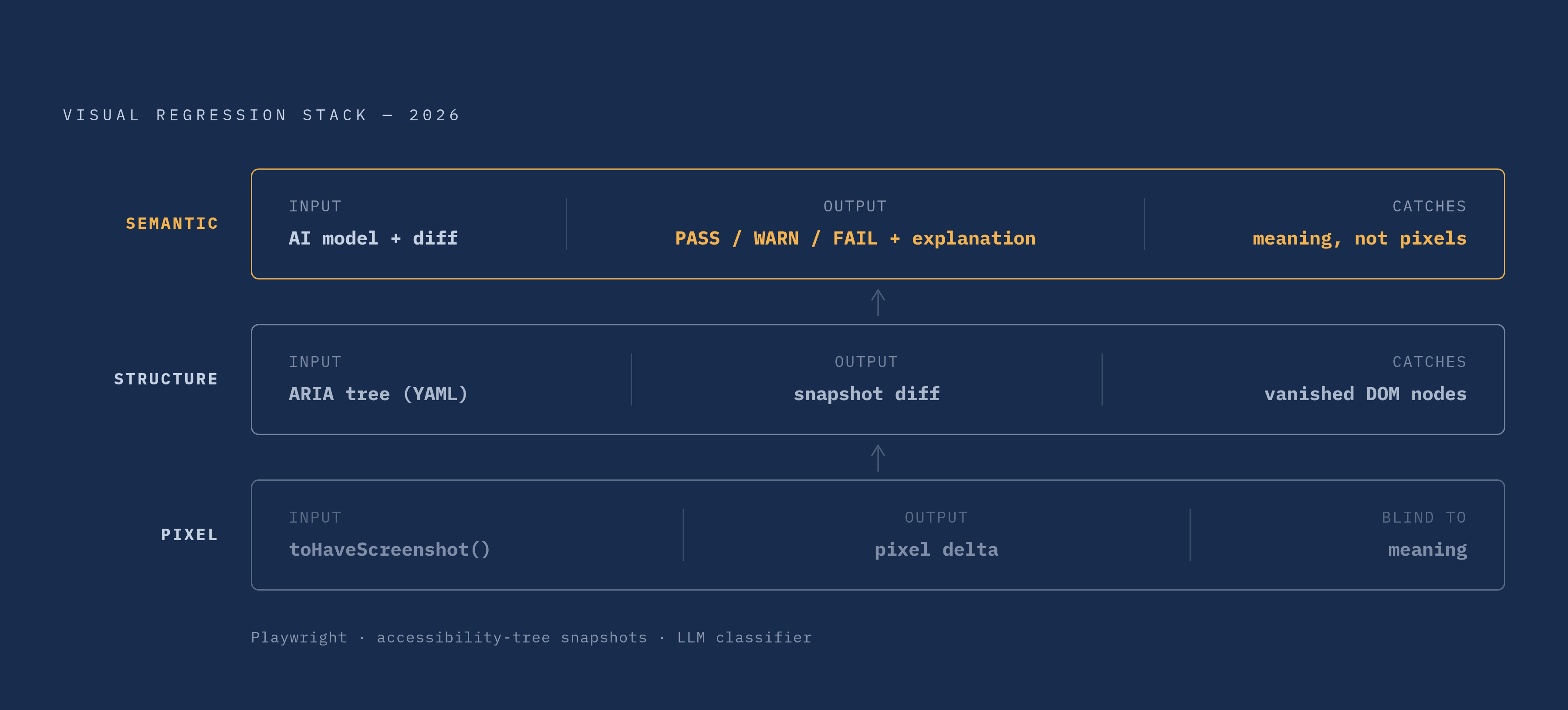
If you run visual checks well in 2026, you no longer rely on one signal. You stack three layers instead: a tool that merely detects a change, a tool that understands what the change means, and an agent that acts on that understanding.
The pixel layer is the familiar one: something like Playwright's toHaveScreenshot() compared against a committed baseline, tuned with threshold parameters to tolerate minor noise. It catches hard differences reliably but has no way to classify what those differences mean. The structure layer sits above it: accessibility-tree snapshots compare the UI as YAML rather than as an image, so a button that has vanished from the DOM fails the check even if the surrounding pixels look untouched. The semantic layer sits on top of both: an AI model classifies each diff and writes a plain description of what changed, and this is the point at which meaning, rather than raw pixels, becomes the unit of comparison.
Recent Playwright releases have pushed all three layers closer together, and you can trace the sequence because it shows the raw material available to an agent getting richer at every step. Playwright 1.56 introduced planner, generator, and healer agent definitions, installable through npx playwright init-agents, with VS Code, Claude Code, and OpenCode supported as clients. Playwright 1.59 added page.screencast.start() with action annotations and chapter overlays, which the release notes call "agentic video receipts," giving a human a way to watch what an agent did. Playwright 1.60 added bounding box data to aria snapshots, letting an agent reason about layout from text alone, without opening an image file. Playwright 1.62, released 24 July 2026, let toHaveScreenshot() store its golden snapshot as WebP, a lossless option that shrinks repository size for teams carrying large baseline collections, with the change requiring one line of configuration. Playwright 1.63, released 4 September 2026, extended the existing snapshots option of tracing to accept an object, { dom: true, aria: true, screen: true }, where previously passing true only captured the DOM. A failed screenshot assertion no longer arrives as a lone image. The trace now carries the aria snapshot and the screen capture for every action at the moment the layout drifted.
None of this makes any single tool able to solve the problem on its own. What it shows is that the evidence available at each layer, pixel, structure, and semantic, has gotten denser and more machine-readable, and that density makes agent-driven review possible.
AI visual testing agents in the review loop
A visual testing AI agent runs automated visual regression tests when code changes, analyzes the resulting screenshots with AI models to separate real bugs from rendering noise, and groups similar changes together for batch review. The meaningful shift is not that it reduces the triage workload. It reduces human involvement in the decision-making itself, so the reviewer gets a curated judgment rather than a raw pile of screenshots.
That shift happens through a loop with four stages, not a single script replayed on command. In the act stage, it runs the tests, filters the results, and organizes what lands in the review queue, with little manual setup required per run. In the learn stage, it matches UI elements by what they do rather than by a fixed locator string, so a "Login" button renamed to "Sign in" does not snap the test. That matching is the self-healing capability, a specific, named feature of these agents. AI testing agents detect locator changes, layout shifts, and structural updates as a run executes and update their own locators accordingly, which makes a regression suite meaningfully less brittle to ordinary application changes.
Multimodal large language models push the classification further still. They evaluate a screenshot the way a person would, assign it a PASS, WARN, or FAIL label, and explain in plain language why a given change matters. A reviewer no longer receives a bare label. They receive a reason, and reasoning is a different kind of input than a flag.
The stable baseline problem
The entire loop still depends on one unresolved question: was this change intentional? An agent can detect a difference, classify it, and gather every piece of evidence a reviewer could want. It cannot know whether a new appearance reflects a deliberate design decision or an accident, because that judgment depends on knowledge of what the product is supposed to look like, and that knowledge belongs to the people who decided what to build.
This is not a gap that better models close over time. It is a structural feature of how the workflow is divided: an agent explains and gathers evidence, and a reviewer decides. Research out of Microsoft and the University of Washington, on how you validate sequential agent behavior, makes the shape of the problem concrete. The research direction being pursued there, a system that learns correct behavior from somewhere between 2 and 10 passing execution traces and validates new executions against that learned model, is exactly that: a research direction, not a shipped guarantee that a machine can replace the judgment call.
The sharpest objection to agentic visual testing, that it solves the wrong problem, traces back to the same gap described at the start of this piece. The three-layer stack answers that objection directly: visual regression with semantic classification catches the positional shift a functional test misses. But it only catches it against a baseline a human has already reviewed and approved as correct. Taking the human out of that approval step leaves the agent comparing the present against a baseline nobody verified in the first place, which defeats the purpose of the comparison. What agents change is what reaches the human before the decision gets made: a small set of classified, explained changes instead of a sprawling pile of undifferentiated screenshots, while a human still has to approve the baseline and judge intent.
Where agents currently work
Calibrating expectations here matters as much as understanding the mechanism, because the gap between what agentic visual testing reliably does in 2026 and what it is sometimes marketed as doing is wide, and it can cause real damage if a team builds a pipeline on the wrong assumption.
Reliable today: autonomous generation of tests from a URL or a plain-English description of intended behavior, self-healing of locators that break when an element's label or structure shifts, visual regression with meaningful noise filtering between browser artifacts and genuine bugs, and coding-agent verification loops scoped tightly to the specific components a change actually touched.
Still overpromised: full replacement of a QA function, root-cause diagnosis that can be trusted without a human confirming it, and unsupervised testing of complex business logic or multi-step transactional flows, where the cost of a missed edge case is high and the reasoning required to catch it goes well beyond pattern matching on screenshots.
So why does a technology that performs so well on classification still struggle with complex flows? Part of the answer is data dependency: AI testing agents lean on historical test data to make good predictions, and a new product or a newly instrumented pipeline with thin test history produces unreliable predictions until that history accumulates. That cold-start period is a real cost of adoption, and it is one that marketing materials for these tools rarely mention with any precision.
The security surface that MCP-connected visual agents introduce
Restructuring the review loop around agents also restructures the trust model of the pipeline those agents operate inside, and that consequence is easy to overlook when the focus stays on screenshots and classification accuracy.
The Model Context Protocol is what lets a visual regression agent query tools, read baselines, and plug into an IDE workflow, but that same connectivity opens up an attack surface that ordinary pipeline-level governance was never built to cover. The scale of the exposure already measured is not small: dynamic security audits of internet-facing MCP servers found that the vast majority operated with no OAuth or identity boundary at all, and a number of them exposed unauthenticated access directly into internal infrastructure. That finding is serious enough that it has drawn attention at the government level. The NSA's Artificial Intelligence Security Center published a Cybersecurity Information Sheet titled "Model Context Protocol (MCP): Security Design Considerations for AI-Driven Automation" on May 20, 2026, and an advisory at that level signals that MCP security has moved well past a niche research concern.
The emerging response is a Zero Trust model for MCP: it treats an agent as a first-class identity, not as privileged automation that inherits whatever ambient permissions happen to be lying around. Under that model, an agent is issued its own credentials, limited in what it is permitted to do, and monitored the same way a human user or a microservice would be. The lesson for a team wiring an agent into its visual testing pipeline is not abstract: the agent that catches a misplaced button also needs an identity, a scope of permission, and a monitoring trail, exactly like any other service with access to the pipeline.
Infrastructure choices that keep agent-driven visual testing on in CI
None of the preceding sections explain why teams actually abandon visual regression testing, and the reason is rarely that the signal itself is wrong. It is that the operational cost of keeping the pipeline running accumulates past the point a team is willing to pay for it: Docker configuration, browser binary management, image storage that grows with every baseline, CI configuration that someone has to maintain, and a baseline repository that needs active upkeep as the product changes.
Self-hosted visual testing pipelines carry that burden directly. The agent era raises the stakes on this choice rather than lowering them: agents running concurrently across many pull requests, multiple environments, and a spread of viewport configurations generate capture and comparison workloads that a self-hosted grid cannot absorb without dedicated capacity planning, the kind of planning most engineering teams would rather not own.
A globally distributed network that combines compute, storage, and identity in one place, where bad traffic never reaches the origin and agents run at the edge nearest to the test environment, removes that capacity-planning tax. Containerized deployment for scaling, externalized prompt management, and single-responsibility agents are all widely cited as good practice for production agentic systems, and every one of them is easier to operate when the infrastructure underneath handles concurrency, failure recovery, retries, logging, and cost efficiency by default, rather than requiring each team to engineer that layer itself.
Pricing is part of this equation too, and it is easy to underweight. The teams that keep visual testing running in CI through a daily-deploy cadence are not the ones with the most sophisticated diff classifier. They are the ones that made running the checks so cheap and automatic that nobody has to decide, under deadline pressure, whether to turn them off.