How Agentic Browser Patterns Stack Into a Working Architecture
Browser agents fail at scale when infrastructure, not reasoning, breaks down.

A browser agent that completes a task flawlessly on a laptop during a demo can fail within minutes of real deployment, once concurrency, authentication, and scale enter the picture. The pattern is consistent enough to name: the agent that books a flight, fills a form, and extracts a dataset in front of a stakeholder is often the same agent that collapses under real concurrency, loses track of which session belongs to which task, or re-authenticates into the wrong account. The instinct is to blame the model. It reasoned well in the demo; surely a sharper model would reason well at scale too. That instinct is wrong, and understanding why it's wrong is the point of this entire piece.
Traditional browsers are fully deterministic, AI-assisted browsers are deterministic with an AI layer on top, and agentic browsers use large language models to reason about what they see on a page, adapting when a button's class name changes from one deploy to the next. That adaptive capacity is genuinely valuable, but it only functions reliably if the infrastructure around it supports probabilistic, multi-step execution at scale. A model that can correctly infer "this is still the submit button" is doing real work. It cannot do that work if the session it's operating in has already dropped, if there's no record of what it did three steps ago, or if its credentials were never properly provisioned in the first place.
These are missing layers, not quality problems with the reasoning engine. They are missing layers: session state lost between steps, no persistent memory of prior actions, credentials exposed to execution environments that were never built to hold them securely, and no mechanism by which a website can tell the agent what it's actually permitted to do. Swapping in a better LLM does not fix any of this, because each failure traces back to a distinct piece of infrastructure, and those pieces have to be assembled in a specific order before the system holds together. The rest of this piece works through that order, layer by layer, starting from the ground up.
The four architectural families that define the current landscape
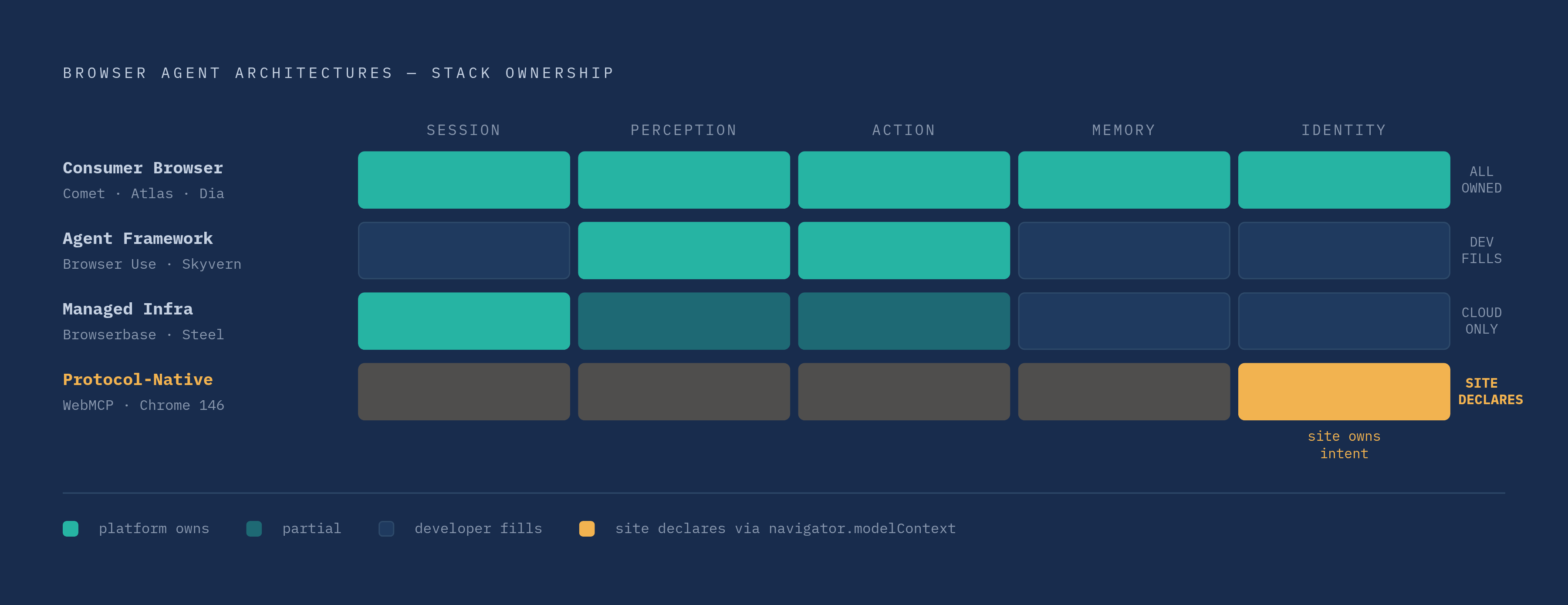
Before stacking the layers, it helps to see how the market has already sorted itself, because every product on offer today is making an implicit bet about which layers it owns and which it leaves to the developer. Four architecturally distinct families exist, and they differ not in how polished they are but in how much of the stack each one actually hands over.
The first family is the dedicated agentic consumer browser, where the browser itself is the agent and the address bar doubles as a prompt box. Perplexity's Comet offers a free tier alongside paid Pro and Max tiers, and ChatGPT Atlas is free to use with paid Plus, Pro, and Business tiers layered on top. Dia Browser and Opera Neon round out this category as consumer-facing options, Dia with a free tier and a paid Pro tier, Opera Neon available as a free download with a paid plan aimed at AI agent use. In all of these products, the platform owns every layer of the stack, session management, perception, action execution, memory, identity, but gives the developer no access to any of it. What you see is what you get.
The second family is the open-source agent framework, aimed squarely at developers who want to build rather than simply use. Browser Use is free aside from underlying LLM costs, carries many tens of thousands of GitHub stars, and posts a leading score on the WebVoyager benchmark. Stagehand v3, also free apart from LLM costs, underwent a February 2026 rewrite that gave it an AI-native architecture speaking directly to Chromium-based browsers through the Chrome DevTools Protocol, a driver-agnostic design substantially faster than its predecessor, with multi-language SDKs added as a separate release in January 2026. Skyvern, free at the entry tier with usage-based cloud pricing beyond that, holds a strong WebVoyager score and leads specifically on form-filling tasks. Agent Browser, a free command-line tool, has also accumulated tens of thousands of stars. What unites this family is what it leaves out: these frameworks handle perception and action competently, but session management, state persistence, and identity are left for the developer to build.
The third family is managed browser infrastructure, which solves a different problem entirely: not reasoning, but hosting. Browserbase runs on a freemium plus usage-based model priced per browser-hour, and Steel is open-source; both provide the cloud-hosted browser itself, handling scaling, lifecycle, and authenticated sessions, without touching the reasoning or identity layers above them. Firecrawl, free at the entry tier with paid plans above it and over 180,000 GitHub stars, adds a web-data layer and a managed Browser Sandbox on top of that foundation, pricing by page credit.
The fourth family is the protocol-native agent runtime, and it represents a different idea altogether: instead of asking the agent to interpret a page visually, let the website declare its own interface. Chrome 146 introduced navigator.modelContext, known as WebMCP, through which an agent calls registered JavaScript tools directly rather than clicking on pixels. It is the only architecture in which the website explicitly tells the agent what it is allowed to do, which makes it both the fastest and the most observable of the four models.
None of these families is simply a worse or better version of another. A team choosing from just one of them is really choosing which layers it will be responsible for building itself. The value of seeing all four side by side is that it makes the layered model legible before diving into what each layer actually requires.
Session management as the foundation every other layer depends on
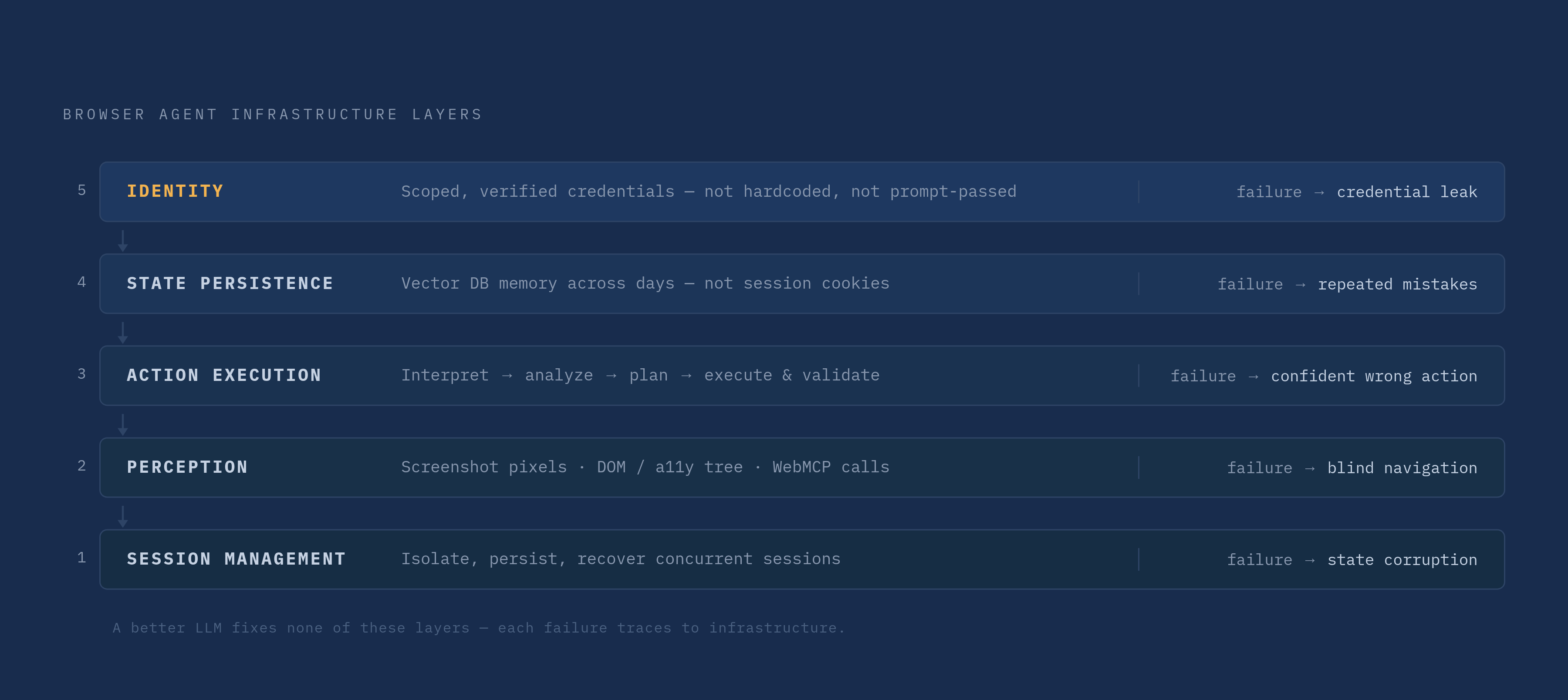
A browser session is a stateful object: cookies, local storage, authentication tokens, scroll position, a half-completed form. None of that persists automatically, and treating session management as a minor implementation detail is the most common reason production browser agents fail once concurrency enters the picture. An agent operating across hundreds of users or tasks at once has to maintain, isolate, and resume each session without leaking state from one into another.
Browserbase illustrates what it looks like to treat this layer as the primary product rather than an afterthought. Developers manage automation frameworks they already know, Playwright, Puppeteer, Selenium, while the platform itself handles the underlying Chromium instances, containers, and browser lifecycle, so the application code stays familiar while the platform absorbs the underlying complexity of keeping browsers alive and isolated.
Production session management has to satisfy several conditions simultaneously. Sessions must stay isolated under concurrency, so thousands of simultaneous sessions don't cross-contaminate. Authenticated sessions must persist, so an agent that logs into a customer portal stays logged in across a multi-step task rather than being bounced back to a login screen mid-task. Failures must be recoverable gracefully, so a crashed session restarts without losing the task context that preceded the crash. And sessions must be observable, so a developer debugging a failure can actually see what the session did rather than guessing.
Why does this layer sit at the bottom of the stack rather than somewhere in the middle? Because everything built above it assumes a stable surface to operate on. A perception model that reads a page correctly accomplishes nothing if the session underneath it drops before the planned action executes. This is not a theoretical concern reserved for edge cases. The Agentverse gap analysis from Q1 2026 classifies session and lifecycle management as one of eight categories of missing infrastructure present even in the most mature agent-native cloud platforms available today, which confirms that this is an open problem at scale rather than a solved one. Once sessions are reliable enough that an agent can trust the ground beneath it, the agent can begin the harder work of reasoning about what it actually sees.
Perception: how agents read a page
How an agent perceives a page is not a cosmetic choice between interfaces. It sets the reliability ceiling for every action built on top of it, and different perception methods fail in different ways.
Three approaches currently operate in production. Screenshot-based perception has the agent look at a rendered image and reason about pixels. DOM or accessibility-tree parsing has the agent read a structured representation of the page instead. Protocol-native tool calls, through something like WebMCP, let the website expose an explicit interface the agent calls directly. Each approach constrains what the layers above it can reliably do.
Screenshot-based perception generalizes to almost any page, since it doesn't depend on the site's underlying markup being clean or consistent, but that generality comes at a cost: layout shifts, overlapping elements, and dynamic content all degrade the signal the model is working from. DOM and accessibility-tree parsing trades some of that generality for structure, giving the agent something closer to a map of the page rather than a photograph of it. Stagehand v3's rewrite makes the tradeoff concrete. By talking directly to the browser through the Chrome DevTools Protocol instead of relying on screenshots, the framework cut out a layer of traditional automation entirely and runs 44% faster than its prior version, a speed gain that comes specifically from reading structured browser state rather than interpreting pixels.
WebMCP pushes this logic to its limit. When a website declares through navigator.modelContext what the agent is permitted to do, perceptual ambiguity disappears, because perception and the set of available actions become the same thing. There's no pixel layout, so nothing stands to be misread.
What happens when perception gets it wrong? The agent doesn't throw an error. It generates a plausible-looking action plan from a mistaken read of the page and executes it with full confidence, and the mistake only surfaces later, at validation, after the action has already run. That has a direct design implication: a team has to settle on a perception method before it designs the action execution layer, because the action layer's input format, its error handling, and its retry logic all depend on what guarantees the perception layer can actually make. Choose screenshots and the action layer needs to tolerate more ambiguity. Choose WebMCP and the action layer can be far stricter, because the website has already told it what's possible.
Action execution versus deterministic scripts in agentic workflows
Action execution in an agentic system is a loop of planning and adaptation, not script playback. It's a loop of planning and adaptation that has to absorb unexpected page states, and any infrastructure that treats it like a fixed script will break the moment the web does what the web always does: change without warning.
The distinction between scripted automation and agentic execution is concrete rather than philosophical. A Playwright script written against a button with the class btn-primary breaks the moment that class changes to button-main, because the script has no concept of what the button means, only what it's called. A browser agent, by contrast, recognizes that the element is still labeled "Submit" and clicks it regardless of what its class attribute says, but only because its action layer is wired into a perception model capable of making that judgment in the first place. Taking away the perception layer discussed above erases this entire advantage.
Four steps have to succeed, in sequence, for an action execution loop to work: interpreting the natural-language intent into planned steps, analyzing the current page state through the perception layer, planning the next specific action, and then executing it while observing the result and adjusting if something unexpected appears, a popup, a CAPTCHA, a layout that's shifted since the plan was made. If any one of those four steps is missed, the loop doesn't degrade gracefully; it produces a confident wrong action instead.
One might argue that a single, general-purpose action loop should be enough, if the perception layer feeding it is good enough. Skyvern's performance suggests otherwise. It posts an 85.85% score on WebVoyager and leads specifically on form-filling benchmarks, and that edge comes from an action model tuned to the particular failure modes of forms, field validation, conditional fields that appear only after other fields are filled, multi-page flows that span several screens, rather than from a generic action loop applied indiscriously to every task type. Specialization inside the action layer is not a nice-to-have; it can turn a middling score into a benchmark win on a particular task class.
There's also a concurrency dimension that's easy to miss. At production scale, action execution has to run in parallel across many sessions at once. Managed infrastructure platforms handle parallelism at the browser layer, but the action planning logic sitting above that infrastructure also has to be stateless enough to run concurrently without two parallel tasks racing each other into a shared piece of state.
An action layer that executes a step without validating the result will carry on to the next step even after the first one silently failed, compounding the error forward through the rest of the workflow. Result validation is a required property of the execution loop, not a bonus feature bolted onto it. It's a required property of the loop itself. But suppose every one of these four steps succeeds, every time, across every session. Is the agent now production-ready? Not quite, because a perfectly executed action is worth very little if the agent has no way to remember, five minutes or five days later, that it ever happened.
State persistence and the difference between a session and a working memory
Most agent architectures quietly break at exactly this layer. An agent that cannot recall what it did in a prior session is not operating autonomously; it is executing a single very capable turn, over and over, with no thread connecting one turn to the next.
Why does this distinction matter in practice rather than just in theory? Consider an agent booking a multi-day travel itinerary, where flight, hotel, and car rental have to stay consistent with each other across separate booking sessions, or an agent monitoring a procurement portal over the course of a week, watching for a status change that might appear on day four. Both tasks require the agent to carry context forward: partially completed steps, decisions already made, credentials already used, pages already visited. None of that lives inside a single session. All of it has to survive the boundary between sessions.
The scale of the problem is reflected in how the field itself describes it. The Agentverse gap analysis names the evolution from "ephemeral key-value storage to a full Agent Memory Cloud" as one of five critical paths that agent infrastructure still has to travel, which confirms that even the most mature platforms available today have not fully solved this layer. The stack most AI engineering teams are converging on pairs an agent framework for orchestration with a managed browser layer for web access and a vector database for storage, where the vector database functions as the state persistence layer, offering semantic retrieval of prior context rather than exact-key lookup. That's a meaningfully different kind of memory than a session cookie. A cookie says "this user is logged in." A vector store can say "this agent already tried this approach three days ago and it failed for this reason," retrieved not by exact match but by relevance.
This layer depends on everything beneath it working correctly. It needs the session layer to produce consistent identifiers, so that memories get associated with the right agent instance rather than scattered across instances that look alike but aren't. And it needs the action execution layer to write results to persistent storage after each individual step, not only once the whole workflow finishes, because a crash halfway through a task should lose at most the current step, not the entire record of what came before it.
Teams that bolt a vector database onto a system built without this layer in mind often find that the memory isn't actually wired into the point where decisions get made. Memories get written at the wrong granularity, full-task summaries instead of granular per-step observations, and retrieved at the wrong moment, after a plan has already been made rather than before, so the memory exists but never actually shapes what the agent does next. Building this layer in from the start gives an agent reliable sessions, accurate perception, adaptive execution, and memory that spans days rather than minutes. What it still lacks is any verified sense of who it is to the systems it touches, and that absence is where the risk stops being purely technical.
Identity: why agents without verified credentials are a security liability, not a feature gap
An agent with solid session management, accurate perception, adaptive execution, and persistent memory can still be dangerous to deploy, because none of those layers answer the question of who the agent actually is to the systems it's touching. Without a verified identity, an agent is indistinguishable from a sophisticated bot from the perspective of any system auditing its access, a structural security problem rather than a minor gap in the feature set. It's a structural security problem.
Consider what happens concretely when a browser agent needs to interact with an authenticated web application. It has to present credentials somehow. One option is to hardcode them into the agent's configuration, which creates an obvious security exposure if that configuration is ever read by the wrong process. A second option is to pass them through the agent's prompt, which exposes them to prompt injection, since anything in the prompt is, in principle, something the model might be manipulated into repeating or acting on. A third option is to provide no credentials at all, in which case the agent simply cannot complete any task that requires authentication. None of these three options is acceptable at production scale, and that's precisely the gap a dedicated identity layer exists to close.
An open-source platform built to meet rigorous compliance standards represents an approach to solving exactly this problem. The logic behind building identity as its own layer, distinct from session management, mirrors the logic that runs through every layer already covered here: a credential handed to an agent is only as safe as the infrastructure built to issue, scope, and revoke it, and that infrastructure does not emerge automatically just because the session, perception, execution, and memory layers beneath it happen to be working well. Each layer in this stack solves a distinct problem that the layer above it cannot solve on its own. Identity is the layer where skipping it turns a failed task into a credential nobody can account for.