Replacing Screenshot-Analyze-Click Loops with Structured Browser Actions
Structured APIs replace visual inference for faster, cheaper agent browser interaction.

The mechanics are familiar enough. The agent captures the current page state, encodes it, transmits it to a vision or language model, receives an action recommendation, executes that action, observes the result, and repeats. Each iteration is a sequential round trip. None of it parallelizes in any meaningful way within a single task.
What deserves more scrutiny is not the raw volume of tokens but their composition. A captured page encodes far more than the agent needs: whitespace, decorative elements, navigation bars, cookie consent banners that nobody consented to designing well. The agent pays, in compute, to process visual noise with zero relevance to the task. On pages with dynamic loading, infinite scroll, or state-dependent rendering, this compounds. Multiple captures per task are the norm, not the exception.
Latency accumulates accordingly. Inference calls stack sequentially, each waiting on the previous one. The sequencing is a consequence of the architecture, not the task. A ten-step task on a moderately complex page can produce end-to-end latency that would be unacceptable in nearly any other production system. The loop works well enough to ship, which is roughly why it shipped.
The subtler cost is stale state. Between capture and action execution, the page may have changed: dynamic content updated, an async call returned, an animation resolved. The agent acts on a description of what the page was, not what it is. This is structural to the approach. It matters when you are trying to locate where failures actually originate, because teams often spend cycles chasing implementation bugs in territory that belongs to the paradigm itself.
What production runs surface most clearly is a cost distribution that merits scrutiny. A substantial share of input tokens in a screenshot-heavy session is cached context, meaning the agent is re-reading page descriptions it already processed, paying again to re-establish context it technically never lost. Most tokens in a screenshot loop are spent describing the interface rather than reasoning about what to do with it. That ratio is the tell, and it points at the architecture, not the implementation.
The three approaches agents use today and where each breaks down
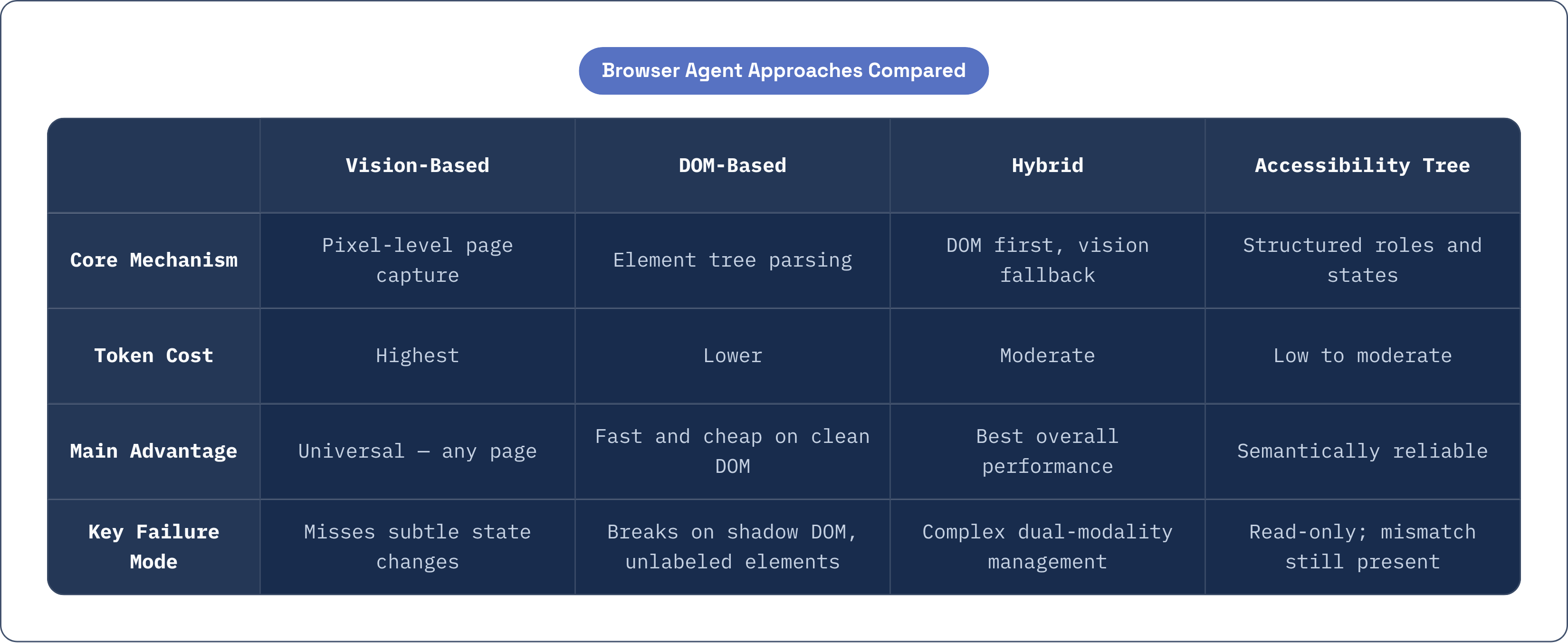
Vision-based agents treat the browser as a pixel canvas. The advantage is universality: any site, any page, any dynamically rendered content. The disadvantages are precision and cost. Subtle state changes are easy to miss at the pixel level; overlapping elements, partially visible buttons, and visual affordances that require contextual interpretation are hard problems for a model operating frame by frame. Token cost is the highest of any approach.
DOM-based agents read the element tree directly, which is faster and cheaper. When the DOM is clean, semantically labeled, and complete, this works well. It frequently is not. Shadow DOM, dynamically rendered components, unlabeled or inconsistently labeled interactive elements, and careless semantic HTML all create gaps between what the DOM describes and what the page actually does. The agent still has to map structure to intent, a non-trivial reasoning step even under favorable conditions.
Hybrid agents use DOM for speed and fall back to vision when the DOM fails. This is the architecture most capable production agents use. It performs better, though at the cost of complexity: managing two modalities, deciding when to switch, maintaining coherent state across both. The agent is still fundamentally reactive, reading a page that was not designed for it and doing its best.
The accessibility tree is an underused middle path. Accessibility APIs surface roles, names, values, states, and hierarchy in structured form without requiring visual inference, closer to what a screen reader exposes and more semantically reliable for agent reasoning than raw DOM. The limitation is that it remains a read-only description of a page built for humans. It narrows the reasoning surface without resolving the underlying mismatch.
All three approaches share a ceiling: the page was built for human perception, and the agent is reverse-engineering it in real time. That ceiling is a consequence of the design premise, not a solvable implementation problem.
What structured browser actions actually are and how they change the model
The distinction is architectural. Instead of describing a page and asking the agent to infer what actions are available, structured browser actions declare the available actions upfront. The agent receives a typed, named action space: callable functions with defined parameters and expected return shapes. It does not need to infer what's possible from what's visible.
Developers already live with the analogous tradeoff. If you want data from a web service, you can scrape the HTML and re-parse every time the design changes, or you can call the API and receive a structured response. The first approach works. The second scales. Structured browser actions apply exactly this logic to agent interaction: instead of asking the agent to read a page and reconstruct intent from visual inference, you hand it an interface with clearly typed operations.
What this eliminates at the source is specific. Visual inference about which element corresponds to which action. DOM parsing to reconstruct intent from structure. Repeated captures to track state changes. Ambiguity about whether an action succeeded, replaced by a typed result: success, failure, or a structured data payload. That is a qualitatively different compute task from pixel-level reasoning, not a faster version of the same task.
It is also worth being precise about what structured browser actions are not. This is not robotic process automation or selector-based tooling in the vein of Selenium. Those tools require explicit selectors specified by a human developer; they address pages without understanding them. Structured browser actions still leave reasoning to the agent: goal decomposition, parameter selection, sequencing, judgment about what to do when a tool call returns an unexpected result. The difference is that the agent reasons against a declared interface rather than one it had to reconstruct from scratch.
WebMCP: what the proposed browser standard does and where it stands
WebMCP, the Web Model Context Protocol, is a proposed standard developed by Google and Microsoft that operationalizes structured browser actions at the browser level. The mechanism is a new browser API through which a website declares a set of named, typed functions that an agent can discover and invoke directly. No DOM parsing. No screenshot. No element hunting.
The interaction model changes substantially. Instead of visually locating a button and clicking it, the agent queries the available tools, discovers a typed function with defined parameters, and calls it. The page does not need to change visually. The developer exposes an action surface through the API alongside whatever visual interface they have built for human users: two surfaces serving two different audiences from the same page.
The reliability model is also different from anything in the screenshot-loop world. When a site updates its WebMCP tools in a breaking way, it must version them or announce deprecation, the same contract model governing any public API. Silent breakage, the most common failure mode in UI-driven automation, is replaced by explicit versioning. The failure mode shifts from "the agent silently did the wrong thing" to "the agent received a clear error it can handle," and that shift matters for debuggability alone, before you get to the reliability benefits.
On timeline: the W3C Web Machine Learning Community Group formally accepted the specification in late 2025. An early preview shipped in Chrome in early 2026, with Edge expected to follow given their shared codebase. Broader native support across major browsers is targeted for the second half of 2026. The open variable is site-side adoption. WebMCP works only where web developers have implemented it, and the economics of implementation need to be compelling enough to drive adoption beyond early movers. The gap between a standard existing and the web broadly conforming to it is where most of the practical complexity lives, and it is a significant gap. Anyone building on the assumption that WebMCP is broadly available is building on a narrower foundation than they may realize.
The token math behind the efficiency gains
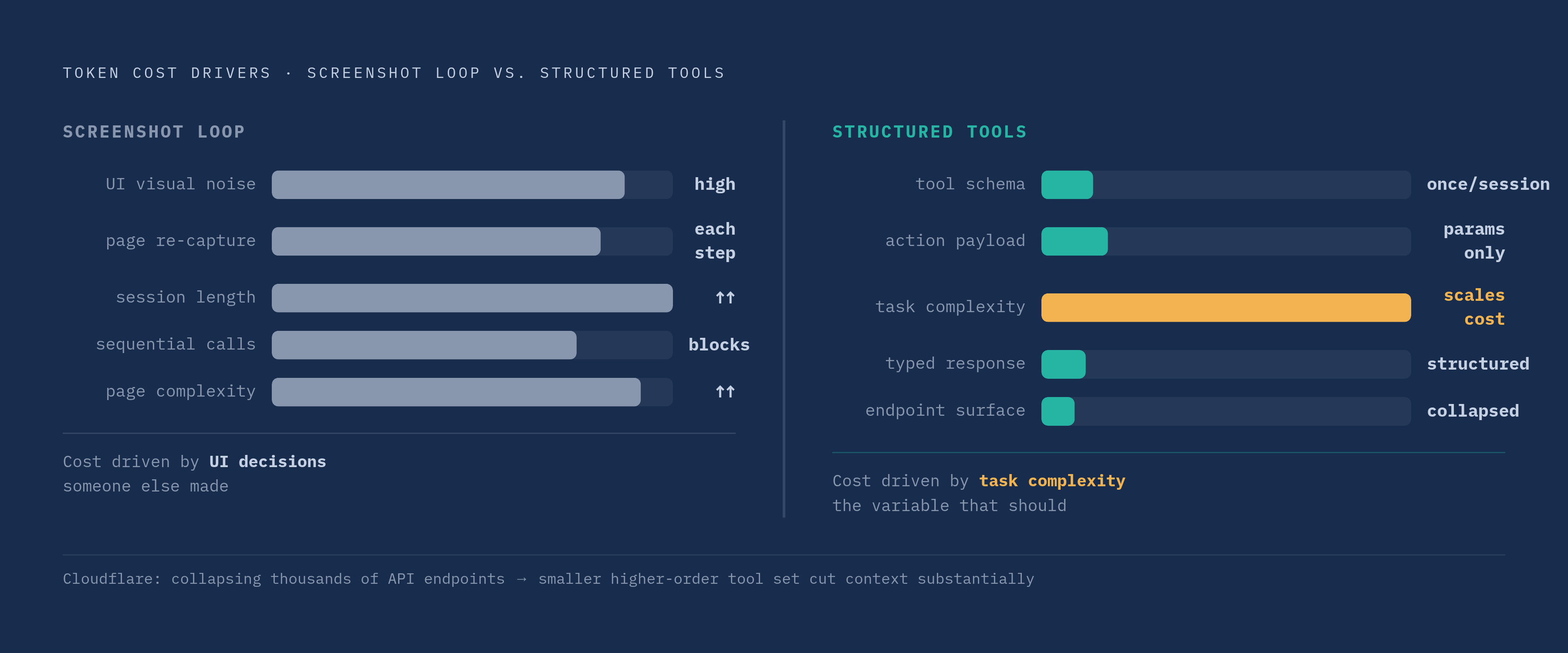
A screenshot-heavy session's token budget is dominated by input context: repeated encoding of page state, a large share of which the agent has already processed. Cost scales with session length and page complexity, not task complexity. Per-task cost becomes a function of UI design choices made by someone who was not thinking about agents at all.
Structured tool calls invert this. The agent transmits only the parameters relevant to the action. The response is a typed result, not a new page state requiring re-interpretation. The tool schema is small, stable, and needs to be read once per session. Token budget scales with task complexity, which is the variable that should be driving cost.
What one large platform documented internally with its MCP tool design is instructive here, even though the context was not browser agents specifically. Its API spans thousands of endpoints. Exposing each as a discrete tool would have imposed an enormous token budget per session because the agent would need to reason over the full tool list on every step. Collapsing to a smaller set of higher-order tools cut context requirements substantially. The lesson generalizes: interface design directly determines per-session cost, independently of task complexity, and the effect compounds across every session you run.
The economic implication is that per-task cost is not a fixed property of the task. It is a property of the interface the agent operates against. Structured interfaces make costs predictable. Screenshot loops make costs a function of how well the UI was designed for machine consumption, a variable the agent operator does not control.
What changes in practice when building agents against structured action surfaces
Against a screenshot loop, the developer manages screenshot timing, element annotation, scroll state across partial-page views, retry logic for failed visual inferences, and state tracking across multiple captures. That engineering overhead has no relationship to the task the agent is meant to perform. It is infrastructure tax, paid repeatedly on every integration, on every page change, on every unexpected DOM mutation.
Against a structured action surface, the developer specifies which tools are available, what parameters they accept, and how to sequence calls. This is closer to writing an API integration than building a visual automation. The cognitive model matches something most developers already know, and that matters more than it might seem when the goal is to staff and maintain agent infrastructure over time rather than demonstrate a capability once.
Tools that allow plain-language intent specification, where the developer writes something like "click the login button" and the system resolves that to a structured element interaction, represent a practical middle ground for the current transition period. The developer does not need to know the selector; the agent reasons against a narrower surface rather than parsing the full DOM. This works best when the accessibility tree is the intermediate representation: roles, names, states, hierarchy, without raw HTML, a narrower and more semantically reliable reasoning surface.
Human-in-the-loop handoffs deserve to be treated as a first-class design requirement rather than an edge case patched in after the fact. Login flows, MFA, CAPTCHA challenges, sensitive approvals: these should not be automated away, and the most robust systems define explicit pause points, surface them to users, and resume without losing session state. Screenshot-loop agents struggle here because preserving state across a human intervention, when the session may have timed out or the visual state may have shifted during the pause, is difficult to handle cleanly. Structured architectures make this tractable, and it is one of the less-discussed practical advantages.
Session observability follows directly from architecture. Structured action systems produce loggable, replayable event streams: DOM changes, input events, navigation transitions. Debugging is tractable because the record is structured. Screenshot sequences are opaque by comparison; reconstructing what the agent saw and why it acted requires interpretive work that is often inconclusive, and that opacity has a compounding cost as agents are asked to operate with less supervision over time.
Infrastructure implications of running browser agents at scale
Each screenshot-loop step requires a full browser instance, a capture, and a vision model inference call, and these requirements multiply across every concurrent session. The headless browser market's growth is evidence that organizations are already running agents at a scale where infrastructure choices carry material cost consequences.
Concurrency is where the pressure becomes operational. Screenshot-based agents hold browser sessions open longer per task because each sequential inference call keeps the session alive while the model reasons. Structured action calls are shorter-lived per step: the action executes and returns; the session does not wait on a vision model. At meaningful concurrency, that difference in session duration is a throughput problem.
Managing browser infrastructure at scale for agent workloads specifically is a distinct engineering problem. Chromium installation management, memory pressure from many concurrent sessions, crash recovery, and cold-start latency all behave differently under agent workload patterns than under human browsing patterns. Purpose-built agent browsers, optimized for lower memory footprint and faster cold start, reflect the recognition that infrastructure designed for human browsing and infrastructure designed for agent workloads have different requirements, often sharply different ones. Organizations that have made this transition report meaningful reductions in server count and operating cost, though the numbers vary enough by workload that they resist clean generalization.
Geography is easy to overlook. Agents interacting with geo-sensitive sites, localized content, region-specific A/B variants, CDN-cached responses, need browser sessions originating from the appropriate geography. This is a capability requirement, not a configuration detail.
Bot identity is also an infrastructure concern, and an ethical one. Agents running at scale need to identify themselves transparently. Cryptographic signatures on agent requests represent one approach to verifiable identity, distinguishing compliant automation from scraping that deliberately bypasses protections. The long-term health of the ecosystem these agents depend on is not separable from whether the ecosystem trusts them.
Where screenshot loops remain necessary and how to bound their scope
WebMCP exists as a specification and is arriving in early browser implementations, but the vast majority of the web has not adopted it and will not adopt it quickly. The hybrid architecture, structured actions where available, accessibility tree where possible, DOM as a fallback, vision as last resort, is the realistic production architecture for most agents in 2026 and likely well beyond.
There are cases where vision contributes real value even where structured alternatives exist. Verification tasks, where the requirement is to confirm what a human would actually see, are one. Visual regression checks and UI testing are fundamentally visual problems. Tasks involving charts, images, or other content with no structured representation are another. Debugging, too: a screenshot is often the clearest way to confirm what state the agent was actually in when something went wrong, precisely because it shows what a human would have seen.
Even capable multimodal agents running against general web tasks had yet to reach human-level task completion rates on standard benchmarks as of late 2025. That gap is primarily an interface problem, not a model capability problem. Agents operating against interfaces built for human users fail more often and cost more per attempt, and better models help less than you might expect when the bottleneck is information quality rather than reasoning capacity. Teams whose roadmaps are anchored to model improvements should sit with that finding for a moment before moving on.
The design goal is not to eliminate screenshots. It is to stop using them as the primary mechanism for action selection. Where WebMCP is implemented, the screenshot loop should step aside. Where it is absent, the loop remains useful while remaining imperfect.
The web interface layer and the agent action layer do not need to be the same thing. Human-facing design and machine-callable interfaces can coexist on the same site, serving their respective audiences without compromise. The mismatch that produced the screenshot loop was not inevitable. It was a consequence of building for one audience and then asking another to adapt, and the tools to address that are, slowly, beginning to arrive.