Structured Data Extraction from Browsers Using AI
Rendering speed and completeness matter more than model quality for extracting web data.
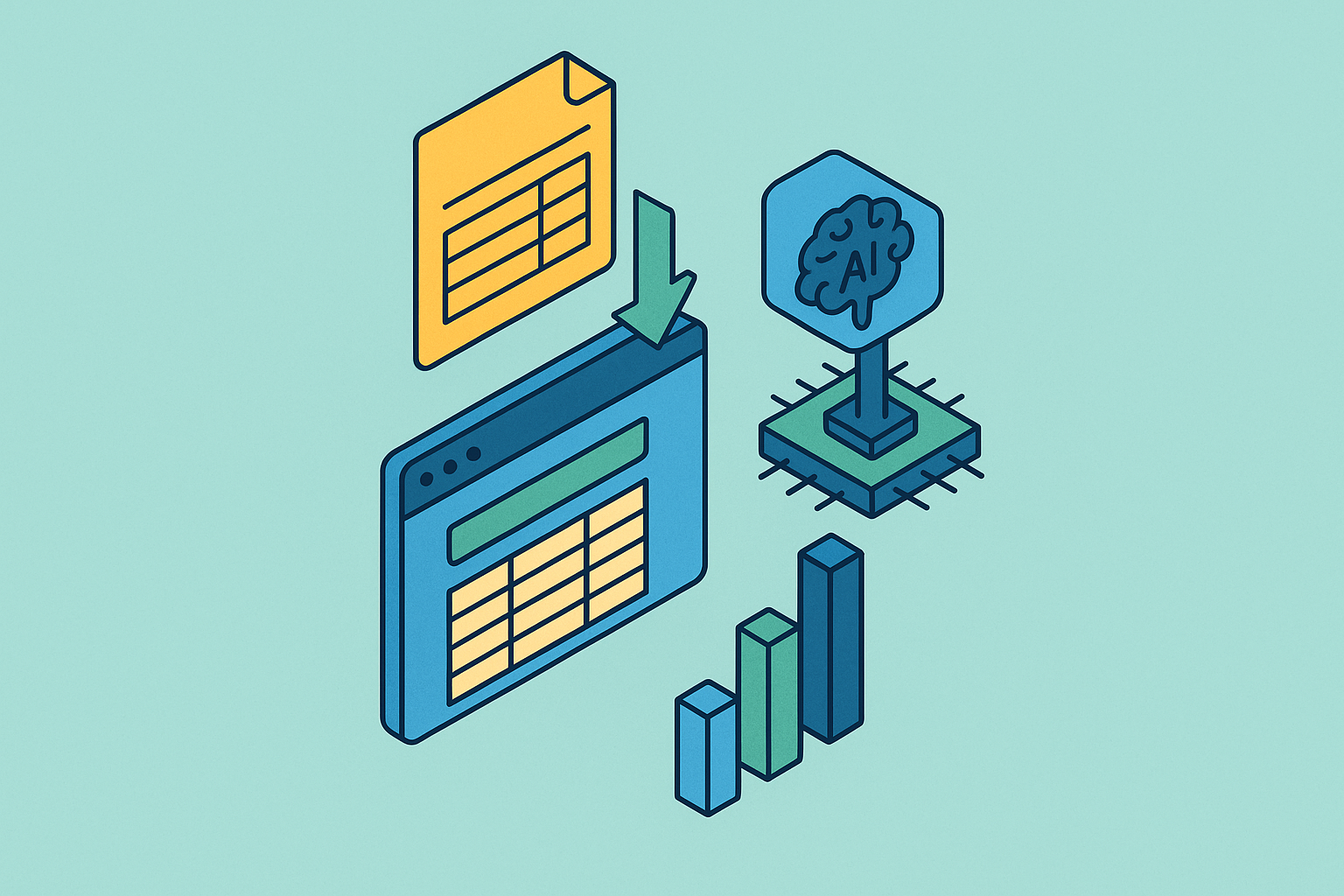
AI-powered structured data extraction from browsers has run into a strange problem: the models are already good enough. The real fight now happens one layer down, in the rendering, cleaning, and formatting work that decides what the model even gets to see. This piece walks through why that shift happened, what a production-grade rendering and extraction pipeline actually looks like, and what changes once teams start treating extraction as infrastructure instead of a one-off script.
Most teams get the fix backwards. The instinct is to assume a better model will clean up bad web data, and that instinct is wrong often enough to be worth examining directly. The 2025 NEXT-EVAL benchmark found large language models hitting F1 scores above 0.95 on structured web extraction tasks, but a critical requirement was that the input had to be properly formatted before the model ever touched it. Feed the same model a messy DOM snapshot, half-loaded JavaScript, or a page missing its dynamic content, and accuracy falls off no matter how capable the underlying model is. That finding relocates the bottleneck. It is no longer inference quality. It is what happens before inference: whether JavaScript actually ran, whether the DOM fully resolved, whether the content a user would see in a real browser matches the content the model receives as tokens. Teams spending weeks tuning prompts while skipping this step are optimizing the wrong stage of the pipeline entirely, and no amount of prompt engineering fixes a page that never finished rendering. That is the position worth stating plainly before anything else here: fix rendering first, or the rest of the pipeline is decoration.
What makes browser-based extraction categorically different from document extraction
Document extraction and web extraction get lumped together constantly, and treating them as the same category is where a lot of teams go wrong from the start. Tools like Google Document AI, Amazon Textract, Azure AI Document Intelligence, Nanonets, Rossum, and Mindee were built to read static business documents: invoices, tax forms, scanned PDFs. Their models are tuned to find line items inside fixed templates, and for finance, procurement, and back-office automation, where the document structure barely shifts month to month, that is a mature and genuinely useful category. Point one of those tools at a JavaScript-heavy product page, though, and it comes back empty. There is nothing to extract yet, because nothing has rendered.
Live-web extraction tools solve the opposite problem. Context.dev, Firecrawl, Diffbot, Bright Data, and Apify are built for pages where content changes by the hour and freshness matters more than matching a known template. Their output tends to be clean JSON or Markdown, shaped for LLM pipelines, retrieval-augmented generation, and agents, rather than for a fixed accounting schema.
So which category actually matters more right now? More than 70% of modern websites run on JavaScript frameworks like React, Next.js, or Vue, and any tool that cannot execute that JavaScript misses the majority of the actual page content on those sites. That is not a rounding error. That is most of the modern web. Document extraction tools, however well built for their own category, are not a substitute for live-web extraction, and the teams that assume otherwise are the ones whose pipelines quietly fail before they have even started. Once that distinction is settled, the next question becomes mechanical: where does the rendering actually happen, and who runs it?
Why rendering is the hardest part of the pipeline to get right
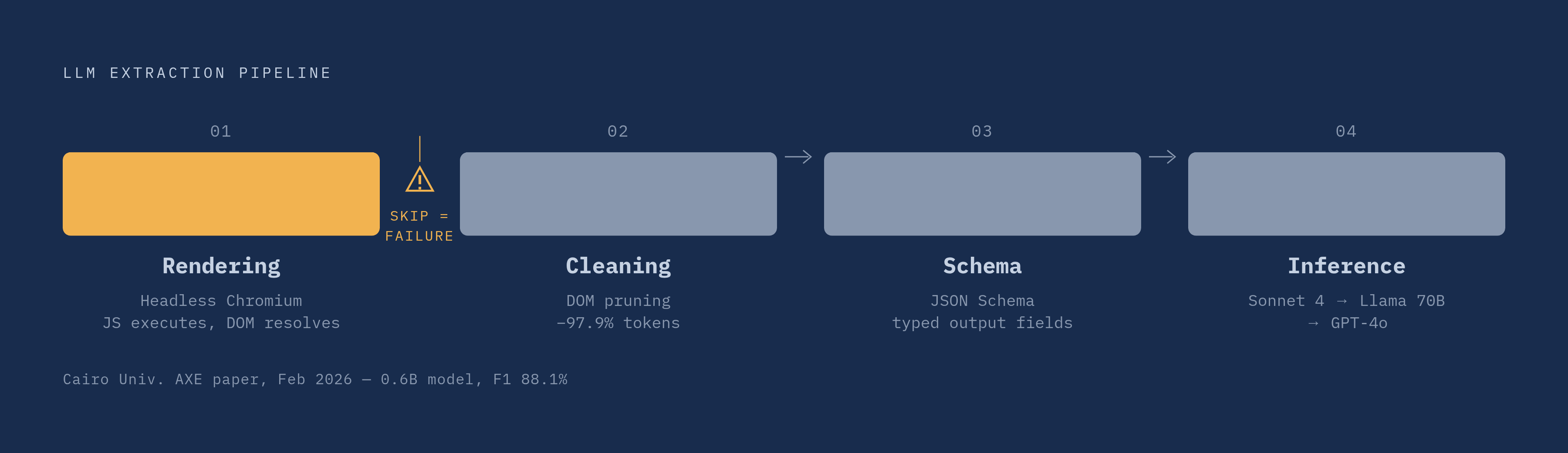
A plain HTTP fetch grabs raw HTML before any JavaScript has run. On a modern e-commerce page, that raw payload might not contain the product listing, the price, or any of the interactive elements a shopper would see, because those get injected client-side after the page loads. Single-page applications and other dynamically loaded content need an actual browser engine to resolve the DOM into something usable. Skip that step, and the pipeline is reading a shell of the page and calling it data.
Not every approach agrees rendering is worth the cost. Capital One's patent (US 12,307,496 B2, granted May 20, 2025, a continuation of applications filed back in 2015 and 2016) bet the other way: extract data without rendering, to save compute. That works fine for elements sitting in the HTML source, hidden fields, structured markup already present in the response. It does nothing for content that only exists after JavaScript executes, which is exactly the content most modern sites are built around, and betting a pipeline on that approach in 2026 is betting against where the web already went. The tradeoff underneath all of this does not have a clean answer: render everything and get accuracy at the cost of speed and resource use, or skip rendering and get speed at the cost of missing half the page. Anyone claiming there is a free lunch here is selling something.
Then there is the operational side, which does not show up in benchmark numbers but shows up immediately in production. Spinning up a browser instance on demand introduces cold-start latency that compounds the moment traffic scales past a handful of requests. Add session state, cookies, auth tokens, and pagination, and each one becomes a new place for the pipeline to fail quietly, without an error message telling anyone it happened. Agentic AI traffic reportedly grew by 7,851% in 2025, according to olostep.com, and rendering setups that held up fine at prototype scale do not survive that kind of load increase automatically. They tend to break in ways nobody notices until someone checks the output and finds it is stale, or empty, or wrong.
How a globally distributed headless browser pool changes the rendering calculus
The fix that has emerged looks less like a smarter scraper and more like a distributed systems decision: run the browser near the origin server, not near the developer's laptop. That means a global pool of headless Chromium instances sitting on edge infrastructure, kept warm rather than spun up fresh for each request. Keeping instances warm rather than spinning them up fresh for each request reduces cold-start latency. Because the browser session opens physically close to the target server, round-trip latency during page load and JavaScript execution shrinks too, and that matters more than it sounds like it should.
Why does geography change the outcome at all? JavaScript execution takes time, and a page's dynamic content often finishes loading only after several round trips between the browser and the server. If the rendering node sits far from that server, the snapshot gets taken too early, before scripts finish running, and the extraction ends up incomplete even though the browser rendered "successfully." Move the rendering closer, and most of the timing problem resolves on its own.
This kind of pool typically works with Playwright and Puppeteer, the two standard browser automation libraries, so there is no proprietary abstraction layer forcing a rewrite. It handles JavaScript-heavy pages and SPAs, the exact cases that break a simple HTTP scraper. Compare that to self-hosting headless browsers directly, where the operational weight of proxy rotation, browser version pinning, IP management, and scaling all lands on whoever built the pipeline, full time, indefinitely, with no end date on that maintenance burden. Self-hosting is the choice teams regret about six months in, once the maintenance backlog is longer than the feature backlog.
Even after rendering is solved, what gets fed to the model still matters just as much. A February 2026 paper out of Cairo University (the AXE paper) found that a small, 0.6-billion-parameter model reached an F1 score of 88.1% once paired with intelligent DOM pruning that cut input tokens by 97.9%. Sit with that for a second: a fairly modest model, given a tightly pruned input, beat what raw model size alone would predict. Bigger is not the lever here. What the model reads matters as much as which model reads it, and that sets up the next problem directly: how do you tell the system what to extract, and in what shape?
Schema definition as the interface between rendering and the model
The old way of pointing at data was CSS selectors and XPath expressions, hand-written paths into a specific page's markup. They are precise when they work, and they break the moment a site redesigns its layout, usually silently, so nobody notices until a downstream report is full of nulls.
The AI-native alternative flips the instruction: describe what the data is, and let the model locate it. Diffbot, for instance, uses computer vision and natural language processing to identify entities like articles, products, people, and organizations, without anyone configuring a selector by hand. Firecrawl's scrape endpoint takes this further by accepting JSON Schema definitions directly and returns typed, structured JSON matching that schema. Some pipelines handle this with a natural-language prompt describing the target fields; others pass a response_format parameter with an explicit JSON schema for typed output. Either way, the extracted data comes back as JSON, with no separate parsing pass required afterward.
Treat the schema as a contract, not a suggestion, because that is functionally what it is. Downstream agents and retrieval pipelines expect specific field names and specific types, and schema drift, a field silently renamed or a type quietly changed, is the kind of failure that does not throw an error. It just produces wrong answers that look plausible, which is worse than an outright crash because nobody goes looking for it. Unstructured.io plays a related role here, normalizing output across different formats and chunking it into passages sized for embeddings, which makes it a meaningful part of the preprocessing stage in RAG pipelines. And for agent workflows specifically, structured JSON beats Markdown as an output format, because an agent comparing products or routing a lead needs specific fields it can act on directly. Markdown looks readable, but it usually requires yet another extraction pass before an agent can actually use it, which defeats the point of extracting in the first place. Schema definition only covers a single request, though. Running this across an entire site, with failures and fallbacks handled gracefully, is a different scale of problem.
Building the full extraction pipeline: crawling, failover, and async job management
A crawl typically starts with one POST request and one URL, and from there the system works outward across the site, returning HTML, Markdown, or AI-extracted structured JSON depending on what is configured. Because crawling a full site can take a while, most of these systems run asynchronously: submit the URL, get back a job ID, and poll for results as individual pages finish processing. And robots.txt configuration is not a side note here. It directly determines what the crawler is allowed to reach, which makes it a compliance dependency baked into the architecture rather than a legal footnote tacked on afterward.
Model failover deserves its own mention, because it is one of the more practical design choices in this space. In Browser Rendering's /json endpoint, for example, the default model is @cf/meta/llama-3.3-70b-instruct-fp8-fast, run through Workers AI. Multiple models can be specified in order, though, and the system attempts each in sequence until one succeeds. An example chain might run Anthropic's Claude Sonnet 4 first, fall back to Meta's Llama 3.3 70B on Workers AI, and fall back again to OpenAI's GPT-4o. Custom models are supported too, through a bring-your-own-API-key setup, and Workers AI usage gets metered and shown in its own dashboard.
Firecrawl takes a related but distinct approach: rather than one endpoint trying to do everything, it splits by task, with separate endpoints for single-URL scraping, recursive crawling, batch processing, and search. Each extraction pattern gets its own interface instead of one overloaded call trying to guess intent. That design choice, splitting by task rather than building one endpoint that tries to guess what the caller wants, is the more defensible one, because it fails in isolation instead of failing in ways that are hard to trace back to a cause.
None of this holds up without treating async job management as real engineering work, not an afterthought. Polling intervals need tuning, partial results need handling gracefully when a crawl times out halfway through, and timeout budgets need to be set deliberately rather than left at whatever default the library shipped with. Token cost is the other thing that catches teams off guard: cost scales with request volume in ways that look fine in a low-traffic prototype and then surprise everyone once real usage kicks in. Caching intermediate reasoning, setting context window budgets per sub-agent, and watching token consumption at each workflow step tend to be the difference between a pipeline that is affordable and one that quietly bankrupts a project. Getting all of this running reliably in a dev environment, though, is a separate problem from running it legally and ethically once it is live.
Compliance, bot identity, and the permission layer that extraction pipelines require
Compliance in this context is a substantive obligation woven into a project from the start, not a checklist item handled after launch. It is an infrastructure decision that shapes what the crawler can do at all. robots.txt functions as a hard gate for any pipeline that intends to stay compliant: ignore it, and the exposure is not just legal risk, it is losing access to entire sections of a site once that access gets noticed and blocked.
The scale of adoption makes this more than a theoretical concern. Roughly 81% of US retailers now run automated extraction for dynamic pricing, according to olostep.com, which means most retail sites are actively watching for and defending against exactly this kind of traffic. At that level of adoption, identifying a crawler honestly is not an ethical nicety anymore. It is a functional requirement for staying operational at all. Related to that: compliant crawlers do not bypass CAPTCHAs, and should not try to. Pipeline design has to account for the reality that some pages are intentionally gated, and build around that instead of trying to defeat it.
There is a security dimension too, one that connects back to Zero Trust principles as they extend into AI infrastructure. IBM's 2025 Cost of a Data Breach Report found that ungoverned "shadow AI" running inside an organization added roughly $670,000 to the average cost of a breach. An extraction pipeline that calls out to external model APIs is exactly this kind of surface if it is not scoped to a specific, governed identity. That is likely part of why identity-centric access control over AI model endpoints and data pipelines has emerged as a prominent Zero Trust use case going into 2026. Once a pipeline is compliant, identified, and governed this way, it stops being a fragile one-off script and starts becoming something reusable, which is the argument the rest of this piece has been building toward.
What treating extraction as infrastructure unlocks for agentic AI workflows
Agents need data that is fresh at the moment they act, not a batch export somebody ran last Tuesday. That single requirement is what makes extraction infrastructure, rather than a script, the right frame for this problem.
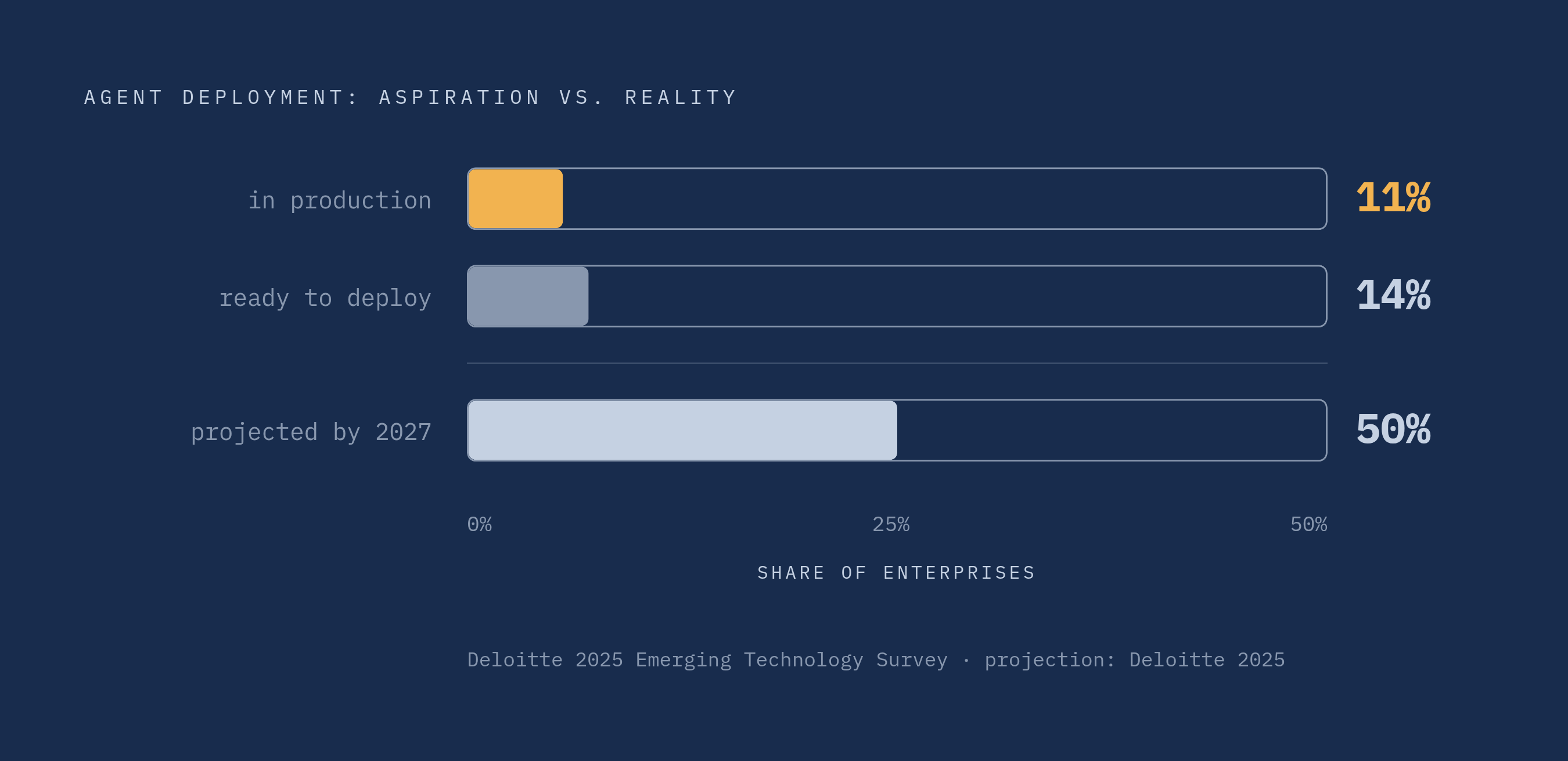
The gap between where the industry talks about agents and where it actually operates them is wide, and it is worth being blunt about how wide. Deloitte's 2025 Emerging Technology survey found only 14% of organizations had AI agent solutions ready to deploy, and just 11% were actually running them in production. That gap has nothing to do with model capability. It is about infrastructure: rendering, schema, failover, and compliance, all the pieces this piece has walked through, none of which show up in a model's benchmark score. Deloitte projects that 25% of enterprises using generative AI will deploy agents during 2025, climbing to roughly 50% by 2027, and estimates the AI agent market growing from $5.1 billion in 2024 to $47.1 billion by 2030. Those are big numbers sitting on a narrow current base, and that gap between projection and present reality says something about how much of this infrastructure still needs to get built.
State management tends to be the piece that gets underestimated most, and probably deserves more attention than it gets in most write-ups on agent architecture. Every tool call an agent makes shifts its internal context. Sub-agents create state scattered across multiple processes. An extraction job running for 30 minutes or more creates temporal state that has to be tracked the entire time it is in flight. None of that is exotic, but all of it needs deliberate design, not improvisation bolted on after something breaks in production.
The production engineering practices that solve this are not new. They are just newly relevant here. Single-responsibility agents, where one agent crawls, another validates against the schema, and another handles downstream ingestion, keep failures contained to one component instead of cascading through the whole system. Version control and automated testing need to apply to schema definitions themselves, not just to application code, since a schema is as much a load-bearing part of the system as any function. And extraction jobs deserve to run like services with defined SLOs, the way site reliability engineering treats any production system, rather than as scripts sitting on a cron job somewhere and hoping nobody notices when they fail. A developer guide on production agents makes roughly this point: the teams that succeed treat the agent as a software system first and an AI product second.
Put those pieces together, rendering that happens close to the origin server, schema as an enforced contract, failover across multiple models, and compliance built in rather than bolted on, and the extraction pipeline stops being something rebuilt for every new project. It becomes a shared primitive. Once those layers are solved at the infrastructure level, every agent in the system can draw on them, and the marginal cost of adding one more data source drops to something much smaller: just defining its schema.