Agentic Design Patterns for Browser-Based Tasks
Six patterns stack to build reliable autonomous browser agents from tool foundations upward.

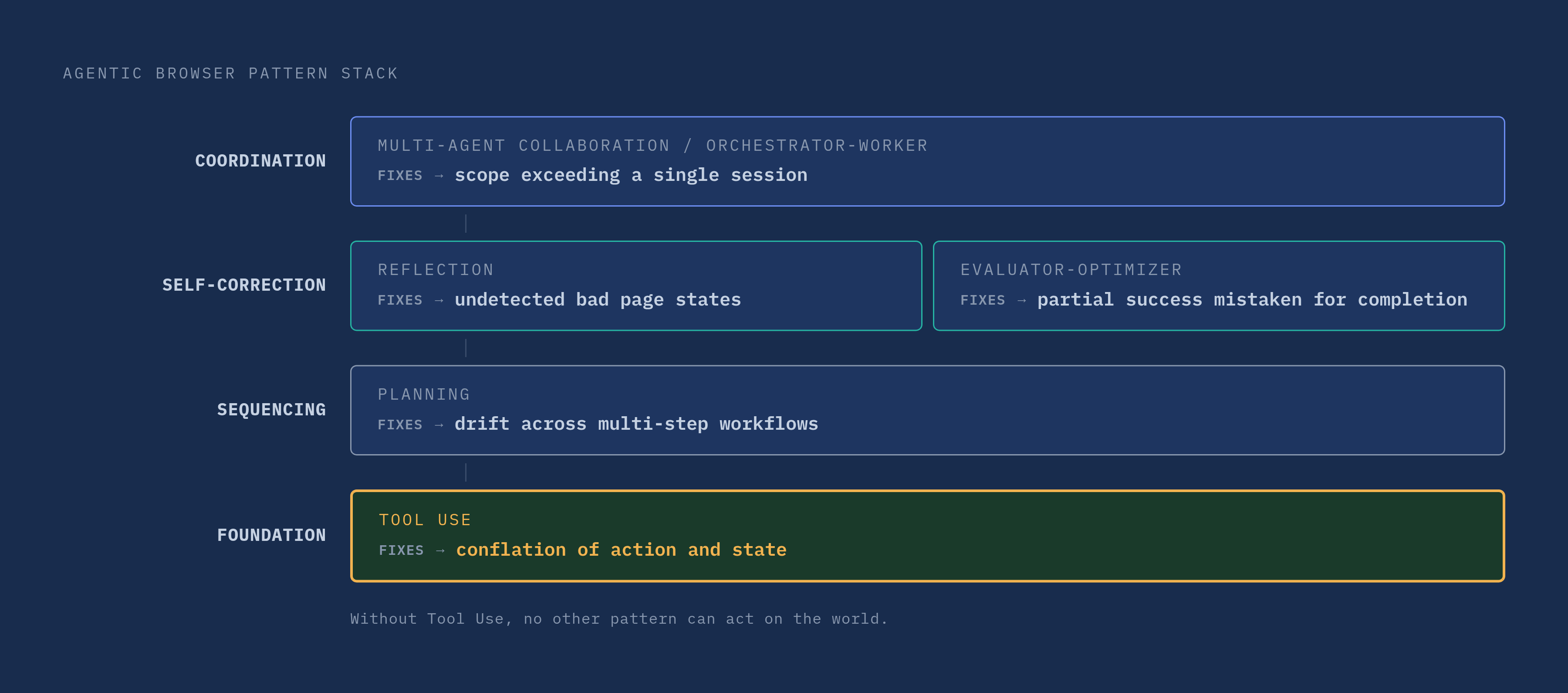
Six patterns cover the full problem surface of autonomous browser operation: Tool Use, Planning, Reflection, Orchestrator-Worker, Multi-Agent Collaboration, and Evaluator-Optimizer. Each addresses a distinct failure mode. Reflection catches page-state errors before they cascade. Planning prevents drift across multi-step workflows. Orchestrator-Worker and Multi-Agent Collaboration manage scope that exceeds a single linear session. Evaluator-Optimizer measures task success and adjusts before returning a result.
These are not interchangeable topic buckets. They form a stack with a specific internal logic: Tool Use is the foundation without which none of the others can act on the world; Planning structures the sequence of actions; Reflection and Evaluation provide self-correction at different granularities; Orchestration coordinates the whole when complexity outgrows a single session.
Every pattern below has a browser-specific instantiation, because the agent must operate as a user, not as an API client. It works through browser automation, virtual environments, and programmatic UI manipulation, inheriting all the variability of interfaces humans navigate daily.
Tool use as the foundation. How agents actually touch a browser
Tool Use means the agent calls discrete, well-defined functions rather than issuing free-text browser commands. When an agent reasons freely about what to do next, it can also reason freely, and incorrectly, about what it already did. Clean tool boundaries are what prevent that conflation.
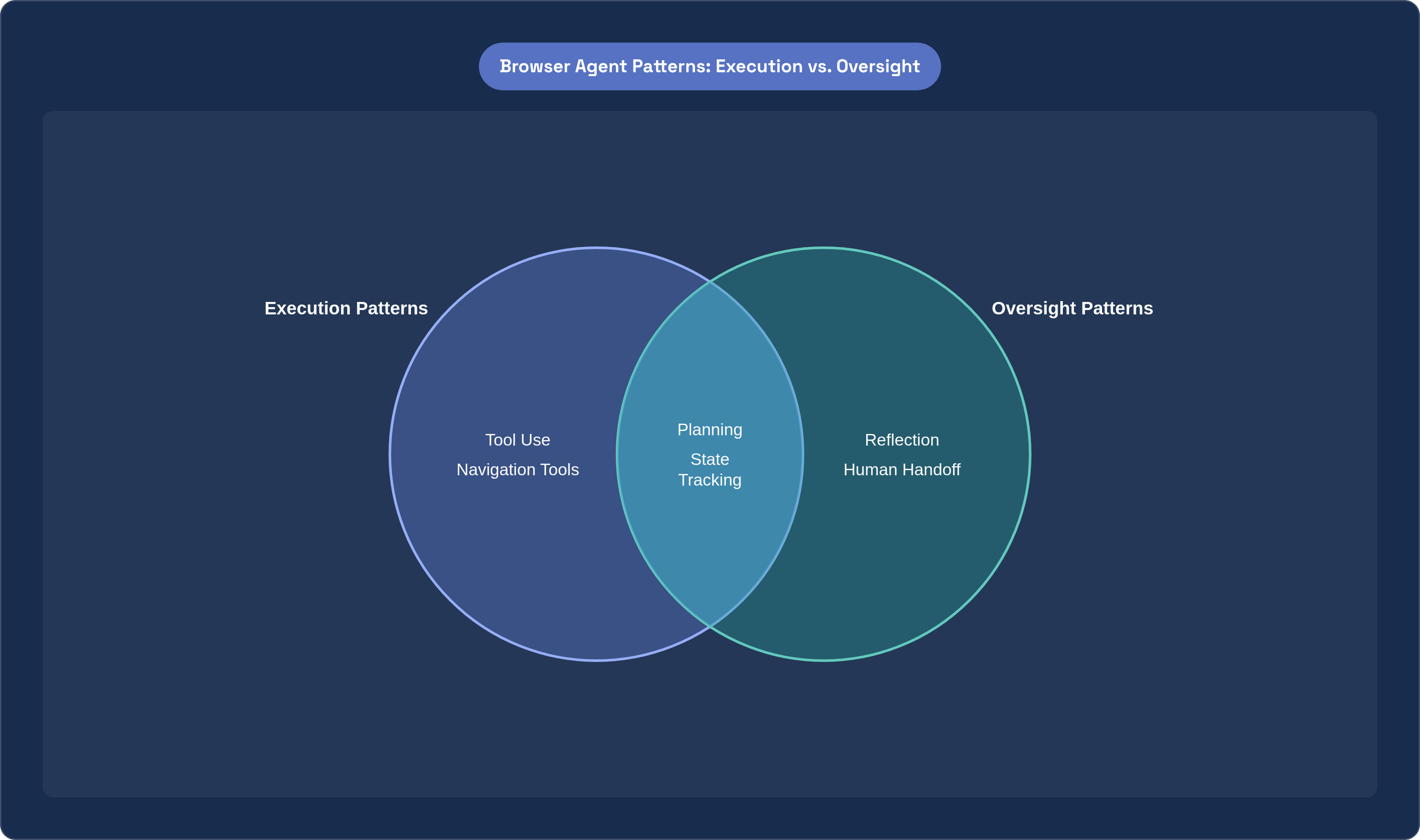
A functional browser agent requires several categories of tools. Navigation tools handle moving to a URL, waiting for page load, and managing redirects. DOM interaction tools cover clicking, typing, scrolling, hovering, and selecting from dropdowns. State inspection tools read element text, check visibility, and extract attribute values. Screenshot capture supports vision-model-based agents that interpret pages visually rather than through DOM traversal. Cookie and session management tools persist authentication state across steps. Network interception tools capture or mock API responses when direct DOM reading is unreliable, which is frequently true on pages that hydrate content asynchronously.
Each tool should do one thing and return a structured, predictable result. This is the single-responsibility principle applied to agentic tool design, and it functions as a reliability constraint rather than a stylistic preference. But what if a tool's return value is ambiguous? The agent's next reasoning step inherits that ambiguity, and errors compound. The visibility check that passes on a partially rendered element is a canonical example: the tool reports clean, the agent proceeds, and the subsequent action targets an element that is not yet interactive.
Tools should also be stateless from the LLM's perspective. Side effects (navigation and form submission being the most consequential) must be explicit, not implicit. An agent that cannot clearly account for what it has already done to a browser session will eventually do it twice, or fail to do it at all, and neither outcome is recoverable without a trace.
The Model Context Protocol standardizes how tools are described to the model and how results are returned, keeping workflow logic separate from tool implementation. Without that separation, changes to tool behavior require changes to the reasoning logic that depends on it, and the surface area for regression grows with every iteration.
Planning. Decomposing a web task before the first click
A booking or checkout workflow has somewhere between eight and fifteen distinct steps across multiple pages, depending on the site. Without a plan, the agent has no reliable way to know where it is, what it has already done, or what constitutes progress. It loses its place. It repeats steps. It mistakes a search results page for a confirmation page. A stateless agent operating on a stateful task will do this not occasionally but consistently.
The Plan and Solve pattern addresses this directly. Before taking any action, the agent decomposes the task into a sequence of sub-goals, each mapping to a discrete page state: filters applied on search results, the correct item selected on a product detail page, shipping information entered at checkout. The plan encodes expected preconditions and postconditions for each step, and the agent checks its current state against the plan at each transition point.
Browser-specific planning must account for complications that cleaner agentic environments do not impose. Pages may not load in the order the plan assumes; plans must include conditional branches. Authentication steps may interrupt execution mid-plan; the plan must treat auth as a recoverable detour. Dynamic content, including prices, availability, and search results, changes between sessions and sometimes within them, so the plan cannot hardcode expected values, only expected structure.
State tracking is what gives the plan operational value. Without a record of which steps are complete, which are in progress, and which remain, the agent re-executes earlier steps, which in the best case doubles costs and in the worst case submits duplicate transactions.
Hierarchical planning handles complex tasks more cleanly than flat sequences. A top-level goal breaks into page-level milestones, which break into action-level steps. Each level carries its own success criterion, giving the agent and the orchestrator a clear picture of progress at multiple resolutions simultaneously.
That raises an important question: what happens when the agent arrives at a page state the plan never anticipated? That is not an edge case; it is a near-certainty in any sufficiently complex workflow. The plan tells the agent where to go. What catches things when the destination looks nothing like expected belongs to the next layer.
Reflection. Catching bad page states before they become unrecoverable failures
In most agentic contexts, the Reflection pattern is good practice. In browser environments it is closer to mandatory, because the page after a click is not guaranteed to match expectations in ways that are often invisible to the tool layer.
Error messages appear where success banners were expected. Unexpected modals interrupt linear flows. Sessions expire silently. CAPTCHA challenges appear without warning. DOM rendering is asynchronous, which means an element the plan expects to be present may not yet exist at the moment the agent checks for it. A reflection step that verifies whether the expected element appeared prevents the agent from acting on a partially loaded page. This failure mode is more common in production than most architecture discussions acknowledge, possibly because the agents that miss it tend to complete tasks that look correct until someone checks the backend.
The asymmetry of consequences is worth sitting with. A wrong click in a checkout flow can submit an order prematurely. A form submitted without reflection verifying field values may contain errors the agent introduced. These are not recoverable by simply retrying. The cost of an unnecessary reflection step is latency; the cost of a skipped one can be an irreversible transaction. That asymmetry should shape how aggressively reflection is applied, and in practice it often does not, because latency is visible in dashboards and irreversible transactions are visible in customer service queues.
Two reflection modes serve browser agents differently. Inline reflection, applied after every tool call, reads back the current page state and confirms it matches the expected postcondition. Checkpoint reflection, applied at the end of each plan milestone, conducts a structured self-critique assessing whether the milestone was achieved. Inline reflection is thorough and expensive. Checkpoint reflection at milestones is the practical balance for tasks where intermediate steps carry low individual risk but meaningful cumulative state.
When reflection identifies a mismatch, the response should be a defined recovery path (whether retry, reroute, or escalation) not a halt. Halting on every mismatch produces systems that require constant human intervention. Ignoring mismatches produces systems that confidently complete the wrong task. Neither is acceptable in production, and choosing between them is one of those decisions that feels abstract until you are looking at a failed order and a clean tool log.
Orchestration. Coordinating work across pages, sessions, and specialized sub-agents
Two patterns apply here, and the choice between them is architectural. The Orchestrator-Worker pattern places one agent in control of the plan and delegates browser sub-tasks to worker agents, which handle individual page interactions and return structured results. The Multi-Agent Collaboration pattern deploys specialized agents with distinct browser capabilities (a form-filling agent, a data-extraction agent, an authentication-handling agent) collaborating on a shared task without single ownership of the full plan.
Browser environments give both patterns practical value beyond what a single agent can provide. Parallel browsing across multiple sources simultaneously cannot be serialized through one agent without prohibitive latency. Domain specialization produces more reliable agents: one agent trained narrowly on e-commerce checkout flows will outperform a generalist on that task because its decision space is smaller. Isolation may be the most practically significant benefit. If one sub-agent's browser session enters a bad state, the orchestrator can abort and restart just that worker without losing the full task's context and progress.
It is also worth considering the state management complexity that orchestrated sessions introduce, because it is easy to defer and costly when deferred. The orchestrator must track not only task progress but which browser sessions are open, what credentials each worker holds, and what page state each worker left at. That is the core engineering challenge of orchestrated browser automation. It is not a secondary concern.
Clean separation between orchestration logic and tool or MCP servers is a production requirement. Orchestrator complexity bleeding into browser interaction code makes both harder to maintain and both harder to debug when failures occur. Security boundaries require the same clarity: each worker agent should operate in an isolated browser context with separate cookies and separate storage. Shared sessions create cross-contamination risks and complicate audit trails in ways that become significant when tasks involve authentication or financial transactions.
Evaluation. Deciding whether a browser task actually succeeded
Success in browser tasks is not obvious, and this is one of those things that sounds simple until you have spent enough time debugging it to stop thinking of it as simple. A booking confirmation and an error modal can both follow a form submission. The page that renders after checkout may indicate success, failure, or a pending state that requires reading a confirmation number, parsing a banner that renders in a subtly different style, or checking an email trigger that fires asynchronously. "Page loaded" is not "task complete." The web was built for human readers who can interpret ambiguous visual signals; agents need something more deterministic, and they rarely get it.
Partial success is the norm rather than the exception. The agent navigated to the right page but extracted the wrong data. It submitted the form with a transposed date. The page showed no error, but the intended backend action did not execute because a required field was silently omitted. None of these surface reliably through tool outputs alone. But how does this affect our original promise of reliable task completion? If tool outputs cannot reliably signal partial failure, the architecture needs something explicitly designed to detect it before an irreversible action is confirmed.
The Evaluator-Optimizer pattern places a separate evaluation step at the end of the execution loop. The evaluator reads the final page state, any available confirmation signals, and compares them against the task specification's definition of completion. The optimizer uses that assessment to revise the approach when the task failed, not merely to retry the same action, but to adjust strategy based on what the evaluator diagnosed. This requires that success criteria be defined before execution, not after, which is planning work, and what makes evaluation tractable rather than subjective.
Evaluation outcomes fall along a spectrum. A soft failure (where the evaluator flags uncertainty) should trigger a human handoff rather than another automated retry. A hard failure (a clearly wrong outcome such as a wrong item ordered or a wrong date booked) should halt before any irreversible action is confirmed. The evaluator is also a cost-control mechanism: an agent stuck in a retry loop exhibits predictable signals, and catching them early prevents runaway token consumption.
How the patterns combine into a runtime loop for autonomous web tasks
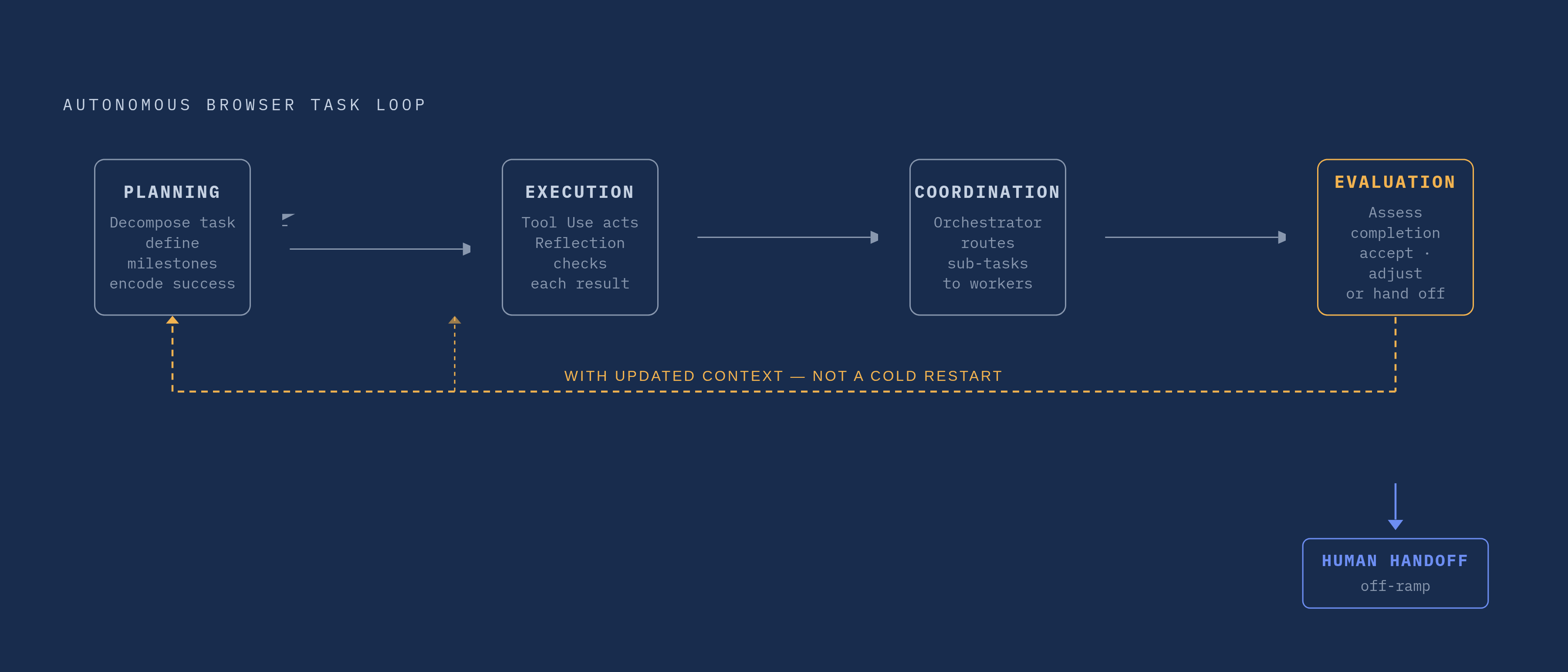
The runtime loop has four phases and does not execute once and terminate. In the planning phase, the agent decomposes the task, defines page-state milestones, and encodes success criteria for the evaluator. In the execution phase, Tool Use performs actions and Reflection checks each result against the plan. In the coordination phase, the orchestrator routes sub-tasks to workers when scope exceeds a single linear session. In the evaluation phase, the Evaluator-Optimizer assesses completion and either accepts the result, adjusts the approach, or escalates to a human handoff.
On adjustment, the loop returns to the planning or execution phase with updated context. This is not a cold restart; the agent carries forward what it learned in the previous iteration.
Memory is the connective tissue that makes the loop functional across iterations. Short-term memory holds current session context, recent tool outputs, and active page state. Mid-term memory records completed plan steps, evaluated milestones, and prior failure modes encountered in this task. Without both layers, the agent re-reads context, miscounts its position in the plan, and re-executes steps it already completed. The resulting behavior is difficult to distinguish from random, which makes it difficult to debug, which tends to make it expensive.
Human handoff belongs in the architecture as a designed boundary, not as a failure exit. The system should define explicit points where human judgment adds more value than another automated retry. Treating handoff as failure produces brittle systems: they either loop indefinitely or surface failures without useful context. The experience of debugging either is instructive in ways that no amount of upfront design review quite prepares you for.
Observability across the loop is not optional. Every tool call, reflection step, and evaluator decision should emit a trace. OpenTelemetry with agent-specific semantic conventions is the emerging standard; both MCP and the Agent-to-Agent protocol treat tracing as first-class. Infrastructure that runs these agents close to users matters here too: Cloudflare, a global edge and security network that runs serverless compute across 330-plus data centers worldwide, is one platform teams use to host and coordinate agentic workloads where latency and observability are tightly coupled. Without traces, debugging a failed multi-step browser task is largely archaeological work, and it shows in how long root cause analysis takes.
The architecture is deliberately agnostic about which model powers which pattern. The orchestrator and evaluator may warrant more capable and more expensive models; worker agents handling repetitive DOM interaction are good candidates for smaller, faster ones. The pattern structure makes heterogeneous deployment tractable because each component's responsibilities are clearly bounded.
Production constraints unique to browser-based agents and how the architecture addresses them
The architecture described above is coherent. Production browser environments are not, and the gap between those two sentences is where most real engineering time goes.
Authentication is the first and most consequential constraint. Most web tasks of real value sit behind login. Session tokens expire. Multi-factor authentication requires out-of-band interactions. CAPTCHAs appear at login screens, at checkout, and sometimes mid-session. Each of these interrupts linear execution in ways the planning and reflection layers must be designed to handle explicitly. An auth failure that halts the task without a recovery path is a fundamental architectural gap, not a prompt engineering problem, and the distinction matters because the fix lives in a completely different part of the stack.
DOM instability is pervasive and underappreciated. Modern web applications rebuild significant portions of their DOM after JavaScript hydration, after user interaction, and sometimes on intervals that have nothing to do with user input. Selectors that locate an element correctly at one moment may resolve to nothing moments later. The tool layer must account for this through explicit wait conditions, visibility checks, and retry logic with backoff.
Unpredictable page behavior (lazy loading, infinite scroll, third-party widgets that load asynchronously, cookie consent modals that block interaction) creates a category of failures that no plan can fully anticipate. The planning layer handles this by encoding expected structure rather than expected content and by building conditional branches for common interruptions. Novel interruptions still surface; the reflection layer's job is to detect that the expected postcondition did not materialize and route to recovery logic before the session compounds the error.
Rate limiting and bot detection represent an adversarial dimension that purely technical architectures tend to underweight. Sites actively work to detect and block programmatic interaction. The behavioral patterns of a browser agent (consistent timing, predictable interaction sequences, absence of mouse movement noise) can trigger detection systems even when the agent's actions are otherwise valid. There is no clean solution here. The agent-as-user paradigm carries real friction against the underlying implementation, and architectural choices about interaction timing and session management carry security and reliability implications that extend well beyond the agent itself.
Data consistency across a multi-step, multi-page workflow is harder than it appears. Prices change between when a product page loads and when checkout completes. Availability changes. Form fields that accept a value during entry may reject it on submission when server-side validation differs from client-side validation. The evaluator's role in detecting these discrepancies before irreversible actions are confirmed is not merely quality assurance; it is what separates a browser agent that can be trusted with consequential tasks from one that cannot.
This architecture does not resolve all of these constraints. It provides a principled structure within which they can be addressed systematically, with each pattern carrying a well-defined responsibility for a specific failure mode. Whether any given deployment is robust enough depends on implementation quality: how carefully the tool layer is built, how precisely success criteria are defined, how thoroughly reflection and evaluation steps are designed. The patterns are a necessary condition for reliable browser agents. Implementation is where that condition either holds or quietly fails, and how those two things interact across real deployments remains, in this practitioner's experience, an unsettled question.