Beautiful Soup Web Scraping in Agent Data Pipelines
Beautiful Soup parses static HTML; everything else requires different tools.
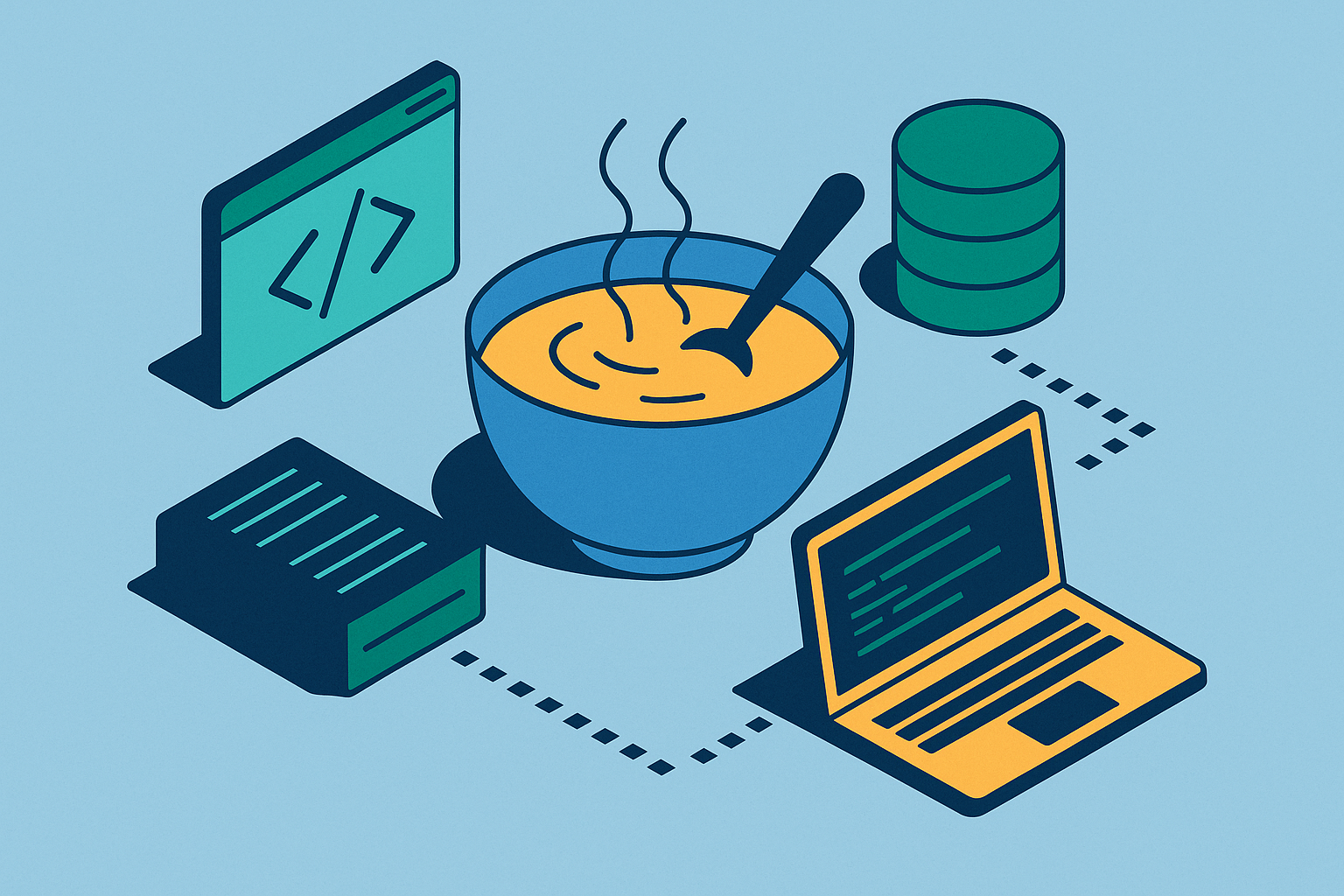
Beautiful Soup is a parsing library, nothing more, and that limit is the single most important thing to understand before wiring it into any agent pipeline. It reads markup you already have and hands back a searchable tree. It does not fetch pages, does not run JavaScript, and does not notice when a site redesigns itself out from under your selectors. Everything below follows from that one fact: what Beautiful Soup does well, what it flatly cannot do, and how to build the layers around it so the whole pipeline holds together once it's live.
Where Beautiful Soup earns its place in the tool hierarchy
Leonard Richardson released Beautiful Soup in 2004 as a general-purpose screen-scraping library, and the core job hasn't changed since: parse HTML or XML into a tree, then search that tree by tag name, CSS selector, or attribute. That's the whole tool. No fetching, no execution environment, no memory of what the page looked like yesterday.
Firecrawl's August 2026 roundup of scraping tools sorted the landscape into four rough buckets. AI-native APIs like Firecrawl, ScrapeGraphAI, and Crawl4AI sit at one end. No-code platforms like Octoparse and Browse.AI serve non-developers at the other. Browser automation tools (Selenium, Playwright, Puppeteer) handle anything that needs a real rendering engine. Then there's the Python library category, Beautiful Soup and Scrapy, best suited for developers who want control over static or medium-scale scraping.
That's the honest niche: a single static site, a stable structure, a developer who wants to write .find('div', class_='price') and know exactly what comes back. Treating Beautiful Soup as a scraping solution rather than what it actually is, a tree search over text someone else already fetched, is the mistake that causes most of the pain later. Once the job outgrows a handful of sites, thousands of pages, link-following, distributed requests, Scrapy is usually the next step up, best understood as a framework built for crawling and scraping at scale rather than a replacement for Beautiful Soup.
Most modern sites render at least some content client-side, and Beautiful Soup, working only from whatever an HTTP client handed it, sees an empty <div id="root"></div> where a browser sees a fully populated page. A lot of real scraping requests boil down to "give me clean data from these URLs," and that's exactly where Beautiful Soup alone comes up short. It needs help before it ever gets a byte of HTML to parse, and that's not a knock against the library so much as a description of where its job legitimately ends.
Parser choice and encoding, the unglamorous details that actually matter
Beautiful Soup doesn't parse HTML itself. It hands the job to an underlying parser, and that choice has real consequences once a pipeline runs at volume. lxml is the fastest option and handles malformed markup without falling over, which makes it the default for anything running at scale. html5lib forgives genuinely broken HTML, the kind with unclosed tags and mangled nesting that would choke a stricter parser, but it's still working from static text. It has no more ability to run JavaScript than lxml does.
One encoding detail trips up more pipelines than it should: pass response.content, the raw bytes, instead of response.text, the string your HTTP library already decoded using its own guess at the character set. Beautiful Soup's own encoding detection tends to beat a generic HTTP client's guess, and skipping that step is a common cause of mangled text on pages using non-UTF-8 encodings, particularly outside markets running certain widely spoken languages. Small thing. Also the kind of small thing that quietly corrupts a dataset for months before anyone notices the accented characters are wrong.
The token cost of dirty HTML, why the parsing layer is a financial decision
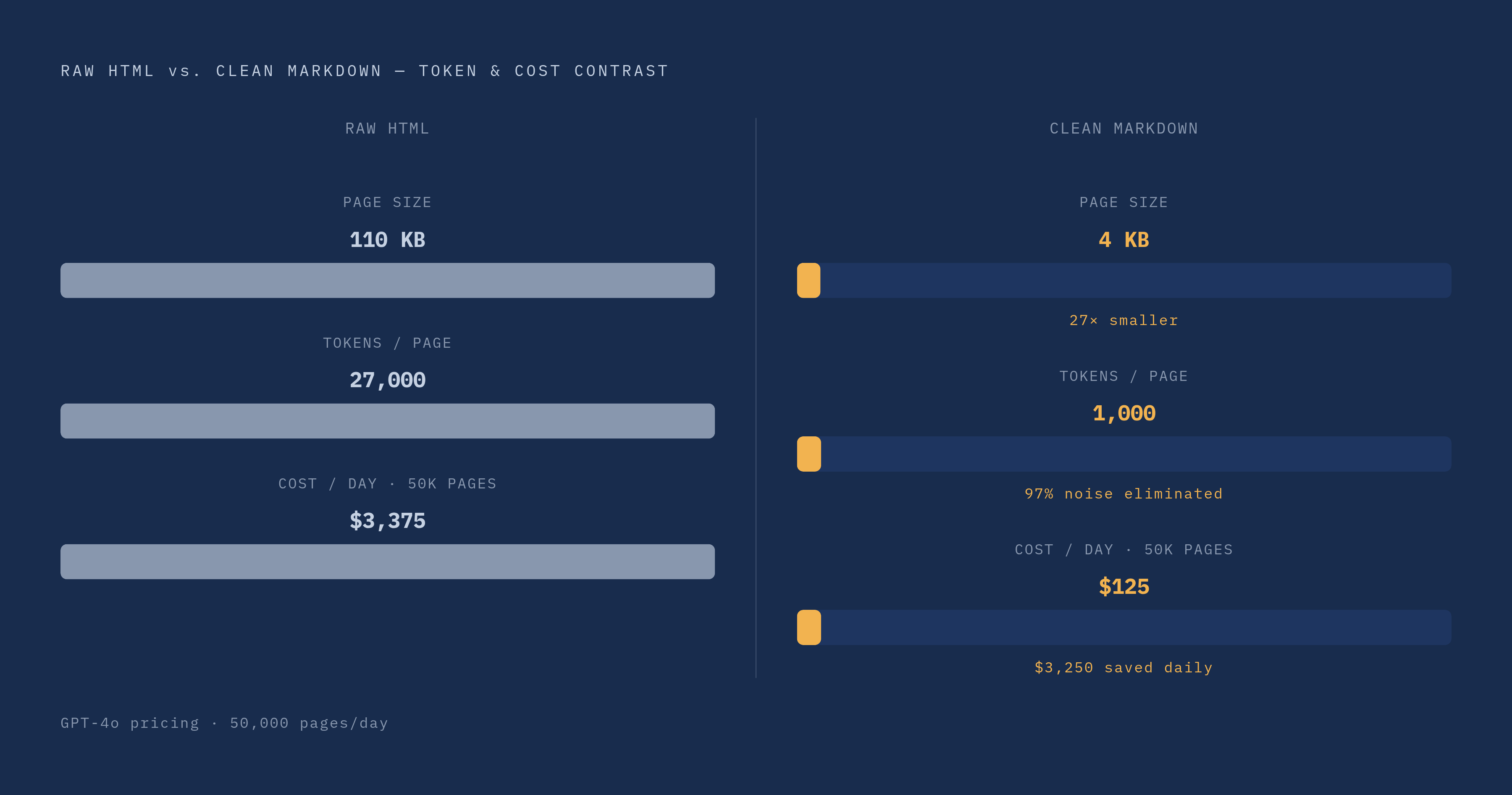
This is where parsing stops being a technical footnote and becomes a line item, and it's the part of the pipeline most teams underprice. Per figures from alterlab.io, a typical SaaS pricing page runs around 110KB as raw HTML, which works out to roughly 27,000 tokens once it hits an LLM's tokenizer. Reduced to clean extracted markdown, the same page comes in around 4KB, about 1,000 tokens. That's a 27x reduction in what a team pays to have a model read the page, and at 50,000 pages a day the same figures put a raw-HTML pipeline at roughly $3,375 a day in LLM API costs against roughly $125 a day for the clean-extraction version of the same job.
The gap implies something like 97% of a raw HTML page is not content at all: navigation chrome, ad scaffolding, cookie banners, script tags, layout markup a model gains nothing from reading. That ratio doesn't shrink as the operation scales up either. It just multiplies the same waste across more pages, and no amount of prompt tuning fixes it. A tighter system message doesn't shrink a 110KB page, and better prompts don't fix a document that's 97% noise. The fix has to sit upstream of the model call, in whatever layer decides what the model even gets to see, and that's exactly the job Beautiful Soup is suited for.
Order matters in that noise-removal pass, and getting the sequence backward is the single most common mistake in this step. Decompose the junk first: nav, header, footer, aside, .sidebar, .ads, .cookie-banner, script, style, noscript. Only after that should content selectors run, roughly in order of specificity: article, main, [role='main'], .post-content, .article-body, .entry-content, #content. Skip the decompose step, or run it after the content selectors instead of before, and a footer or nav block will sometimes get picked up as "main content" simply because nothing more semantic exists to outrank it. It's a small sequencing detail with an outsized effect on data quality, and it costs roughly 750 milliseconds of extraction overhead per page, a fixed tax worth budgeting for when sizing how many pages run concurrently.
The two layers Beautiful Soup cannot replace: fetching and rendering
Beautiful Soup never operates alone, and it can't, since it has no concept of a network request. Something has to fetch the page first. The usual starting point is requests: free, open source, and enough for any site that renders its content server-side.
JavaScript is where that starting point stops being enough. Single-page apps, React and Vue front ends, listings that load in after a background fetch, paywalled articles that swap content in dynamically, none of that shows up in the raw HTML a plain HTTP client gets back. The DOM a browser eventually paints and the markup requests receives can be almost unrelated documents.
Two paths deal with this, and treating them as equally good options is where teams waste the most engineering time. One is running Playwright or Puppeteer directly, which means managing browsers: memory leaks, zombie processes that don't clean up after a crashed page load, proxy rotation, retry logic, and the general overhead of keeping a browser fleet alive. Per an account from zackproser.com describing this kind of infrastructure run commercially, the operational cost is real: a queue to manage, retries to write, browser lifecycles to babysit, all of it becoming a permanent line item for whichever team owns it. The better default for most teams is the other path, a managed headless service that absorbs that complexity, because running your own browser fleet is infrastructure work disguised as a scraping decision, and few teams actually want to be in the business of babysitting instances of a browser engine.
One pattern worth flagging for JS-heavy pages specifically: use a wait_for selector that blocks until a target element actually shows up in the DOM, rather than a fixed sleep. React and Vue apps mount content asynchronously and on inconsistent timelines, so a two-second sleep that works on a fast connection fails silently on a slow one. Waiting for the actual element works because it's tied to the thing that actually matters rather than a guess about timing.
Laid out end to end, the architecture is visible now: a fetch layer, a render layer, a parse layer (Beautiful Soup), and an LLM extraction layer on top. Each layer has a defined owner and a defined failure mode, which matters more than it sounds like it should, because a failure in one layer doesn't require tearing apart the whole pipeline to diagnose. Serverless headless browsers, edge-hosted Puppeteer and Playwright, let an agent navigate to a page, let it render fully, and get back a complete DOM without the team ever touching browser infrastructure directly. That's the direct answer for anyone who wants Beautiful Soup's parsing precision without signing up to run a browser fleet.
What a self-healing agentic pipeline looks like around Beautiful Soup
Most scraper code carries an assumption that quietly breaks in production: the request will succeed, the response will be complete, and the DOM will keep the same structure it had last week. Per reporting from ProxyEmpire in April 2026, any one of those three assumptions can fail on its own, and a pipeline built without planning for that treats every failure as a surprise instead of a normal operating condition.
A self-healing pipeline flips that assumption around. Failure isn't the exception path, it's a state the system expects some percentage of the time, and it's built to diagnose failures rather than retry blindly. If a primary selector (.job-card, say) comes back empty, the pipeline needs to figure out why: is the page genuinely empty, is this a bot challenge page dressed up as a 200 response, or has the site's markup actually changed underneath the selector? Three different failure modes, three different fixes, and treating them the same wastes retries on problems retries can't solve.
That's where a fallback selector chain earns its keep: try alternate selectors, check whether the page embeds structured data like JSON-LD or microdata that sidesteps the HTML entirely, or route the page to a secondary parsing routine built for exactly this case. When the plain HTTP client comes back empty or blocked, the fix is switching approach rather than retrying the same request. Escalating to a JS-rendering layer makes sense because a bot challenge or a client-rendered page fails the same way every time, no matter how many times the same tool asks.
This maps onto a two-stage model cleanly. Stage 1 handles acquisition: proxy management, CAPTCHA resolution, getting reliable HTML back from a hostile or script-heavy target. Stage 2 applies the LLM for semantic extraction, pulling structured meaning out of content that's already clean. Beautiful Soup sits at the seam between the two, cleaning Stage 1's output before it ever reaches the model in Stage 2. One trick worth using at that seam and rarely seen in practice: hash the extracted markdown body. A stable URL that suddenly produces a different content hash is a cheap, almost free signal that either the underlying data changed or the site's structure did, and either way it's worth flagging before bad data quietly enters the dataset.
A benchmark published in January 2026 (arXiv:2601.06301) compared LLM-assisted scripting, prompting a model to generate Beautiful Soup or Scrapy code that a person then runs by hand, against end-to-end LLM agents like Claude and Simular.ai that handle login flows and scraping autonomously with retries and error detection built in, across 35 websites spanning five security tiers from plain static HTML up to sites hardened specifically against automation. Separately, research out of McGill University in 2025 found one model's methods holding 98.4% accuracy even as page structures changed underneath them, with setup time dropping substantially. Beautiful Soup doesn't need replacing to capture most of that gain. The self-healing pattern around it, the fallback chains, the hash-based change detection, the escalation logic, is what closes most of the distance, and it's a lot cheaper to build than it sounds.
When to stop extending Beautiful Soup and switch to an LLM-native extraction layer
There's a scale at which writing more selectors stops being the answer, no matter how sound the parsing logic underneath. Call it the 5,000-site problem: extracting the same handful of data points from thousands of uniquely structured websites means writing, in the worst case, thousands of different CSS selector sets, each one specific to a site that might redesign itself in six months. Sticking with Beautiful Soup past this point isn't frugal, it's the expensive choice, since the engineering hours needed to maintain that many selector sets dwarf what a managed extraction layer would cost. The model of "know the structure in advance" simply doesn't hold when the structure is different everywhere and shifting constantly.
One enterprise case documented by GPTBots in 2026 makes the economics concrete: a team of 15 manual scrapers, replaced by an AI-driven extraction system, saw first-year cost drop from $4.1 million to $270,000, while data accuracy rose from 71% to 96%. That's not a marginal efficiency gain, it's a different operating model, one where nobody is writing a selector for every new site that shows up.
A few tools have grown up around exactly this gap. Crawl4AI converts pages directly into LLM-ready markdown, stripping navigation, removing ads, and converting links into a numbered citation list, aimed at RAG pipelines and agents rather than general-purpose scraping. It went from a solo repository to roughly 75,000 GitHub stars in about three years, which says something about how many teams hit this exact wall. ScrapeGraphAI takes a different angle: intent-based extraction, where a person describes what they want in plain language instead of writing a selector, and the model interprets the page semantically. Managed APIs push further still, Firecrawl among the clearest examples, handling JavaScript rendering, content extraction, and boilerplate removal behind a single API call, returning clean markdown or structured JSON, with separate endpoints for scraping, crawling, searching, interacting, parsing, mapping, and extraction. Firecrawl's free tier runs 1,000 credits a month with a keyless trial requiring no signup, which lowers the bar for testing whether it fits before anyone commits.
None of this comes free of tradeoffs. Managed APIs remove the burden of running a browser fleet, but they introduce dependency on a third party, one with its own pricing, its own uptime, its own pace of change. They also remove the selector-level control that makes Beautiful Soup precise on a page whose structure is well understood and unlikely to shift. The decision rule that falls out of this is fairly clean: reach for Beautiful Soup when the structure is known and someone on the team owns its upkeep, and reach for LLM-native tooling when the structure is unknown, wildly variable, or spread across too many sites to selector-map by hand. Anyone still writing custom selectors for a 5,000-site crawl in 2026 is solving the wrong problem with the right tool.
The bot-detection environment the pipeline must operate inside
None of the architecture above matters if the fetch layer can't get past whatever defenses sit in front of the target site, and those defenses have gotten sharply more concentrated. DataDome's 2025 Global Bot Security Report found only 2.8% of websites fully protected against bot attacks that year, down from 8.4% in 2024, while over 61% were completely unprotected. That's an odd split: a small number of sites hardening aggressively, and a large majority with essentially no defense at all, meaning the threat surface a pipeline has to plan for looks completely different depending on which side of that line the target sits.
The volume moving through that landscape is enormous. DataDome recorded close to 8 billion AI agent requests in just the first two months of 2026. Traffic isn't landing where a naive rate-limiting strategy would expect, either: 64% of observed AI bot traffic hit form pages, 23% hit login endpoints, and only 5% reached checkout flows. Form pages and login endpoints draw the largest share of observed AI bot traffic, not the content pages a scraping pipeline is usually built to read, which means defenses tuned around content-page rate limiting miss most of the actual volume.
One thing static rules can't touch at all: intent that shifts mid-session. AI bot traffic spreads across form pages, login endpoints, and checkout flows in ways that make any single behavioral signature incomplete because nothing about the request pattern necessarily changes. Major bot-protection platforms, Imperva, DataDome, HUMAN Security (formerly PerimeterX), Kasada among them, respond by stacking signals: TLS fingerprinting, IP reputation scoring, HTTP/2 fingerprinting, JavaScript challenges, behavioral analysis, and per-customer machine learning models trained on that specific site's traffic.
July 2025 marked something of a turning point on policy as much as technology: blocking AI-based scraping by default became the standard network-level setting at many enterprise platforms, following backlash against stealth crawlers that had misrepresented themselves. Preemptive denial, even of traffic from agents identifying themselves honestly, is common now. The implication for pipeline design is blunt: the fetch layer has to handle proxy rotation, request fingerprint normalization, and CAPTCHA resolution before Beautiful Soup ever touches a byte of HTML. These aren't edge cases to patch in later. They're the baseline condition the fetch layer operates under from day one.
Hosting and orchestrating the pipeline at the edge
Where the pipeline runs changes both its economics and its latency profile, and centralized cloud functions carry a cost that's easy to underestimate until someone measures it directly. Cold starts on conventional serverless platforms can add meaningful latency, and that's a real tax when a pipeline triggers hundreds of parallel fetches, since every cold worker adds that delay before doing any actual work.
V8 Isolate architectures substantially reduce cold-start overhead, which pulls infrastructure startup out of the latency equation almost entirely, relevant specifically to agents spinning up new parsing workers on demand rather than keeping a fixed pool warm. Workers AI extends the same model to the LLM extraction stage: serverless GPU inference across more than 50 open-source models, running in over 200 cities, with an OpenAI-compatible API, 10,000 Neurons a day free and roughly $0.011 per 1,000 Neurons above that on a paid plan. The extraction stage can run on the same network as the fetch and parse stages this way, instead of shipping data across the open internet to a separate provider.
Vectorize fills the storage role for pipelines feeding a RAG system: embeddings stored close to users for low-latency semantic search, a free tier covering 5 million stored and 30 million queried dimensions a month, support for up to roughly 5 million vectors per index at 1,536 dimensions each, and about $0.01 per million queried dimensions past the free tier. By December 2025, the underlying network had become the fastest provider across 60% of the top 1,000 networks globally, up from 40% measured during Birthday Week 2025, a jump that matters directly to fetch-layer latency, since fetching is the first and most repeated step in the whole pipeline.
Managed serverless headless browser support closes the loop on rendering, letting Puppeteer and Playwright run without the team owning browser infrastructure cut round-trip time and hand back a fully rendered DOM before Beautiful Soup's parsing step even starts. Durable Objects and Queues or Workflows handle orchestration, letting an agent hold session state across retries, queue a failed fetch for a later attempt, and coordinate a multi-step scraping job without standing up a separate orchestration service just for that. Put together, the stack looks like this: Workers for compute, Workers AI for extraction, Vectorize for the embedding store, Durable Objects for state, Queues and Workflows for orchestration, a serverless browser for rendering. Each piece binds to the next without a network hop in between.
Putting the architecture together
Strip away the individual tools and the pipeline resolves into a simple shape: fetch, render if needed, parse, extract. Beautiful Soup owns exactly one of those four steps, and that's not a limitation so much as a design choice that's held up for two decades. A parsing library that tried to also fetch pages, render JavaScript, and adapt to markup changes on its own would be a much larger, much less predictable piece of software. Predictability is precisely what makes Beautiful Soup useful once it's slotted into the right spot in a bigger system.
The financial case from earlier, roughly $3,375 a day against roughly $125 a day at 50,000 pages, is really an argument about efficiency at scale more than about Beautiful Soup specifically. It's an argument for having some noise-removal layer at all before content reaches an LLM, and Beautiful Soup happens to be a well-understood, low-cost way to build that layer when the target sites are static and a team wants direct control over what gets kept and what gets thrown out. Once the operation moves past a few dozen sites into the thousands, or once bot defenses and JavaScript rendering eat more engineering time than the parsing logic itself, the calculus tips toward LLM-native tools built for that scale. Neither choice wins in the abstract, but most teams default to Beautiful Soup out of familiarity long after the job has outgrown it, and that habit is worth naming plainly rather than treating as a neutral preference.
What holds the whole architecture together, whether it runs on managed APIs, a self-hosted browser fleet, or an edge-native stack, is treating each layer as accountable for its own failure mode. The fetch layer answers for blocked requests and bot challenges. The render layer answers for incomplete DOMs. Beautiful Soup answers for extraction quality and noise removal. The LLM layer answers for semantic accuracy on the clean text it's finally handed. Built this way, a pipeline doesn't just work when everything goes right. It degrades in a way that's diagnosable when something, inevitably, doesn't.
Sources
- Web Scraping Pipelines for AI Agents | Cut Token Waste
- From Scraper to Agent: Turning Python Scripts into Self-Healing Data Pipelines | by ProxyEmpire | Medium
- Best Web Scraping API for AI (2026): Build or Buy?
- 13 Best Web Scraping Tools in 2026
- The Future of Web Scraping: AI Agents + Human Co-Pilots in 2026
- arxiv.org
- BeautifulSoup Scrapes Pages. Crawl4AI Assumes No One Reads Them. - Andrei Nita
- Best Web Extraction Tools for AI in 2026