Autonomous Web Agent Reliability and Error Recovery
Web agents need durable checkpoints and idempotent tools to recover from failures.
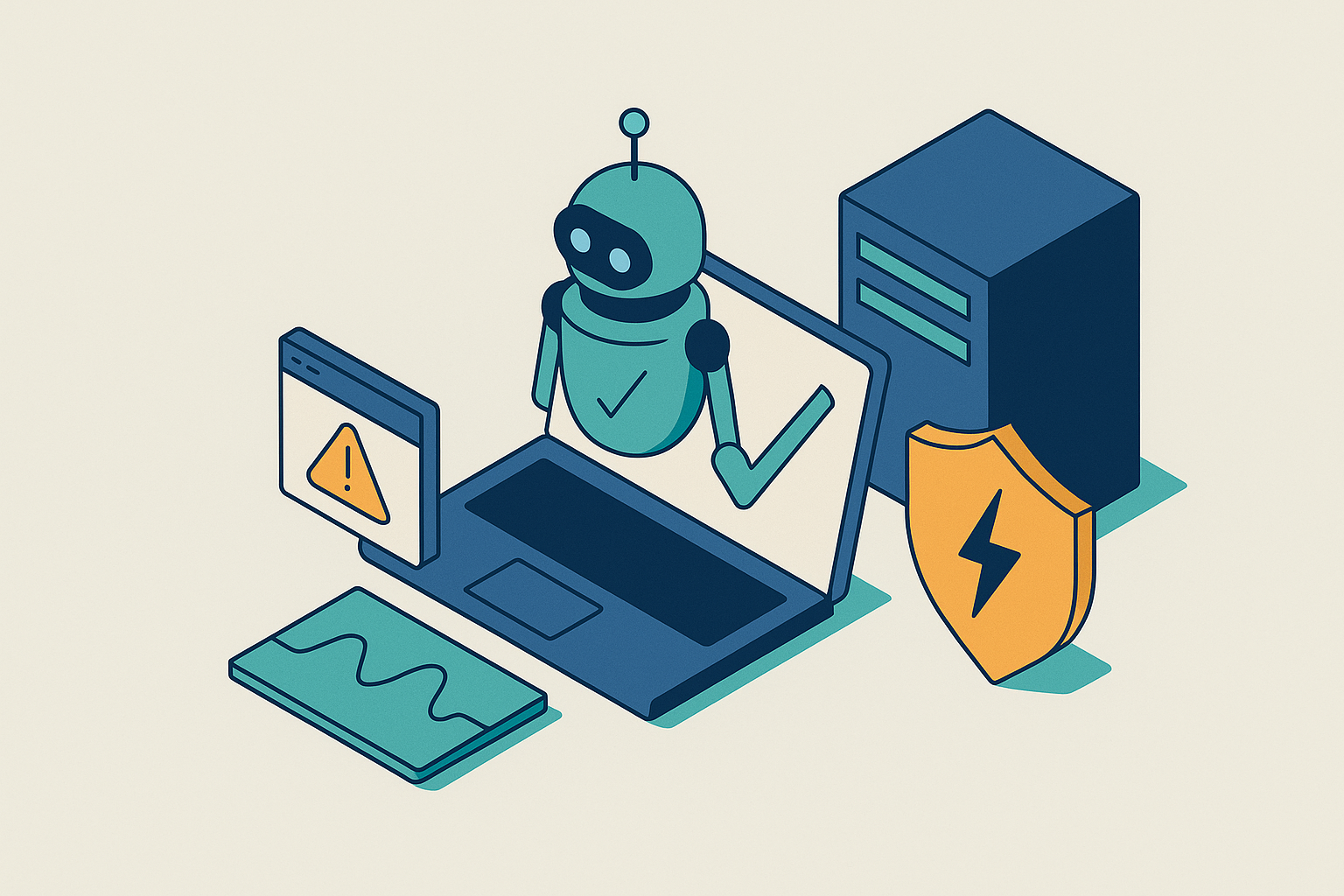
Not every failure category matters equally for web agents. A taxonomy is only useful if it maps to decisions, and most published taxonomies fail to do that.
Network timeouts mid-workflow are the most common recoverable failures, provided the agent was designed to recover. Most early-stage agents lack that design. Rate limiting from third-party APIs deserves separate treatment from other timeout failures. A human browsing a web interface generates requests at the pace of human cognition, a few per minute at most. An agent running the same workflow generates requests at computational speed, and many APIs will interpret that pattern as abuse before they interpret it as legitimate usage. I have watched agents get silently rate-limited for hours before anyone noticed the task had stalled — not because the system was misbehaving, but because nothing in the design anticipated the gap between "no error returned" and "work is actually progressing." LLM API slowdowns and context-window overflows belong in this same bucket: availability failures the agent did not cause and cannot unilaterally prevent.
Web agents interacting with browser interfaces face a failure class that purely API-based systems do not encounter. An element that existed in yesterday's DOM may have moved, been renamed, or been replaced by a component that loads asynchronously. Acting on a stale selector is not a reasoning error; it is a timing and versioning problem. Anti-bot detection compounds this. An agent's interaction pattern — uniform timing, precise click sequences, no scroll drift — looks nothing like a human's, and increasingly sophisticated detection systems will surface a CAPTCHA or silently degrade the response before the agent recognizes what happened. The silent degradation is the dangerous case. At least a CAPTCHA stops the workflow visibly.
Authentication failures follow their own logic. Session tokens expire. MFA prompts appear mid-workflow when a service detects an unusual access pattern. Permission scopes change when an organization updates its API policy. Each requires human credential input to resolve, and each is predictable enough that the agent's designers should have anticipated it.
State drift is where the cost multipliers live. A well-documented production failure mode: an agent processing a long-horizon task loses track of its current step when its context window fills, re-reads its state, concludes it is further back in the workflow than it actually is, and re-executes steps it has already completed. In workflows with external side effects — submitted forms, sent communications — that duplication is not just wasteful; it is harmful. Parallel sub-agents writing to shared state without coordination produce a related failure: conflicting writes that leave the system in an indeterminate condition neither agent can diagnose.
Then there is the category sitting at the boundary between infrastructure and reasoning. A hallucinated tool call returns an unexpected response. The agent, designed to retry on unexpected responses, retries. The retry produces the same wrong result because the problem is structural, not transient. By the time the retry budget exhausts, the error has compounded considerably. The system cannot distinguish a transient fault worth retrying from a structural error that retrying will only worsen. That distinction receives far too little attention in the literature.
Finally, budget and resource runaway. An agent whose reasoning loop lengthens unexpectedly will call more APIs and consume more tokens than its budget assumed. This is not a broken agent. It is an ungoverned one.
How State Management Determines Whether a Failure Is Recoverable
State is the underappreciated variable in agent reliability discussions. Most recovery strategies assume the agent knows where it is. Without checkpointing, that assumption fails, and recoverable situations become unrecoverable ones.
The checkpoint must survive the agent process dying. That requirement immediately rules out in-memory state. A durable store — relational, blob, or distributed key-value — is necessary. What to serialize at each checkpoint: the full conversation history to that point, tool outputs already received, the current plan and which steps are marked complete, sub-agent states, and an explicit record of any external resources already modified. The last item is the one I have seen teams omit most consistently. Knowing which steps are complete is insufficient if the agent cannot also know which side effects it has already committed.
Idempotent tool calls are the complement to checkpointing, not a nice-to-have addition. A checkpoint tells the agent where to resume; idempotency ensures resuming from that checkpoint does not duplicate a side effect. Idempotency must live on the tool side, not the agent side. The agent cannot be trusted to remember what it already did if state was lost — that is precisely the scenario checkpointing is designed to handle. Form submissions with client-generated idempotency keys, file writes that check for prior existence before overwriting, API calls that use PUT or PATCH semantics rather than POST wherever the operation allows: payment processing systems have relied on these patterns for decades, and agent workflows need them for the same reasons.
Agents running long-horizon tasks will fill their context window. This is not an edge case; it is the expected condition for any workflow longer than a few minutes. The mitigation is architectural: cap context per sub-agent, cache intermediate reasoning outputs externally, pass summaries rather than full transcripts to downstream agents. An agent that ingests the entire history of every prior step will eventually exceed its window and start dropping information, producing exactly the state drift described above.
What disciplined state management makes possible is concrete: a failed agent that can be resumed from its last checkpoint, inspected by an engineer or a human operator, and retried from exactly where it stopped, without re-running completed steps or committing duplicate side effects. The goal is not perfect execution. It is bounded, inspectable failure.
Retry, Backoff, and Circuit Breakers: The First Line of Defense Against Transient Failures
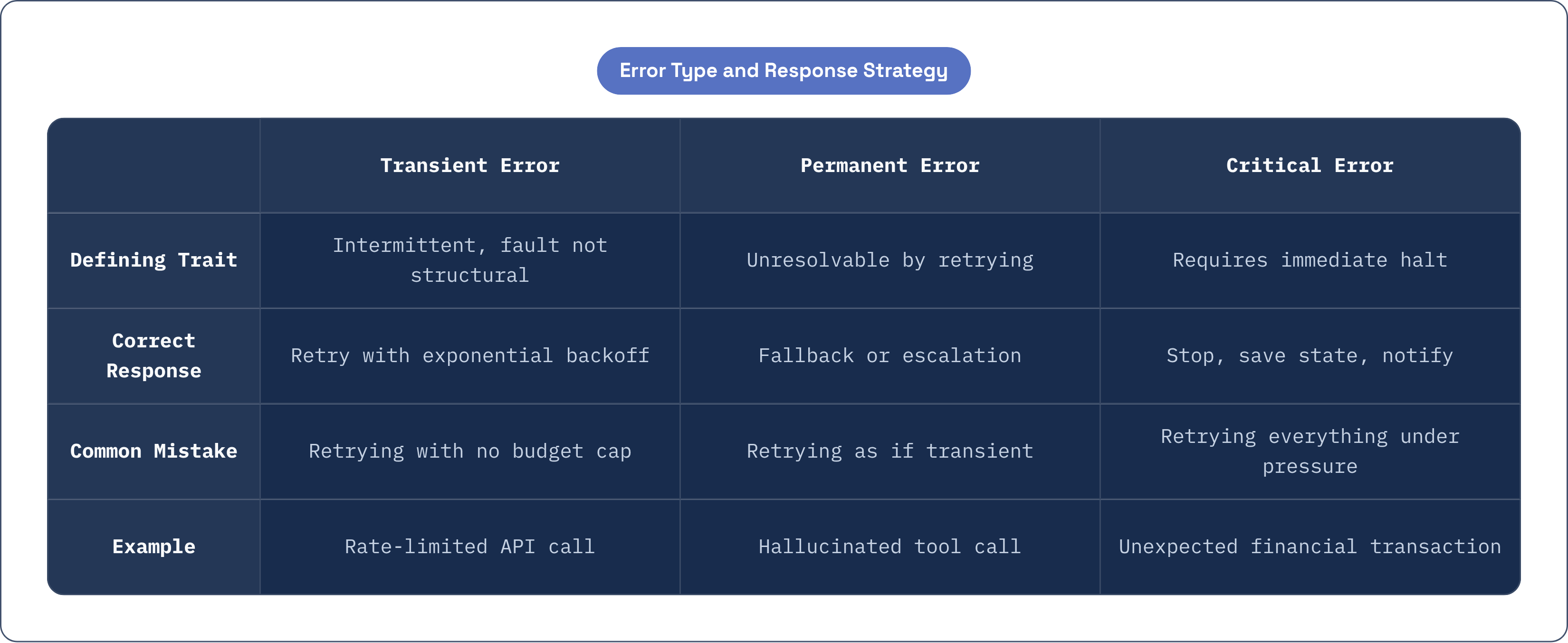
The core distinction driving pattern selection is not which error occurred but what kind of error it is. Transient errors call for retry with backoff. Permanent errors call for fallback or escalation. Critical errors call for an immediate stop, a state save, and notification. Most teams get this roughly right under normal conditions and completely wrong under pressure, when the temptation is to retry everything and hope.
Exponential backoff is borrowed directly from distributed systems engineering, the same logic payment processors use when a transaction fails at a gateway. It reduces contention by spreading retry attempts over time. Adding jitter, a small random offset to the backoff interval, prevents the thundering-herd problem: when multiple agents have all hit the same rate-limited API and all retry at the same calculated interval, the result is a synchronized retry storm that makes things measurably worse. Retry budgets matter just as much as the backoff interval itself. Cap both the number of attempts and the total elapsed time before escalating. An agent that retries indefinitely is not recovering; it is consuming resources and blocking forward progress on a task that may require a different resolution entirely.
Circuit breakers address a related problem. When a dependency fails repeatedly, continuing to send requests to it degrades the entire workflow. A circuit breaker tracks failure rates and, above a threshold, stops outbound requests to the failing service for a defined recovery window. The three-state model — closed during normal operation, open during failure, half-open when testing whether recovery has occurred — is standard in distributed systems literature and applies directly to agent tool integrations. It matters most when the agent depends on external APIs with no guaranteed SLA, which describes most of them.
Bulkheads isolate failing subsystems from healthy ones. The principle comes from naval architecture: a breach in one compartment does not sink the ship. A broken tool integration should not cascade into portions of the agent workflow that do not depend on it. If the document-retrieval tool is failing, the email-drafting tool should continue to function if the workflow permits partial execution.
Worth being explicit about what these patterns do not touch: hallucination. They handle infrastructure unavailability. A retry of a hallucinated tool call returns the same wrong result because the error is in the plan, not in the network. Conflating the two produces systems that retry their way into deeper trouble.
Fallback Chains and Graceful Degradation When the Primary Path Cannot Succeed
When the primary path is permanently unavailable and retry logic exhausts without resolution, a different question surfaces: whether an alternative path can achieve the same goal at acceptable quality.
A fallback chain is an ordered sequence of alternatives, each with a known quality tradeoff. If the primary LLM endpoint is unavailable or too slow, route to a secondary model, accepting that output quality may differ. If a structured API call fails permanently, can the goal be achieved through a different interface? A scraping path, a cached response, or a human-readable page may all serve when the structured source is unreachable. If live data is unavailable, serve stale cached data rather than blocking entirely. Content delivery networks have operated on this logic for years: when an origin server is down, a CDN serves its cached copy rather than returning an error. An agent can apply the same logic to previously retrieved data, with the same obligation to be transparent about what it is serving.
An agent that cannot complete a ten-step workflow should complete as many steps as it safely can, report what it achieved, and clearly mark what remains undone. Blocking entirely on a failed intermediate step is strictly worse: completed work is discarded and the user receives nothing useful. This requires the workflow design to distinguish steps with external side effects — which cannot be partially completed without risk — from read-only steps, which are safe to skip or defer. That distinction belongs in the design phase, not the incident postmortem.
When falling back, quality acknowledgment is not optional. A result produced by a secondary model or from cached data should be explicitly labeled as such. Presenting a degraded result as equivalent to the primary output is a trust problem, not just a technical one.
The reasoning failure case applies here too. Retrying a bad plan produces the same bad plan. The appropriate fallback is a different planning strategy, a smaller decomposition of the same sub-task, or a request for clarification — not another iteration of the same reasoning chain that already failed twice.
When Agents Should Stop and Escalate to a Human Rather Than Recover Autonomously
Not every failure is recoverable by the agent. Some require judgment the agent cannot safely exercise. Failing to define escalation triggers in advance is an architectural problem, not a configuration detail you can revisit after the first incident.
The clearest triggers: when token consumption or API credit spend crosses a predefined ceiling, the loop stops and a human is notified. When the next step would delete data, send an external communication, or commit a financial transaction and the agent's confidence is below a defined threshold, it should stop before that action, not after. When MFA prompts, CAPTCHAs, or unexpected consent screens appear, the agent has encountered a structural blocker; retrying accomplishes nothing and may trigger additional security responses. When an agent has attempted multiple strategies for the same sub-task and succeeded at none, further retrying compounds cost without progress. When the task specification does not give the agent enough information to choose between two paths with meaningfully different outcomes, the correct behavior is to surface that ambiguity rather than guess.
Good escalation looks like this: the agent stops before the problematic action and produces a structured handoff covering the current state checkpoint, a summary of what it has completed, a description of what it was about to do, a clear statement of why it stopped, and the specific decision or information it needs from a human. The human resumes from the checkpoint, not from scratch. This is the outcome the entire checkpointing infrastructure is designed to support; escalation and state management are the same problem viewed from different angles.
The financial risk of skipping escalation design is concrete. An agent with no spend controls and no escalation triggers will continue consuming API calls and compute budget until someone notices. In production, that notice may not come for hours.
Observability and Evaluation Infrastructure That Makes Error Recovery Actually Work
Knowing whether an agent is working — working as intended — is harder than building the agent. The metrics teams reach for first — request success rates, latency percentiles, error counts — were designed to describe stateless request-response systems, not agents that accumulate state and make decisions across dozens of steps. That mismatch is why so many production incidents go undetected until a user complains.
Conventional application monitoring asks whether a request succeeded or failed. Agent observability asks something harder: what did the agent decide, why did it decide that, which tool did it call, what did the tool return, did that return match the intent, and what did the agent change in the world as a result? End-to-end tracing must cover the full chain: LLM calls, tool invocations, sub-agent handoffs, state transitions, and any external mutations. A trace that covers only the LLM calls is a partial picture, and partial pictures produce false confidence, which is arguably worse than no monitoring at all.
The metrics that belong on every agent dashboard: token consumption per workflow step — not just in aggregate, because step-level data reveals which steps are ballooning and why; retry rate by failure type, which distinguishes a flaky external dependency from a systematic reasoning problem; escalation rate and escalation reason, because if the agent is escalating far more frequently than anticipated, either the task scope is too broad or the trigger thresholds need recalibration; and time-to-detection for silent failures. That last metric is the most important and the one most dashboards omit entirely. Silent failures compound.
Automated checks that compare agent outputs against known-good references or business rules are necessary, not optional. Agent output volume makes manual review impractical at scale.
The research community has devoted considerably more attention to benchmarking agent capabilities in controlled settings than to evaluating agent behavior in production. Teams building production agents must largely construct their own evaluation harnesses, which means defining what "correct" looks like for each task type before launch, instrumenting the system to surface divergence automatically, and building audit trails that support both operational review and regulatory compliance. The gap between benchmark performance and production behavior tends to be wider than most teams expect. What that implies about how much any benchmark result should inform deployment confidence is a question worth sitting with longer than most teams do.
How the Infrastructure Layer Underneath an Agent Shapes Its Failure and Recovery Behavior
The infrastructure layer is not neutral. Execution environment, network proximity, and security posture all affect how often failures occur and how quickly recovery can happen. Teams that treat infrastructure as an afterthought tend to discover this during a production incident rather than before it.
Serverless runtimes with short execution windows are poorly suited to long-horizon agentic workflows that may legitimately run for minutes. A timeout that terminates an agent mid-step is an execution environment mismatch, not a failure the agent can recover from. Edge runtimes designed for lightweight request transformation impose CPU time limits appropriate to their intended purpose, which is not heavy agent orchestration. They can serve the lightweight retry and routing logic that sits in front of agents, but the orchestration layer itself requires durable execution environments that support checkpointing and resumption without penalizing wall-clock wait time. Some platforms offer a relevant architectural approach through long-lived, stateful computation that survives individual request lifecycles and supports resumable workflow execution without forcing a re-architecture of the entire application.
An agent making sequential API calls to external services accumulates latency and failure probability at each hop. Running agent orchestration closer to those services, or closer to the user, reduces both. Global distribution of agent workers means users in any region receive low-latency execution without routing through a distant origin, and it narrows the window during which a slow network link produces a spurious timeout that looks, from the agent's perspective, like a real failure.
Security is a reliability concern, not a separate discipline. I have seen that separation cause real problems. An agent operating without identity-aware access controls will encounter auth failures it cannot recover from: permission scope changes, token revocations, and unexpected access denials become failure modes rather than detectable policy states. Zero Trust principles applied to agent workloads address this directly. Each agent receives the minimum permissions required for its specific task, credentials are short-lived and scoped, and access decisions are made at the point of each action rather than inherited from a broad grant made at startup. An agent that cannot reach its escalation channel because it lacks the credentials to do so is not an edge case. It is a gap in the architecture.
The infrastructure layer, correctly designed, does not eliminate agent failures. It reduces their frequency, contains their blast radius, and makes recovery faster when failures occur. Systems fail; the question is whether they fail visibly, in ways you can diagnose and address, or silently, in ways your users find before you do.