Agentic AI Workflow Architecture Patterns
Three concurrent tiers structure how organizations actually deploy agentic AI systems.
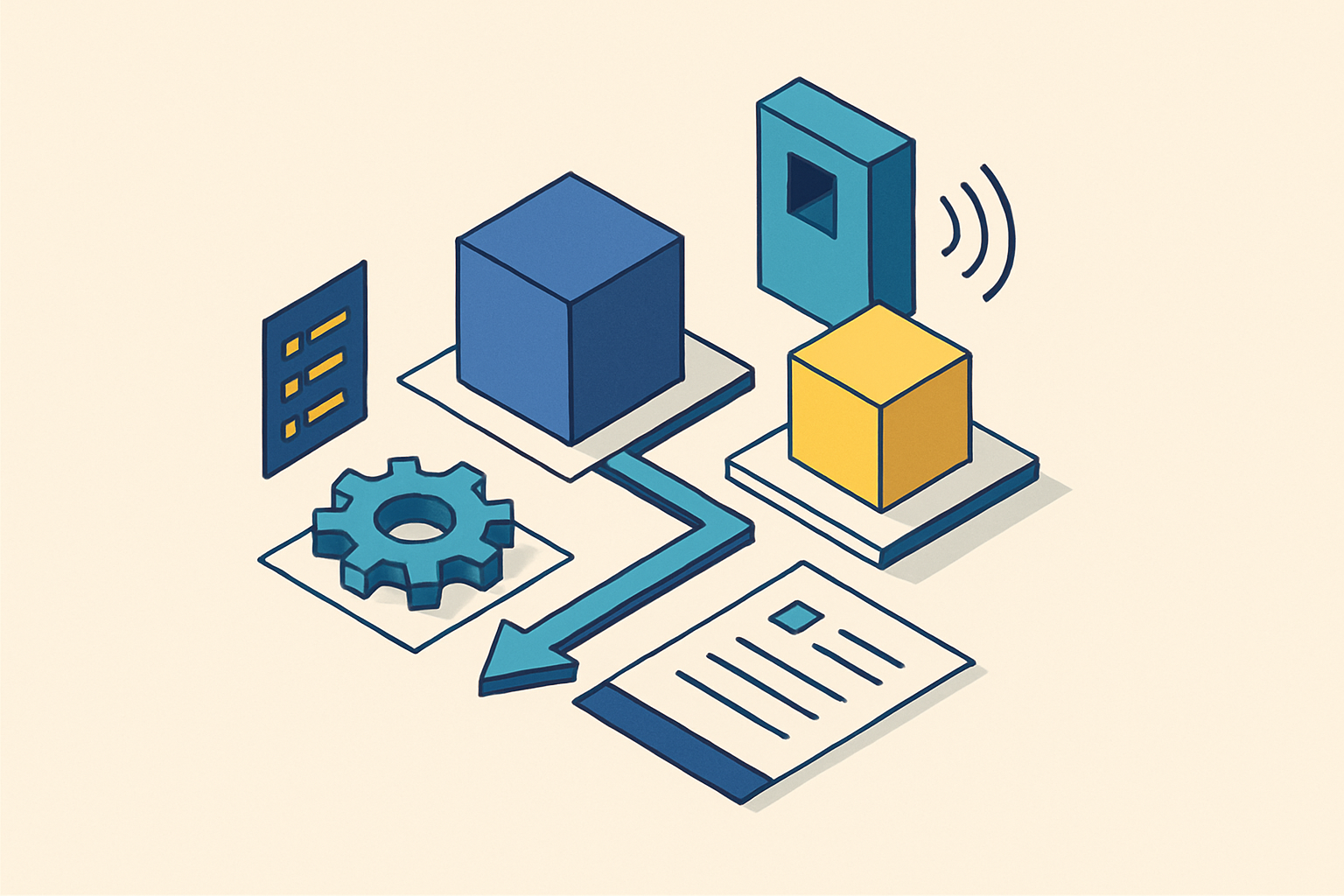
When mature organizations actually deploy agentic systems, as opposed to how vendors describe those deployments, a three-tier structure consistently emerges. Not a maturity ladder you climb sequentially. A concurrent architecture, where different components of the same deployed system operate at different tiers simultaneously.
The foundation tier establishes controlled intelligence: transparent reasoning, enforced data governance, strict operational gates. The workflow tier adds orchestration through the core compositional patterns, prompt chaining, routing, parallelization, each with defined inputs, outputs, and handoff points. The autonomous tier is where goal-directed adaptive agents operate, often in multi-agent collaboration, under human oversight and regulatory constraints.
What this framing forces is a question teams consistently dodge: which tier should this component actually operate in, and why? The temptation is to reach for the autonomous tier because the model technically can handle the task. Capability and reliability are different properties, and conflating them is where architectural debt quietly begins. You tend to make that mistake once.
Prompt chaining: building reliable multi-step reasoning from sequential outputs
The core mechanic of prompt chaining is simple enough to explain to a skeptical CFO: the output of one LLM call becomes the input to the next, forming a linear pipeline. But its value isn't simplicity. Its value is decomposition, specifically the kind that forces failures to surface between steps rather than being buried inside one large, opaque result.
A monolithic prompt attempting to do everything produces output where errors are nearly impossible to localize. Chaining converts that opacity into stages you can actually inspect. Research from 2024 and 2025 shows prompt chaining achieving meaningfully better accuracy than monolithic prompts on complex tasks. LangChain's telemetry data from 2024 tells a related story: average steps per trace across their user base roughly tripled over the year, with a substantial share of organizations migrating to advanced graph-based workflows. These architectures are not simplifying over time. They're getting more elaborate, and systems designed without that trajectory in mind tend to break at exactly the moments task complexity increases.
Prompt chaining suits tasks with clear sequential dependencies: document drafting pipelines, multi-stage data transformation, compliance review workflows. The limitation is equally clear. The pattern is strictly linear; it cannot branch on conditional logic or process independent subtasks simultaneously. That constraint is what motivates the next two patterns.
Routing: directing tasks to the right model or tool based on intent
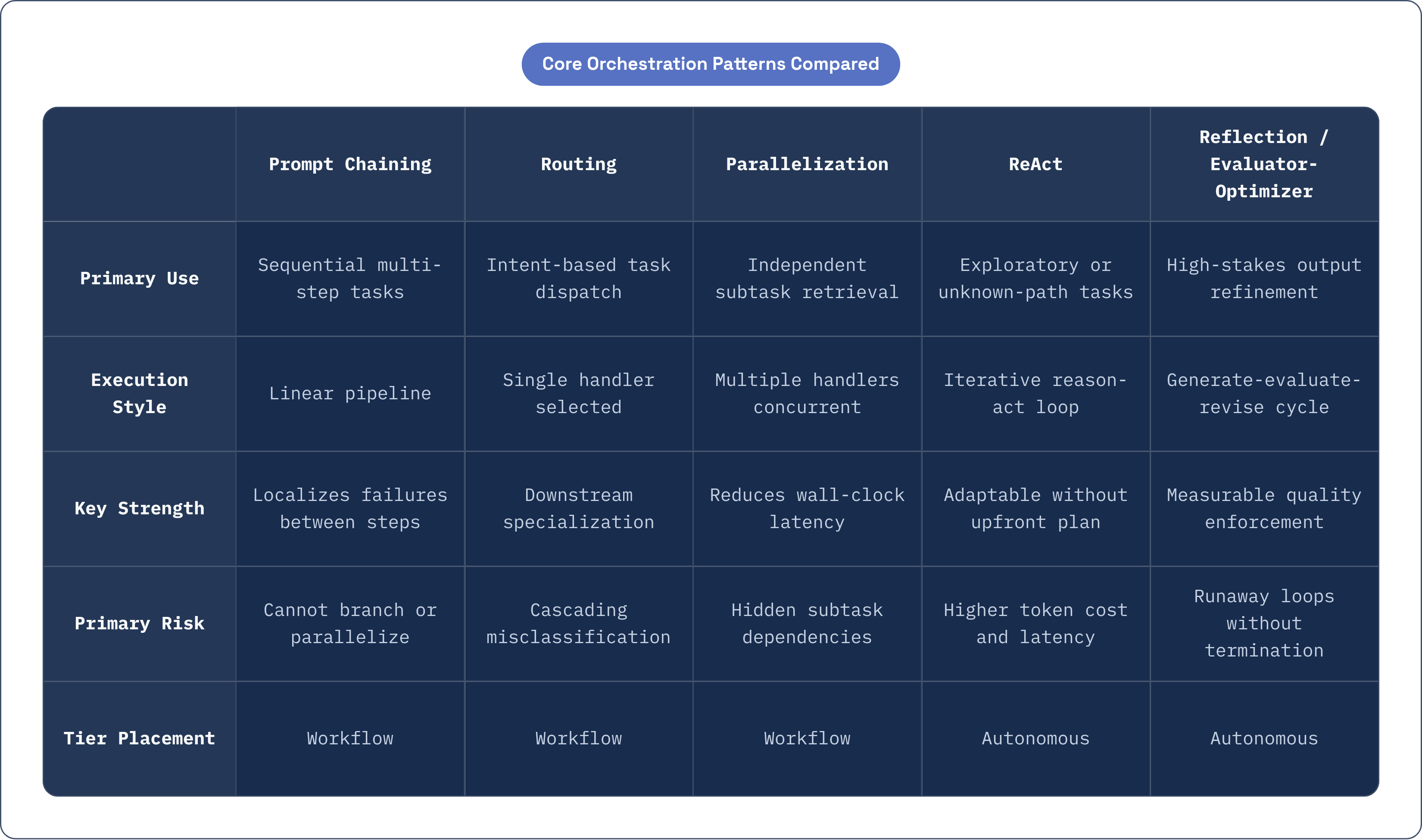
Think of a routing layer as a traffic manager that never gets tired and never improvises. A classifier, implemented either as an LLM call or as rule-based logic, inspects an incoming task and dispatches it to the most appropriate handler. The canonical production example: a service agent receives three request types. A calculation goes to a deterministic calculator tool. A policy question goes to a retrieval-augmented generation pipeline against internal documentation. A customer communication goes to a writing-optimized model. Three different handlers, one unified entry point, none of the seams visible to the caller.
What this achieves architecturally is a clean separation between deciding what to do and executing it. Each downstream handler can be specialized, independently optimized, and independently tested. A general-purpose handler forced to serve all request types performs adequately across all of them and excellently at none. That mediocrity tends to become visible only after deployment, which is a poor time to discover it.
The failure mode worth emphasizing: a miscalibrated router sends tasks to the wrong handler, and that error cascades through the entire downstream pipeline because every subsequent step assumes it is operating on an appropriately classified input. How much investment should go into router accuracy before the rest of the pipeline is built? More than teams typically budget. Much more. Router accuracy is a primary concern, not a secondary one; treating it otherwise is among the more predictable ways a well-designed system misbehaves in production. In the three-tier model, routing sits in the workflow tier, as the mechanism that makes downstream specialization possible without exposing that complexity to the caller.
Parallelization: running independent subtasks simultaneously and synthesizing the results
Where routing selects one handler from several, parallelization invokes multiple handlers simultaneously and synthesizes their outputs afterward. The mechanic requires a fork operator to split the task and a join operator to collect results before passing them to a synthesizer.
The primary production use case is agentic RAG. Rather than querying a single retrieval source sequentially, multiple retrieval agents run in parallel, each optimized for a specific data source: web search, internal document stores, structured databases. A central LLM synthesizes the retrieved results into a coherent output. A related robustness pattern sends the same query to multiple models in parallel and compares their answers before returning a final response, surfacing disagreement before output rather than after. In high-stakes domains, that overhead is usually justified.
What makes or breaks this pattern in practice is whether the parallel branches are genuinely independent. Any hidden dependency between subtasks produces race conditions or incoherent synthesis. Teams consistently underestimate how often subtasks that appear independent are actually coupled through shared state or overlapping retrieval domains. That assumption of independence deserves verification before deployment. Parallelization reduces wall-clock latency for complex retrieval tasks but increases concurrent token usage and infrastructure cost, and that resource cost needs to be planned for explicitly, not discovered at the first billing cycle.
Orchestrator–worker: coordinating specialized agents through a directing layer
The orchestrator-worker pattern extends the logic of specialization further. A coordinator agent receives a high-level goal, decomposes it into subtasks, dispatches each to a specialized worker agent with its own tools and domain expertise, and aggregates the results. The workers are general-purpose in name only; one handles code execution, another handles retrieval, another handles external API calls.
The reasoning behind this design is concrete: a general-purpose agent forced to do everything accumulates context that dilutes performance. An agent simultaneously reasoning about code execution, document retrieval, and API authentication does each of them worse. Specialized workers maintain focused execution because their context is constrained.
The design question that most determines how this pattern performs is how much the orchestrator should reason dynamically versus how much it should follow explicit routing rules. An orchestrator that reasons about task decomposition on the fly is more flexible, better able to handle novel goals it was not explicitly designed for, and considerably harder to debug, audit, and predict. An orchestrator following explicit routing rules is less flexible and far more transparent. There is no universally correct answer, only the answer appropriate to a given domain's risk tolerance. Getting that calibration wrong in either direction tends to be expensive in ways that compound.
ReAct: interleaving reasoning and action in a continuous loop without upfront planning
ReAct, which stands for Reason, Act, Observe, and then repeats, is the pattern that most closely matches how LLMs naturally operate. The agent produces reasoning text, calls a tool, incorporates the tool's output into its next reasoning step, calls another tool if needed, and continues until the task resolves. No plan is fixed upfront; the agent discovers the correct sequence of actions as it goes.
This is the default orchestration architecture for LLM-based agents for a practical reason: it does not require the problem to be fully specified before execution begins. Research tasks, debugging sessions, exploratory data analysis, these are tasks where the correct sequence of steps cannot be known in advance. They are precisely where ReAct outperforms patterns that require upfront planning. The structure is particularly useful when retrieval context changes the nature of the next required action, which is most of the time in non-trivial domains.
The cost is explicit and deliberate. Every reasoning step consumes visible tokens; ReAct increases token usage and latency compared to direct action patterns. That is not a defect. It is the mechanism by which the pattern achieves interpretability and adaptability. The same visibility that increases cost makes failures traceable: you can read the agent's reasoning, step by step, and see exactly where the logic broke down. For teams operating in regulated environments or complex domains, that auditability is frequently worth the overhead. Resisting ReAct on cost grounds alone often means paying more later to debug the opaque alternative.
Reflection and self-critique: agents that evaluate and revise their own outputs
Reflection introduces a feedback loop after initial generation. An actor generates the initial output; an evaluator assesses it against defined criteria; a self-reflection module produces specific, actionable improvement feedback for the actor to use in revision. The actor and the evaluator can be the same model or separate models. Using the same model for both reduces cost and raises the risk of the evaluator endorsing the actor's errors. That tradeoff is real, and the default configuration is not obviously correct.
The performance data is compelling on its face. Research cited by Redis.io in 2025 attributes accuracy gains on the HumanEval coding benchmark of roughly eleven percentage points to self-reflection alone, with substantially larger gains when combined with external verification tools. Those numbers deserve scrutiny. Coding benchmarks have unambiguous correctness criteria: a solution either passes the tests or it does not. In domains where "correct" is contested, strategy, creative work, nuanced policy analysis, gains from self-reflection will be smaller and harder to measure. The benchmark data almost certainly flatters this pattern relative to what most production environments will actually experience.
Where reflection loops are applied in a pipeline also matters practically. They add latency and token cost at every application; deploying them uniformly across all agent steps is indefensible in most systems. They are most cost-effective on high-stakes outputs: a contract clause, a clinical recommendation, a financial analysis. Applying them to every intermediate step requires explicit justification, not an implicit assumption that more review is always better.
Evaluator–optimizer: iterative refinement loops for precision in dynamic environments
The evaluator-optimizer pattern generalizes the feedback loop further. An evaluator scores the agent's output against a defined metric, whether accuracy, format compliance, factual grounding, or domain-specific criteria. If the score falls below a threshold, an optimizer revises the output and the cycle repeats. The key difference from self-reflection is that the evaluator can be entirely external: a separate model, a rule-based system, a human reviewer, or some combination.
This matters most in regulated domains. Healthcare applications requiring clinical accuracy, financial applications requiring regulatory compliance, customer service systems measured by resolution rate: these are environments where "good enough" is defined by a measurable standard, not by general quality. The evaluator-optimizer loop operationalizes that standard directly into the architecture.
The risk that must be explicitly designed against is divergence without termination. A loop that cannot meet its threshold will cycle indefinitely without a convergence condition, consuming tokens and time without producing output. Well-designed implementations set a maximum iteration count and route to human review when the threshold is not met within that count. This pattern belongs in the autonomous tier precisely because it requires the system to make repeated autonomous judgments about whether its own output is adequate. That autonomy requires corresponding containment designed in from the start, not retrofitted after the first runaway loop.
Planning with Tree of Thought and Graph of Thought: structured exploration of multiple reasoning paths
ReAct navigates forward through a task without a fixed plan. Tree of Thought and Graph of Thought take the opposite approach, maintaining an explicit structure of partial solutions and exploring multiple paths simultaneously.
In Tree of Thought, that structure is a search tree. Each node is a partial solution, and the agent can backtrack explicitly when a branch fails, abandoning a dead end and exploring an alternative. This is qualitatively different from ReAct's linear adaptation because backtracking is a first-class operation, not an improvised response to failure. Graph of Thought generalizes further, allowing intermediate thoughts to be merged, refined, split, or reused across branches. The structure is more expressive and correspondingly harder to implement correctly; that implementation complexity is unevenly distributed across teams, and worth being honest about before committing to it.
These patterns belong to tasks where the solution space is large, poorly defined, and where multiple hypotheses must be explored before committing. Complex scientific reasoning and multi-constraint planning are the canonical examples. The cost is proportional to the branching factor; both patterns multiply token usage significantly, and neither is practical for latency-sensitive or high-volume applications.
Pure Tree of Thought or Graph of Thought implementations remain relatively rare in production. What appears more often is a hybrid: an orchestrator uses structured planning for top-level task decomposition, while individual workers use ReAct for their specific steps. This preserves exploratory reasoning where it adds value without applying the full overhead of structured search to every operation. It is a practical compromise that reflects where structured planning actually earns its cost.
Human-in-the-loop: where deliberate checkpoints sit in an otherwise autonomous pipeline
Human-in-the-loop is sometimes framed as a concession to systems that are not yet good enough to run autonomously. That framing leads directly to poor architecture. Human-in-the-loop is a deliberate design choice about where a particular workflow should sit on the autonomy spectrum, independent of what the model is technically capable of doing on its own.
The mechanic is straightforward: the system pauses at defined checkpoints and routes specific decisions to a human reviewer before continuing. The critical architectural decision is where those checkpoints sit. Too many and the efficiency gains of agentic automation are negated; the pipeline is no faster than a manual process. Too few in a high-stakes domain and the system creates risk that is difficult to contain after the fact. Triggers for human review should be specified in advance: output confidence below a defined threshold, actions with irreversible consequences such as financial transactions or data deletion, regulatory requirements for human sign-off.
Gartner's 2026 CIO survey data is instructive here. Only 17% of organizations had deployed AI agents at the time of the survey, and over 40% of agentic AI projects are projected to be abandoned by the end of 2027 due to escalating costs and inadequate risk controls. Human-in-the-loop design is one of the risk controls that separates projects reaching production from those that stall in late-stage pilots. The failure mode is not excessive autonomy in isolation; it is excessive autonomy without the architecture to contain what it produces.
Memory architecture: the infrastructure layer that makes patterns stateful
Every pattern discussed above assumes the agent has access to relevant context. Memory architecture is what makes that assumption true rather than aspirational.
The CoALA framework, developed at Princeton, provides the most useful taxonomy for thinking about this. It distinguishes four memory types: in-context or working memory, which holds current task state; episodic memory, which stores past interactions; semantic memory, which holds factual knowledge; and procedural memory, which encodes rules and skills. IBM, MongoDB, and LangChain have all adopted this taxonomy in their own documentation, which is a reasonable indicator of practical utility beyond academic origin.
Storage implementations differ by layer for good reasons. Working memory lives in ephemeral in-memory stores because it needs to be fast and does not need to persist. Semantic knowledge lives in vector databases because retrieval by relevance is what that layer requires. Decision traces and episodic memory live in structured logs of prompts, responses, and decisions. Weaviate's 2025 context engineering framework makes an important refinement: the retrieval strategy should match the memory type. Temporal proximity matters for episodic retrieval; semantic relevance matters for knowledge retrieval; freshness matters for working memory.
Using the same retrieval strategy across all three types is a recurring architectural mistake, and one whose consequences are slow to surface. The wrong output arrives not with an obvious error but with a subtle plausibility that passes review until someone traces the retrieval logs back to the source. That diagnostic path takes longer than it should, and it usually reveals a mismatch that was present from the first deployment.
The dependency on memory is concrete in each pattern. An evaluator-optimizer loop needs episodic memory to avoid repeating failed strategies. A routing pattern needs semantic memory to classify intent accurately. A ReAct loop needs working memory to track tool call state within a session. A stateless LLM, regardless of its capability, cannot build relationships, learn from past errors, or carry expertise across sessions without an explicit memory layer designed to match retrieval semantics to memory type. Without it, the patterns described throughout this piece remain theoretical.
MCP and A2A: the interoperability protocols that let patterns connect across systems and vendors
Well-architected patterns are bounded by the scope of a single system. When agentic components need to communicate across vendor boundaries, interoperability protocol becomes a structural question, not a preference.
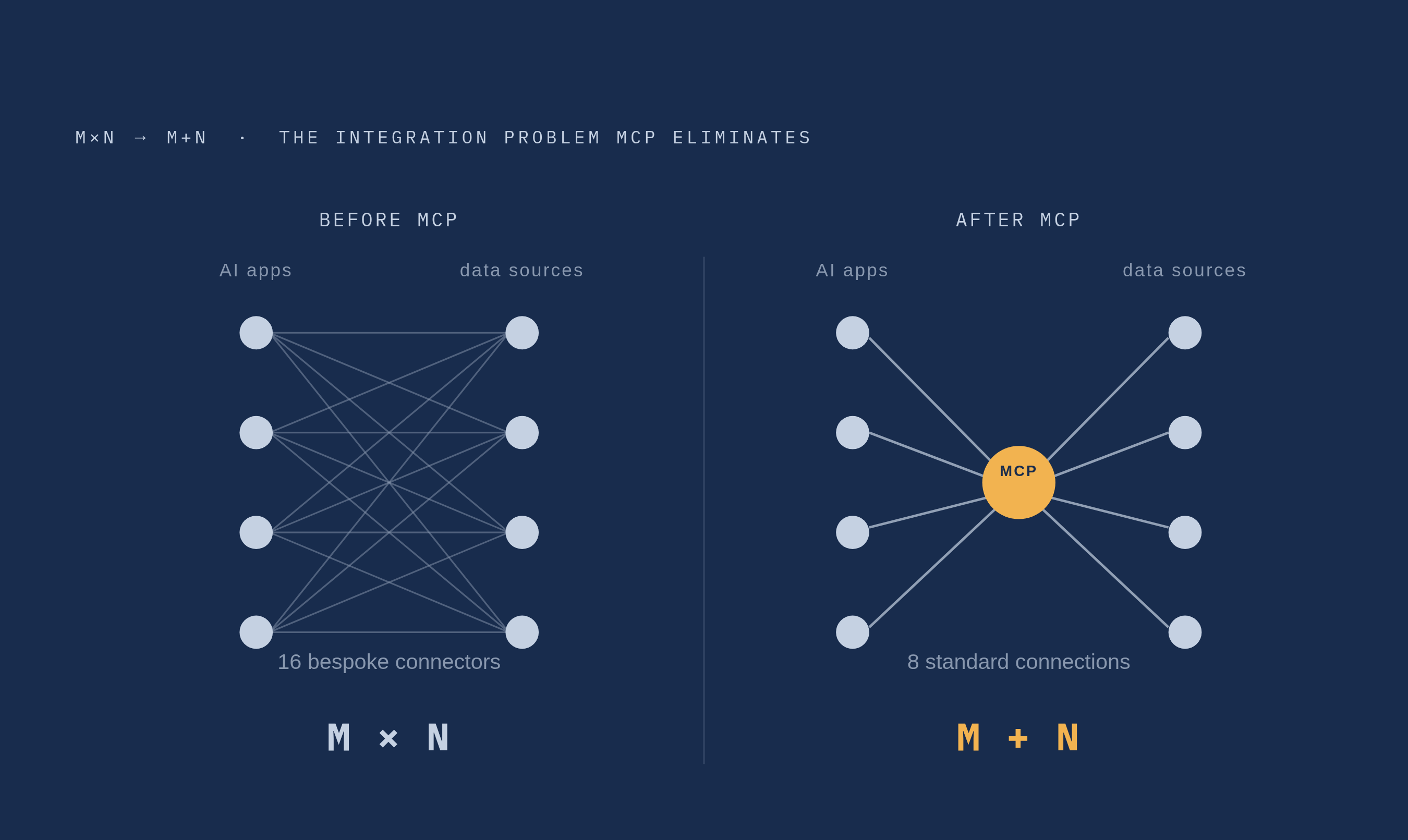
Model Context Protocol, introduced by Anthropic in November 2024, addresses the M×N integration problem directly. Before MCP, connecting M AI applications to N data sources required M×N bespoke connectors. MCP defines one protocol on each side, reducing the problem to M plus N. The adoption velocity is notable: within one year, MCP reached over 97 million monthly SDK downloads, more than 10,000 active servers, and first-class client support across ChatGPT, Claude, Cursor, Gemini, Microsoft Copilot, and Visual Studio Code, according to the MCP blog in December 2025. In December 2025, Anthropic donated MCP to the Agentic AI Foundation under the Linux Foundation, with co-founding participation from Block and OpenAI and support from Google, Microsoft, AWS, and Bloomberg. That level of industry convergence suggests MCP is becoming infrastructure, not a differentiator any single vendor can hold.
The security implications deserve direct attention. As of April 2025, security researchers had identified prompt injection and poisoned tool vulnerabilities in MCP that allow data exfiltration through connected tools. These are live risks in any multi-tool architecture, not theoretical edge cases, and they require explicit mitigation rather than deferred concern.
Agent2Agent Protocol, announced by Google in April 2025 and donated to the Linux Foundation in June 2025, addresses a different problem: agent-to-agent coordination across vendors. Where MCP handles how an agent connects to tools and data sources, A2A handles how agents discover and communicate with each other, using HTTP, Server-Sent Events, JSON-RPC 2.0, and Agent Cards for capability advertisement. The two protocols are complementary, not competing.
For pattern composition at scale, this distinction matters concretely. An orchestrator-worker architecture spanning multiple vendor environments requires A2A for agent coordination and MCP for tool integration. Without these standards, every cross-vendor integration is a custom engineering problem, and the architecture cannot scale without accumulating integration debt that eventually dominates the engineering budget. The patterns described throughout this piece are, in that sense, only as composable as the protocols beneath them allow.