Agentic Workflow Real World Examples
Agents enrich leads, score fit, and personalize outreach without human intervention.
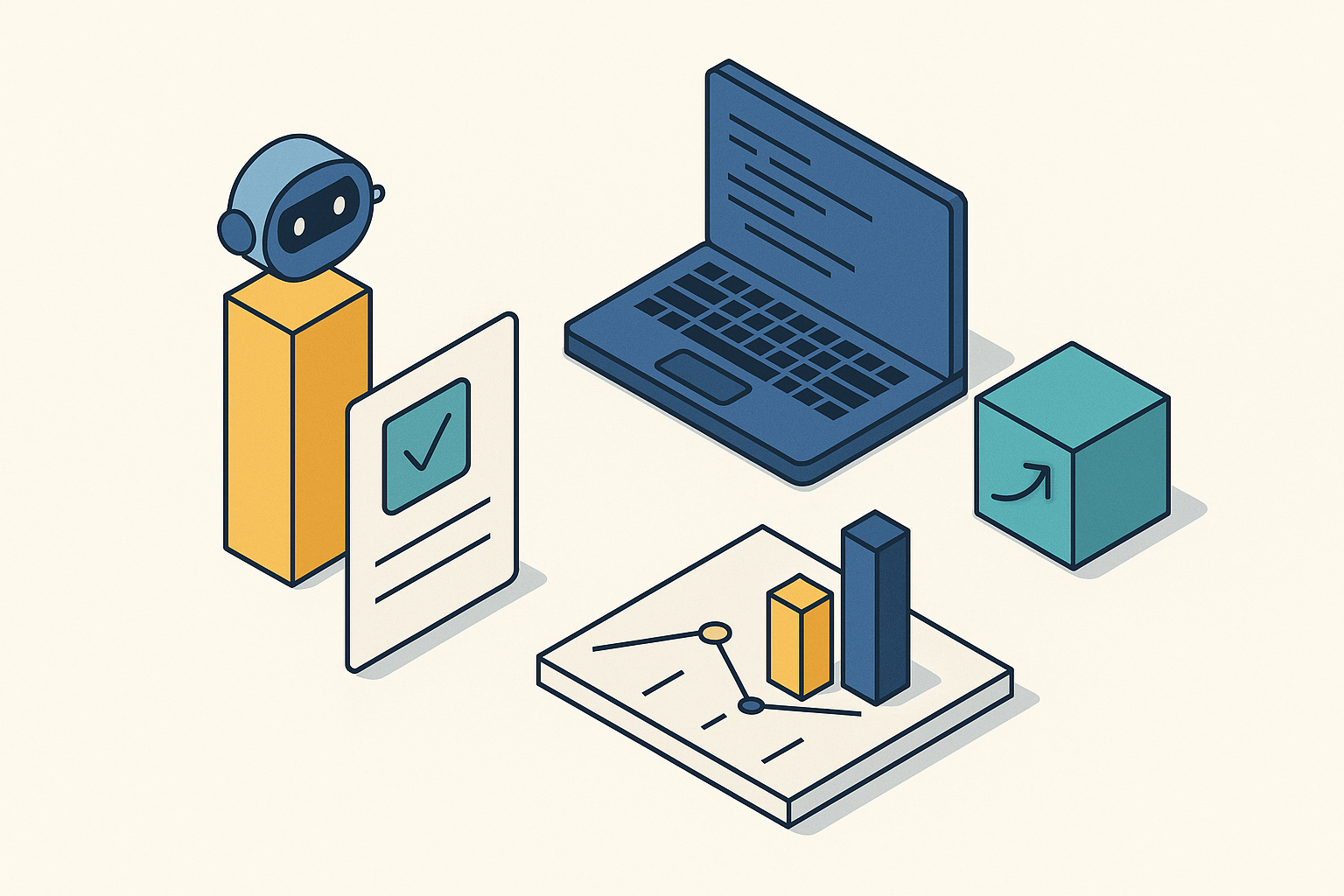
Walk through the sequence concretely. A contact form is submitted. Rather than routing the name and email to a rep's inbox and waiting, an agent begins enriching the record immediately: company size, technology stack, recent news, industry vertical, all pulled from external enrichment sources via API. That enriched profile is scored against the ideal customer profile the agent holds in memory. Based on the score, the agent drafts a personalized outreach email, not a template with a first-name merge field, but a message that references the specific context the enrichment step surfaced. The enriched contact is logged to the CRM, a follow-up task is scheduled for the rep with appropriate priority, and the email goes out at a send time the agent selected based on engagement patterns.
When a contact form is submitted, the agent begins enriching the record immediately: company size, technology stack, recent news, and industry vertical are all pulled from external enrichment sources via API. That enriched profile is scored against the ideal customer profile the agent holds in memory, and based on that score, the agent drafts a personalized outreach email that references the specific context the enrichment step surfaced. The enriched contact is logged to the CRM, a follow-up task is scheduled for the rep with appropriate priority, and the email goes out at a send time the agent selected based on engagement patterns. Memory holds the ICP criteria and scoring logic across all steps, tool use pulls from enrichment APIs and writes to the CRM, planning sequences enrichment before scoring before drafting, and action sends the email and creates the calendar task.
Where each capability fires matters. Memory holds the ICP criteria and scoring logic across all steps; without it, each step is disconnected from the last. Tool use pulls from enrichment APIs and writes to the CRM; without it, the agent has no real-world reach. Planning sequences enrichment before scoring before drafting. Reverse that order and you have an email written before there was anything worth putting in it. Action sends the email and creates the calendar task; without it, the workflow produces a recommendation that still requires a human to execute.
A human doing this manually would spend somewhere between twenty and forty minutes per lead, and under volume pressure, most of the enrichment steps get skipped. The lead gets a generic email, or nothing. What separates this from a drip sequence is precisely that the output of the enrichment step shapes the draft. The agent is making the email a function of what it found rather than following a script. This use case is, as of 2026, among the most commercially mature agentic deployments in live production, which makes it a reasonable baseline against which messier cases can be measured.
How Did 260 Sample Sale Reach Fewer Customers and Convert More of Them?
The Bloomreach Loomi Marketing Agent analyzes customer behavior, identifies highest-intent segments, builds personalized campaigns, and selects timing and channels autonomously. 260 Sample Sale used it and achieved a 2.4x higher conversion rate while targeting 82% fewer customers than their previous broad-send approach.
That outcome is striking, but it warrants scrutiny before being treated as a clean win. The obvious inference is that precision outperforms reach, at least in contexts where relevance drives purchase intent more than sheer exposure does. But the reported result may conflate two separate contributions: audience selection and message personalization. These are distinguishable mechanisms with meaningfully different implications for a marketer deciding where to invest. The data, as published, does not cleanly separate them, and that ambiguity matters if you're trying to replicate the result rather than just cite it.
Memory of past purchase and browse behavior provides the behavioral substrate the agent reasons against. Tool use against the customer database and campaign platform is what allows the agent to actually execute. Planning determines optimal send time and channel per recipient, work a marketer would have done manually with segment filters, usually at population rather than individual level, and usually crudely. Action executes the campaign and then adjusts based on early engagement signals mid-send.
The targeting decision is doing the substantive analytical work. More than execution speed or message polish, the agent is making the call a human would have made with far less processed data and far more elapsed time. Whether that call is replicable at other retailers, with different catalog structures and different behavioral data densities, is a question the case study does not answer.
What Ramp's Finance Agent Actually Does When It Audits an Expense Report
Ramp launched its AI finance agent in July 2025 within their spend management platform. "AI audits expenses" is vague enough to be nearly meaningless, so the mechanics are worth specifying. The agent reads company policy documents, audits submitted expenses against those policies, flags violations without requiring a human to review each line item, generates reimbursement approvals, sends notifications, and cross-checks vendor compliance with procurement systems. Over time, it updates its working model of what constitutes a violation in this company's context, which reduces false positives rather than locking in a static false positive rate indefinitely.
Planning is doing the central work. The agent must parse a policy document, typically written in natural language and riddled with conditional logic, map individual expense line items to the applicable rules, and decide whether to approve, flag, or escalate. That is a three-branch decision tree executed without a human in the loop, across thousands of expenses and thousands of businesses. Finance teams reported meaningful reductions in manual audit hours following launch.
The memory dynamic here is subtler than it first appears. The agent is not re-reading the policy from scratch with each expense report. It maintains a working model of what the policy implies in practice, refined by each prior decision. This is closer to institutional knowledge accumulation than to the within-session context retention a chatbot manages, and that distinction has real implications for how you evaluate the system over time.
One thing the architecture gets right: finance teams still own the rules the agent is applying. The agent operationalizes policy; it cannot set it. In a domain where policy errors carry financial and legal consequences, that boundary is correct design. Treating it as an apologetic concession to organizational caution misreads what's actually at stake.
Why Insurance Claims Processing Is One of the Clearest End-to-End Agentic Cases
Claims processing has structural properties that make agentic workflows legible and measurable in a way many other domains don't. A claim arrives, documents are ingested and validated, the claim is triaged, a routing decision is made, and either a payout is triggered or the claim is escalated for human review. No hand-off occurs unless an exception condition fires. That conditional branching across multiple systems is precisely what planning looks like when it reaches production.
BCG's 2025 analysis found claim handling time reduced by up to 40% in early deployments, with net promoter scores rising by 15 points. The NPS figure is more interesting than the efficiency figure, and not for an obvious reason. Speed gains have a clear mechanism: automated processing is faster than manual processing. The NPS gain is less obvious. When rules are applied consistently by an agent rather than variably by whichever adjuster picks up the file, disputed decisions decline. That is a quality argument, not a speed argument, and it should interest any organization where outcome variance is itself a liability.
Edge cases, contested claims, and situations where the policy language is genuinely ambiguous all route to human review. Where to draw that line is an architectural choice, not a technological limitation. The agent handles volume. Humans handle ambiguity. Getting that boundary wrong in either direction is where deployments tend to accumulate quiet costs, and in insurance, quiet costs have a way of becoming loud ones at renewal time.
How Twitch Cut a 7-Day Sales Cycle and a 2-Hour Response Lag with a Single Agentic Deployment
The specifics make this case more useful than the headline outcome. Twitch's ads sales team had more than 30 sellers per specialist. Questions posed in Slack averaged a two-hour initial reply time. Twenty percent of questions went unanswered entirely. Full campaign launch cycles stretched to seven days.
The solution was a RAG pipeline embedded in a Slack-based assistant, built on Amazon Bedrock, with a multimodal knowledge base and an agentic workflow layer to handle follow-up actions and reduce hallucinations. Tool use is what separates this from a sophisticated FAQ bot. The agent retrieves from a structured knowledge base, interprets the context of the question, and can trigger downstream workflow steps rather than returning a document link and waiting.
The 20% unanswered rate is the figure that should hold attention. Those questions didn't disappear; they stalled deals. An agent that answers at 11 pm on a weekend removes a structural lag that no human rota could close cost-effectively. The economics of coverage shift when the marginal cost of an additional answer approaches zero, and that shift is permanent, not contingent on hiring conditions or time zones.
Memory operates within conversation threads, so a seller can ask a follow-up without re-explaining the advertiser's campaign situation. In isolation that sounds like a minor convenience. In practice it changes how sellers engage with the tool entirely, because it behaves more like an informed colleague than a search interface. That distinction affects adoption rates in ways that don't show up in accuracy benchmarks.
What Vxceed's Multi-Agent Supply Chain Platform Does That a Single Agent Cannot
Vxceed's platform, built on AWS, processes $250 million in daily transactions and delivers measurable sales uplift for consumer goods brands. The architecture divides labor among specialized agents: one interprets field signals from stores, another summarizes patterns across those signals, a third generates narrative explanations, and a fourth recommends next steps based on near-real-time store conditions.
The platform also produces AI-generated news bulletins through a similar coordination model, with agents handling script drafting, audio production, and visual generation before the system assembles the output. That secondary example is instructive because it illustrates compound outputs, things no single agent could produce alone, emerging from coordinated specialization rather than from a single increasingly capable model.
One might argue that a sufficiently capable general-purpose agent could handle all of this. In practice, such a system would be slower, less accurate in each domain, and considerably harder to debug when something goes wrong. Specialized agents can be improved or replaced independently. When the field signal interpretation agent underperforms, you don't have to rebuild the recommendation engine to fix it. That modularity is a maintenance argument as much as a performance argument, and over a multi-year deployment horizon, maintenance arguments tend to outweigh launch-day performance ones.
BCG's 2025 analysis characterizes multi-agent coordination of this kind as workflow orchestration, and integrations with ERP and CRM systems in this model see cycle time reductions of 20 to 30%. The deployment implication is direct: multi-agent systems require a governance layer. When agents produce conflicting outputs, and eventually they will, the system needs a defined resolution path that doesn't require a human to adjudicate every disagreement.
How Healthcare Researchers Found That 80% of Agentic AI Work Happens Before the Agent Runs
MIT Sloan and Kellogg researchers documented in 2025 an AI agent deployed to detect adverse events among cancer patients from clinical notes. The agent's detection performance was substantive. The more transferable finding, the one that should give any enterprise AI team pause, was this: 80% of the project's total effort went to data engineering, stakeholder alignment, governance, and workflow integration. Not to model tuning, not to prompt design.
The structural explanation is not complicated, but it is stubborn. Clinical notes lived across multiple EHR systems with inconsistent formatting. Access permissions required negotiation across departments and legal teams. The agent couldn't act until the data plumbing existed to feed it. An agent that can in principle query any system can in practice only query the systems someone has already cleaned, permissioned, and connected. That gap between principle and practice is where most enterprise deployments quietly stall, and it tends to widen as organizational complexity increases.
IBM drew a parallel observation from more than 200 agentic engagements in 2025: organizations that struggle tend to deploy agents into existing workflows without questioning whether those workflows make sense in an agentic world. The pre-agent work the researchers quantified is not exceptional overhead. It is what enterprise data environments actually look like when someone tries to connect an agent to them, which is an uncomfortable fact for vendors selling deployment speed as a differentiator.
In clinical settings, agents operate with human sign-off requirements at decision points that affect patient care. That is correct design. The architecture should reflect the consequences of error, and in healthcare, those consequences are not abstract.
What the Gap Between Interest and Production Deployment Reveals About Where Agentic Adoption Actually Stands
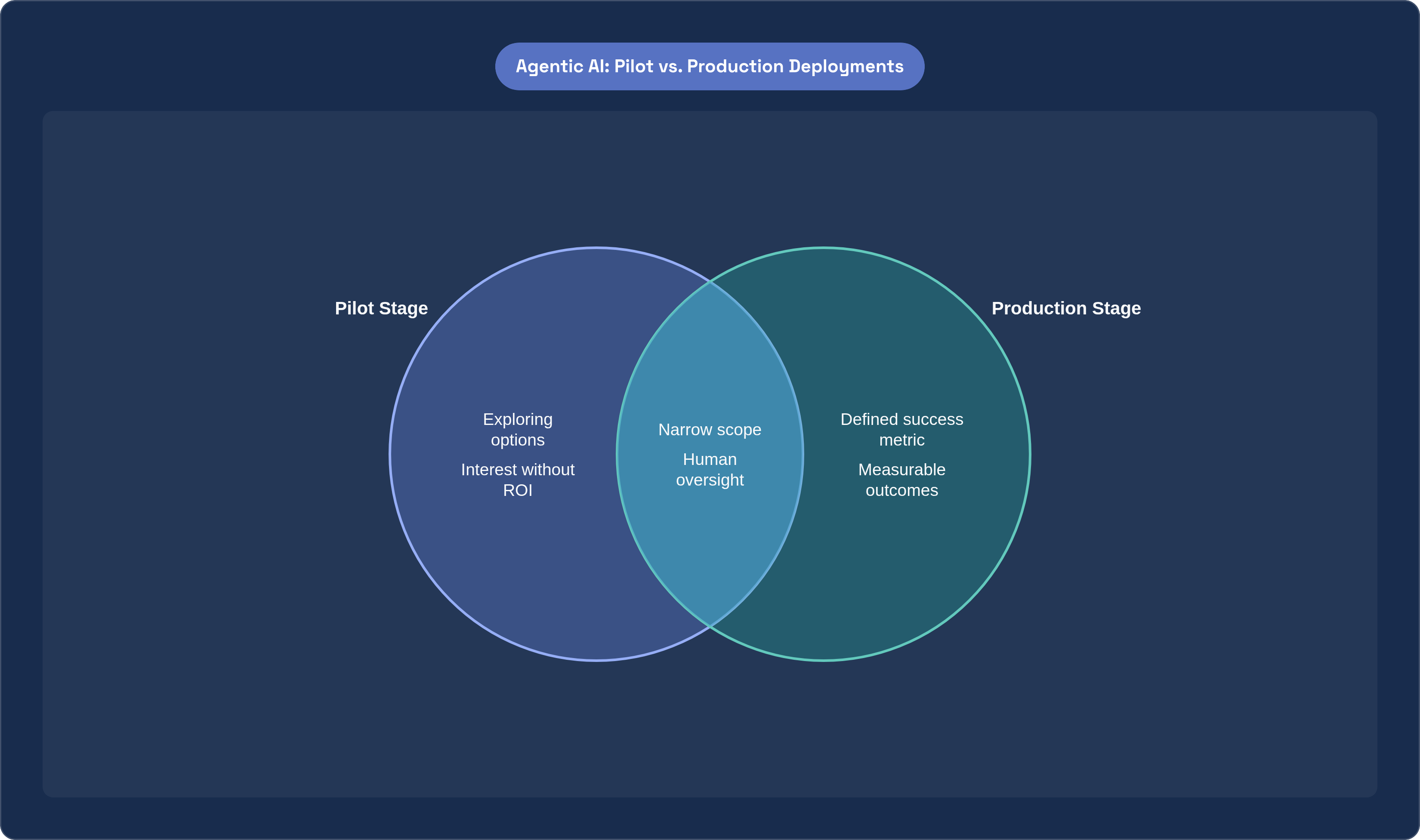
Deloitte's 2025 survey found 30% of organizations exploring agentic options and 38% piloting, but only 11% actively using these systems in production. UiPath's 2025 report, drawing on 250-plus US companies with revenues exceeding $1 billion, found 93% of IT executives describing themselves as extremely interested, with just over 37% already using agentic AI workflow solutions. Gartner projects that fewer than 5% of enterprise applications are currently integrated with task-specific AI agents, with that figure expected to reach 40% by 2026.
Those numbers describe a wide funnel with a very narrow exit into production. Every deployment examined here that produced measurable outcomes, Ramp, 260 Sample Sale, Vxceed, Twitch, started with one defined process and one clear success metric. None began with platform-wide transformation as the stated objective. That pattern is not coincidental.
The healthcare case reframes the adoption gap rather than simply illustrating it. The distance between pilot and production is not primarily a technology readiness problem. It is a data infrastructure and governance problem that the agent itself cannot solve. The 35% of organizations Deloitte found with no formal agentic strategy are not necessarily behind. Some of them may have done the researchers' math and concluded, reasonably, that the pre-agent infrastructure work isn't yet worth the investment at their current data maturity. That is a defensible position, even if it rarely gets framed as one.
The Design Choices That Separate Agentic Systems Worth Building from Those That Stall
Narrow scope with a defined outcome outperforms broad ambition. Every case here that produced ROI had a specific process and a specific metric before the agent was designed. The scope constraint is not organizational timidity; it is what makes the system debuggable and the outcome attributable. Without it, you can't tell whether the agent is working or whether conditions just happened to improve.
The more useful diagnostic is not "does this system have AI?" but "does it adapt its next step based on what the previous step returned?" A system with memory and action but no planning is a faster version of what existed before. The adaptation is the capability.
Human oversight is an architectural decision calibrated to consequences, not a failure mode to be engineered around. Healthcare agents route for sign-off at clinical decision points. Ramp agents escalate edge cases. Where to draw that line depends on what goes wrong when the agent is mistaken, not on some general principle about AI reliability that applies uniformly across domains.
Multi-agent architectures unlock outputs no single agent can produce, but they introduce orchestration risk in direct proportion to how loosely the handoffs between agents are defined. Vxceed functions because each agent's domain is clearly bounded. Unclear handoffs are where errors compound and where debugging becomes genuinely expensive, often in ways that don't surface until the system is under production load.
Data readiness determines deployment readiness. The 80% pre-agent effort in the Kellogg study is not an outlier; it is representative of what enterprise data environments look like when an agent actually tries to connect to them.
IBM's observation across more than 200 engagements is the one that stays with me: genuine ROI follows from rethinking the process, not from placing an agent inside an existing workflow and measuring whether it runs faster. An agent that automates a broken process automates the breakage. Every case here that produced something worth measuring reflects someone asking, before deploying anything, whether the process itself still made sense now that a system could adapt between steps. That question is harder than picking a vendor. It is also, consistently, the one that separates the 11% from everyone still in the funnel above them.