Agentic Workflow vs Agentic AI Distinctions
Bounded agents differ from multi-agent systems by design and capability.
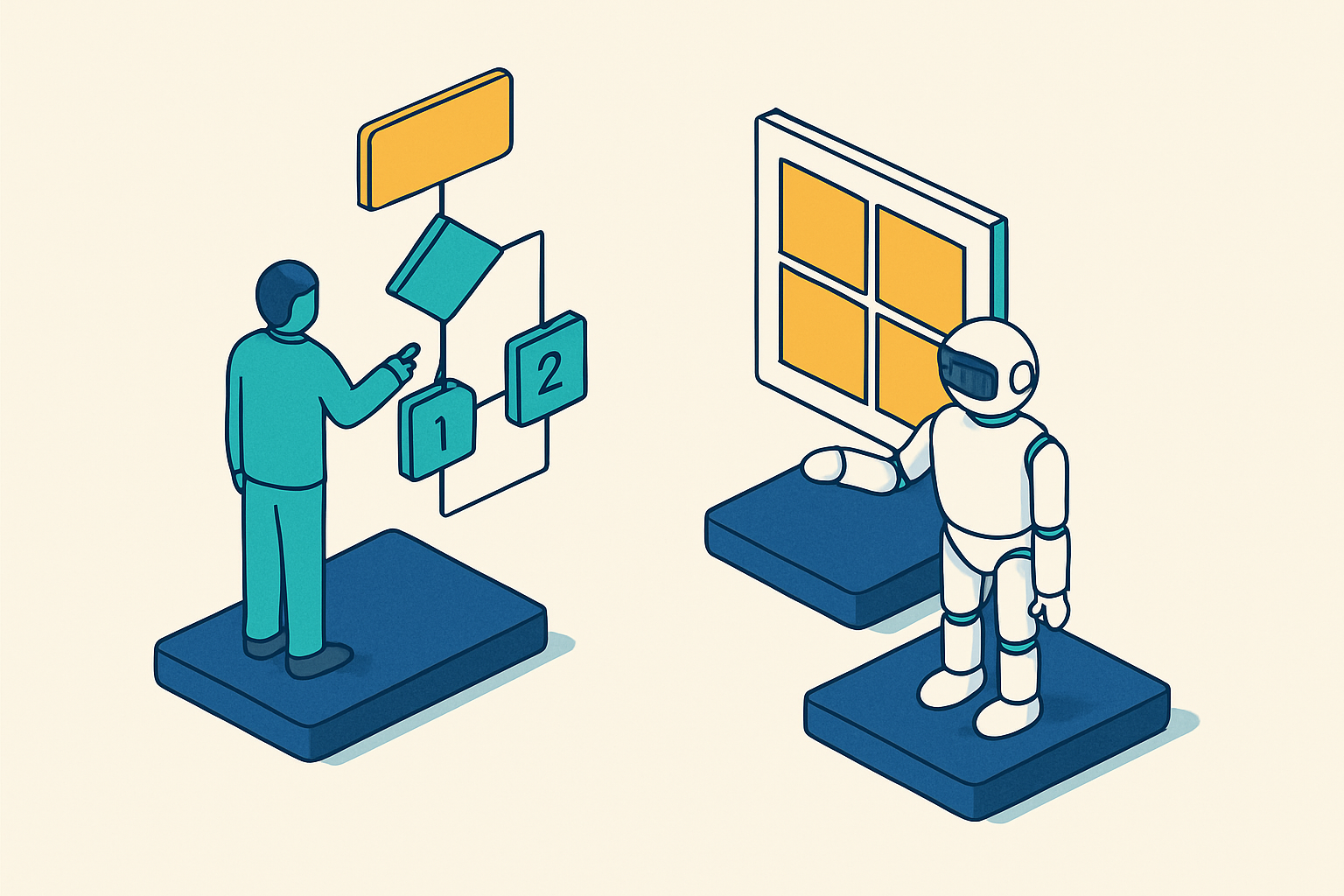
An AI agent, in the most defensible use of the term, is a single-entity system that uses tool calls, sequential reasoning, and real-time retrieval to complete a well-defined, bounded task. MIT Sloan's framing is useful here: autonomous software that perceives, reasons, and acts in digital environments to achieve goals on behalf of human principals, with capabilities for tool use, economic transactions, and strategic interaction. Note what that definition excludes: nothing about coordinating with other agents, nothing about goals that persist across sessions, nothing about decomposing novel objectives on the fly.
That boundary is the whole point. An AI agent's autonomy is scoped. Its goal exists for one workflow, one session; when the session closes, so does the goal. The canonical use cases Sapkota et al. (2025), writing in Information Fusion, associate with this architecture confirm the pattern: customer support automation, internal enterprise search, email filtering, personalized content recommendation. Bounded inputs, bounded outputs, bounded context. There is nothing dismissive about that description. Bounded, done well, solves real problems.
Brittleness and hallucination are the characteristic failure modes at this level, and they deserve treatment as architectural realities rather than implementation bugs. An agent operating on structured data in a familiar context performs reliably. Introduce ambiguity, shift the domain, or ask it to hand off state to another agent, and performance degrades in ways that resist prediction until you are already in production. I have been in that room, watching a stakeholder demo turn into a triage session because no one thought to test what happened when the agent hit an unfamiliar input format two steps into the workflow. The engineers knew what had gone wrong within minutes; explaining why it hadn't been caught earlier took considerably longer. Those failure modes are the architectural pressure that motivates everything that follows.
How Agentic AI Differs from an AI Agent
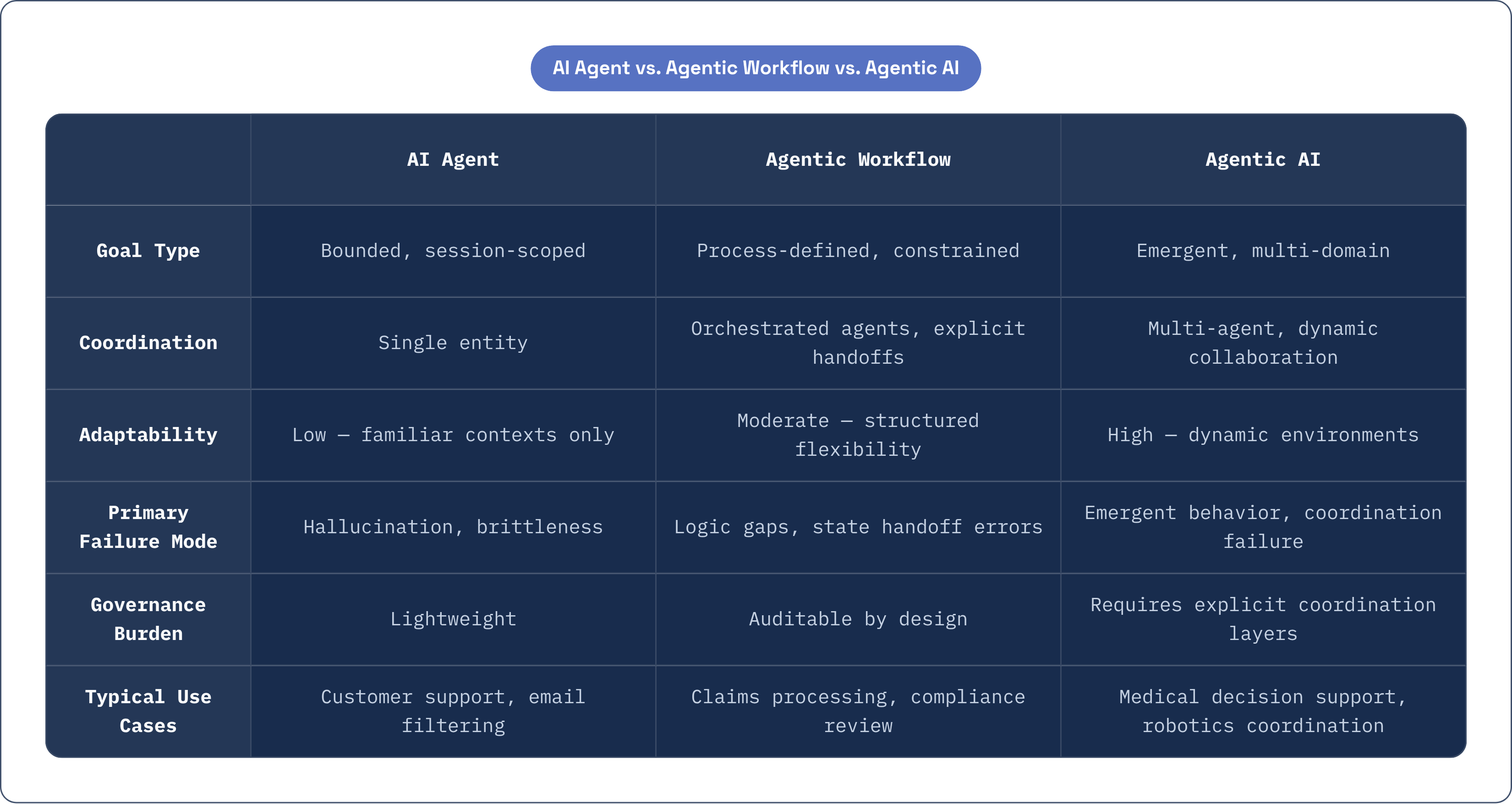
More agents do not constitute agentic AI. This is the inference that costs teams the most time and money, partly because it feels so natural. If one agent is useful, surely ten agents doing ten things is more capable and therefore more agentic. But what if that intuition is precisely wrong? Sapkota et al. (2025) address precisely this point: having multiple AI agents does not automatically produce agentic AI. What produces it is coordination, planning, and goal-directed reasoning across agents toward objectives that no single agent was designed to handle alone.
Microsoft's working definition cuts to the structural markers: an autonomous AI system that plans, reasons, and acts to complete tasks with minimal human oversight, characterized by multi-agent collaboration, dynamic task decomposition, persistent memory, and coordinated autonomy. These are architectural properties. A system either has them or it does not.
The failure modes shift qualitatively at this level, and the shift matters more than most teams initially appreciate. Hallucination and brittleness give way to emergent behavior and coordination failure. One agent producing a wrong answer is a recoverable error. Multiple agents reasoning toward a shared goal, one of which introduces a faulty premise that propagates through the others before any human sees the output, is a different class of problem entirely. Governance structures adequate for the former are insufficient for the latter, and the mismatch rarely becomes visible until you are already inside it.
The application examples from Sapkota et al. illustrate how far the scope expands: multi-agent research assistants, intelligent robotics coordination, collaborative medical decision support, adaptive workflow automation across enterprise functions. These are not agent tasks at higher volume. They are problems with emergent complexity that single agents cannot navigate.
Where Agentic Workflow Fits In, and Why It's Not the Same as Agentic AI
If agentic AI is the paradigm, an agentic workflow is one way to implement within deliberate constraints. That sentence is simple; the confusion it resolves is not. Teams regularly treat these terms as synonyms, which produces two distinct failure patterns: importing the full governance burden of agentic AI into deployments that do not need it, or assuming that a well-designed workflow is sufficient infrastructure for problems that actually demand the fuller paradigm.
IBM's definition anchors the distinction: agentic workflows are AI-driven processes where autonomous agents make decisions, take actions, and coordinate tasks with minimal human intervention. The emphasis belongs on "process layer." The workflow provides what the agent alone cannot: goal definition, sequencing, state handoff, error handling, and human review gates. The agent supplies flexible reasoning; the workflow supplies the business logic that keeps the output auditable and policy-aligned.
Contrast this with traditional rule-based automation, where robotic process automation executes rules. Agentic workflows execute judgment. They adapt to real-time data and unexpected conditions rather than following a fixed decision tree. The workflow also constrains that adaptability deliberately, and that constraint is what distinguishes it from agentic AI in its fuller expression. It is also worth considering what happens when that constraint is removed: the instinct in most engineering conversations is to treat constraints as deficiencies to be engineered away, but in agentic workflow design, they are often load-bearing by intention, and the system becomes harder to govern the moment you remove them without understanding what they were holding.
A Practical Way to Measure How "Agentic" a System Is
Treating agenticness as binary is where most scoping conversations quietly go sideways. Research published on ArXiv in July 2025 proposes treating it as a spectrum, defined by the degree to which a system adaptably achieves complex goals in dynamic environments with limited supervision. Four dimensions define position on that spectrum.
Goal complexity covers the range and difficulty of tasks the system can handle, weighed against reliability and safety under stress. Environmental complexity addresses whether the system operates in multi-stakeholder or long-horizon contexts where conditions shift in unpredictable ways. Adaptability describes how the system responds to circumstances outside its training distribution. The fourth dimension, less often named explicitly in the literature, is supervision tolerance: how much the system can accomplish before requiring human review or override.
Microsoft's five properties of agentic AI (2025) map onto this as a working checklist: autonomy, reasoning, adaptable planning, context understanding, and action-enabled capability. A system can score high on one dimension and low on another. A single agent handling structured data retrieval sits at a very different point on this spectrum than a multi-agent medical decision support system navigating incomplete clinical data across specialist domains. Pretending otherwise creates expensive mismatches between design assumptions and operational reality, and those mismatches tend to surface at the worst possible moment.
The spectrum framing also explains why agentic workflows sit below agentic AI: the workflow constrains agenticness intentionally, trading some adaptability for predictability. That is a design choice, not a deficiency.
The Design Patterns That Make Agentic Workflows Work in Practice
Pattern choice in agentic workflows is not arbitrary, and the patterns are not interchangeable options. Each carries assumptions about task type, risk tolerance, and how much ambiguity the system needs to absorb. They also form something closer to a progression of complexity than a menu, which means skipping steps in that progression tends to create problems that look architectural but were really sequencing errors.
Reflection is the simplest and most foundational: the agent generates output, evaluates it against defined criteria, and either accepts or revises. The agent acts as its own reviewer. Teams underestimate this loop with remarkable consistency, both in how much output quality it can improve on structured tasks and in how often it gets skipped in the interest of reducing latency. Latency is a real constraint. So is shipping outputs that no one reviewed.
ReAct, introduced in 2022, combines reasoning with acting to enable dynamic plan creation during execution. Rather than committing to a plan upfront, the agent reasons about what to do next based on what it has already learned. This suits tasks requiring exploration before commitment: market research, technical troubleshooting, anything where the right path depends on early findings.
Planning patterns bifurcate by context. Plan-Act works well for predictable, structured workflows, such as employee onboarding or compliance reviews, where the sequence of steps is known in advance and deviation from it is undesirable. Plan-Act-Reflect extends this for evolving requirements, adding a review step that allows the workflow to update its plan as conditions change. The choice between them often reduces to a single question: how confident are you that the problem will look the same at step eight as it did at step one? If the honest answer is "not very," Plan-Act is probably the wrong foundation.
Multi-agent orchestration is where agentic workflows begin to approach agentic AI territory, and it warrants careful attention precisely because the boundary can blur. A managing agent holds the overall goal; specialized worker agents execute sub-tasks with their own tools and domain knowledge. Consider a claims processing workflow: a data extraction agent pulls structured fields from unstructured documents, a validation agent checks completeness and consistency, a risk-scoring agent applies policy criteria, a compliance agent flags exceptions, and a managing agent delegates, monitors, and reconciles outputs across all four. The coordination is explicit and auditable. That auditability is what keeps this in workflow territory, and it is also what makes the pattern defensible to compliance stakeholders who will eventually ask exactly that question.
Memory and tool use are structural, not optional. Combining short-term context with long-term memory that persists across sessions separates agentic workflows from stateless automation; without it, each step starts from scratch. Tool use grounds the workflow in real-world data and enables real-time adaptation, but it also introduces new surface area for errors and policy violations. The workflow's governance layer matters as much as the agent's reasoning, sometimes more.
Where Each Approach Fits in Enterprise Deployments
Agentic workflows earn their keep precisely where rule-based automation stalls: ambiguous requests, partial context, situations that fall outside predefined logic. That gap, where rigid rules break down and human judgment used to be the only viable option, is where the most durable enterprise deployments tend to concentrate.
SoftBank Corp., as documented by Dataiku in 2025, deployed an AI-agent-powered sales operating model that captures and structures sales conversations automatically, linking them to CRM. Approximately 20 hours were saved per seller per month, projecting to over 250,000 hours reclaimed annually across the organization. The task is bounded, the data sources are defined, and the output feeds into a structured system. That clarity of scoping is part of what made the deployment viable. Vague scoping on a project like this does not produce a more ambitious system; it produces a failed one.
A financial services use case from the same source illustrates the governance dimension. An agent evaluates flagged loan applications against policy criteria across multiple data sources and recommends approve, decline, or escalate, replacing a fully manual review process. The workflow's structure, with defined criteria, traceable state, and an explicit escalation path, is what made the output auditable and acceptable to compliance stakeholders. The agent's reasoning ability alone would have been insufficient to clear a compliance review without that scaffolding, and anyone who has sat through a compliance review on an AI system knows how quickly that conversation turns on auditability rather than accuracy.
The radiology case from 2025 sits in different territory. Multi-agent frameworks in diagnostic imaging use role-based specialization and cross-validation across agents to improve accuracy, with evidence from 2024 to 2025 showing meaningful improvements in diagnostic performance, though the methods remain computationally demanding and lack comprehensive clinical validation. This is agentic AI territory: coordinated reasoning across specialist agents, emergent synthesis of findings, environmental complexity that no single agent could navigate reliably. The governance requirements are correspondingly heavier, and they need to be designed in from the beginning, not added after the first production incident.
A selection logic emerges: single-agent workflows for bounded, auditable tasks; agentic AI for coordinated, open-ended, multi-domain problems where no predefined path covers the full solution space. MIT Sloan reported in 2025 that 80% of the work in implementing agentic AI was consumed by data engineering, stakeholder alignment, governance, and workflow integration. Teams that underestimate this, typically because they scoped the project as a workflow problem when it was actually an agentic AI problem, discover that discrepancy through rework.
How to Apply the Distinction When Scoping a Project
Start with the task structure, not the technology. Is the goal well-defined, and is the path to it largely predictable? A single agent inside an agentic workflow is likely sufficient; adding coordination overhead beyond that creates complexity without corresponding benefit. Is the goal emergent, multi-domain, or dependent on coordinated reasoning across specialist agents? Agentic AI is the appropriate framing, and the governance infrastructure needs to match that choice from the beginning.
The reliability-versus-flexibility trade-off is real and deliberate. Workflows constrain autonomy to gain predictability. Agentic AI relaxes those constraints to gain adaptability. One might argue that agentic AI is simply a more capable version of an agentic workflow, and on the surface, that argument has a certain coherence to it. But treating one as a better version of the other, rather than as tools suited to different problems, is the category error that produces the most expensive misfires. Capability is not the relevant axis. Fit to problem is.
Governance follows architecture, not the other way around. Agentic workflows are inherently more auditable: defined stages, human review gates, and traceable state make it possible to reconstruct what happened and why. Agentic AI systems require explicit coordination layers and, for high-stakes applications, causal modeling to manage emergent behavior. MuleSoft's 2025 research found that 93% of IT leaders plan to add autonomous agents within two years, with nearly half already having done so. That deployment pressure makes pre-scoping clarity more important, not less.
Before any scoping conversation, three questions tend to surface the actual architecture: What is the scope of the goal, and is it bounded or emergent? How much environmental variability must the system tolerate, and over what time horizon? Who needs to review or approve outputs, at what frequency, and under what regulatory constraints? The answers map directly onto the agenticness spectrum. They also have a way of revealing, sometimes uncomfortably, whether the team is building the right system or building the wrong one with considerable confidence. Getting that question on the table early is almost always cheaper than getting it on the table after the first production failure.