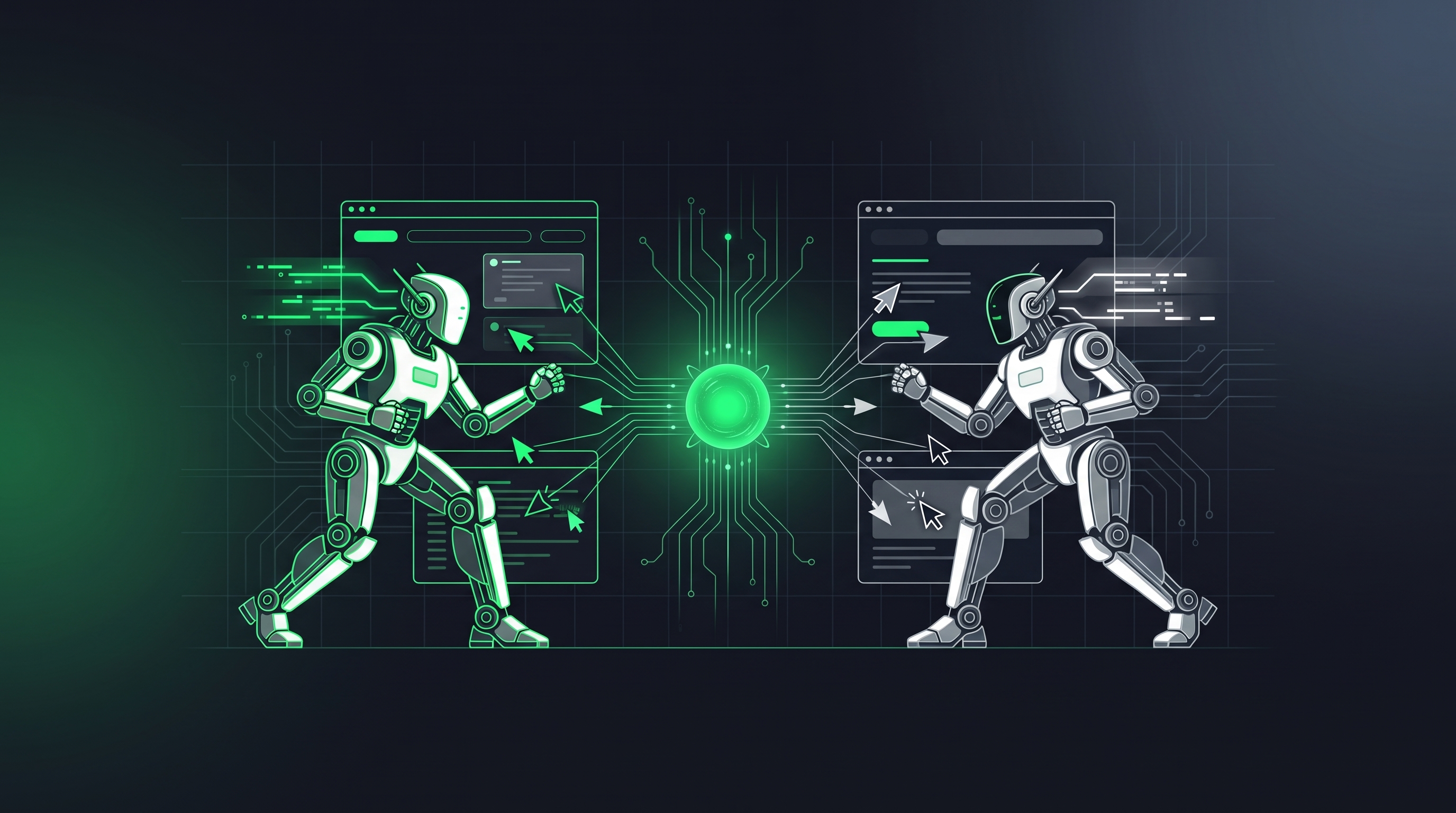
What Are Agentic AI Tools

Most people enter a conversation about AI carrying the same mental model: you type something, a model generates a reply, the interaction ends. Generative AI made that loop faster and more fluent, but the structure held. You ask; it answers.
Agentic AI breaks that structure entirely. The clearest analogy I've found, borrowed from AtScale, is the difference between asking someone a question and hiring someone to solve a problem end-to-end. One interaction concludes with an answer. The other begins with a goal and runs until the work is done, with the person you hired making dozens of intermediate decisions you never see, some of which you might not have sanctioned had you been asked.
Horton et al. (2025), writing for MIT Sloan, define agentic AI systems as "autonomous software systems that perceive, reason, and act in digital environments to achieve goals on behalf of human principals, with capabilities for tool use, economic transactions, and strategic interaction." Three words carry the weight: perception, reasoning, action. An agentic system takes in context, decides what to do with it, and then does something in the world, not just in a text window.
This is a system, not a model. "Agentic" refers to agency, the capacity to act on behalf of someone toward a goal, which is what separates these systems from the tools most organizations already run. Chatbots respond but do not act. Robotic process automation executes predefined scripts but cannot reason about exceptions. Copilots assist and suggest while requiring a human to authorize every move. The word "agent" is being applied loosely across the industry, and that looseness creates real confusion during procurement. But what if the distinction between a true agent and a well-branded chatbot matters more than most buying conversations acknowledge? That gap will become painfully clear as budgets and accountability follow these tools into production.
The Five Capabilities That Make an AI System Agentic
Cisco and Libertify identify five core design patterns that, taken together, define what agentic behavior actually requires: planning, tool calling, reflection, collaboration, and memory.
Planning is the capacity to decompose a goal into an ordered sequence of steps before acting. A system that reacts to each moment without a plan is reactive, not agentic. Planning is what allows an agent to hold a goal across multiple actions without losing the thread.
Tool calling is the ability to recognize which external capability a task requires, whether a web search, a database query, an API call, or a code interpreter, and invoke it at the right moment. Without it, an agent is confined to what the underlying model already knows. This is roughly equivalent to hiring a contractor who refuses to use any tools they did not personally manufacture. The work still gets done, slowly, badly, and with obvious gaps.
Reflection is the feedback loop that separates agents from linear scripts. A reflecting agent critiques its own intermediate outputs, identifies errors or gaps, and revises before continuing. This mechanism is how autonomous systems catch their own mistakes rather than propagating them silently downstream through a workflow. I have watched agents without this capability confidently execute in the wrong direction for several steps before anyone noticed, and "anyone" was usually the person at the end of the chain who received the output.
Collaboration enables multiple agents with distinct roles to work in parallel or in sequence, with no human manually passing the work between them.
Memory is what allows an agent to track what has happened, what worked, and what did not, either within a session or across time. Without it, every task starts from scratch.
No single capability is sufficient on its own. A system with tool calling but no reflection will execute confidently in the wrong direction. A system with planning but no memory will replan the same problem every time it runs. A tool missing both reflection and memory is, whatever the vendor calls it, a sophisticated script. The combination of all five is what produces autonomous, adaptive behavior, and the distance between "sophisticated script" and "genuine agent" is precisely where most vendor claims quietly collapse under examination.
How These Capabilities Combine in a Working Agent: The Architecture Underneath
A working agent has three functional layers. The reasoning layer is a large language model handling natural language understanding and decision-making. The integration layer connects the agent to databases, APIs, business intelligence platforms, and cloud data warehouses, giving it access to real-world information rather than just its training data. The execution layer is the mechanism by which the agent acts: submitting forms, triggering workflows, writing to systems of record.
Orchestration ties these layers together. It determines the order in which agents act, the boundaries within which they operate, and the conditions under which a workflow escalates to a human. Without orchestration, multi-agent systems become unmanageable with surprising speed. Agents may each perform their individual functions correctly while collectively producing chaos, because no one defined how their outputs interact. I have seen this happen in environments where the technical build was sophisticated and the orchestration design was an afterthought. The chaos is not dramatic; it accumulates quietly as small misalignments compound.
Secure data access is a prerequisite, not an afterthought. Permissions and access controls must be defined before agents begin pulling information at scale. An agent operating with overly broad access creates risk that compounds as autonomy increases, and the compounding is not gradual.
When something goes wrong mid-execution, a well-architected agent does not stop and wait. Reflection and replanning happen in motion. The agent detects that its current path is failing and recalculates, which is what makes agentic systems suited for complex, unpredictable tasks, and also what makes them difficult to oversee.
Here is the part that tends to disappear from most implementation conversations: the scaffolding, orchestration plus integrations plus access controls, is as consequential as the model itself. Swapping in a more capable LLM while leaving weak scaffolding in place produces a more articulate agent making the same structural errors. Teams that are technically sophisticated enough to know this distinction still routinely lead with model selection, because the model is the thing that demos well. But how does this affect our original promise of autonomous capability? The scaffolding reveals itself only after something breaks in production, which is an expensive and stressful time to discover it matters.
The Interoperability Standards That Let Agents Connect to Tools and to Each Other
Two open standards now define how agents plug into the broader ecosystem.
Model Context Protocol, created by Anthropic and donated to the Linux Foundation in December 2025, defines how agents connect to external tools and data sources. OpenAI and Google both support it, and Claude ships with more than 75 connectors available through the standard. MCP is the handshake between an agent and the tools it needs to act.
Agent-to-Agent protocol, created by Google and also donated to the Linux Foundation, defines how agents discover, communicate with, and collaborate with each other regardless of which vendor built them. More than 150 organizations have committed support.
MCP handles agent-to-tool communication; A2A handles agent-to-agent communication. They are complementary rather than competing, and together they define the connective tissue of a composable agentic ecosystem.
Without them, every platform builds proprietary integrations, agents cannot be composed across vendor boundaries, and organizations find themselves locked into a single ecosystem whether or not that was the intent. The Linux Foundation's stewardship of both protocols signals something more durable than a single company's roadmap. It is also worth considering how quickly this convergence happened relative to prior infrastructure cycles. The speed implies that fragmentation became obviously costly early enough for the major players to act before the lock-in calcified. Whether that reflects institutional learning from previous interoperability failures, or simply a different commercial calculus this time around, I am uncertain.
Where the Major Platforms Sit and What Each Is Built For
Four distinct enterprise platform types have emerged. Platform choice is largely a function of where your data already lives, and the sooner an organization accepts that constraint as a guide rather than a limitation, the less time it wastes evaluating options that will never be realistic candidates.
Salesforce Agentforce is CRM-native, purpose-built for autonomous customer-facing workflows. It runs on the Atlas Reasoning Engine and reached more than 8,000 customers with $900 million in AI and Data Cloud revenue within six months of launch. If the work lives in customer service, sales, or account management and the data lives in Salesforce, Agentforce is the natural starting point. "Natural" does not mean frictionless; the integration work still bites, and anyone who has navigated a Salesforce implementation at scale knows the gap between what demos cleanly and what operates reliably.
Microsoft Copilot Studio is a low-code builder operating inside the Microsoft 365 ecosystem. Within its first 90 days, 160,000 organizations had built more than 400,000 custom agents on the platform. Its strength is persistent, memory-enabled workflows spanning SharePoint, Teams, and Outlook. For organizations already running on Microsoft infrastructure, the integration overhead is lower than anything else currently available. That is a real advantage, and also a form of dependency that deserves deliberate consideration rather than passive acceptance.
Google's Gemini Enterprise Agent Platform spans the full development spectrum: no-code tooling through Agent Studio, a model selection layer with access to more than 200 models through Model Garden, pre-built templates through Agent Garden, and code-first development through the Agent Development Kit. For teams building custom, model-agnostic systems, it is the most architecturally flexible of the four.
ServiceNow earned the top position in the 2025 Gartner Critical Capabilities report for RPA in the Building and Managing AI Agents category. Its distinguishing capability is the AI Control Tower: cross-platform governance that manages agents running on ServiceNow, Microsoft, and Salesforce simultaneously. For organizations already operating across multiple agentic platforms, unified oversight of that kind is not a convenience feature. It is a governance requirement, and the organizations that recognize this before their second or third deployment are considerably better positioned than those that discover it afterward.
For developers building outside these enterprise platforms, the open-source ecosystem is mature. LangChain remains the standard for prototyping; LangGraph handles complex multi-agent workflows; AutoGen targets enterprise-grade multi-agent infrastructure. Browser Use reached 78,000 GitHub stars within months of release, a rate of adoption that signals something about how quickly the developer community is organizing around these patterns, and probably something about how much of the real technical innovation is still happening outside enterprise vendor roadmaps.
What Agentic AI Is Actually Doing in Production Today, and in Which Industries
The clearest production value for agentic systems is automating business processes too complex or unpredictable for traditional automation: competitor research that requires synthesizing sources across the web, customer feedback synthesis spanning unstructured text at scale, operational bottleneck identification that requires reasoning across multiple data systems simultaneously.
In financial services, multi-agent systems monitor transactions, conduct KYC checks, and detect fraud patterns at speeds and volumes no human team can match. Human analysts retain approval authority for high-risk decisions. That design choice is more consequential than vendor literature tends to acknowledge, for reasons that will become clear when the security section addresses accountability asymmetry directly.
In healthcare, Kellogg et al. (2025), writing for MIT Sloan, describe an agent detecting adverse events in cancer patients from clinical notes. The technical capability was demonstrably real. Roughly 80% of the effort spent on deployment, however, went to data engineering, stakeholder alignment, governance, and workflow integration. One might argue that ratio reflects a project management failure. Having worked through deployments with similar proportions, I would argue it does not. It is the actual composition of the work, and it holds across sectors more consistently than most implementation case studies acknowledge. Case studies are typically written by people with an interest in framing the technical build as the central challenge, because that is the part their audience finds legible and their organization found hard.
In IT service management, agents handle L1 ticket triage, cross-functional approvals, and known-incident resolution at scale, freeing human engineers for work that requires judgment.
Gartner projects that AI agents will autonomously resolve 80% of common customer service issues by 2029, with an associated 30% reduction in operational costs. The gap between that projection and current deployment data is where the more interesting analysis begins.
How Far Adoption Has Actually Progressed Versus How Much Attention the Topic Receives
The market trajectory is real. The global agentic AI market is projected to grow from $28 billion in 2024 to $127 billion by 2029, a 35% compound annual growth rate (Flobotics, citing industry analysts).
The adoption curve, however, is steeper in intent than in execution. Deloitte's 2025 Emerging Technology Trends study found that 30% of organizations are exploring agentic AI, 38% are piloting, 14% have deployment-ready solutions, and just 11% are in active production. McKinsey's 2025 State of AI report found that most organizations experimenting with agents struggle to move beyond pilots because their planning architectures lack feedback loops. Gartner projects that 15% of day-to-day work decisions will be made autonomously through agentic AI by 2028, up from effectively none today.
Eleven percent in production, against a backdrop of near-universal industry attention. The conference circuit is not closing that gap, and the gap does not close on its own. The hype is running well ahead of the infrastructure, and the infrastructure problems are organizational as much as technical. Both of those facts require sitting with for a moment rather than rushing past toward the solution section.
Why Moving from Pilot to Production Is Harder Than Building the Agent Itself
Deloitte's 2025 data shows that 42% of organizations are still developing their agentic strategy roadmap, and 35% have no formal strategy at all. Those numbers explain a great deal about why the pilot-to-production gap is where it is.
Most agents still rely on APIs and conventional data pipelines, which create bottlenecks that constrain autonomous capability before the agent encounters its first genuinely complex task. Legacy systems typically lack four things that agentic integration requires: real-time execution capability, modern APIs, modular architecture, and secure identity management. Gartner predicts that more than 40% of agentic AI projects will fail by 2027 because legacy systems cannot support modern AI execution demands. That raises an important question: is this a projection about AI capability, or about organizational infrastructure? These are distinct problems with distinct remediation paths. The failure gets attributed to the technology when the actual constraint was the environment the technology was deployed into.
"Agent washing" deserves more direct attention than it typically receives in analyst coverage. Vendors are rebranding existing chatbots, RPA scripts, and linear workflow tools as agents. A chatbot with an API wrapper is not an agent; it is a chatbot with broader reach and, often, fewer guardrails than the original implementation carried. The five-capability checklist from the second section exists precisely to make this distinction auditable rather than rhetorical.
Governance debt is accumulating quietly across organizations rushing to pilot agents without defining decision rights, mapping accountability, or establishing data discipline. Every additional deployment built on an unresolved governance question makes that question harder to answer later. Lumenova's analysis of agentic deployment failures consistently identifies this pattern: the technical build works; the organizational scaffolding around it does not.
The MIT Sloan healthcare case makes the point concretely. The 80% of effort that went to data engineering and stakeholder alignment was not a detour from the real work. It was the real work. The technical build is, in most mature deployments, the smaller half of the problem, and recognizing that before starting is worth more than any framework applied after the fact.
The Security and Oversight Risks That Autonomous Action Introduces
Autonomy is the source of both the value and the risk. An agent that can act without waiting for human confirmation can also act incorrectly without human correction. Those two properties are inseparable; they come from the same design choice, and no vendor positioning dissolves that tension. The industry's tendency to discuss agentic benefits and agentic risks in separate conversations, often with separate audiences, is itself a governance problem.
Prompt injection is among the most technically immediate risks. Malicious content embedded in an agent's environment, inside a webpage it visits, a document it reads, or an email it processes, can redirect its behavior entirely. The agent follows the injected instruction rather than the user's original goal, often without any visible indication that the hijack has occurred. This has been demonstrated repeatedly in controlled research settings, and the attack surface grows directly with the breadth of access granted.
Privilege escalation is the structural risk that follows from broad permissions. Agents granted wide access to execute tasks efficiently may access or modify data well beyond what any individual task requires. The path of least resistance in a system designed for speed is often the path of greatest exposure.
Multi-agent architectures compound both risks. One compromised agent can instruct others, propagating errors or malicious instructions across an entire workflow before any human sees the output. The financial services model, retaining human approval authority for high-risk decisions, reflects a clear-eyed understanding that the cost of an autonomous error in that domain is asymmetric. The agent is faster; the human is accountable. That asymmetry should be shaping architectural decisions in more industries than it currently does. Why exactly does this not happen more often? Because designing accountability asymmetry explicitly into a system requires someone in the room willing to name where the agent's authority ends, which is an uncomfortable conversation when the organizational appetite is for automation.
Human-in-the-loop checkpoints are an architectural decision, not a policy one. They need to be built into the orchestration layer before deployment, not retrofitted after the first significant failure. MCP and A2A include permission scoping by design, but standards define what is possible. Implementation discipline determines what actually happens.
What a Grounded Evaluation Framework Looks Like When Assessing Any Agentic AI Tool
Start with the five-capability checklist before evaluating anything else. Does the tool meaningfully support planning, tool calling, reflection, collaboration, and memory, or is it a chatbot with an API wrapper and a marketing rebrand? That question is not rhetorical; it has a verifiable answer, and the answer determines whether everything downstream is worth the investment.
Assess orchestration and governance before assessing model quality. A weaker model inside strong orchestration will consistently outperform a stronger model inside weak orchestration, because the former has a reliable mechanism for catching and correcting errors at scale. The latter relies on the model alone to self-correct, which is not a governance strategy.
Match platform to data residence. Salesforce-native workflows belong in Agentforce. Microsoft 365 workflows belong in Copilot Studio. Organizations operating across multiple platforms need ServiceNow's AI Control Tower or an equivalent cross-platform governance layer. The most capable platform is the one your team can actually build on, integrate safely, and govern over time without accumulating obligations they cannot later retire.
Run an interoperability check. Does the tool support MCP and A2A, or does it require proprietary connectors that bind the organization to a single vendor's ecosystem indefinitely? Open standards are a hedge against lock-in, and lock-in in this space will prove expensive as the market matures and organizational requirements diverge from any single vendor's roadmap.
Identify where human-in-the-loop checkpoints are required before deployment, not after. The failure will surface precisely where the checkpoints are missing; mapping that in advance is considerably cheaper than discovering it under operational pressure.
Deloitte's finding that only 11% of organizations are in active production is not a signal to wait. It is a signal about where competitive advantage is quietly forming. The organizations doing the governance work, the data engineering, the stakeholder alignment, and the access control design now are building infrastructure that compounds. The organizations accumulating pilot debt are building technical obligations they will eventually retire under pressure, and the pressure will arrive faster than the market projections imply.
The capabilities are real. The production deployments exist. The standards are maturing. What the evidence does not yet support is confidence that most organizations are treating the organizational work of responsible deployment with the same seriousness they bring to the technical build. The gap between those two kinds of seriousness is where most of the actual risk is accumulating, and it is not the kind of risk that shows up in a demo.