End-to-End Testing with AI-Generated Test Cases
AI models find edge cases and permutations human testers skip under deadline pressure.
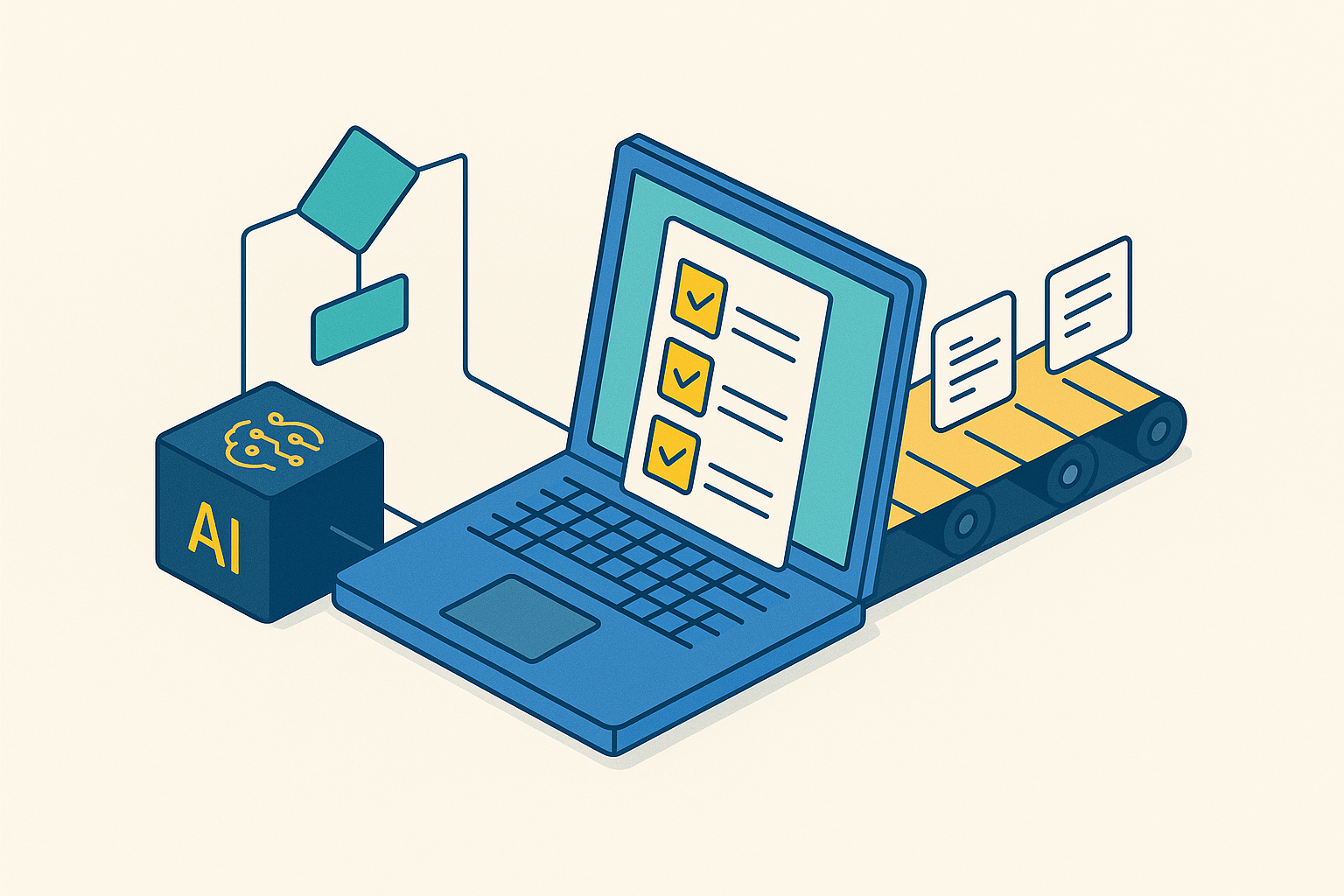
The core process is less magical than it sounds and more consequential than vendors let on. AI models ingest naturallanguage requirements, user stories, and acceptance criteria; parse the text for user flows and logical conditions; and emit step-by-step test cases. Some tools read requirements documents directly. Others analyze source code, API schemas, or database models. The richer the input, the more meaningful the output, which is already a more conditional statement than most sales decks contain.
AI-generated end-to-end test case creation works by ingesting natural-language requirements, user stories, and acceptance criteria, parsing that text for user flows and logical conditions, and emitting step-by-step test cases. Some tools read requirements documents directly; others analyze source code, API schemas, or database models. The coverage benefit originates at the point where human-to-logic translation happens automatically: the model surfaces boundary conditions, error paths, and data permutations outside the happy flow that human authors skip under deadline pressure, finding the fifteenth variation no more tedious than the first. The risks accumulate at that same translation point, because the richer the input the more meaningful the output, meaning thin or imprecise requirements produce thin or misleading test cases, and raw output is not production-ready without human review regardless of what sales decks imply.
The distinction from traditional test automation is architectural. In conventional scripting, a human author translates intent into logic, step by step, decision by decision. In AI-assisted generation, the author specifies intent and the model infers the scenarios that follow from it. Where that translation happens is where the coverage benefit originates, and also where the risks accumulate.
What AI reliably surfaces that human authors skip are the paths testers consider obvious to omit: boundary conditions, error paths, data permutations outside the happy flow a tester naturally scripts first. Under deadline pressure, a human writes the flow they already understand and moves on. The model has no deadline and finds the fifteenth variation no more tedious than the first. Multi-step workflow scenarios that would take weeks to script manually can be produced in days, as Tricentis has documented. Generation is the starting point, not the end state, and no credible practitioner claims raw output is production-ready without review. The value is in what gets surfaced for human evaluation, not in what bypasses it.
Where does the real coverage benefit from AI test generation come from?
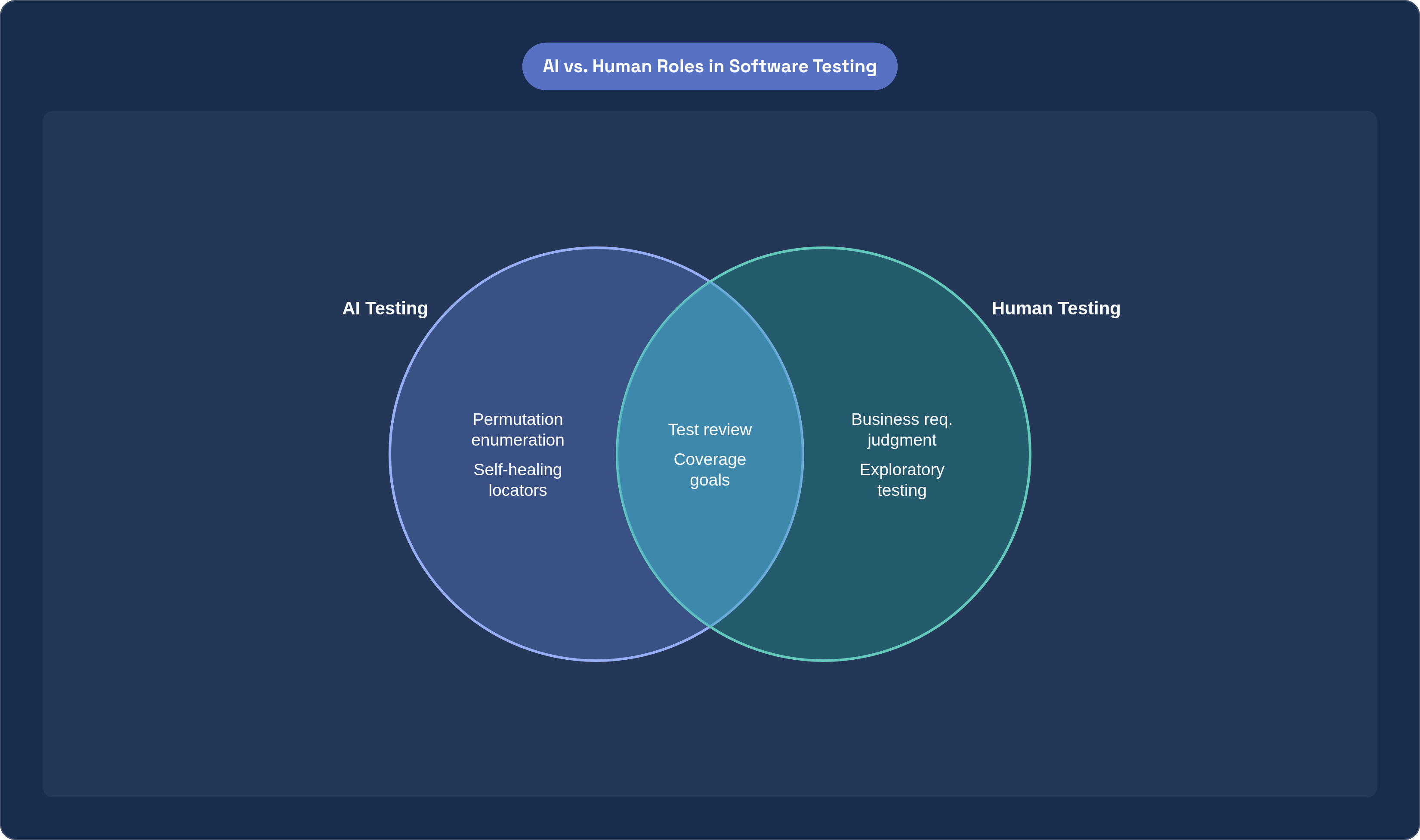
Human testers converge on flows they already understand. Edge cases, rare permutations, and cross-service interactions get deferred under deadline pressure, not because testers are careless, but because human attention is finite and schedules are real. I have watched disciplined QA teams, working in good faith, ship releases with substantial untested surface area — not out of negligence but because the combinatorial scope of a modern application simply outruns the hours available. AI's ability to enumerate permutations systematically is a direct counter to that constraint.
PractiTest's 2025 State of Testing Report puts numbers on the perceived benefit: 45.6 percent of respondents cited improved test automation efficiency as a top benefit of AI in testing; 34.7 percent cited better generation of realistic test data. Those two responses led the survey, and they reflect exactly the gap that manual authoring struggles to close.
Some platforms approach coverage from a different angle entirely. Rather than generating tests from anticipated flows, tools that learn from production traffic generate tests from what users actually do. The logic is defensible: if a workflow appears in production telemetry, it needs coverage; if it has never appeared in real usage, its priority is lower. That approach bridges the gap between engineering assumptions and observed behavior, though it also means novel use cases with no prior data, and use cases not yet described in documentation, still require human imagination. Any system that learns from existing evidence cannot anticipate what has never happened. That is a structural constraint, not a limitation of any particular tool.
Where Self-Healing Tests Change the Maintenance Equation
Test flakiness is endemic, even at organizations with disciplined engineering cultures. Google's own published data shows approximately 16 percent of their tests exhibit some degree of flakiness. Industry surveys place maintenance work at 30 to 40 percent of QA team capacity, per Autonoma. The 60 to 70 percent maintenance tax that VirtuosoQA documents is not a failure of effort; it is a structural consequence of how E2E tests are written, because element locators are coupled to presentation-layer decisions that change frequently and unpredictably.
Self-healing addresses the selector problem specifically, using visual recognition, contextual analysis, and pattern matching to automatically update element locators when UI changes. Most teams report eliminating a meaningful share of UI-change-induced failures with self-healing tooling. What remains after that tends to signal genuine behavior changes, which is the correct outcome.
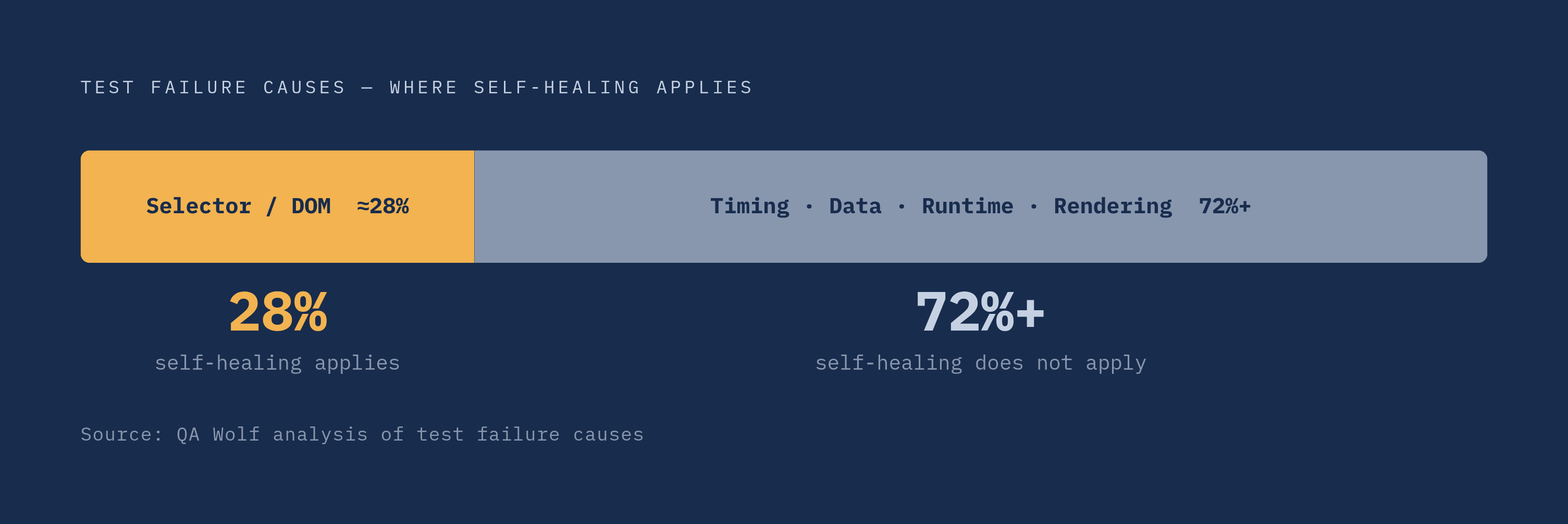
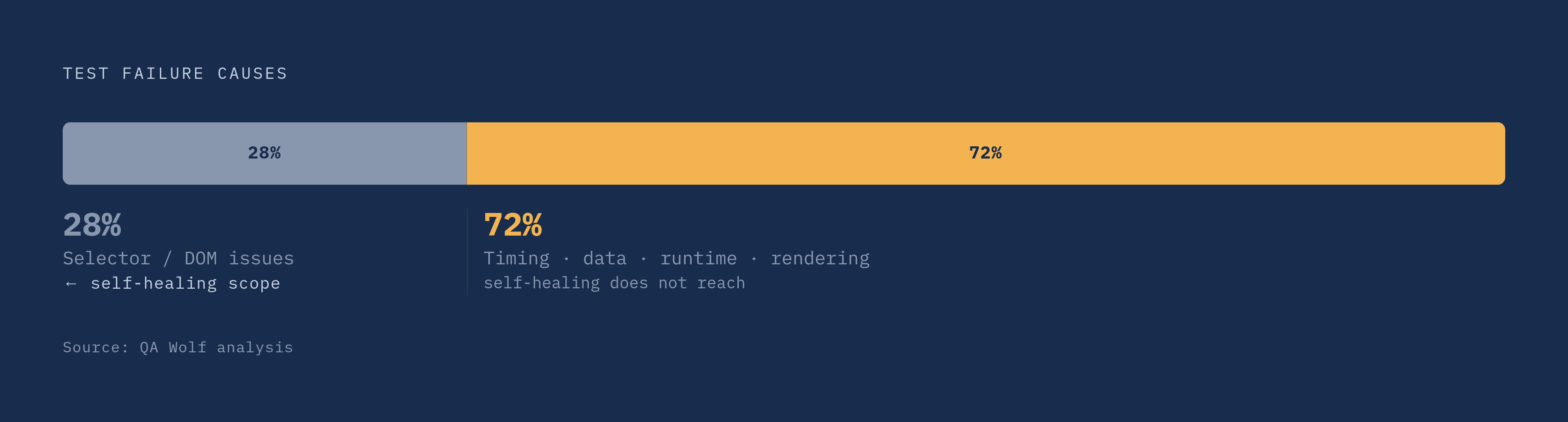
But DOM changes and brittle selectors cause only about 28 percent of test failures, per analysis from QA Wolf. Timing issues, test data problems, runtime errors, and rendering failures account for the remaining 70-plus percent. Self-healing is a real improvement to a real problem. It is not a general solution to test fragility.
The deeper risk is subtler. A self-healing tool that silently updates a locator and re-passes a test may be masking a regression. The test passes; the failure disappears from reporting; the underlying behavioral change ships. That outcome is worse than the test failing outright. Teams need explicit policies governing when healed tests get flagged for human review versus auto-merged. That is not a technical configuration. It is a judgment call about risk tolerance, and one that most adoption checklists treat as an afterthought.
Agentic Testing Systems and What They Do Differently From Earlier Automation
Earlier AI testing tools augmented human workflows. An engineer still decided what to test, reviewed output, ran the suite, and triaged failures. Agentic systems close the loop: analyze codebase, generate tests, execute, diagnose failures, self-heal, and re-run, without requiring human steps at each junction. That is a categorical shift, not an incremental one.
Forrester's 2025 category rename, from "Continuous Automation Testing Platforms" to "Autonomous Testing Platforms," reflects that recognition. The new label marks the moment the industry acknowledged agentic behavior as the emerging baseline expectation, not a premium feature.
The mature testing stack that practitioners are converging on for 2026 and beyond has three layers. Fast unit and API tests form the base. Scripted E2E regression covers critical paths in the middle tier. An agentic layer sits on top, providing breadth, exploratory coverage, and resilience to UI churn. Each layer catches what the layers below miss. The agentic layer is additive.
One empirical finding complicates the enthusiasm here. A February 2026 arXiv paper (arXiv:2602.07900) analyzed six large language models on SWE-bench Verified and found that test-writing frequency had no statistically significant effect on task resolution rates in autonomous coding agents. More AI-written tests did not produce better outcomes in that study. The honest read is that agentic tools increase coverage breadth and reduce human labor without automatically producing better software quality. Those are different claims, and conflating them is how adoption expectations get set at the wrong altitude.
The Accuracy Gap in AI-Generated Tests and What Closes It
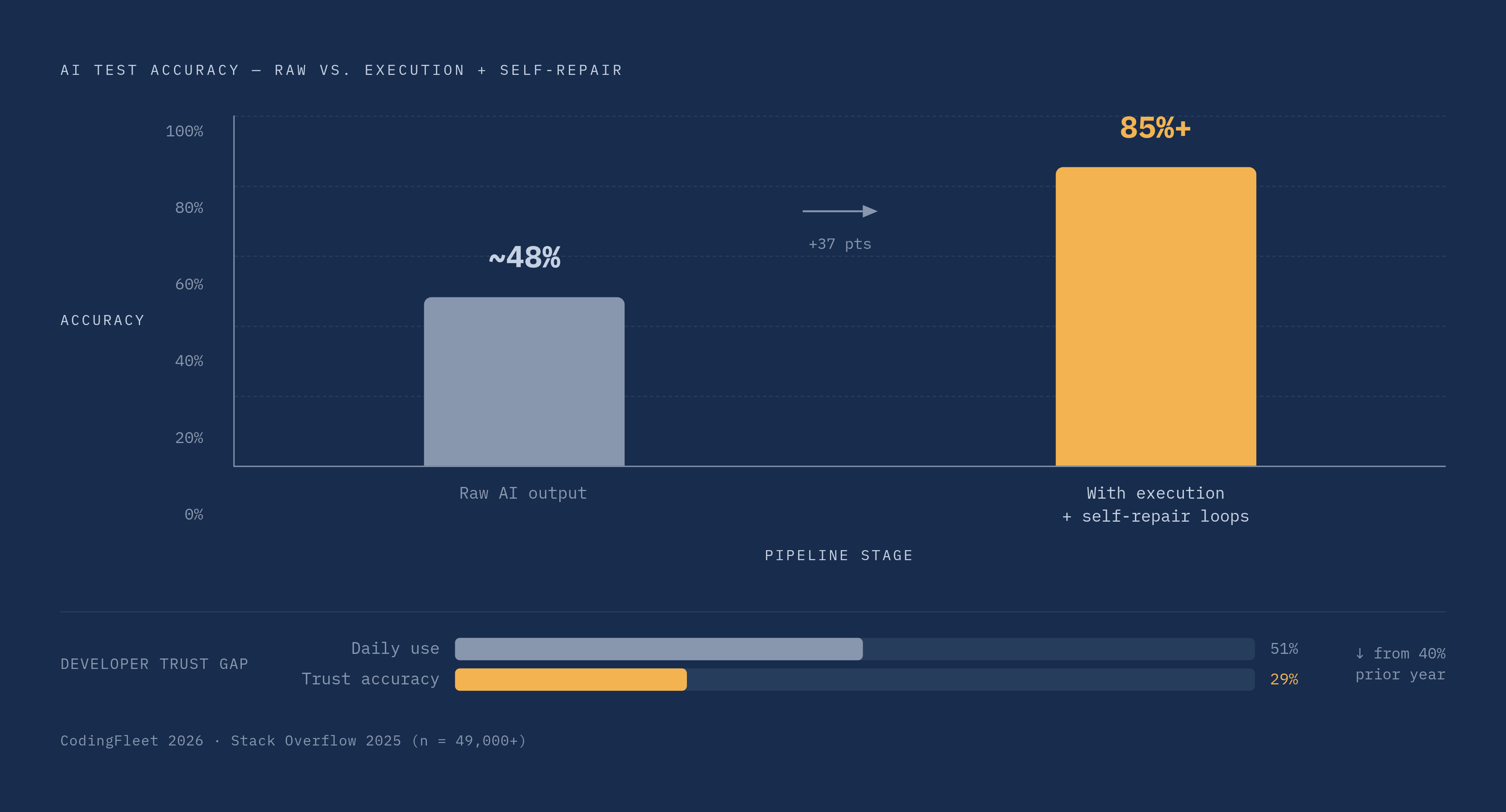
The gap between what teams expect from AI-generated tests and what they receive in practice is wider than most adoption plans account for. Raw accuracy on complex real-world functions, without intervention, is materially lower than vendor benchmarks suggest. With sandbox execution and self-repair loops added to the pipeline, accuracy climbs into the mid-80s and above, per 2026 analysis from CodingFleet. The distance between those two figures is the entire argument for execution-and-repair loops as a mandatory pipeline component.
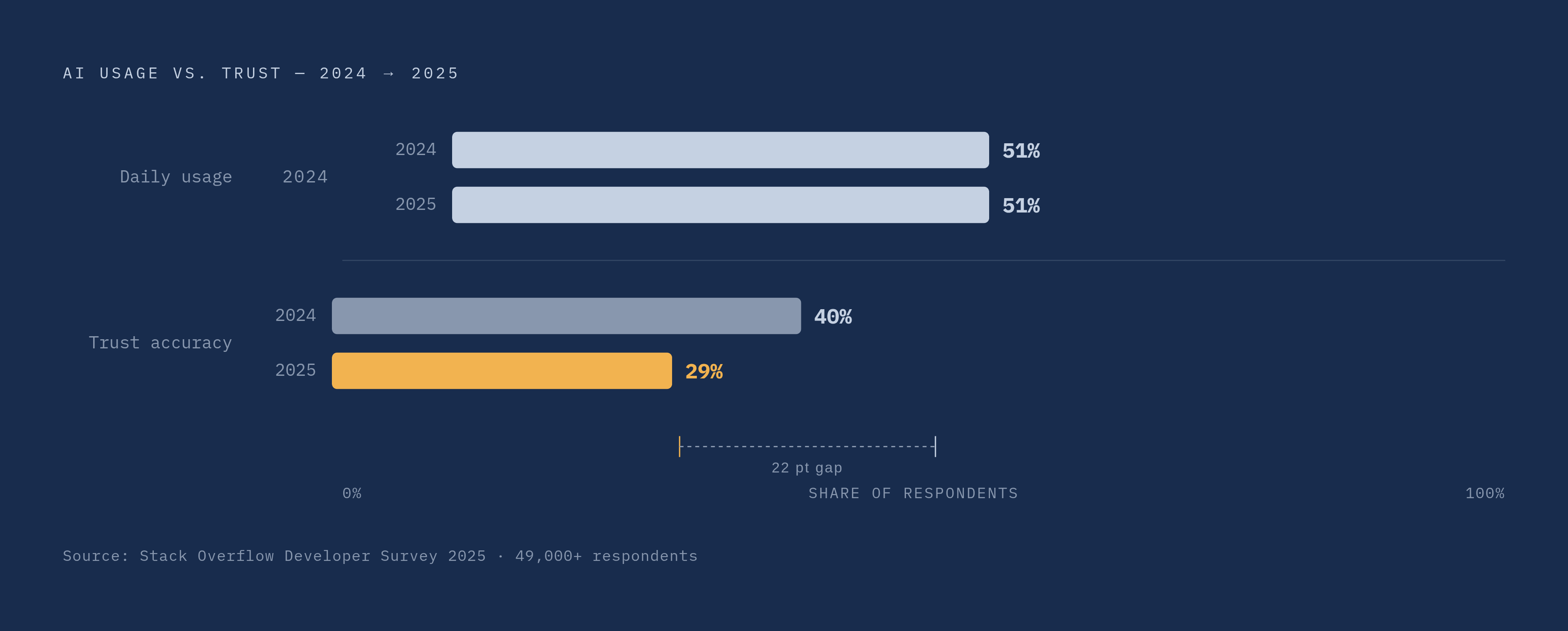
Developer trust data reinforces the concern from a different angle. Stack Overflow's 2025 Developer Survey, drawing on responses from more than 49,000 developers, found that 51 percent use AI tools daily, but only 29 percent trust their accuracy, down from 40 percent the prior year. Usage increasing as trust declines is a pattern worth sitting with. It suggests adoption is being driven by pressure rather than confidence, which is not a stable foundation for a quality-sensitive discipline.
Iterative refinement adds further complexity. An IEEE-ISTAS 2025 peer-reviewed study of 400 AI-generated code samples found that asking models to iteratively improve their own output produced a 37.6 percent increase in critical vulnerabilities after five rounds; average vulnerabilities per sample climbed from 2.1 in the first iteration to 6.2 by the tenth. The mechanism matters here. Self-repair driven by actual test execution is different from asking a model to "make this better" in free text. The former has a grounding signal. The latter is speculation accumulating on top of speculation.
The accuracy figures from current tooling are better understood as a floor to verify against than a ceiling to aspire toward. They reflect current-generation models and will shift. But they should be measured internally before teams discover the gap during a production incident.
Where Human Judgment Remains Load-Bearing in an AI-Assisted Workflow
AI cannot determine whether a test case reflects the right business requirement. It generates scenarios consistent with the inputs it received. If the source requirement was ambiguous, the generated test will be confidently wrong in ways that execution alone cannot catch, because a syntactically correct test that passes can still validate the wrong behavior. I have seen this happen in practice, and it is a peculiarly difficult failure mode because it produces green dashboards.
Only about 34 percent of organizations are actively using generative AI in Quality Engineering tasks as of 2025, per TestGrid. Most teams are still forming the workflow conventions that make human-AI collaboration reliable. The question of where handoffs belong, specifically which decisions require human review and which can be delegated to the tooling, is one that each team has to work out against its own risk profile and codebase characteristics. There is no universal answer, and teams that import one from vendor documentation without adapting it tend to discover the mismatch slowly.
Self-healing policy is one of the sharper examples. A healed test that auto-merges without review is an untested assumption that a UI change was cosmetic. Sometimes it was. Sometimes the UI change reflected a behavioral change that the test should have caught, and the heal obscured that signal. The tooling cannot distinguish between those two cases. A human reviewing the merge can, if the policy requires the review.
Exploratory testing, accessibility judgment, and business-risk prioritization of what actually gets tested remain human responsibilities that current tools do not automate meaningfully. The practical model that emerges from watching mature teams operate: AI handles breadth and maintenance velocity; human testers own whether the right things are being tested and whether failures carry real business risk.
How to Evaluate Whether AI Test Generation Is Working in Practice
Measurement discipline separates teams that extract value from this tooling from teams that accumulate impressive-looking coverage numbers with little to show for them underneath. Several metrics are worth tracking from the first release cycle, and the list is shorter than most practitioners expect.
Coverage delta is the clearest signal. Measure path and branch coverage before and after AI generation is introduced, and look for lift specifically on previously untested flows. A tool that generates tests for flows already covered adds reporting overhead without adding safety. The number that matters is new coverage, not total coverage.
Maintenance cost trend tells a separate story. Track the ratio of time spent writing new tests versus fixing existing ones. Self-healing should shift that ratio visibly within a few release cycles. If it does not, either the tooling is failing to address the dominant failure modes in that codebase, or the self-healing policies need adjustment. Either diagnosis is worth making explicitly rather than waiting for the ratio to improve on its own.
False positive rate in generated tests is the metric teams most consistently neglect. If a high proportion of AI-generated tests pass trivially and fail under no real regression, coverage numbers increase while confidence in the system is misplaced. That is coverage theater, and it is harder to detect than an outright failure.
Human review load matters as a counterbalance to authoring efficiency. How many generated tests require substantive revision before merging? A rising review burden can offset the authoring savings, particularly without a clear policy distinguishing tests that require deep review from those that can move through with lighter scrutiny.
The arXiv finding noted earlier, that test-writing frequency alone had no significant effect on resolution rates, is a useful internal benchmark. Test count is not the metric. Test relevance and execution feedback quality are. Enterprise adoption of AI in testing is projected to reach 80 percent by 2027, per Panto's 2026 analysis. The organizations with clean data to act on at that point are the ones establishing internal benchmarks now, before adoption pressure turns measurement into a formality.