Agentic Workflow Builder Tools Compared
Understand agentic workflows before choosing a platform to avoid costly mistakes.
The distinction matters before anything else, because conflating the two leads directly to the wrong tool selection, and I have watched that mistake play out enough times to find it frustrating.
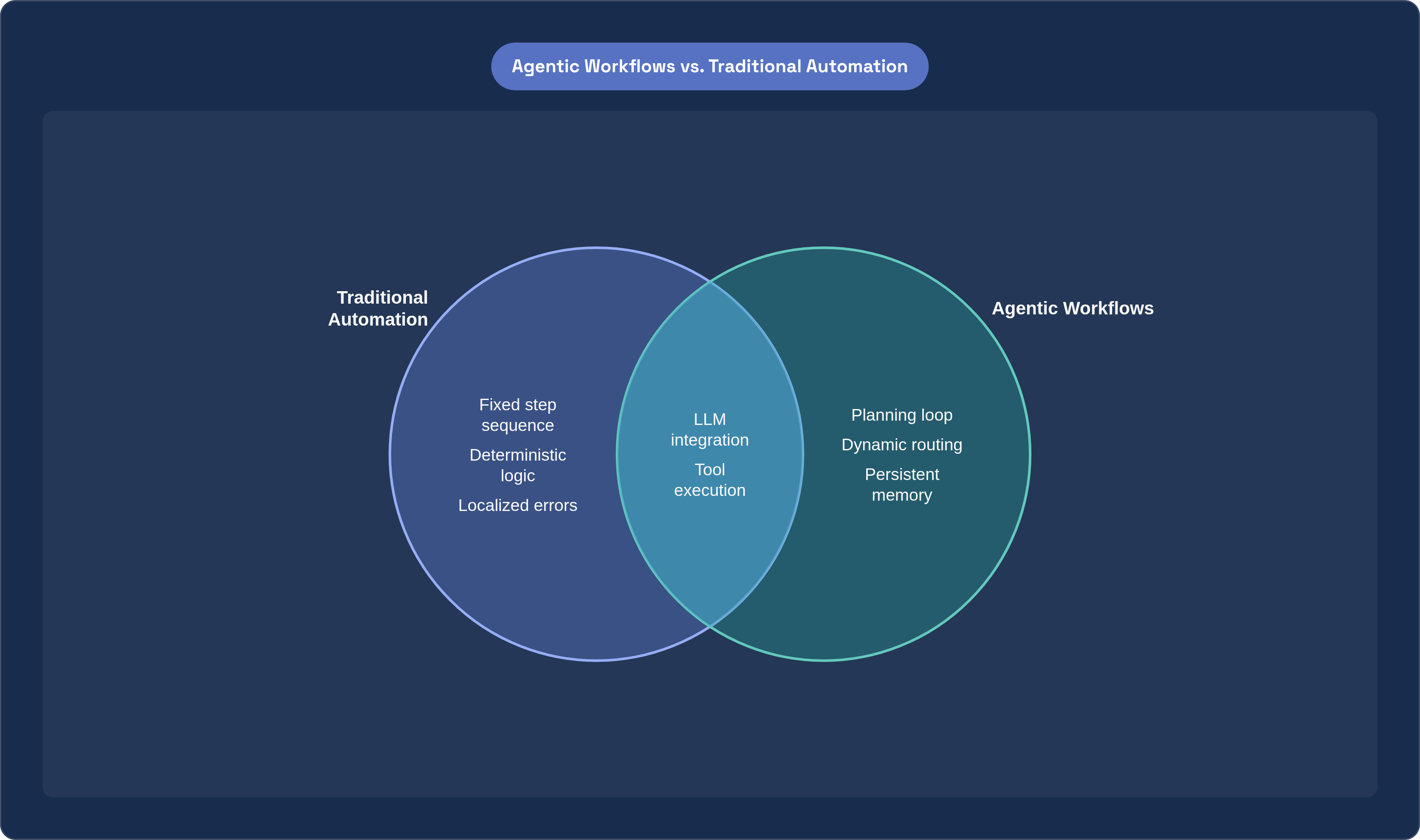
A traditional automation executes a fixed sequence. Step one runs, step two follows, output is produced. The logic is deterministic; the developer wrote it in advance. An LLM can sit inside that sequence, generating text at a designated step, and the workflow is still not agentic. The LLM is filling a slot the developer defined, not deciding what the next slot should be. But what if the LLM could decide what the next slot should be?
An agentic workflow is defined by a planning loop: interpret goal, plan steps, act with a tool, evaluate the result, continue or revise. The critical structural difference is that the LLM's output changes which step runs next. Routing decisions, not content generation, are what make a workflow agentic. A system that uses an LLM to summarize an email and send it is a GenAI automation. A system that uses an LLM to read an email, decide whether it requires a CRM update or a calendar hold or an escalation to a human, execute the appropriate action, and then verify the outcome, is exhibiting agentic behavior. The gap between those two things is not cosmetic.
That distinction has practical consequences that vendors rarely foreground. Agentic systems can get stuck in loops, accumulate token costs through redundant reasoning steps, and produce failure modes that are qualitatively harder to debug than a broken Zap or a misconfigured Make scenario. When a deterministic automation fails, the error is usually localized and traceable. When an agent fails, it may have completed several plausible-looking intermediate steps before producing a wrong or harmful terminal action, and reconstructing what went wrong requires a kind of forensic patience that most operations teams are not staffed for.
Gartner has predicted that 40% of agentic AI projects will be canceled by 2027, with failure clustering around agents whose business cases didn't survive actual token spend. I find that figure credible, not because the technology is deficient, but because the category label is so commercially attractive that teams apply it to problems that would be better served by a well-designed deterministic automation. Keep that prediction visible throughout this comparison. It is an argument for asking, before evaluating any platform, whether the task actually requires an agent or whether careful automation would do the job at a fraction of the cost and risk.
The Four Criteria That Should Drive Any Agentic Workflow Builder Evaluation
Four dimensions structure the comparison that follows. Each addresses a different way that platforms diverge from one another, and none of them maps cleanly onto vendor marketing.
Autonomy depth describes how far an agent can plan and self-correct without human intervention. Single-step tool use, where the agent calls an API and returns a result, sits at the shallow end. Multi-step reasoning loops, where the agent evaluates intermediate results and revises its plan, sit further along. Persistent memory across sessions, where the agent retains context from prior executions to inform current ones, represents the deep end. Most platforms marketed as agentic operate at the shallow end, a fact that their demo videos are carefully designed to obscure.
Integration breadth describes the number and quality of pre-built connectors to external systems. Raw connector counts mislead significantly. A platform with thousands of integrations that doesn't connect to a team's specific ERP or data warehouse is less useful than a platform with hundreds that does. The question is not how many integrations exist; it is whether the relevant ones exist and whether they are well-maintained, which is a different question entirely and one that requires hands-on verification rather than trust in a feature page.
Human-in-the-loop controls describes the infrastructure for keeping humans informed and in command during agent execution. Approval gates that pause the workflow pending a human decision, audit trails that record every action the agent took and why, role-based permissions that constrain what an agent can do based on who deployed it: these are not nice-to-haves in regulated industries. They are requirements. Platforms differ enormously in whether these controls are native or must be engineered manually into the workflow structure, and the difference between those two situations is not trivial when something goes wrong at two in the morning.
Technical barrier to entry is not simply the no-code versus code distinction. It is the skill floor required to handle error states, customize logic for edge cases, and maintain the system over time. A visual builder that requires developer intervention whenever a workflow breaks outside its happy path is not truly no-code in practice. That gap between marketing claim and operational reality is one of the more consequential things a buyer can misread, and it tends to surface only after the contract is signed.
How the Tool Landscape Divides into Three Tiers Before You Compare Individual Products
The nine platforms covered here divide into three tiers, and a team's tier membership should be determined before any individual product evaluation begins. Skipping this step is how teams end up selecting tools that are technically impressive and practically wrong for their situation.
Tier 1 covers no-code and low-code platforms: Zapier, Make, n8n, and Gumloop. These are designed for business users, operations managers, and non-technical teams. Their strengths are speed to deployment, template libraries, and low technical floor. Their ceiling is meaningful: complex branching logic, persistent memory, and RAG pipelines are difficult or impossible within most of these environments, with n8n being a partial exception worth examining on its own terms.
Tier 2 covers developer-oriented open-source frameworks: LangGraph, CrewAI, and Microsoft's AutoGen. These are code-first environments that offer maximum flexibility at the cost of significant engineering investment. No pre-built connectors, no managed infrastructure, no visual debugging. The teams that belong here have dedicated engineering capacity and are building differentiated systems that off-the-shelf platforms would constrain.
Tier 3 covers enterprise platform suites: Salesforce Agentforce, Microsoft Copilot Studio, Workato, and StackAI. These are governed deployment environments with deep compliance controls, often built on top of existing enterprise software relationships. Faster to deploy than Tier 2 for qualified customers, but implementation is measured in weeks to months rather than hours, and the switching costs they create are real and tend to grow over time.
The tier mismatch problem deserves emphasis. Mordor Intelligence projected the agentic AI workflow orchestration market at $2.73 billion in 2025, growing to $14.76 billion by 2031 at a 33.11% CAGR, according to their January 2026 report. That growth rate signals one thing above all else: vendors are flooding the category faster than buyers can evaluate it. Survey data suggests only 23% of organizations have actually scaled an agentic AI system in production despite 79% reporting some adoption. The gap between experimentation and production is large, and a plausible contributor is teams selecting tools from the wrong tier, whether non-technical teams attempting developer frameworks or enterprise teams selecting Tier 1 tools that lack the governance controls their compliance requirements demand. That raises an important question: how do you know which tier you actually belong to before you've made a costly mistake finding out?
Zapier and Make: Where Fast Deployment and Wide Integration Coverage Trade Off Against Logic Depth
Zapier's clearest differentiator is integration breadth. With more than 8,000 app integrations and approximately 3.4 million companies using the platform, it connects more systems than any other tool in this comparison. For teams whose primary challenge is stitching together SaaS tools without engineering resources, that breadth has real value, and the value is substantial enough that it's worth not underselling.
The autonomy depth, however, is limited in ways that matter. Zapier's AI capabilities are concentrated in background task execution across connected apps. The platform can route information, trigger actions, and incorporate LLM-generated content at specific steps, but it does not implement a genuine multi-step reasoning loop where the LLM's output determines the next action. It is strong automation with AI features. It is not an agentic engine, regardless of how the product pages are written.
The pricing model compounds this limitation at scale. Zapier charges per task, counting each action separately. Agentic workflows, by their nature, generate many sub-actions per high-level goal. The economics of running a multi-step agent through Zapier's pricing structure degrade significantly as workflow complexity increases, which is precisely the direction agentic use cases push.
Make offers more logic depth at lower cost. Its scenario builder provides granular visual control over data routing, error handling, and conditional branching that meaningfully exceeds what Zapier's interface permits. At comparable operation volumes, Make's pricing is substantially lower: at 100,000 operations per month, Make stays below $100 while Zapier pushes past $300. The platform's AI capabilities, including its Maia assistant and native AI modules, are in active development, positioning Make as a middle ground between pure automation and agentic execution, though those capabilities are still maturing.
Neither platform offers meaningful human-in-the-loop infrastructure out of the box. Approval gates and audit trails are not native features; both platforms expect the workflow designer to build constraints into the workflow structure itself. For bounded, pre-defined automations, that is a reasonable design assumption. For agentic workflows where the agent's action space is open-ended, it becomes a risk that is easy to underestimate until something consequential goes wrong.
n8n: What a No-Code Interface Backed by a Genuine Agentic Engine Actually Looks Like
n8n occupies a distinct position within Tier 1: close enough to no-code to be accessible to technical non-engineers, but deep enough to support genuinely agentic behavior. The platform's 2.0 release, launched in early 2026, added more than 70 AI nodes, native LangChain integration, persistent agent memory across executions, vector database support for RAG workflows, and sandboxed code execution. That is a qualitatively different capability set from Zapier or Make, not an incremental improvement on the same architecture.
The architectural difference is real. Where Zapier and Make treat AI as another integration category, something you connect to alongside your CRM and your email provider, n8n treats it as a first-class workflow primitive. The agent is not a node in a sequence; it is the orchestrating logic that determines what the sequence is. That framing difference manifests in what you can actually build, and it shows up in the kinds of problems teams bring to the platform. It is also worth considering whether that architectural distinction is durable as the other Tier 1 platforms continue to develop their own AI capabilities, or whether n8n's current lead narrows over time.
The trade-off is a steeper learning curve than either competitor. The drag-and-drop interface is accessible, but designing a workflow that uses persistent memory effectively, handles retrieval correctly, and fails gracefully when the LLM reasons poorly requires comfort with both the platform's abstractions and the underlying AI concepts. The platform allows developers to drop into code when visual tooling reaches its limits, which is the right design decision, but also a signal that some use cases will require engineering involvement even on a platform marketed as no-code.
Pricing shifted in April 2026, when n8n removed all active workflow limits across every plan. The Community Edition remains free and self-hostable; paid tiers price on execution volume. Self-hosting is both the platform's strongest argument for data-sovereignty-conscious teams and its most significant operational burden. Organizations without DevOps capacity should weigh the ongoing maintenance cost of managing their own infrastructure against the sovereignty benefit before committing, because that cost is not theoretical.
Integration breadth, at roughly 400 connectors, is narrower than Zapier by a significant margin. For teams whose systems are among those 400, this is not a meaningful constraint. For teams whose critical system is not covered, it becomes the primary objection.
Gumloop: Natural-Language Agent Building for Teams That Want Neither a Visual Canvas Nor Raw Code
Gumloop approaches the category from a different angle than the other platforms here. The platform offers two explicit modes: Flows, which are deterministic and visual, and Agents, which are goal-directed and adaptive. The explicit separation is a thoughtful design decision. It prevents users from accidentally handing autonomy to a system when they wanted predictable output, and it makes the autonomy tradeoff legible rather than obscured beneath a layer of marketing language.
The platform's most distinctive feature is Gummie, a built-in assistant that lets users build workflows through conversation. Rather than dragging nodes onto a canvas, a user describes what they want the workflow to accomplish and the assistant constructs it. Of all the platforms covered here, Gumloop presents the lowest technical barrier to entry. A motivated non-technical user can build a working agentic workflow without understanding the underlying orchestration architecture.
The platform also supports MCP server connectivity and bring-your-own-LLM configurations without requiring users to manage separate API keys for each model provider, a meaningful convenience for teams experimenting across model providers who haven't yet committed to a single inference stack.
The limitations are worth naming plainly. Gumloop is a newer platform; production reliability and integration breadth lag the more established players by a meaningful margin. Enterprise security and compliance features exist but are custom-priced rather than standard. Gumloop is best suited to teams in the prototyping phase of agentic workflow development, not to organizations running mission-critical automation at scale. The entry price point is accessible. The production suitability for complex enterprise use cases remains to be established, which is not a dismissal so much as an honest read of where the platform is in its maturity curve.
Salesforce Agentforce and Microsoft Copilot Studio: Enterprise Autonomy Inside Existing Platform Investments
Both platforms represent the same fundamental proposition: if your organization is already deeply embedded in a particular vendor ecosystem, that vendor's agentic workflow tools will deploy faster and integrate more naturally than anything external. The switching costs cut both ways, accelerating adoption for existing customers and creating meaningful friction for everyone else.
Agentforce replaces rules-based if-this-then-that logic with the Atlas Reasoning Engine, which supports genuine multi-step planning and dynamic execution. This is not a chatbot wrapper over Salesforce's existing automation infrastructure, and treating it as one is a mistake. The $2-per-conversation pricing makes the economics predictable, though that predictability becomes a concern at volume for organizations whose agents handle large numbers of conversations.
The more important caveat is structural. Agentforce's autonomy advantage is inseparable from Salesforce Data Cloud. Context-aware execution depends on having customer and operational data already unified in that environment. Organizations that have not made that investment face a substantial setup runway before Agentforce's agentic capabilities are meaningfully accessible. A Salesforce-led study surfaced findings that multi-step agents frequently struggle to complete objectives reliably, which signals that human-in-the-loop checkpoints remain necessary even on this platform, even for organizations with a mature Data Cloud foundation. The vendor surfacing that finding in their own research deserves some credit, and also some scrutiny about what it implies for organizations evaluating the platform's autonomy claims.
Microsoft Copilot Studio reaches approximately 340,000 enterprises. Average deployment times decreased from over four months to roughly three weeks, according to data cited by Axis Intelligence covering 2025 to 2026, a genuine improvement even if the baseline was slow by comparison to Tier 1 tools. The governance model is the platform's clearest differentiator: role-based agent assignments, Microsoft 365 permissions inheritance, and native audit integration make it the strongest compliance story for organizations already running on Microsoft infrastructure.
Both platforms share the same fundamental constraint: implementation timelines are measured in weeks to months. Teams expecting rapid deployment should look at Tier 1. Teams expecting enterprise-grade governance should recognize that governance carries a setup cost, and the cost is not negotiable.
Workato and StackAI: Where Enterprise Integration Complexity and Compliance Controls Converge
Workato and StackAI serve organizations for whom integration complexity and compliance requirements are the primary selection criteria, not secondary considerations that can be addressed post-deployment.
Workato's 2026 standout capability is Agentic Orchestration within its Workato One platform, AI automations that reason, adapt, and learn from execution patterns across more than 1,200 pre-built connectors. That combination of agentic reasoning and deep integration breadth positions Workato for Fortune 500 organizations with sprawling system landscapes that have already exhausted simpler iPaaS solutions. The platform is not designed for teams that are new to enterprise integration. It is designed for teams that have already confronted the limits of lighter tooling and found them frustrating.
StackAI's focus is governed AI workflows, specifically the infrastructure needed to move from a compelling agent demo to a production system that a compliance team can audit and a security team can sign off on. Multi-agent coordination, RAG capabilities, environment separation, role-based access, audit trails, and source controls are native rather than bolted on. That distinction matters more than it sounds. The emphasis on closing the gap between demo and production is deliberate and relevant; many agentic AI projects fail not because the agent doesn't work but because the surrounding governance infrastructure doesn't exist, and nobody thought to build it until a regulator or an incident forced the question.
Both platforms publish workflows as internal applications or APIs, making agent outputs consumable by downstream systems without additional integration work. The human-in-the-loop controls available on both platforms are the most mature across the nine tools compared here: approval gates, audit trails, and role-based permissions are structural features, not manual additions. For high-stakes use cases in regulated industries, that maturity tends to be the decisive factor, the one that survives the scrutiny of a legal or compliance review when other platforms don't.
LangGraph, CrewAI, and the Developer Frameworks: Maximum Autonomy Depth at the Cost of Everything Else
Developer frameworks are what you reach for when the workflow logic is genuinely too complex to express in a visual builder and the data sensitivity is too high to route through a managed platform. Both conditions must be true. If only one applies, a Tier 3 platform is probably the better call.
LangGraph models agent workflows as directed cyclic graphs, giving developers fine-grained control over agent state, branching logic, human checkpoints, and long-running processes. Conditional branching, loops, parallel execution, retry logic, and custom functions in Python and JavaScript are all expressible within the framework. The ceiling is effectively the developer's ability to write correct code, which is either the most liberating or most terrifying characteristic depending on the team.
CrewAI and Microsoft's AutoGen offer multi-agent coordination primitives: role assignment, inter-agent communication, and task delegation. These are relevant when the problem requires multiple specialized agents working in parallel rather than a single agent iterating through a loop. A workflow that needs one agent to retrieve and summarize information while a second evaluates it and a third acts on the evaluation is a reasonable candidate for this architecture, though I would encourage any team considering it to ask hard questions about whether the coordination overhead actually buys them something a single agent with careful prompting would not.
The cost of these frameworks is comprehensive. No pre-built connectors; integration breadth is theoretically unlimited but practically bounded by what the team's engineers can write and maintain. No managed infrastructure; the team owns uptime, scaling, and security. No visual debugging; failure diagnosis requires code-level investigation and the kind of patience that is expensive to hire. The autonomy depth available here is unmatched by any other tier, but it is only accessible to engineering teams that can build and maintain the full stack, and those teams are not cheap.
For organizations building differentiated, proprietary agentic systems where off-the-shelf platforms would constrain the logic or require routing sensitive data through third-party infrastructure, these frameworks are the correct answer. For most organizations, they are not, and the appeal of maximum control tends to be most seductive precisely in the early stages of a project, before the maintenance reality sets in.
How the Four Criteria Actually Map Across All Nine Platforms
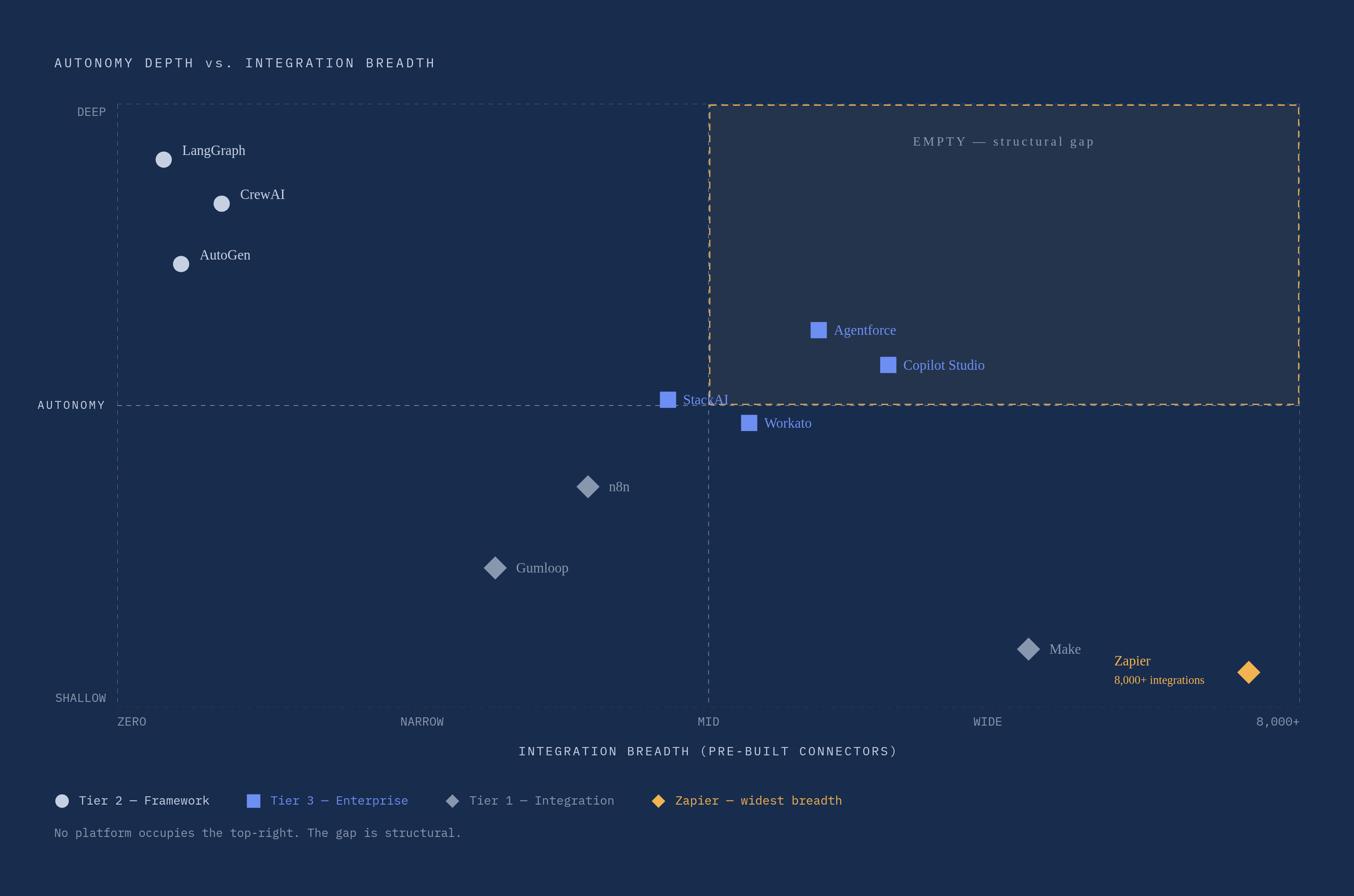
Mapping the criteria across platforms reveals two gradients worth naming, because they explain why no single platform dominates the evaluation.
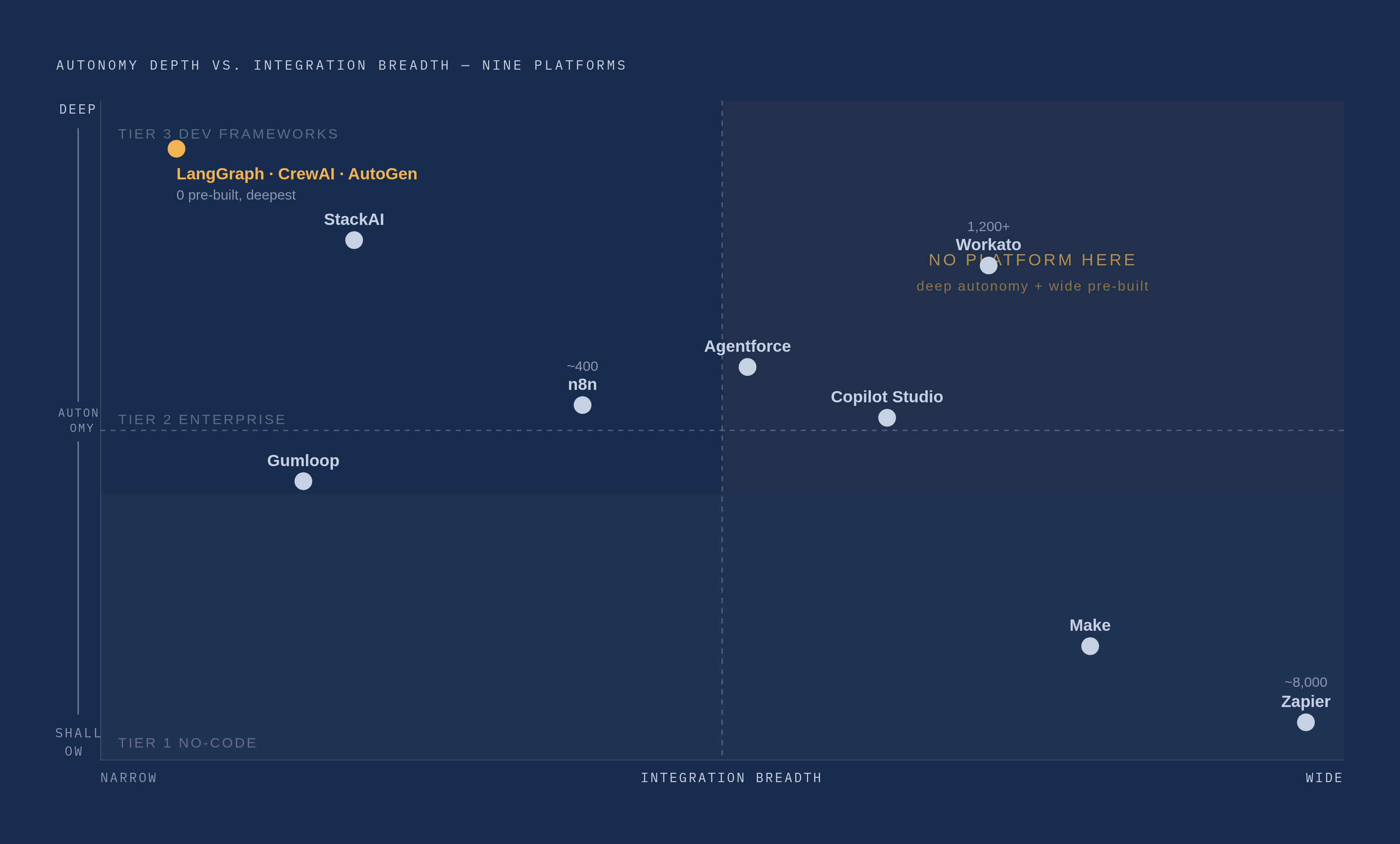
Autonomy depth and integration breadth move in opposite directions across the market. Developer frameworks offer the deepest autonomy and the least pre-built integration coverage. Zapier offers the widest pre-built coverage and the shallowest autonomy. The market has not produced a platform that excels on both dimensions simultaneously, and there are structural reasons for that: deep autonomy requires managing agent state, memory, and reasoning loops, which is architecturally different from maintaining thousands of third-party API connectors. These are different engineering problems, solved by different teams with different incentives. It would be surprising if a single product solved both well, and the current landscape confirms that it hasn't. But how does this affect our original promise of finding the right tool for a given team? It means the selection process must involve a deliberate trade-off rather than a search for a platform that avoids one.
Human-in-the-loop controls cluster by tier in a predictable way. StackAI and Workato lead with native audit trails, role-based permissions, and environment separation. Copilot Studio is strong within Microsoft's governance model. Agentforce is adequate within Salesforce's. Tier 1 platforms require the workflow designer to engineer constraints manually. Developer frameworks offer unlimited flexibility to implement controls but no default infrastructure for them, which means the quality of those controls depends entirely on whether the engineering team prioritized building them.
The technical barrier axis is the most important first filter and the one most often evaluated last. Gumloop and Zapier present the lowest floors. Make is slightly higher. n8n requires comfort with infrastructure concepts. Copilot Studio and Agentforce require platform administration expertise within their respective ecosystems. Developer frameworks require engineering teams. A team that misidentifies its position on this axis before selecting a platform will likely fail to deploy successfully regardless of how well the other criteria align, and that failure tends to be expensive in ways that go beyond the licensing cost.
No platform leads on all four criteria simultaneously. That outcome is not a flaw in the framework; it is what the framework is designed to surface.
Signals That Indicate Which Tier and Which Platform Fits a Given Team's Situation
A team's fit with a tier and platform becomes legible once the right signals are examined in the right order. The sequencing matters, because some signals are disqualifying and others are merely directional.
Start with technical resources, because this is the only criterion that functions as a hard gate. If there is no dedicated engineering capacity, the developer frameworks are categorically unavailable regardless of their capability advantages. The choice is within Tier 1, or at most within the lower-administration portions of Tier 3. This sounds obvious, but I have watched organizations spend months evaluating LangGraph before arriving at this conclusion the hard way.
Examine workflow logic complexity next. If the workflows are repeatable, bounded, and center on connecting SaaS tools with moderate conditional logic, Zapier or Make will likely be sufficient and will deploy faster than any alternative. If the workflows require persistent memory across sessions, retrieval from unstructured data, or multi-step reasoning where intermediate results change the next action, Zapier and Make have reached their ceiling. n8n or a Tier 3 platform becomes appropriate, and the choice between those two depends primarily on the compliance and governance signals examined in the next step.
Compliance requirements often become the decisive signal in regulated industries, or in any use case where the agent can take high-stakes actions. Tier 1 platforms do not provide native human-in-the-loop infrastructure. StackAI and Workato offer the strongest native governance. Copilot Studio and Agentforce are strong within their ecosystems. If compliance controls are required and the team is already inside a Salesforce or Microsoft environment, the switching cost argument for the respective enterprise platform is substantial and should be taken seriously rather than dismissed as vendor lock-in.
Existing ecosystem investments are the final structural signal. A team already deeply embedded in Salesforce will deploy Agentforce faster and with lower integration friction than any external alternative. The same logic applies to Microsoft and Copilot Studio. If neither condition holds, the ecosystem lock-in cost of Tier 3 enterprise suites deserves explicit scrutiny before commitment, because it is the kind of cost that is easy to underestimate in a competitive sales process.
Finally, and this is worth sitting with before any platform evaluation begins: ask whether the task is actually agentic. The Gartner cancellation prediction is a useful counterweight to the market enthusiasm. Many business problems being framed as agentic AI opportunities are, on closer examination, well-structured automation problems. A Make scenario with thoughtful conditional logic will solve some of those problems more reliably, more cheaply, and more maintainably than an LLM-driven agent. The platforms that make it easiest to build agents also make it easiest to over-engineer solutions that don't need them.
The category is real. The capability differences between platforms are real and consequential. What is not yet clear, in a market moving at this velocity, is which platforms will maintain their current positioning as the underlying model capabilities shift beneath them. The four criteria described here are durable. The specific feature comparisons will drift as vendors ship and the model landscape evolves. Treat the criteria as stable anchors; treat the platform assessments as current readings, not permanent verdicts.