How ML Improves Web Scraping Beyond Rule-Based Selectors
Language models adapt scrapers to layout changes that break traditional selectors.
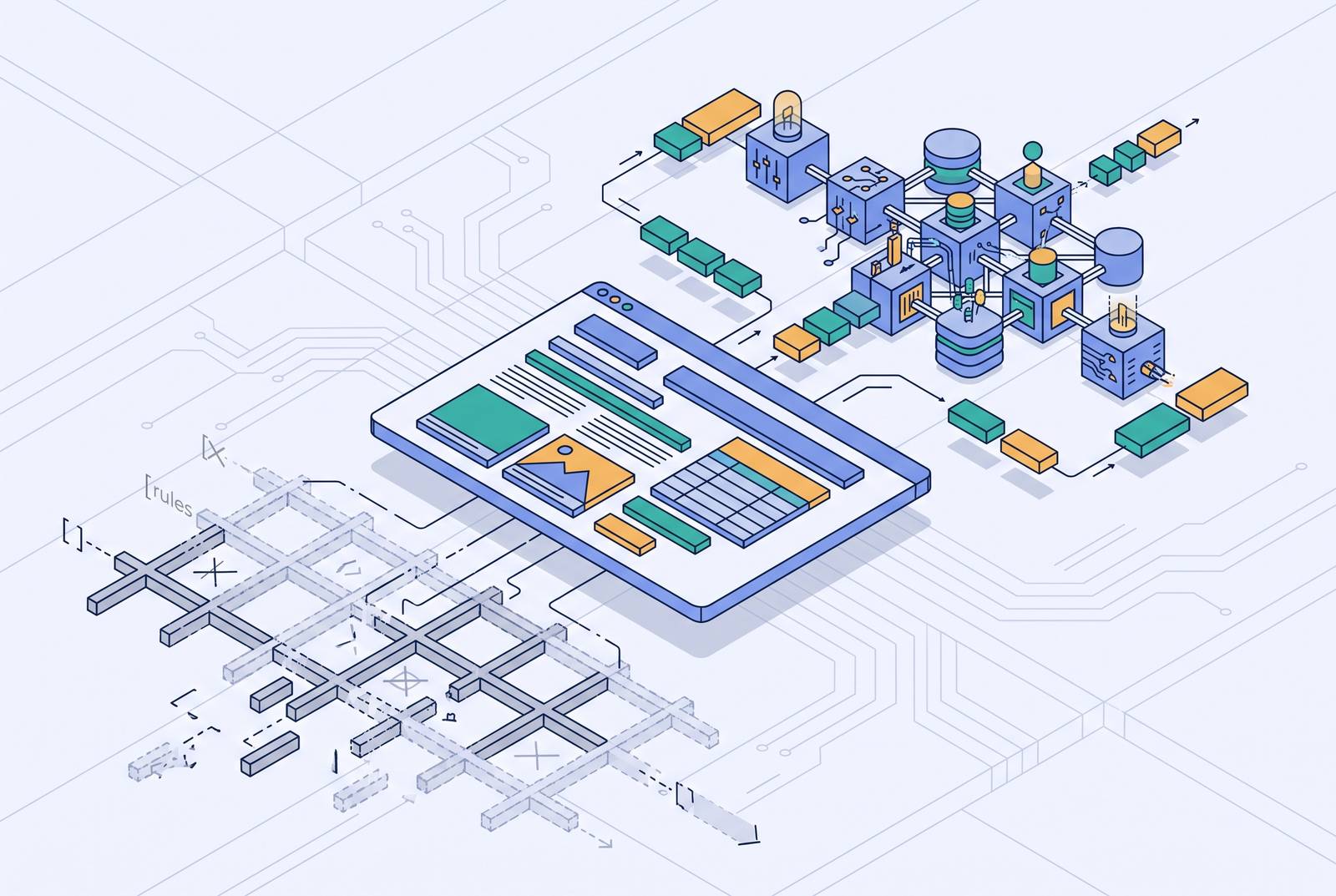
Web scraping has run on the same basic logic for two decades: find an element on a page, write a rule that points to it, run that rule on a schedule. Machine learning is breaking that model apart: it replaces fixed rules with systems that infer meaning from content and recover when the page underneath them changes. This piece traces that shift mechanism by mechanism, from single-page extraction to the governance questions that come with agents capable enough to act on their own.
Why rule-based scrapers break
The standard method has always been simple enough to teach in an afternoon: inspect the element, write a CSS selector or an XPath expression, point it at the right node, run the script on a schedule. It still works, and plenty of production pipelines run on exactly this today. What it does not do well is survive time. A selector binds itself to a specific position in a document's markup, not to the meaning of what sits there, and that distinction is the whole problem.
Consider what happens when the page changes underneath the rule. A page shifts to client-side rendering, so the content loads after the initial HTTP response, and a plain request returns an empty shell with no price, no listing, no article body anywhere in the markup it fetched.
The failure is not always a crash. A selector can keep matching an element that exists but no longer holds the data it once did, and the pipeline keeps running, confident and wrong, often for days before anyone notices the numbers look off. That silent failure costs more than an outage does, because people notice an outage right away, but they don't notice a bad feed.
Scale makes the arithmetic worse. Scale exposes an architectural problem: the extraction logic is coupled to the form of the page rather than to the meaning of its content, so anything built on that coupling inherits its fragility.
How LLMs replace selectors with schema-driven semantic extraction
The fix that ML offers is a change in what the extraction logic actually targets. You can define a schema instead, a plain description of the fields you want, and hand that schema along with the page's content to a language model, rather than writing a rule that points to a specific DOM node. The model infers which parts of the page correspond to which fields and returns structured JSON, regardless of how the underlying markup happens to be arranged.
That reframing matters because the same piece of data can appear in wildly different markup, even across versions of the same site. A price might sit inside a span, a div, an HTML attribute, or a sentence of surrounding prose, and a schema-driven extractor maps all of those surface variants onto the same output field without needing a separate rule written for each one. Layout changes stop mattering in the way they used to: as long as the semantic content, the actual price, the actual product name, is present somewhere on the page, the model can find it without a human rewriting a selector to match the new structure.
This is, functionally, an attempt to get a machine to read a page the way a person does, identifying what's being looked for by context and meaning rather than by counting div levels down from the root. It also changes who can build a scraping pipeline. Specifying a schema in natural language is a much lower bar than writing XPath, and that lower bar has measurable effects: researchers studying LLM-powered web scraping found that large language models have opened sophisticated scraping operations to users without traditional technical expertise, including end-to-end agents that complete complex extraction workflows from a single prompt with minimal refinement afterward.
None of this comes free, and the honest accounting matters here. Hybrid designs, selectors on the stable high-volume paths, LLM extraction on the variable or newly added ones, capture the strengths of both without forcing an all-or-nothing choice.
Self-healing pipelines: how ML detects structural drift and regenerates extraction logic
Replacing a selector with a schema solves the extraction problem for a single page at a single moment. It does not, on its own, solve what happens six months later when that page changes again. Closing that gap is the job of a self-healing pipeline: a system that watches its own output, notices when something has gone wrong, and repairs its own extraction logic without a person stepping in to rewrite it.
The loop runs in three stages. When a site changes its markup, the system can often recognize the equivalent elements under the new structure, so nobody has to rebuild the extraction logic from scratch, and that cuts downtime and makes the data pipeline more stable over time.
ML's role in this loop does not stop at structural repair; it reaches into the data itself.
Agentic orchestration: what changes when the scraper can plan, navigate, and recover
Self-healing pipelines fix extraction logic after the fact. Agentic systems go a step further: they handle workflows where a single static page was never the whole problem to begin with. Most valuable web data does not sit in the open. It sits behind something: a search form that has to be filled out, a "Load More" button that has to be clicked repeatedly, a login wall, a filter dropdown that narrows a catalog to the subset actually wanted. An agent handles these by navigating the way a person would, observing the page, taking an action, checking the result, and deciding what to do next, rather than requiring a custom Playwright script written for every single interaction pattern a target site presents.
That adaptability extends to defensive behavior as well. When a CAPTCHA appears, the better-designed agents escalate for human intervention instead of failing silently, so no one has to discover the outage later the way they would if a script simply crashed.
How much should a reader trust an agent to handle all of this on its own? Not completely, and the limitation deserves to be stated directly rather than waved past. Agent-based systems are probabilistic by nature. Deterministic selector-based systems stay more reliable on stable, well-known targets because they do not have to make a judgment call at every step. Benchmark research on LLM-powered scraping bears this out directly: even the strongest framework tested did not achieve perfect success rates across all task types. Agentic scraping improves what's reachable without making failure disappear as a category.
That caveat suggests a production heuristic: sandboxing follows the same logic, and production agents need human approval checkpoints on sensitive actions, never holding access to financial accounts or credentials without an explicit authorization gate sitting in front of them.
What the anti-bot arms race means for ML-powered scrapers
Every mechanism described so far assumes the scraper can reach the page. That assumption is getting harder to hold, because the systems built to stop scrapers are now ML-driven themselves. A scraper's semantic intelligence, its ability to understand a schema and adapt to layout change, does nothing if the request never gets past the detection layer standing in front of the page.
Modern anti-bot systems typically check somewhere between five and seven distinct layers before deciding whether a request is coming from a human: the fingerprint of the TLS handshake itself, the behavior of the HTTP/2 protocol stack, browser-level signals like how canvas and WebGL render on the client, and behavioral patterns like mouse movement and scroll timing. Headless browser instances running default configurations are now reliably identified by these systems, which has pushed serious scraping operations toward full browser instances and managed cloud environments built specifically to handle fingerprint realism.
What results is a genuine arms race rather than a one-time contest. ML-based extraction keeps improving scraper sophistication and evasion capability, and ML-based detection keeps retraining on whatever new behavioral patterns scrapers adopt, so neither side settles into a lasting advantage. Proxy spend, not compute, tends to be the dominant cost of running a self-hosted scraping operation at scale against a hostile target, often by a wide margin, and this is why managed infrastructure maintaining its own bypass layers has become the economical choice for many teams rather than a convenience.
The ecosystem's response to all this layers several defenses on top of each other: HTTP clients built to impersonate real TLS fingerprints, stealth-patched browser builds, and residential or mobile proxy pools, each adding its own cost and its own operational complexity to maintain. None of this is a reason to abandon ML-powered scraping. So you have to architect for the adversarial environment rather than assume semantic extraction alone is enough, and if teams lean on managed environments with built-in evasion, realistic browser fingerprints, and correct session handling, they spend measurably less effort maintaining custom bypass code of their own.
Edge and serverless infrastructure in the modern scraping architecture
Extraction logic and evasion tactics both run on top of infrastructure, and that layer has shifted as much as the logic sitting above it. Scraping workloads tend to arrive in bursts, spike when a new target gets added, and need to run from varied geographic vantage points, and that load profile fits cloud-native, on-demand compute better than a fixed fleet of always-on servers sized for peak capacity that mostly sits idle.
Consumption-based pricing suits scraping's irregular load well: you pay for what you use instead of provisioning idle capacity for traffic that may not arrive. That same billing model has a sharp edge: a high volume of small requests can accumulate cost quickly, and billing that spans per-request charges, CPU time, and egress bandwidth all at once needs careful modeling before a team commits to a given architecture, not after.
The architecture that holds up under this pressure separates concerns cleanly rather than bundling them. Edge compute handles orchestration and routing. Browser infrastructure handles rendering and session management. LLM extraction handles semantic interpretation of whatever content comes back. Each layer can be swapped out independently of the others, which matters because the anti-bot landscape described above and the extraction techniques described earlier are both moving targets, and a pipeline that locks all three concerns together loses the ability to upgrade one without disturbing the rest.
Governing what ML agents do once they can reach anything
An agent that can navigate logins, call external tools, and operate across several systems at once can also do real damage if nothing is watching what it does with that reach. The security model for a scraping pipeline built around this kind of agent has to go beyond network-level controls like IP allowlists and rate limiting; it has to ask about agent identity, action authorization, and whether a given intent is reasonable.
Much of this capability now runs through the Model Context Protocol, which has become a standard interface for connecting AI models to external data sources and tools: a model can fetch live information and trigger actions in outside systems through one consistent interface. One documented attack vector, tool poisoning, hides malicious instructions inside an MCP tool's description, text the AI model reads but the human user never sees, and this has been demonstrated in practice rather than existing only as a theoretical risk.
Standard authentication does not cover this gap, because the risk is not whether the agent is who it claims to be but whether the specific action it is about to take is one it should be allowed to take. Production agent pipelines need controls that authenticate the agent, authorize the specific action requested, validate the parameters attached to that action, and evaluate whether the underlying intent is reasonable, a fourth check traditional API security was never built to perform. The practical controls that follow from this are familiar from other areas of security engineering: least-privilege scope reduction so an agent can only reach what a given task requires, short-lived tokens bound to proof-of-possession rather than long-lived credentials, and fine-grained authorizations that restrict a request to specific resources or specific tool parameters rather than broad access. Human-in-the-loop checkpoints on sensitive actions follow directly from everything the agentic orchestration section established about probabilistic behavior: an agent that occasionally makes the wrong call needs a checkpoint in front of its riskiest actions, not after them.
The hybrid model that works in production
None of the mechanisms covered above replace the others, and none of them replace selector-based scraping outright either. LLM extraction replaces the brittle, high-maintenance parts of a pipeline, the parts bound to a specific DOM structure that breaks the moment a site redesigns. Self-healing loops take over the manual labor of noticing drift and rewriting logic by hand. Agentic navigation replaces bespoke scripts for every gated workflow a target site presents. Each mechanism earns its place because it solves a specific failure mode established earlier in this piece.
What holds up in production is the pipeline that uses each approach where it is strongest: selectors on stable, high-volume, well-known targets where throughput and cost matter most; LLM extraction where schema flexibility is worth the added latency and inference cost; agents where the data sits behind genuine interaction a static request cannot reach; managed infrastructure where the anti-bot layer makes self-hosting a losing economic bet; and governance controls sized to match how much reach the agent in question has. The pipelines that last are the ones built on that match between method and target, rather than on a bet that any single technique, rule-based or ML-driven, is sufficient on its own.
Sources
- Beyond BeautifulSoup: Benchmarking LLM-Powered Web Scraping for Everyday Users
- Identifying AI Web Scrapers Using Canary Tokens
- Article Not peer-reviewed version Self-Healing ML Pipelines: Automating
- WebLists: Extracting Structured Information From Complex Interactive Websites Using Executable LLM Agents
- The Agentic Web Requires New Normative Infrastructure