edge-native versus cloud-function approaches to headless browser automation
Edge deployment cuts latency and operational burden compared to centralized cloud functions.
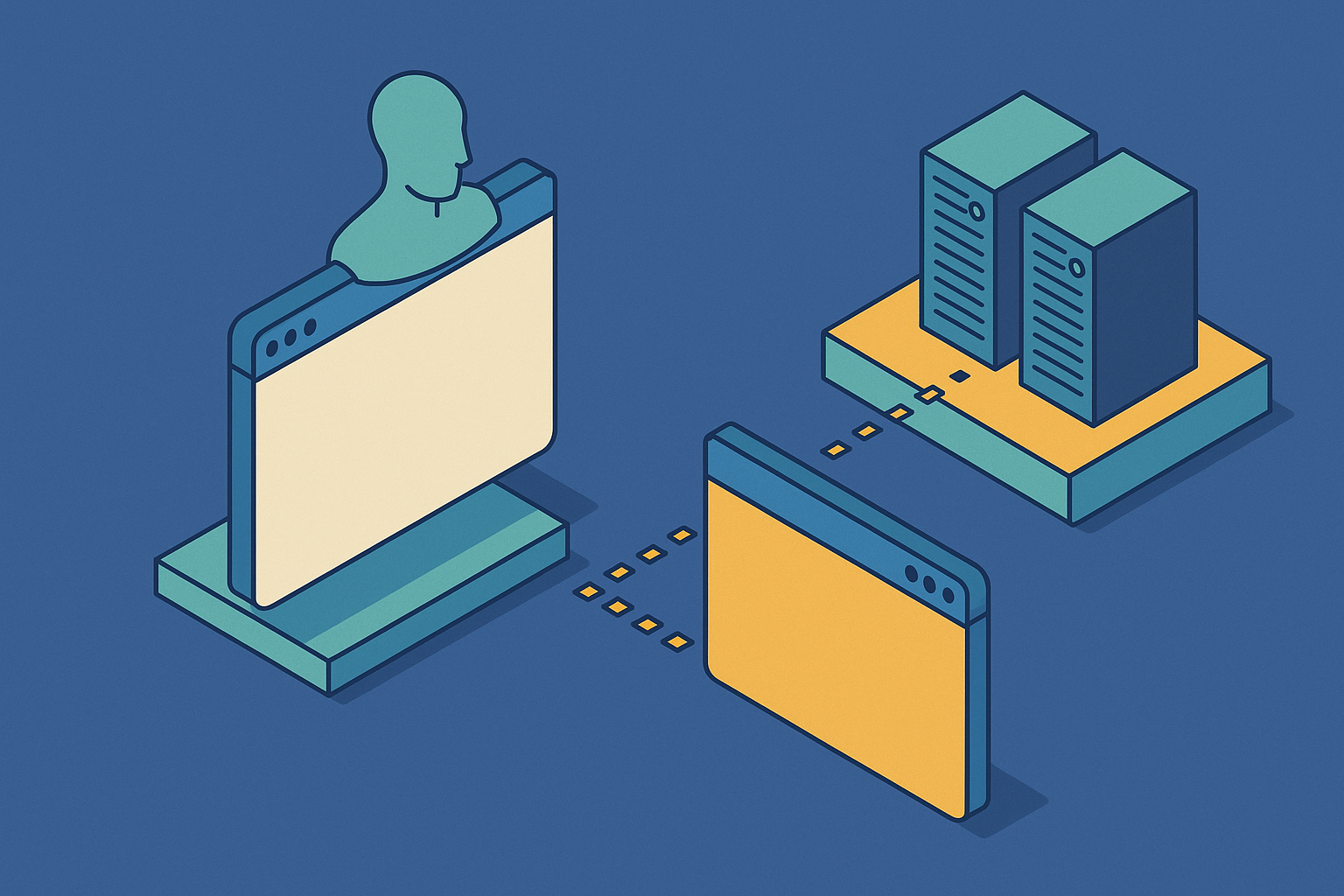
A headless browser is a full copy of Chromium, or something close to it, running with no screen attached: it executes JavaScript, loads images and fonts, holds cookies and session state, and does everything a real browser does except show anything to a person. That's the engine underneath most web scraping, automated testing, PDF generation, and now agentic browser control. This piece isn't about which framework to pick or which browser version to pin; it's about where that browser process actually runs, who keeps it alive, and how those two answers change what a team can build. On that question, the industry's default answer, "just containerize it and scale out," fails for more workloads than most teams assume, and sticking with it past a certain point is how good engineering hours get spent on plumbing instead of product.
Each session carries real weight. RAM climbs with page complexity, CPU spikes hard during rendering, and the process itself needs a lifecycle: start it, watch it, kill it, restart it when it dies. Memory leaks aren't some rare failure mode that shows up on a bad day; at scale, they're just what happens, and a Playwright script that runs fine on a laptop will, with some regularity, start failing in ways nobody predicted once it hits production. That gap between "worked locally" and "fell over under load" is where most of this argument lives.
Three things decide the architecture, and they matter more than anything about the browser itself: where the process runs and who manages it, how close that execution point sits to the data or user it's serving, and how the whole setup holds up as sessions climb from ten to ten thousand. Framework debates and version-pinning arguments are secondary to these three, worth naming up front so the rest of this doesn't get lost arguing about Puppeteer versus Playwright.
How the two execution models are structured
Two models dominate, and most teams pick between them for the wrong reason: familiarity, not fit. The first puts Chromium inside a container, Docker or something similar, running on a regular cloud instance or a regional serverless function. The team running it owns everything: browser version, memory limits, concurrency caps, what happens when a process crashes mid-session. That ownership means updates, leak monitoring, cleanup scripts, and CI integration all sit on the operator's plate. Going from tens of concurrent sessions to hundreds isn't a matter of adding more of the same; it usually means rebuilding the architecture, and the jump rarely scales in a straight line.
The second model is edge-native. Managed browser instances run co-located with a CDN's points of presence, so execution happens at the network edge instead of one regional data center. The provider owns the browser's lifecycle: version updates, keeping one process isolated from another, memory management, scaling up and down. A developer sends an API call or a snippet of code, the edge network spins up a session, runs the task, hands back the result. What gets given up is granular control over the exact execution environment, and that trade is explicit; it's the whole point of the model.
Here's the part most teams skip past: these two models encode different answers to a basic question, namely who owns the complexity, the team or the platform. Most teams never actually decide that; they inherit whatever their first prototype happened to use, and that's usually where the trouble starts. Self-managed should be the exception a team argues its way into, not the default it backs into by accident.
Cold-start latency and what it costs in practice
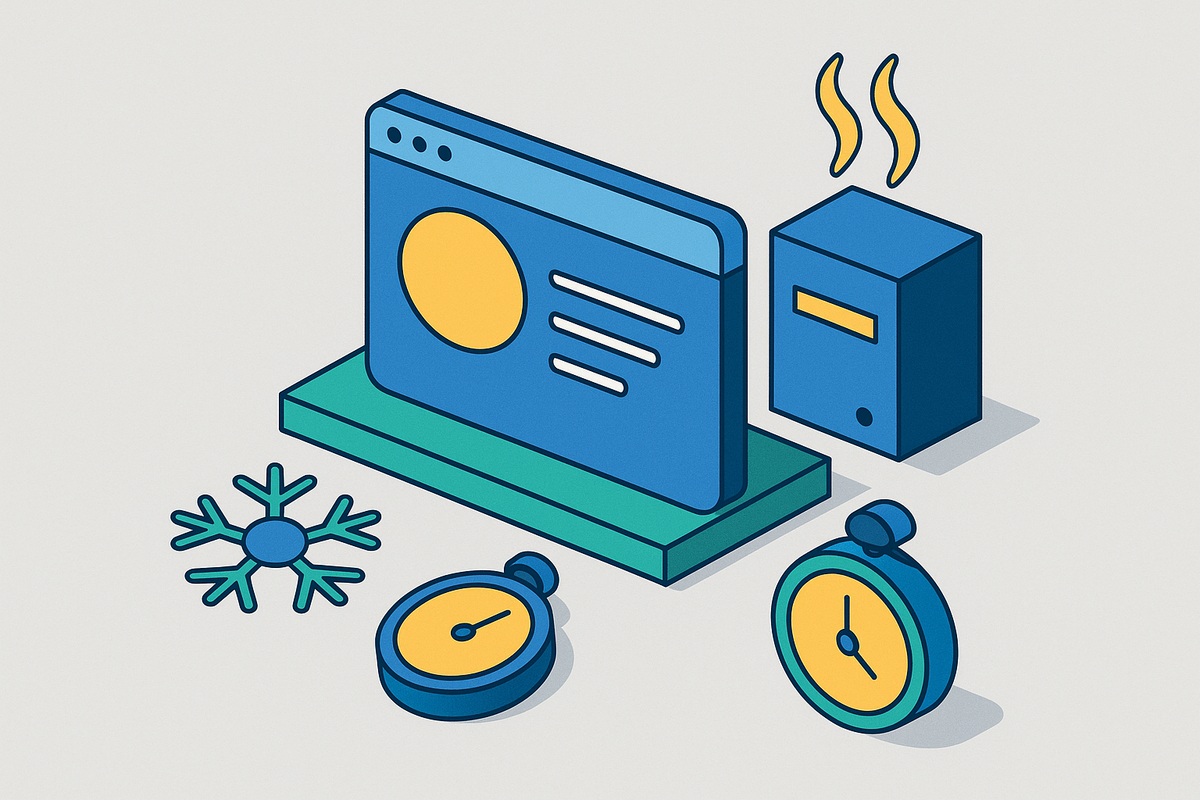
Cold starts are usually the biggest source of latency in function-based browser automation. Before any useful work happens, a container has to get pulled down, initialized, and a browser process launched inside it. In traditional serverless setups, that initialization tax can run from a few hundred milliseconds to over a second, before the automation task itself even starts.
Edge runtimes that use V8 isolates instead of full containers carry a much lighter startup cost. Isolate-based startup, the kind behind Workers-style compute, can land under a few milliseconds, which for practical purposes makes the cold start disappear.
Put rough 2026-era numbers side by side and the gap gets concrete. Workers-class edge functions carry materially lower average latency and tighter peaks than container-based alternatives. Compare that to platforms averaging around 200 milliseconds with peaks well past a second, or others averaging around 250 milliseconds with peaks in a similar high range. Edge runtime variants of those same platforms close most of that gap considerably.
Whether that difference matters depends entirely on the job. For anything interactive, a screenshot fired off on demand, live content extraction, a PDF generated the moment someone clicks a button, that cold-start tax lands directly on the user's experience, and nobody wants to wait a second and a half for a screenshot. For batch jobs running overnight or pulling from a queue, that same latency barely registers; the metric that matters there is throughput and cost per session, not how fast the first millisecond feels. Cold-start sensitivity is a property of the workload, and treating it as a universal argument against containers is how teams end up over-engineering batch pipelines that never needed edge compute in the first place. That's a more common mistake than the reverse.
Geographic distribution and why proximity to the request changes the automation calculus
A cloud function runs in one region, maybe a handful, and a user sitting far from that region pays a round-trip latency tax on top of whatever the cold start already costs. Edge-native execution places the browser session physically close to wherever the request came from, which can pull total round-trip latency down meaningfully compared to centralized functions, approaching single-digit or low double-digit milliseconds at a CDN point of presence.
That gap compounds in specific situations. Automation rendering pages whose own content is geographically distributed, CDN-served assets, geo-targeted copy, feels this directly, and so does scraping, especially when the target site serves different content by region and getting an accurate read depends on actually sitting in that region. Any agent workflow chaining several browser steps together feels every one of those milliseconds add up across the chain.
Self-managed setups can chase this by deploying containers across multiple regions, but that doesn't remove the operational burden. It multiplies it: now there are several regions of infrastructure to patch, monitor, and keep in sync instead of one. Edge-native distribution comes bundled with the managed lifecycle already described, while self-managed multi-region means the team owns both problems at once. That's the reason teams underestimate what "just deploy to three regions" actually costs in engineering hours, and it's usually the sentence that gets said in a planning meeting right before the timeline doubles.
Operational overhead of self-managed browser fleets at scale
At small scale, none of this is hard. Tens of concurrent sessions run fine on one well-resourced machine with a fairly simple Docker setup and standard monitoring tools. The trouble starts higher up, and it starts faster than most teams expect.
Push into the hundreds or thousands of concurrent sessions and the operational surface stretches thin fast. Every browser version upgrade now needs compatibility testing across the entire fleet of automation scripts before it ships, memory leak detection has to run continuously rather than as a one-off check, and crashed processes need automated recovery, because a dead browser sitting in a session queue doesn't just fail quietly, it blocks everything behind it. CI/CD pipelines for browser automation have a reputation for fragility that's earned: scripts that pass cleanly on a developer's machine fail inside containerized pipelines because the environments aren't actually identical, no matter how carefully the Dockerfile gets written.
None of this is a cost paid once. It comes back with every browser update, every infrastructure change, every new workflow bolted onto the fleet. Managed cloud browser services, whether edge-native or regionally hosted, offer a flat, predictable compute rate instead, something in the neighborhood of $0.10 an hour in some offerings, according to Hyperbrowser pricing data, turning unpredictable engineering hours into a line item that's easy to forecast.
There's a counterargument worth taking seriously, though. At very high session volumes, fixed hardware costs can end up more predictable than per-session billing, and that's the real financial case for staying self-managed once volume gets large enough. But it's a narrower case than it sounds: managed, cloud-native platforms can hit throughput roughly three times higher than comparable self-managed setups, which closes the cost-per-task gap even when the sticker price per session looks worse on paper. The "self-managed is cheaper at scale" argument holds up less often than the people making it think, mostly because they never actually ran the throughput math before deciding.
Billing model differences and how compute pricing shapes architecture decisions
Self-managed infrastructure charges a fixed cost no matter how busy it actually is, and idle browsers sitting between jobs still draw against the hardware budget, whether they're doing anything or not. Traditional serverless functions bill by invocation and duration, which sounds tidy until the clock turns out to include idle wait time and initialization overhead, quietly padding the bill.
Edge-native and other consumption-based models charge only for the work actually done: no idle server time, no wall-clock charge ticking during a cold start. At moderate to high request volumes, tens of millions a month, that difference stops being trivial. Edge-native pricing can land meaningfully below what a comparable regional serverless setup would cost.
The billing model shapes more than the invoice, though. It shapes how teams build. Fixed-cost self-managed setups tend to push teams toward over-provisioning: buying enough capacity to survive peak load and paying for that headroom even when it sits unused most of the time. Consumption-based billing pushes the opposite instinct, since idle time is now a line item somebody notices, which is exactly the pressure that produces leaner automation and faster-finishing sessions. Per-session managed pricing makes forecasting simple, right up until session duration runs long or isn't well bounded, at which point it can get expensive fast.
Matching the billing model to the shape of the workload is the honest takeaway here, and it cuts against how most teams actually choose. Bursty, unpredictable automation fits consumption-based edge pricing well, while steady, high-volume batch work often fits self-managed fixed costs better. Teams that pick the billing model first and force the workload to fit it are the ones who end up surprised by the invoice.
Where AI agents change the infrastructure requirements
Traditional automation is deterministic: a CSS selector breaks, the script breaks, end of story. Browser agents work differently. An LLM looks at what's rendered on screen and reasons about it, so if a button's class name changes from one string to another, the task doesn't necessarily fail, because the model still recognizes it as the submit button.
This isn't a niche experiment anymore. Survey data from 2025 put a majority of organizations, 62%, already experimenting with or actively using AI agents, part of a broader climb in AI adoption generally, from 78% in 2024 to 88% in 2025. Agentic browser automation is well past the proof-of-concept stage, and infrastructure that was fine for scripted automation starts showing its age fast once agents enter the picture.
That shift changes what the infrastructure has to handle. Agents run multi-step, often branching workflows, so sessions need to stay alive across multiple LLM reasoning calls, not just survive a single page load. Fault tolerance gets harder too, since an agent task can fail at any reasoning step along the way, not only at the usual network or render failure points. And latency compounds in a way traditional scripts never had to worry about: ten sequential browser steps, each carrying a 200-millisecond cold start, add up to two full seconds of pure initialization overhead before the isolate-based alternative even breaks a sweat.
A handful of frameworks have emerged to handle this in production. Browser Use posts an 89.1% success rate on the WebVoyager benchmark, a suite of 586 diverse web tasks. Skyvern comes in close behind at 85.8% on the same benchmark, with roughly 22,000 GitHub stars as of August 2026. Worth flagging too: cryptographic bot identification, proving an automated client is legitimate rather than malicious, is turning into a compliance question as much as a technical one, a thread picked up more fully next.
The anti-bot tension embedded in browser automation
Here's a tension baked into the whole category, and self-managed teams tend to underestimate it until it costs them a launch: headless browsers are, by default, easy to spot. Missing fingerprints that a real browser would have, timing patterns that don't match human interaction, and telltale signatures of automated clicking all trip well-configured anti-bot systems.
Self-managed Chromium instances sit at the most exposed end of this problem, and the exposure is structural, not incidental. Operators running their own fleets have to build evasion separately, and that's a moving target, since bot defenses keep evolving to catch whatever worked last quarter. Some managed cloud browser platforms have made anti-detection their specialty, using machine learning to run automation against sites with heavy protection: social platforms, ticketing systems, e-commerce checkouts. That's the correct default for anyone shipping against protected targets, and treating anti-detection as a bolt-on feature to add later is the mistake that gets a scraper blocked in week two.
Edge-native operators running inside a major network sit in a structurally different spot. The same network that handles bot mitigation for protected origins can also vouch, cryptographically, that a given piece of outbound automation is legitimate. Context matters here: in 2025, 40% of global bot traffic originated from the United States, and major cloud providers accounted for roughly a quarter of all bot traffic worldwide, which shapes how target sites already tend to view requests coming from cloud IP ranges. The broader threat backdrop underlines why this matters: DDoS attack volume rose 121% year over year in 2025, with the single largest recorded event hitting 31.4 terabits per second. In an environment like that, proving who's making a request, and why, becomes as important as making the request at all.
The real question for a team choosing between models involves how the site or API on the other end is going to read that traffic, and whether the platform underneath gives it a defensible identity. Skip that question and even a technically flawless scraper ends up blocked within days, a failure mode that has nothing to do with code quality and everything to do with infrastructure choice. Most teams debug this as a code problem for weeks before anyone checks the IP reputation of the box the script is running on.
Developer experience differences across the two models
Self-managed setups hand over full control: browser version, launch flags, the exact shape of the execution environment. Local development matches production because there's no abstraction sitting between the developer and the actual browser process. Debugging is direct, since attaching a debugger, inspecting the running process, and reading logs straight off the OS all stay available. But the cost shows up early: getting Docker, Playwright, and CI to all agree on one environment takes real setup time before a single automation script runs in production.
Managed platforms flip that trade. A quick-actions tier can hand back a screenshot or a structured scrape result within minutes, no infrastructure to stand up first. But local development and production can drift apart, since testing against an edge runtime locally takes its own tooling investment, and debugging loses some of its directness as a result: the browser process lives somewhere remote and managed, so the way in is through logs and returned artifacts rather than a process a developer can reach into directly.
Which one wins depends heavily on team makeup. Teams without dedicated DevOps capacity get the clearest win from a managed model, since it takes browser lifecycle work off their plate entirely, and that's the deciding factor more often than raw session volume. Teams running high-volume batch workloads with real infrastructure expertise on staff might find the extra control of self-managed execution worth the overhead it demands. Teams that assume they'll "figure out DevOps later" usually end up paying for that decision right around the time their session count crosses into the hundreds.
Matching execution model to workload type
No single model wins across every workload; the right answer depends on which constraint bites hardest for the use case in front of you. Interactive, latency-sensitive tasks, where a user is waiting on the other end for a screenshot or a scrape result, favor the edge-native model, since cold-start latency in the single-digit milliseconds and geographic proximity to the request both work directly in the user's favor. Edge runtimes built on V8 isolates, the approach behind Cloudflare Workers, skip container initialization entirely and hit cold starts under 10 milliseconds by design, which makes that startup delay effectively invisible during an interactive task.
Steady, high-volume batch work, the kind that runs overnight against a fixed set of targets with no one watching a spinner, favors self-managed infrastructure, where fixed hardware costs and full control over the execution environment can outweigh the operational overhead once volume justifies it. Agentic workflows sit somewhere in between, leaning edge-native as step counts climb, since compounding cold starts across ten or twenty sequential reasoning steps punish container-based execution far more than they punish an isolate that starts in a few milliseconds.
Cold starts, geography, operational load, billing, and bot detection got walked through separately here rather than folded into one blended verdict, because each axis pulls toward a different answer depending on the workload in front of it. But if there's one bias worth naming plainly: most teams default to self-managed out of habit, not analysis, and most of them would be better served starting edge-native and earning their way into self-managed infrastructure only once the throughput numbers actually demand it.