headless browser services with built-in edge network execution
Distributing browser execution across edge networks cuts latency and costs at scale.
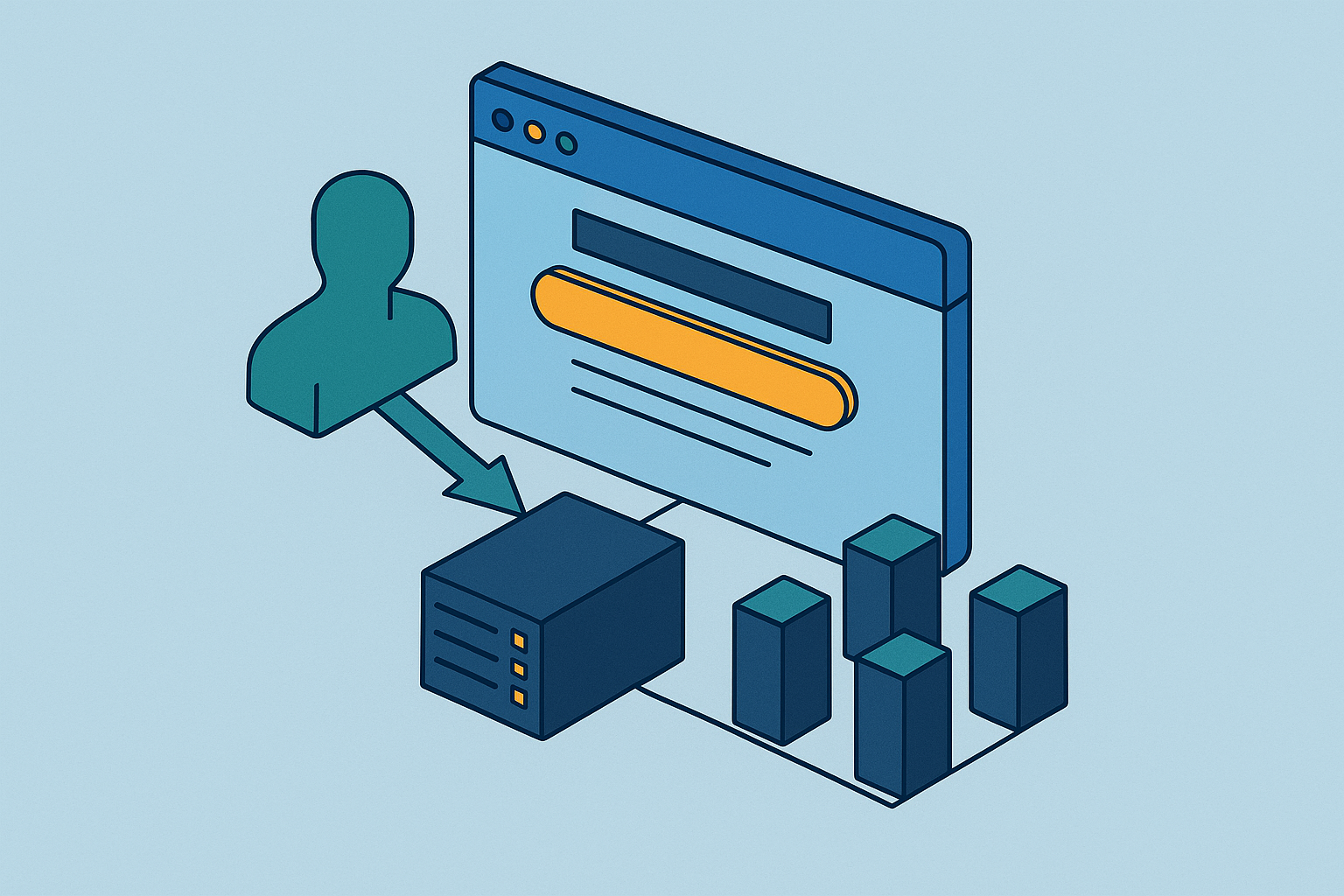
A headless browser is a real browser engine, Chromium, Gecko, or WebKit, running without a screen attached. It parses HTML, builds a DOM, runs JavaScript, fires off network requests, all exactly like the copy of Chrome sitting on a laptop. What changes is where that engine physically runs, and that single decision is the one most teams get wrong: they treat it as an implementation detail when it's actually the thing that determines whether the service holds up at scale. Most of the industry defaults to one cloud region serving the whole world, everyone paying the same latency tax, and almost nobody stops to ask why that default still stands.
Why running headless browsers from a central cloud region is the wrong default
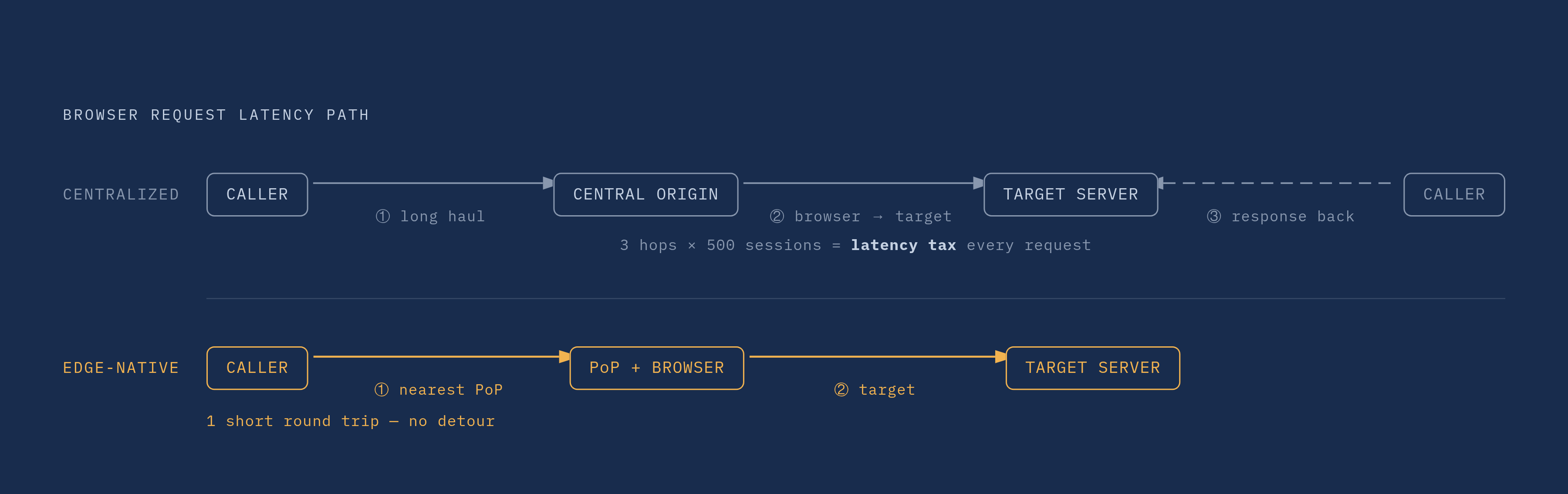
Most headless browser services work the same way: spin up a pool of Chromium instances in one cloud region, maybe two, and route every request there no matter where the caller or the target site actually sits. It's the easy way to build the thing, and at low volume it holds up fine. Push concurrency up, spread the targets across continents, and the geography starts costing real money and real time. That's a cost worth examining rather than tolerating quietly. At real scale, or for anything time-sensitive, the centralized default carries real drawbacks, and the rest of this piece is largely an argument for why.
Trace the actual path a single scrape or test takes. The calling code sends a request to the regional origin, the origin's browser instance reaches out to the target server, and the response travels back to the origin, gets processed, and only then heads back to whatever triggered the request in the first place. Three long hops before anything useful happens, each one adding real round-trip time. Run one request and it's nothing. Run 500 concurrent sessions against targets scattered across continents, though, and that same tax gets paid 500 times over, compounding into minutes of wasted time on a job that should take seconds.
For an AI agent making decisions in something close to real time, that wait doesn't just slow things down. It breaks the loop the agent depends on. An agent that browses, observes, and decides can only move as fast as its slowest step, and a centralized browser sitting several hops from both the agent's compute and the target page is usually that slowest step. Trace it back far enough and the problem is architectural: this design was built for batch jobs that can absorb a few extra seconds, and that assumption strains against a loop that fires hundreds of times inside a single task.
Shared pools bring problems that have nothing to do with distance, too. When browser instances share memory or state across tenants, session bleed stops being theoretical, and one customer's heavy workload drags down performance for everyone else parked in the same pool: the classic noisy-neighbor problem. A compromised instance in that kind of shared environment also has a wider blast radius, so the security exposure scales with however many tenants got crammed into the pool.
Then there's the cold-start tax. Container-based execution has to provision a container, load the function, and only then execute, and that sequence adds a real penalty on the first invocation after any idle period. Painful for a batch job. Genuinely disruptive for a latency-sensitive agent that can't tolerate a multi-second stall before its first browser action even fires. Scaling a centralized region doesn't fix any of this either: adding more capacity in the same data center does nothing about the calling code, or the target server, or both, sitting somewhere else entirely. Layer the billing model on top, wall-clock session time or idle capacity charged whether or not the browser actually did anything, and the centralized approach ends up expensive in ways that have nothing to do with the work performed.
How embedding browser execution inside an edge network changes the architecture
An alternative puts the browser inside the network fabric itself, instead of parking it in a data center that reaches out to the network from a fixed point. The browser instance runs at whichever point of presence sits closest to the target resource or the calling code, not at one regional origin trying to serve the whole planet. A well-built edge network runs many dozens of those points of presence, spanning cities and countries rather than one or two regions stacked with everyone's traffic.
Anycast routing handles the geographic matching automatically. The nearest available point of presence picks up the session without a developer writing region-selection logic into the application by hand. There's no trade-off to negotiate between "close to the caller" and "close to the target," because the network fabric is spread out enough that both conditions are usually satisfied at once.
The isolation model changes just as much as the geography does. A V8 isolate handles each browser session in place of a container, the same sandboxing model that lets a JavaScript engine spin up an isolated execution context far faster than a container needs to provision. That speed gain cuts the cold-start penalty by a wide margin, since the runtime is already sitting at the edge node, waiting. And because each session lives in its own isolate, a compromised or misbehaving session stays contained there instead of threatening the whole shared pool.
The operational overhead that used to eat weeks of engineering time shrinks along with it: no Chromium version to patch and redeploy on a schedule, no browser pool capacity to forecast against traffic spikes, and no region-selection branch buried somewhere in the application code. Scaling becomes the network's problem: more concurrent sessions means more points of presence absorb the load, distributing demand instead of straining a single cluster somewhere.
The billing model follows directly from the architecture: pay for actual browser work, rather than for a warm instance sitting idle waiting on the next request. For an AI agent that needs to browse, scrape a page, and act on what it finds, over and over, that's the part that actually matters. The browser capability lives where the agent's own compute lives, easing the several network hops away in a data center the agent would otherwise have to keep phoning.
The services landscape for edge-native headless browser execution
The market for managed browser services spans a real spectrum now: fully managed cloud APIs, self-hosted open-source stacks, and edge-native offerings where execution happens inside the network fabric itself.
A few dimensions separate these services in ways that matter more than the marketing copy suggests. Execution model comes first: shared pool, selectable multi-region instance, or edge isolate, and each implies a different latency floor before anything else is even considered. Protocol support is second: some services expose only a REST API, others offer full Puppeteer and Playwright compatibility, and some go further still and expose the Chrome DevTools Protocol directly for teams that need that level of control. Geographic spread matters just as much: single region, multi-region with manual selection, or true anycast distribution across dozens of points of presence. Then there's state: does a session carry over across multiple steps of a workflow, or does every call start from a blank page, again, every time?
Established managed Chromium services like Browserless offer REST and WebSocket APIs with Puppeteer and Playwright compatibility, running mostly out of centralized infrastructure. Scraping-focused cloud browser APIs such as ScrapingBee and ScrapingAnt lean into residential proxy integration for data extraction work, also from centralized regions. Bright Data's Scraping Browser targets high-volume scraping pipelines with proxy network integration built in from the start.
Cloudflare's Browser Rendering sits in the edge-native category: headless Chromium runs directly inside its global network through Workers bindings, sessions instantiate at whichever point of presence sits nearest, and it supports the full Puppeteer and Playwright API surface, with both a stateless REST API for one-off tasks and stateful Workers bindings for anything multi-step. One detail worth sitting with: it identifies its traffic as automated through cryptographic signatures, an approach distinct from trying to pass browser sessions off as human visitors. Cloudflare also offers Browser Run, which pushes that same edge-native capability toward AI agents specifically, with live view, human-in-the-loop controls, CDP access, and session recordings built to plug into agent orchestration directly, ahead of any afterthought API layer.
That identity question, bot or impersonator, is turning into a real procurement question rather than a philosophical one. A service that cryptographically declares itself as automated traffic leaves an auditable record a site operator can point to when checking terms-of-service compliance. A service built to mimic a human visitor, by contrast, creates legal and reputational exposure for whoever runs the pipeline, exposure that surfaces the moment a target site's fraud team goes looking for it. Compatibility is the other unglamorous requirement that ends up mattering more than most feature lists: a team that already built its automation logic on Playwright or Puppeteer shouldn't have to rewrite any of it just to move to a managed service. API surface compatibility is a baseline requirement worth weighing alongside any other feature.
How AI agents specifically stress-test headless browser infrastructure
Batch scraping and automated test suites run one browser action, get a result, move on. Agents run in a continuous loop instead, and that difference is exactly what breaks infrastructure built for the batch case.
An agent runs: browse, observe, decide, act, repeat. Every step has to finish before the next one starts, so any latency inside that loop compounds with each cycle rather than staying fixed. An agent workflow might run for minutes or stretch across hours, which means it needs browser state that carries across steps, rather than a fresh blank session on every call. Some agent workflows need a human to check in at a decision point, which makes live view and human-in-the-loop controls an infrastructure requirement worth planning for upfront. And because agents often write code on the fly to finish a task, the browser environment has to be sandboxed against code nobody wrote or reviewed at deploy time.
Statelessness is the core mismatch. A browser API that resets on every call works fine for a single screenshot or a one-shot scrape; a ten-part agent task needs a session that actually carries context between steps. Durable Objects offer one answer: each agent runs as its own Durable Object, carrying persistent storage, SQLite, WebSocket connections, and scheduling alarms that let it resume exactly where it left off after an interruption, saving the whole task from starting over from scratch. Persistent code interpreters solve a related problem, keeping variable scope and imports alive across steps so an agent's code execution behaves like an ongoing notebook session rather than a pile of disconnected script runs.
Gartner's June 2025 survey of 3,412 organizations projected that a substantial share of agentic AI projects will get canceled by the end of 2027, citing rising costs, unclear value, and weak risk controls. Worth sitting with that finding rather than skimming past it, because it reframes infrastructure choice as a cost governance question as much as a technical one. A browser fleet that bills for idle time, or keeps warm instances running whether or not they're doing anything, makes every agent loop cost more than it should, and that expense compounds fast across a workflow running thousands of loops a day. Risk controls, meanwhile, need observability to mean anything at all: session recordings, CDP event streams, gateway-level logging. Those serve as the audit trail that lets an organization actually govern what its agents are doing, alongside debugging them after something goes wrong.
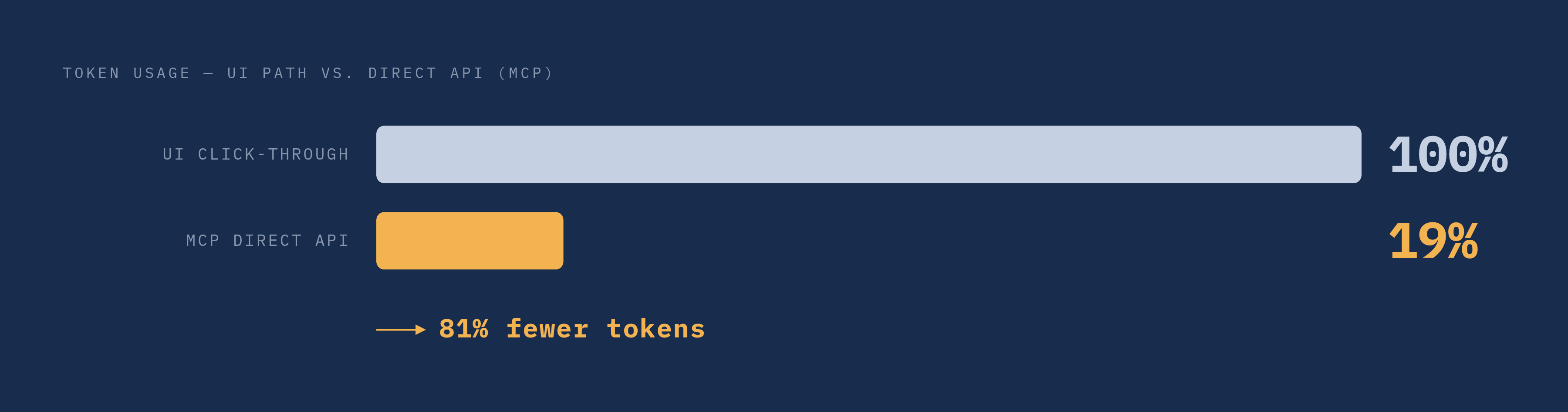
Token economics matter here too. A well-built MCP (Model Context Protocol) server that lets an agent call an API directly, instead of clicking through a page's UI one step at a time, can cut token usage by 81%, which changes the underlying economics of running agents at any real volume.
Headful browsing, meanwhile, is becoming the sensible default for agentic work that has to cross anti-bot surfaces built specifically to catch automation. That complements headless-first bulk scraping rather than replacing it; it's the other half of a hybrid strategy, and the two only work together if the underlying infrastructure supports both modes from the same binding surface instead of forcing a rebuild every time a team needs to switch between them. Agents that write and run their own code raise a further requirement on top of all this: a genuinely sandboxed Linux environment, alongside a browser isolate. Cloudflare's Sandbox, reaching general availability in April 2026, adds persistent Linux environments with PTY support, file management, and R2-backed persistent storage, accessible from the same Workers runtime that runs the browser itself.
Security properties that edge execution adds to headless browser deployments
None of this matters if the browser itself becomes the attack surface, and a headless browser running arbitrary web content is exactly that: a plausible vector for credential harvesting through redirect chains, malicious script execution, and data exfiltration through browser APIs that were never built with an automated caller in mind.
Remote Browser Isolation tackles this head-on as a Zero Trust control. Rendering happens remotely, and the local device or calling application only ever gets a visual stream or structured output back, never the raw page content itself. A zero-day exploit embedded in a page, a drive-by download, a malicious script: all of it stays boxed inside the remote browser environment rather than reaching whatever called it. For an AI agent specifically, that isolation boundary is what stops a compromised or malicious page from tricking the agent into leaking proprietary data back through a browser session it was never supposed to fully trust in the first place.
Spreading execution across an edge network adds a second layer of defense that has nothing to do with the browser itself. Built-in DDoS protection covers the service's endpoints from volumetric attacks, which matters given that any publicly reachable browser API is a plausible target on its own merits. WAF rules filter malicious inbound requests before they ever reach a browser instance, and because anycast spreads incoming traffic across every point of presence at once, an attack aimed at overwhelming a single origin instead lands diffused across the whole network rather than piled onto one address.
Identity enforcement closes the loop. Zero Trust access controls decide which agents, services, or human users get to spin up a browser session in the first place, working as a gate positioned early rather than bolted on later. Every session can get logged and tied to a specific identity, subject to data loss prevention policy the same way any other sensitive workload would be. That's the governance layer that turns the Gartner risk-control concern from the previous section into something an organization can actually audit rather than just worry about in the abstract.
The cryptographic bot identification question from earlier turns out to be a security property too, alongside an ethical one. A cryptographic signature on every automated session builds a chain of attribution that holds up when a scraping pipeline gets audited, or when a security incident needs forensic reconstruction after the fact. Traffic trying to pass as human leaves no such trail behind; traffic that declares itself does.
What to actually evaluate when choosing a headless browser service for edge workloads
Start with execution model before looking at any feature list. Where does the browser instance actually run: a shared pool in a single region, a fleet across selectable regions, or an isolate at the nearest edge point of presence? That single answer sets the latency floor, the isolation guarantee, and the cold-start behavior for everything built on top of it, and no pile of extra features fixes the wrong execution model for a given workload. This is exactly where most teams get the evaluation backwards: they compare pricing tiers and API docs first, and ask where the browser physically sits last, if they ask at all. Flip that order around.
From there, match the service to the actual job. Batch scraping and test suites care about throughput, concurrency limits, cost per session, and Playwright or Puppeteer compatibility; headless-first makes sense for nearly all of this work, no argument there. Agentic workflows need something different: sessions that carry state, storage that survives across steps, live view, human-in-the-loop controls, and CDP event streaming, because the agent's loop depends on state that a stateless API simply cannot hold onto. SEO prerendering for JavaScript-heavy single-page apps cares most about latency to first byte and how faithfully the browser executes JavaScript before a crawler ever sees the page, which makes edge proximity the dominant variable on the spec sheet. Any AI-integrated pipeline needs to be checked against the cost and governance concerns raised earlier, too: does the billing model charge for idle time, and does the service produce the kind of session logs and recordings that make an agent's behavior auditable after the fact, beyond just visible in the moment it happens.
None of these questions has one universal right answer. What they share is a dependency on where the browser actually runs, which is the argument this piece keeps circling back to. Latency, isolation, and cost are consequences baked into the architecture the moment a service decides whether its browsers live in a data center or inside the network itself; they function as structural outcomes rather than settings a team tunes after deployment. Get that one decision wrong, and no amount of tuning afterward buys it back.