Cold Start Latency in Serverless Browser Functions
Launching Chromium adds latency that fundamentally differs from standard serverless cold starts.

Cold starts are not a new problem. Anyone who has operated serverless infrastructure at production scale has felt the particular frustration of watching latency metrics spike when traffic thins out, then spike again when it picks back up. The irony of serverless is that the very elasticity that makes it attractive introduces a cost paid in time, and that cost is paid by the user. For most standard functions, the tax is tolerable. For browser functions, it is not.
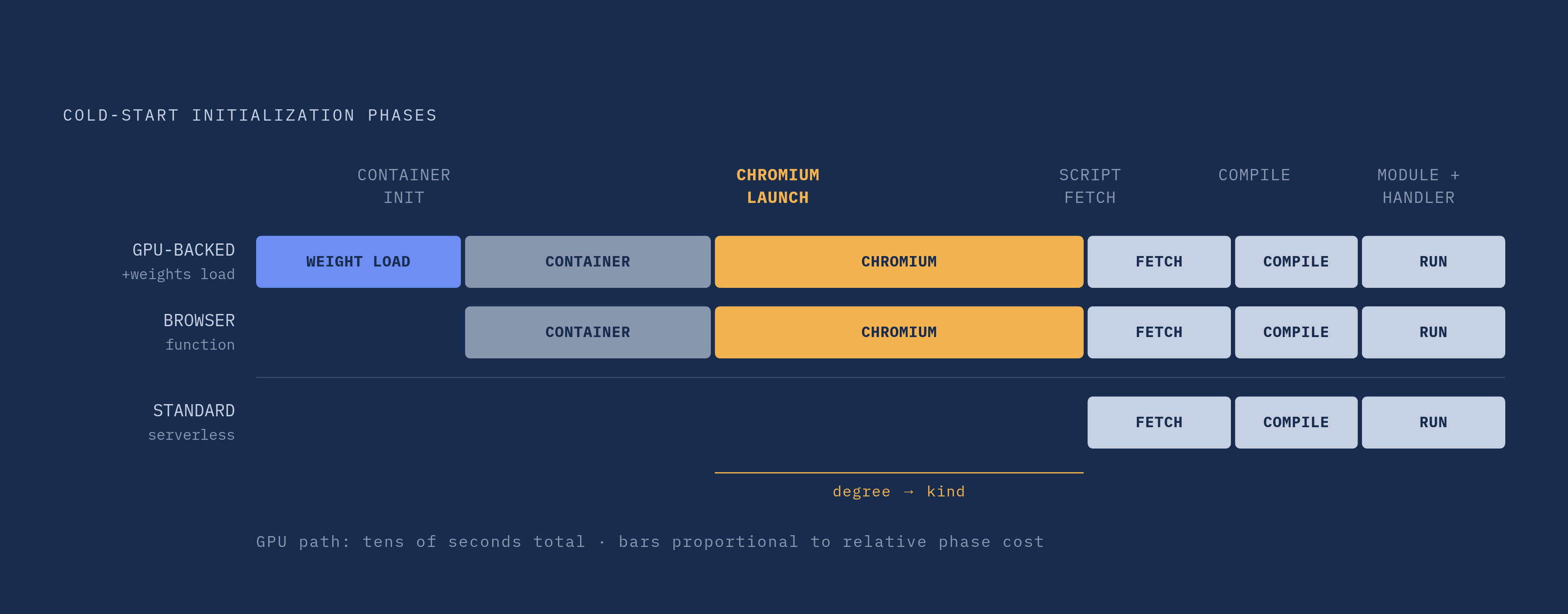
The gap between a request arriving and a useful response being returned is the cold start. It exists because the runtime must complete several phases of initialization before it can execute user code: fetching the script from storage, compiling it, running module-level code, and only then invoking the handler for the first time. Each phase is serial. None can overlap with its predecessor. This sequentiality is the reason cold starts are so difficult to eliminate rather than merely mitigate.
For standard serverless functions, this chain runs from hundreds of milliseconds to a few seconds depending on the runtime and deployment package size. For browser functions, there is an additional phase inserted before any of that work begins: Chromium must be fetched, launched, and brought to a navigable state. That single insertion changes the character of the problem entirely.
Why Cold Starts Hit Browser Functions Harder Than Standard Serverless Functions
The distinction worth preserving here is not merely one of degree. It is one of kind.
Standard serverless cold starts are dominated by script compilation and module execution. Optimize those two phases and you have meaningfully improved the situation. Node.js, Python, and similar runtimes launch fast; the binary cost is not the dominant term. Browser functions reverse this relationship entirely. The script compilation cost is nearly irrelevant compared to the cost of cold-launching Chromium inside a container.
Chromium is a large binary. It spawns multiple processes: a browser process, one or more renderer processes, and potentially a GPU process. Each of these must reach operational state before the function can load a page, let alone interact with one. Cold-launching that stack inside a container means paying container initialization costs first, then paying browser initialization costs on top. The latency stack is long, and every element within it is blocking.
GPU-backed inference functions compound this further. When a browser automation workflow feeds a large language model, the initialization sequence extends again: container pull, weight load, hardware warmup. The latency before a single token is produced can extend into the tens of seconds. That is not a worst case. That is a predictable outcome of chaining initialization-heavy systems.
The functions where this pain is most acute tend to share a profile. They are invoked on demand, often infrequently. They may be inside a VPC, where networking overhead accumulates on top of initialization time. They have large deployment packages. These are not edge cases; they describe a substantial fraction of real production workloads. Cold starts have remained the top developer complaint about serverless, and browser functions represent the most severe expression of the underlying problem.
How Cold Starts Compound When Browser Functions Are Chained Inside Agent Workflows
A single cold start is an annoyance. A chain of cold starts is a failure mode.
Modern AI agent pipelines are composed sequences. An intent classifier feeds a context retrieval step, which feeds a reasoning layer, which feeds a response generator, each step potentially residing in a separate serverless invocation. The crucial property of this architecture is that cold starts are additive, not averaged. If three functions in a six-step pipeline each cold-start independently, the user pays the sum of their initialization costs, serially, before receiving a response.
A P95 latency spike from two seconds to eighteen seconds within an hour is not a theoretical projection. It describes what happens when compounding cold starts hit a multi-function agent pipeline under conditions that are easy to reach in production: traffic that patterns unevenly, functions that have had time to evict their warm instances between invocations, and a pipeline architecture that treats each function as independently managed.
Browser-using agents amplify this further. Every tool call that routes to a browser function and cold-starts adds latency that the user perceives across the entire session. The session feels slow not because any one step is catastrophically delayed but because each step pays a toll, and the tolls accumulate.
Code-executing agents face an orthogonal initialization cost: repositories must be cloned, datasets loaded, environments established before execution can begin. A large repository clone can add several minutes of delay that no cold-start mitigation strategy addresses, because it is not a cold-start problem. It is a problem of pre-execution overhead, which compounds the same way.
The architectural implication is worth stating plainly: optimizing one function in isolation is insufficient. The user-facing outcome is determined by the pipeline as a whole. This reframes the mitigation question. Strategies that reduce cold-start probability at the infrastructure level, before the function is invoked, matter more for agents than strategies that shave milliseconds off compilation time inside a single function.
The Container Model's Structural Role in Browser Cold-Start Latency
Understanding where latency comes from requires understanding the execution model that produces it.
Traditional serverless browser functions run Chromium inside a Docker container. The container model is well-understood, broadly compatible, and deeply entrenched. It is not wrong. It is expensive for the browser-function workload profile, and the expense is structural.
Container startup cost is paid before any browser work begins. Image pull, process isolation setup, network namespace initialization: these steps complete in sequence before the browser binary ever launches. Once the container is live, the browser binary launches, spawns its subprocesses, and reaches a navigable state. Only then does the function begin its actual work.
Provisioned concurrency, the conventional mitigation, addresses this by pre-warming containers and holding them ready. It works. It also costs money whether or not traffic arrives, and it cannot scale to zero without reintroducing the cold-start problem it was deployed to solve. This is not a criticism; it is the trade-off.
A subtler problem emerges under dispersed architectures. In a distributed network, requests for a low-volume function land on geographically proximate servers, spreading instances thinly across many machines. Each machine may evict its local instance between requests, even when the system as a whole has warm capacity. The warm instances exist; they are simply not where the next request lands. The result is cold starts that appear random and are maddeningly difficult to reproduce in testing, because the conditions that produce them are a function of traffic patterns and server-level eviction policies that no individual developer controls.
Recognizing the container as the structural cause clarifies the solution space. There are two directions: optimize within the container model, or replace it with a lighter execution primitive.
Mitigations That Work Within the Existing Container and Session Model
For teams operating within the container model, meaningful improvement is available. The ceiling is real, but it is higher than many teams reach.
Session reuse is the single highest-leverage mitigation available within this architecture. Keeping a browser session alive across multiple requests eliminates the browser-launch cost for every request after the first. The mechanism is a persistent-process primitive, such as Durable Objects, that holds an open browser session and routes subsequent requests to it rather than cold-starting a new one. The trade-off is state management: a stuck or leaked session must be detected and recycled. This is tractable engineering, not a theoretical barrier.
Deployment package discipline is underappreciated. Every byte added to a deployment package lengthens the script-fetch and compilation phases. Tree-shaking, dependency auditing, and avoiding bundling the browser binary where the runtime already provides it are concrete actions with measurable outcomes. Python Workers without memory snapshots have paid roughly ten seconds of cold-start overhead loading common packages; memory snapshots captured after top-level module execution eliminate that reload on every subsequent cold start. That ten seconds is not recovered at compile time; it is recovered by moving expensive initialization out of the per-request path.
Pre-loading expensive resources at module-execution time rather than inside the request handler follows the same logic. Connection pools, compiled regular expressions, configuration parsing: anything placed at the module's top level runs once at startup and is reused across warm requests. This is basic and frequently neglected.
Traffic coalescing through scheduled warm-up pings is blunt but effective for workloads with predictable invocation patterns. The infrequently invoked function that serves a nightly batch job does not need sophisticated concurrency management; it needs to be kept alive between invocations.
None of these techniques eliminate the structural cost of launching a Chromium process. They reduce how often that cost is paid and how expensive the surrounding phases are when it is.
How V8 Isolates Change the Cold-Start Equation for Non-Browser Serverless Functions
The V8 isolate model represents a departure from the container model significant enough to change the character of the cold-start problem, at least for functions that can run inside one.
Isolates are lightweight sandboxes sharing a single process rather than independent OS processes. Spinning up a new isolate is inexpensive because the runtime is already running; the marginal cost of an additional isolate is low. Cloudflare Workers, built on this model, measured cold starts in single-digit milliseconds as a result.
The TLS pre-warm technique exploited a useful timing property: establishing a TLS connection takes longer than warming an isolate. Under five milliseconds for the isolate, versus the full TLS handshake round-trip time. By the time the client's first HTTP request arrived, the Worker was already warm. The cold start was hidden inside latency the client would have paid regardless.
This advantage eroded as the platform matured. TLS 1.3 reduced handshake round trips, narrowing the timing window. Simultaneously, maximum script size and startup CPU budget increased to support heavier applications, which lengthened cold-start duration for complex Workers and ate into the timing margin. The structural advantage of isolates remained, but the specific technique became less universally applicable.
The fundamental constraint persisted: isolates only apply to code that runs inside a V8 isolate. Until recently, browser engines were categorically excluded. Chromium is not a JavaScript library; it cannot be embedded in an isolate context. This was the hard boundary that separated the fast cold-start world of Workers from the slow cold-start world of browser functions. It is worth knowing where the boundary was, because what came after is defined in contrast to it.
Traffic Coalescing at the Infrastructure Level: How the "Shard and Conquer" Technique Reduced Cold-Start Rates by 90%
The eviction problem described above, where warm capacity exists but requests still cold-start because they land on wrong servers, is addressable at the infrastructure layer through traffic coalescing.
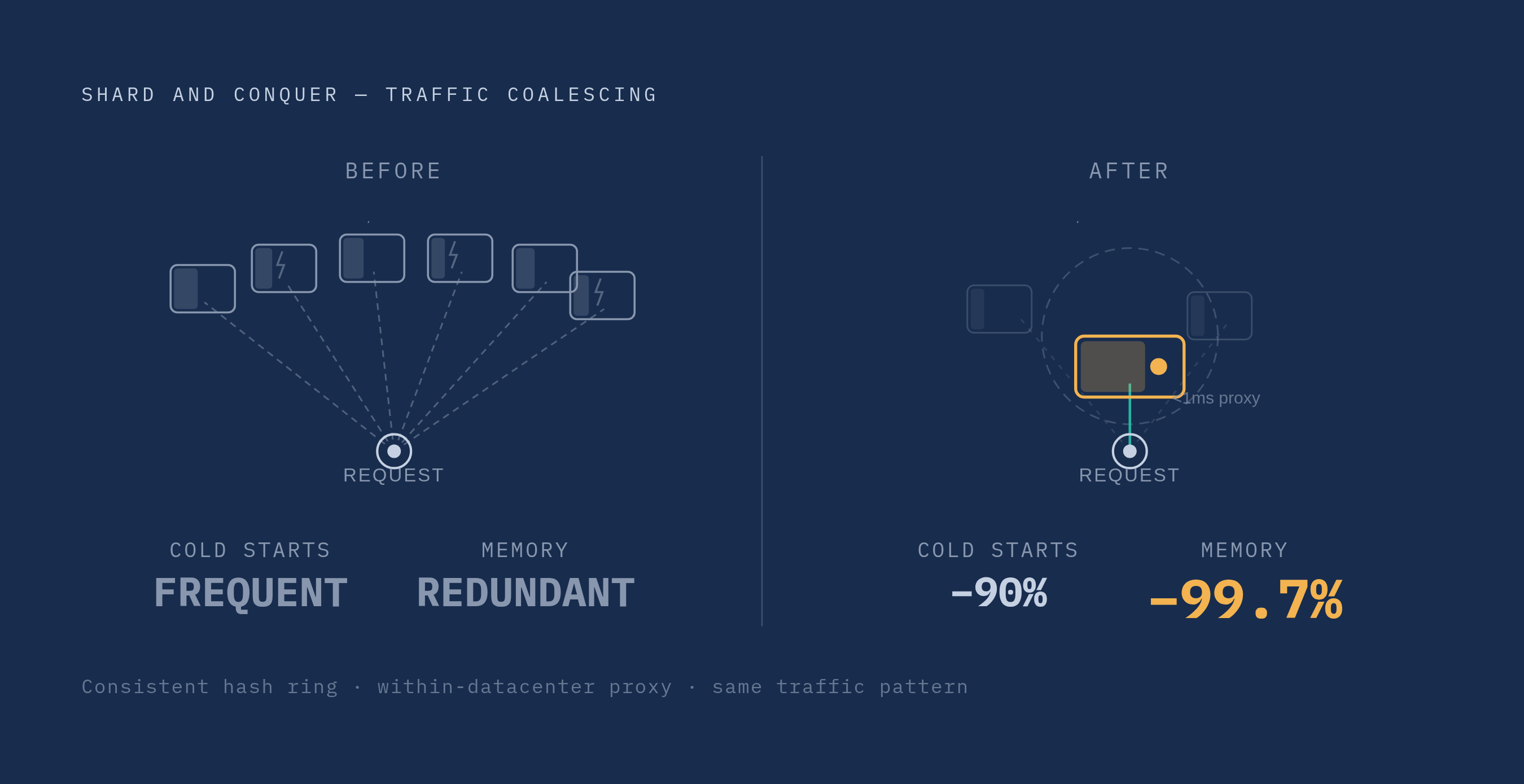
The Shard and Conquer technique routes all traffic for a given Worker to a single designated shard server within a data center using a consistent hash ring. The effect is that instances concentrate rather than scatter. A user may experience one cold start; after that, the shard server's instance stays warm and serves subsequent requests. Cloudflare reported a 90% reduction in cold-start rates and a 99.7% reduction in memory used to serve the same traffic pattern, because redundant warm instances across many servers are replaced by a single well-utilized instance on one server. Within-datacenter proxying adds less than one millisecond to time-to-first-byte: a negligible cost for the outcome achieved.
The efficiency gain is as notable as the latency improvement, and worth examining on its own terms. The memory reduction reflects how much waste the scattered-instance model generates. Keeping many partially-utilized warm instances alive across many servers to reduce cold-start probability is a fundamentally inefficient strategy. Coalescing traffic replaces it with a fundamentally efficient one.
What this technique does not solve is equally important to understand. Shard and Conquer addresses cold-start frequency: how often a cold start occurs. It does not address cold-start cost: how expensive a cold start is when it does occur. For browser functions, where the cold-start cost is dominated by the browser binary launch rather than script compilation, frequency reduction alone is insufficient. A less frequent cold start that still takes several seconds is still a problem.
What Browser Run Does and Where Its Cold-Start Overhead Comes From
Browser Run, a headless-browser service (formerly Browser Rendering, renamed in April 2026 after a rebuild on top of a container platform), represents the production solution for teams that need Chromium's full rendering capabilities within this ecosystem.
The rebuild on Containers enabled higher concurrency limits, more reliable session management, and faster iteration on new capabilities. The primary cold-start mitigation remains session reuse: Durable Objects persist open browser sessions so subsequent requests skip the browser-launch phase. A global pool of pre-warmed browsers distributed across the edge network reduces the probability that any given request encounters a cold start, opening sessions geographically close to users.
Three control surfaces give developers flexibility in how they interact with it. Workers bindings support Puppeteer and Playwright via maintained compatible forks. A REST API handles one-shot quick actions, including screenshot, PDF, markdown extraction, and structured-data extraction, billed on browser-hours consumed rather than uptime. A direct Chrome DevTools Protocol endpoint, added in 2026, allows any Puppeteer, Playwright, or CDP client to connect with a one-line configuration change and no Worker required, in any language that supports CDP.
Agent-specific features address problems that emerge specifically at the agent-workflow level. Live View lets a developer watch the agent work in real time, which is diagnostically valuable in a way that logs alone are not. Human in the Loop allows a human to be injected when the agent encounters a captcha, confirmation dialog, or other step that automated reasoning consistently fails to resolve.
The structural limitation persists regardless of these improvements. Browser Run still runs Chromium inside containers. Session reuse defers the browser-launch cost; it does not eliminate it. The container remains the execution primitive, which means the container's initialization overhead is still present on every cold start, and the browser binary's initialization overhead is still present on every session that cannot be reused.
Kitesurf: Removing the Browser Cold-Start Problem at the Architecture Level
What would it look like to solve the browser cold-start problem structurally rather than mitigating it? Kitesurf, announced in August 2026 as part of Agents Week, answers that question with a specific and interesting set of trade-offs.
Kitesurf is a browser engine written in Rust, compiled to WebAssembly, running entirely inside Workers V8 isolates. There is no Chromium binary anywhere in the execution stack. The phase that dominates browser cold-start latency, launching a large binary inside a container, is structurally absent because the execution model no longer accommodates it.
Because it runs inside an isolate, Kitesurf inherits the sub-five-millisecond cold-start profile of the Workers platform. It instantiates at any of 300-plus points of presence. The cold-start problem for browser functions, under this model, is resolved by removing its cause rather than working around it.
The design philosophy reflects a deliberate choice about what agents actually need from a browser. Tabs, themes, browser extensions, pixel-perfect rendering for human consumption, persistent authenticated user sessions: these are features that serve human browsing workflows. Kitesurf omits them. What it optimizes for instead is token count efficiency, context window management, scalability, and cost, which is a fair characterization of what an agent workload actually requires from a browser interaction. An agent navigating a web page to extract structured data does not need a GPU process. It needs DOM access, JavaScript execution, and the ability to communicate what it found to the next step in the pipeline.
The architecture distributes across three isolate-level components. The Engine manages the external interface and session state. PageScript handles page-level JavaScript, DOM state, and HTML and CSS processing. PageRenderer converts computed page data to images or PDFs.
The fault isolation property of this design is practically significant. PageRenderer holds no page state, only a disposable cache. If it gets stuck on a failed RPC call, the Engine can kill and relaunch it without restarting the session. Each render is self-contained and retryable. In a container-based architecture, a hung render process typically requires recycling the entire session. Here, it does not.
Migration path for existing tooling is a single parameter. Existing Puppeteer, Playwright, and CDP clients add browser=kitesurf to switch execution environments. No rewrite is required. Web Platform Test conformance exceeds hundreds of thousands of passing subtests as of the most recent run, with coverage continuing to expand.
The limitations are worth stating plainly because they define the boundaries of where Kitesurf applies. No video. No WebGL. No handling of TLS-fingerprint bot challenges. No persistent authenticated sessions yet. These are not temporary omissions in all cases; some reflect deliberate architectural choices about what the system is and is not for.
How Kitesurf's Resource Profile Compares to Chromium for Agent Workloads
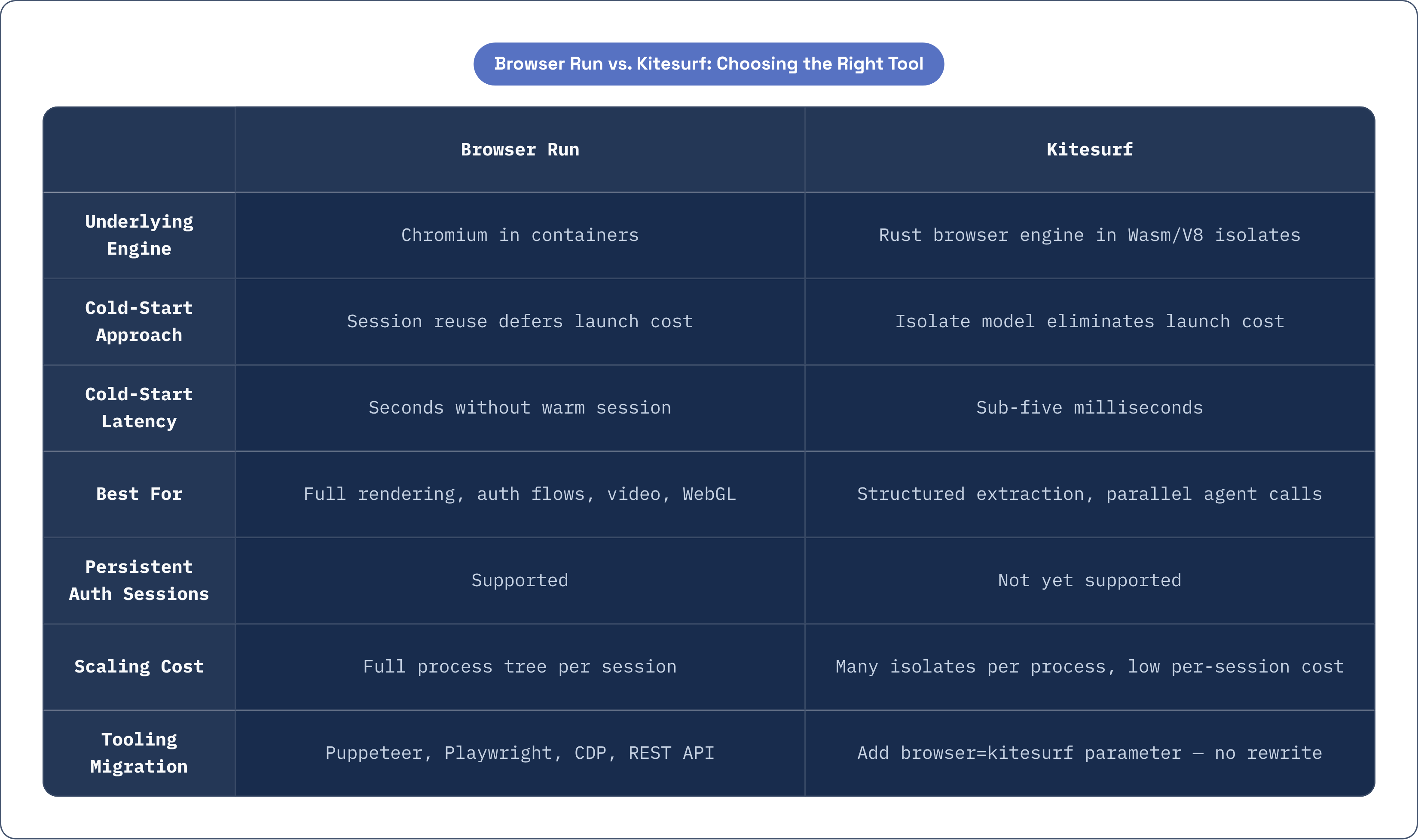
The resource comparison between Kitesurf and Chromium does not require fabricated figures to be instructive. The architectural difference is sufficient to reason from.
Chromium's process model, a browser process, one or more renderer processes, and optionally a GPU process, is designed for general-purpose web browsing by humans. It maintains a significant memory footprint in steady state and requires substantial resources simply to exist in a ready state. The concurrency implications are direct: each concurrent browser session in a container-based architecture is a full instantiation of that process tree. Horizontal scaling requires proportionally more of everything.
Kitesurf runs as a Wasm module inside a V8 isolate. Isolates are designed for dense concurrency; many can coexist within a single process at dramatically lower per-isolate resource cost than a container per session. For agent workloads that issue many parallel browser calls, this changes the economics of horizontal scaling in a meaningful way. The per-session resource cost is lower, which means a given infrastructure budget supports more concurrent sessions.
For workloads that require Chromium, including full JavaScript rendering parity, video, WebGL, complex authentication flows, or anything that involves TLS fingerprinting challenges, Browser Run remains the appropriate tool. Kitesurf is not a replacement for every Chromium use case. It is a replacement for the specific subset of use cases that agent workflows represent: structured extraction, navigation, form submission, and screenshot generation in a context where human-facing fidelity is not the objective.
The decision between them is not primarily a performance decision. It is a requirements decision. An agent that needs to complete an authenticated multi-step workflow with persistent session state needs Browser Run today. An agent that needs to extract structured data from thousands of pages in parallel, at low latency and low cost, is precisely what Kitesurf was built for.
Understanding which phase of the cold-start chain dominates in a given workload, and which execution model that workload actually requires, is the analysis that determines which tool is the right one and which mitigation is worth the investment.