Browser Session Pooling Architectures
Four interdependent layers determine whether your browser pool succeeds or fails in production.
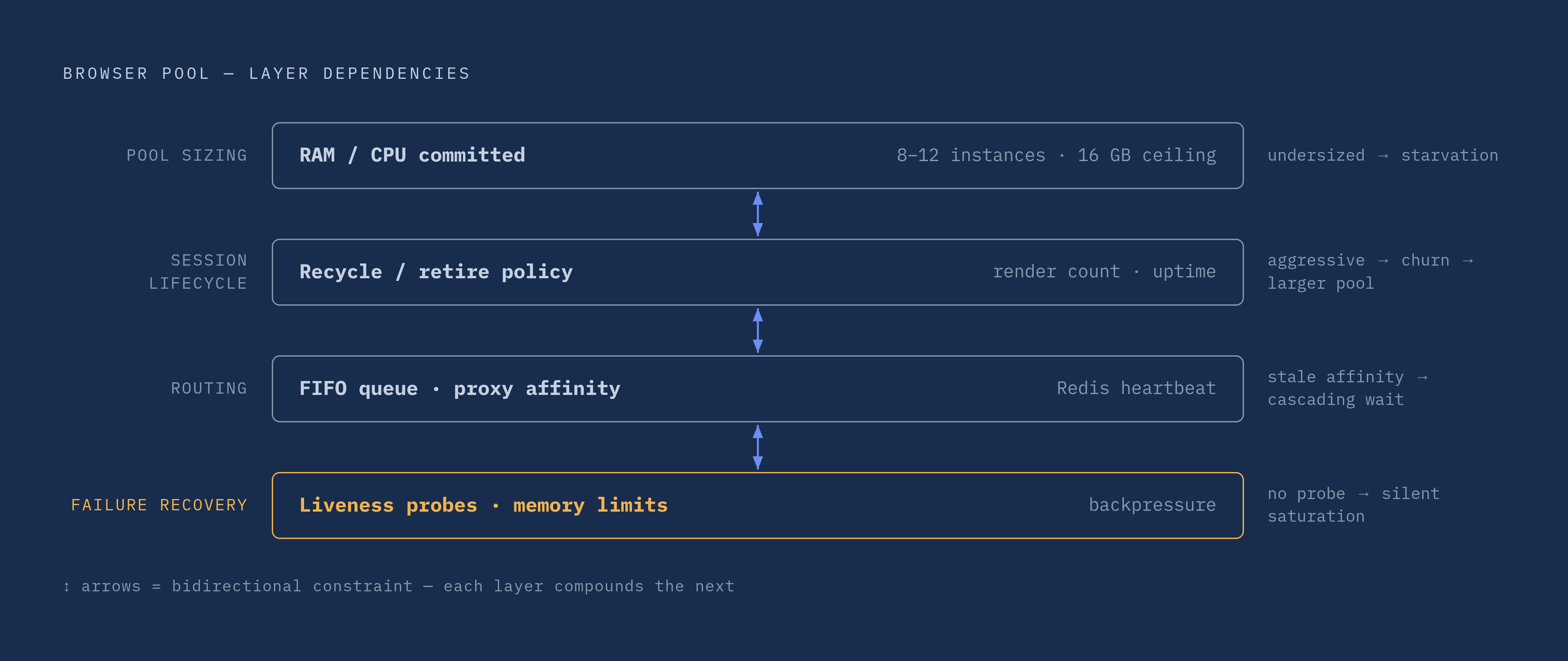
The mental model that gets engineers into trouble is treating a browser pool as a single tunable parameter. More instances, faster recycling, bigger queue. When something breaks, turn one of those dials. I operated this way for longer than I should have, and the production incidents I paid for were preventable. Pool sizing, session lifecycle, routing, and failure recovery are distinct layers. They interact, and tuning one changes the behavior of the others in ways that stay invisible until traffic creates the exact wrong pressure.
Pool sizing determines what resources you are committing to. Session lifecycle determines how long each instance is valid before accumulated state becomes a liability. Routing determines how incoming work finds an available, appropriate instance. Failure recovery determines what happens when that process breaks down.
These concerns run concurrently, not sequentially. A lifecycle policy that recycles aggressively increases instance churn, which demands more headroom in pool sizing. A routing layer without proxy affinity awareness makes session-level anti-detection unenforceable. Failure recovery that depends on the browser reporting its own failure misses the most damaging failure modes at scale: zombie processes, slow memory leaks, silently degraded contexts. Each layer is a constraint on the others, and the constraints compound.
How to size a pool: the tradeoff between concurrency and resource consumption
Pool size is not an environment variable you tune at deploy time. It is a function of available RAM, available CPU, and the latency your system can tolerate when demand exceeds capacity, and those three inputs do not always point at the same answer.
At a hundred concurrent sessions, the browsers themselves can consume several gigabytes of RAM before a single line of application logic runs. Each active headless Chromium instance can consume between 150 and 400 MB depending on page complexity, which puts the practical ceiling for a 16 GB server somewhere between eight and twelve instances (Sendwin, 2026). The EdgeComet model, reported in March 2026, runs fifteen to twenty-five instances per server on a FIFO queue: workers acquire an instance, execute their task, release it back to the pool. That range reflects variance in page weight, not arbitrary configuration.
FIFO is simple, and its semantics are easy to reason about when something goes wrong. That legibility has genuine operational value, especially at three in the morning when you are reading logs and making decisions quickly. But simple mechanisms conceal consequential decisions. What does the system do when the pool is exhausted? Launch a new session on demand and you negate the pool's performance benefit while risking resource exhaustion under load. Return an error immediately and you push retry logic onto the caller. Block with a timeout and you need explicit configuration and a coherent story about what happens when the timeout expires. These options are not equivalent, and in my experience the choice is more often defaulted into than made deliberately.
The warm pool versus on-demand launch question lives inside this same decision space. A warm pool pays the cold-start penalty once at startup rather than on each request; the cost is idle resource consumption during low-traffic periods. Predictable batch workloads favor warm pools. Bursty or unpredictable traffic may warrant a hybrid: a warm floor plus an on-demand ceiling, with the ceiling bounded by hard resource limits. The ceiling matters. Without it, a traffic spike can turn the on-demand layer into the exact resource exhaustion problem you were trying to avoid.
Session isolation models: one-tab-per-browser, browser contexts, and persistent contexts
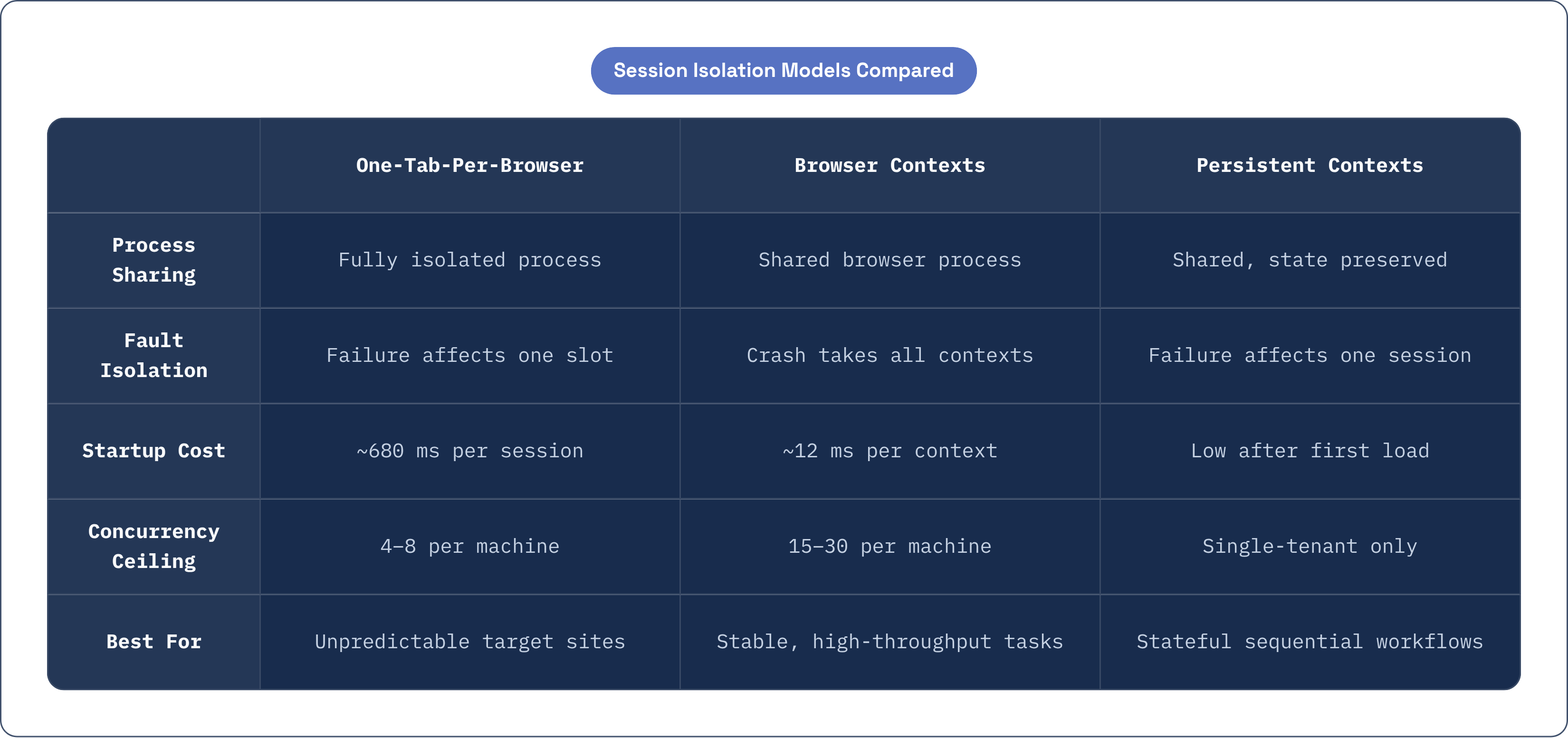
Tabbed multi-session looks attractive on paper: fewer processes, less memory overhead, faster startup. In production it has one specific and costly failure mode. A JavaScript memory leak or an infinite loop in one tab affects every other tab sharing that process. A single misbehaving target site can degrade an entire pool slot's worth of concurrency, and the symptom is hard to attribute because nothing crashes cleanly.
One-tab-per-browser is the production-proven model. Each Chrome instance gets its own process tree. The overhead exceeds 200 MB per instance, but fault isolation justifies it. When one instance fails, it fails alone.
Playwright's browser context model offers a third option, and the performance numbers are real enough to pay attention to. Each context carries its own cookies, localStorage, sessionStorage, IndexedDB, and cache, but shares the underlying browser process. Creating a new browser context takes around 12 ms versus roughly 680 ms for a new Selenium WebDriver session (2026 benchmark). Across a hundred-task suite, that gap exceeds a minute of pure session management overhead. Playwright's architecture supports fifteen to thirty concurrent tests per eight-core machine via contexts; Cypress and Selenium, which require heavier browser instances, are practically limited to four to eight per machine (TestDino, 2026).
The tradeoff is structural, not configurable. A crash in the underlying browser process takes all its contexts with it. For workflows targeting sites with aggressive JavaScript or unpredictable third-party scripts, that correlated failure risk is not theoretical. Whether process-level isolation or context-level performance wins depends on the failure rate of target environments and the cost of correlated loss when that failure arrives.
Persistent contexts, which restore cookies, storage, and cache across restarts via a userDataDir, occupy a different position in this taxonomy. They are useful for stateful agent workflows where session continuity is the primary requirement. But two workers cannot safely share a persistent context simultaneously. This is a structural constraint, not a configuration limitation, and it defines where persistent contexts belong: single-tenant, sequential workflows, not pooled concurrency.
Session lifecycle: when to recycle, restart, and retire an instance
Long-lived sessions drift. Accumulated cookies, cache growth, and slow memory leaks make behavior progressively less predictable. Short-lived sessions introduce startup overhead and resource churn. Neither extreme is a production answer, and the right balance is more workflow-specific than most lifecycle policies acknowledge.
The practical approach is to track two metrics per instance: render count and uptime. An instance that has processed a thousand renders in two hours may be fine; the same instance running twelve hours with fifty renders may have accumulated problematic state. Single-metric policies miss these asymmetric cases. Batch jobs that run overnight but process few pages per hour look healthy by render count and broken by uptime. Lightweight scrapers hammering fast pages produce the reverse. When you generalize across workflow types in a single recycling policy, you will eventually optimize for the average case and break both extremes.
Recycle too aggressively and long-running workflows are interrupted mid-execution. Recycle too conservatively and degradation accumulates in ways that resist attribution, because no single session appears obviously broken. The right policy depends on what the pool is running, how long tasks take, and what interruption costs for each workflow type.
Version drift is a lifecycle failure mode that receives less attention than it deserves. A script that executed cleanly yesterday can break because Chromium auto-updated on one instance overnight. The symptom looks like a flaky automation script; the actual cause is environmental inconsistency across pool instances. Pool hygiene requires version pinning enforced at the container or image level. Running different Chromium versions across a pool and treating the behavior as a single coherent system is operationally equivalent to running different software on different servers and expecting consistency.
Routing requests to the right session
Within a single server, routing can be as simple as a FIFO queue: the next available instance gets the next task. This works until you have more than one server, or until routing constraints require that specific requests reach specific sessions. At that point, coordination becomes load-bearing infrastructure.
The coordination layer needs sufficient information about session location to direct each request to a backend capable of fulfilling it. US Patent 7,962,630 describes exactly this middle-tier routing model, where session location metadata drives request dispatch. The routing intelligence must live somewhere, and wherever it lives needs a live view of pool state.
Redis works well as a practical coordination layer for multi-server deployments. Each server publishes its current capacity and load via heartbeat; the gateway reads this state and routes incoming requests to servers with available slots. The heartbeat interval determines how stale the routing state can be, and therefore how often a request might be directed to a server that has just become fully occupied. This interval is worth testing deliberately: too long and routing accuracy degrades under load; too short and heartbeat overhead becomes meaningful at scale.
Session transfer, sometimes called live migration, addresses the harder problem of moving a session between servers without interrupting the workflow. US Patent 11,082,499 describes a broker service that serializes session context from an active instance, launches a corresponding session on a different server, and initializes it with that serialized state. The mechanical complexity is significant, but it enables rebalancing and failover scenarios that pure FIFO routing cannot handle. Whether the complexity is worth it depends on how much failover flexibility the system actually needs.
Proxy affinity is where routing and anti-detection intersect. Sessions bound to specific proxies cannot be freely reassigned to arbitrary pool slots, which means the router must track proxy binding alongside availability. The routing state model is more complex than a simple availability bitmap. Ignoring this constraint produces sessions whose network identity and browser fingerprint diverge, and that divergence is a detection signal that no amount of fingerprint tuning can correct after the fact.
Failure modes that appear only at scale
Below a few hundred concurrent sessions, most failures are visible and reproducible. A browser crashes; a task fails; the error appears in logs. Past a thousand sessions, failure modes become emergent. The engineering challenge shifts from debugging individual failures to reasoning about system behavior under conditions you cannot reliably reproduce in a development environment.
Zombie processes are among the most persistently underestimated failure modes I have encountered. Chrome crashes mid-task but does not fully terminate; the process lingers, consuming CPU and memory, while the pool's bookkeeping marks that slot as available. The monitoring dashboard shows a healthy fleet. Task throughput slowly degrades. There is no single visible failure event, just a gradually worsening resource leak distributed across the fleet, invisible until the aggregate effect becomes unmistakable. Detecting zombies requires external process monitoring. Trusting the browser to report its own failure is how you discover the problem six hours after it started.
Memory growth at scale is similarly diffuse. No single session appears to be the culprit. Aggregate consumption rises slowly. Restarts seem to help, until they do not. Per-instance memory metrics look normal in isolation; only the aggregate trend reveals the problem, and that trend may take hours to become statistically distinguishable from normal variance.
Traffic spikes without explicit backpressure handling follow one of two failure paths: the fleet is overwhelmed and crashes, or jobs are silently dropped. Both are worse than the visible error of an exhausted queue with a defined timeout. Queue depth, timeout handling, and failure semantics must be defined explicitly per workflow type, not left as implicit system defaults.
Flaky behavior that manifests only at peak load is the hardest failure mode to diagnose because it resists isolation. Identical jobs produce divergent execution times even when the automation code is unchanged. The cause is almost always resource contention, not logic errors, but that distinction is invisible in task-level logs. This is the failure mode that generates the most misattributed bug reports, because the evidence points at the code and the actual problem is in the infrastructure.
Building failure recovery into the architecture
Crash detection cannot rely on the browser reporting its own failure. An external health check, running outside the browser process, is the only reliable mechanism. Kubernetes liveness probes formalize this pattern: a probe queries the instance on a defined interval, and failure to respond triggers a restart. Memory limits enforced at the container level provide a complementary mechanism that prevents a leaking instance from exhausting host resources before the probe catches it.
These two mechanisms together, liveness probes and memory limits, provide a recovery layer that pool-level logic alone cannot replicate. Pool logic can track assignment state and recycle completed sessions; it cannot detect a process that appears alive at the socket level but has stopped executing work.
Backpressure design must be explicit. When all instances are busy, the system needs a defined, intentional behavior: queue with a timeout, reject with an error, or scale horizontally. Implicit behavior, unbounded queuing or silent job drops, makes the system's limits invisible until an incident reveals them. An explicit backpressure policy makes those limits testable before the incident arrives.
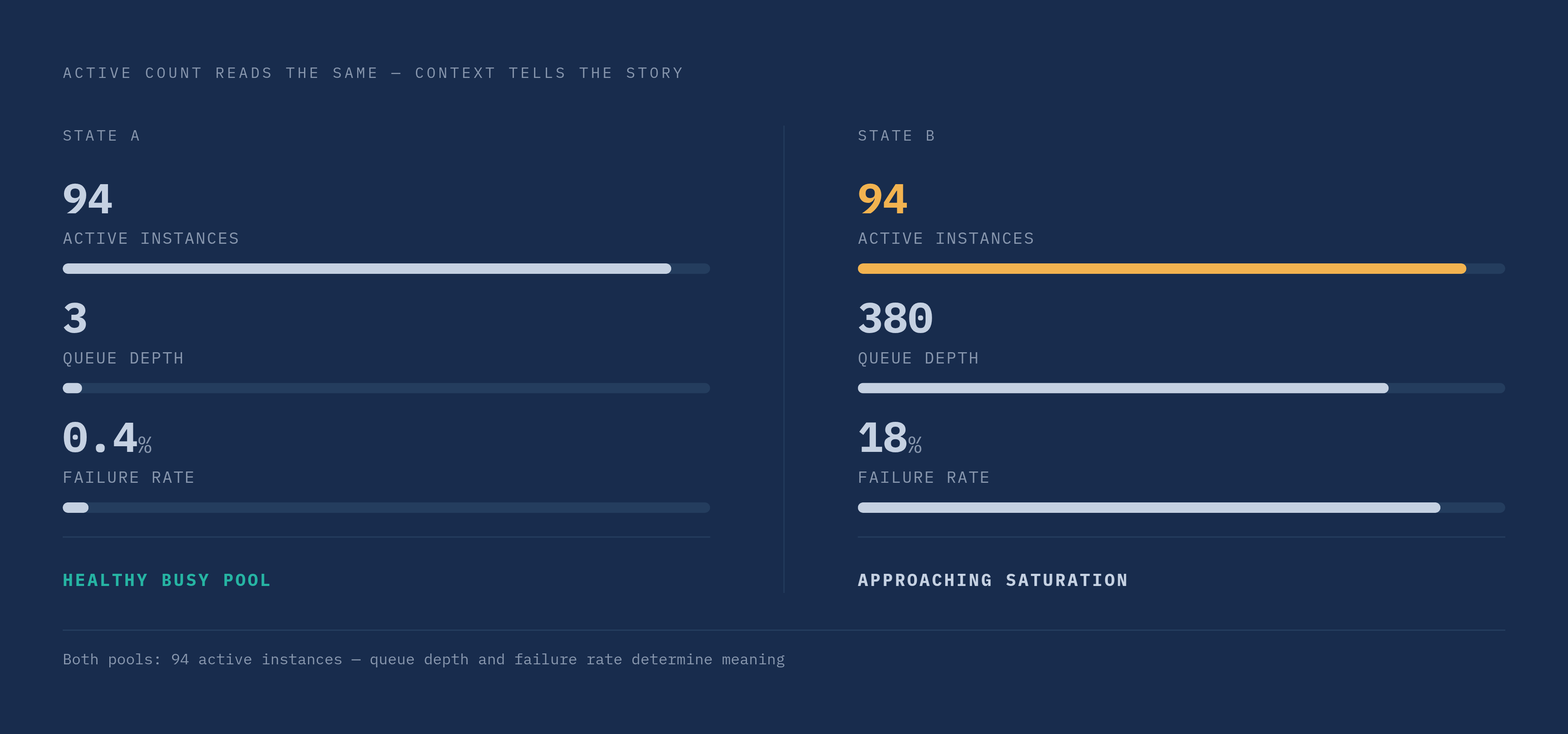
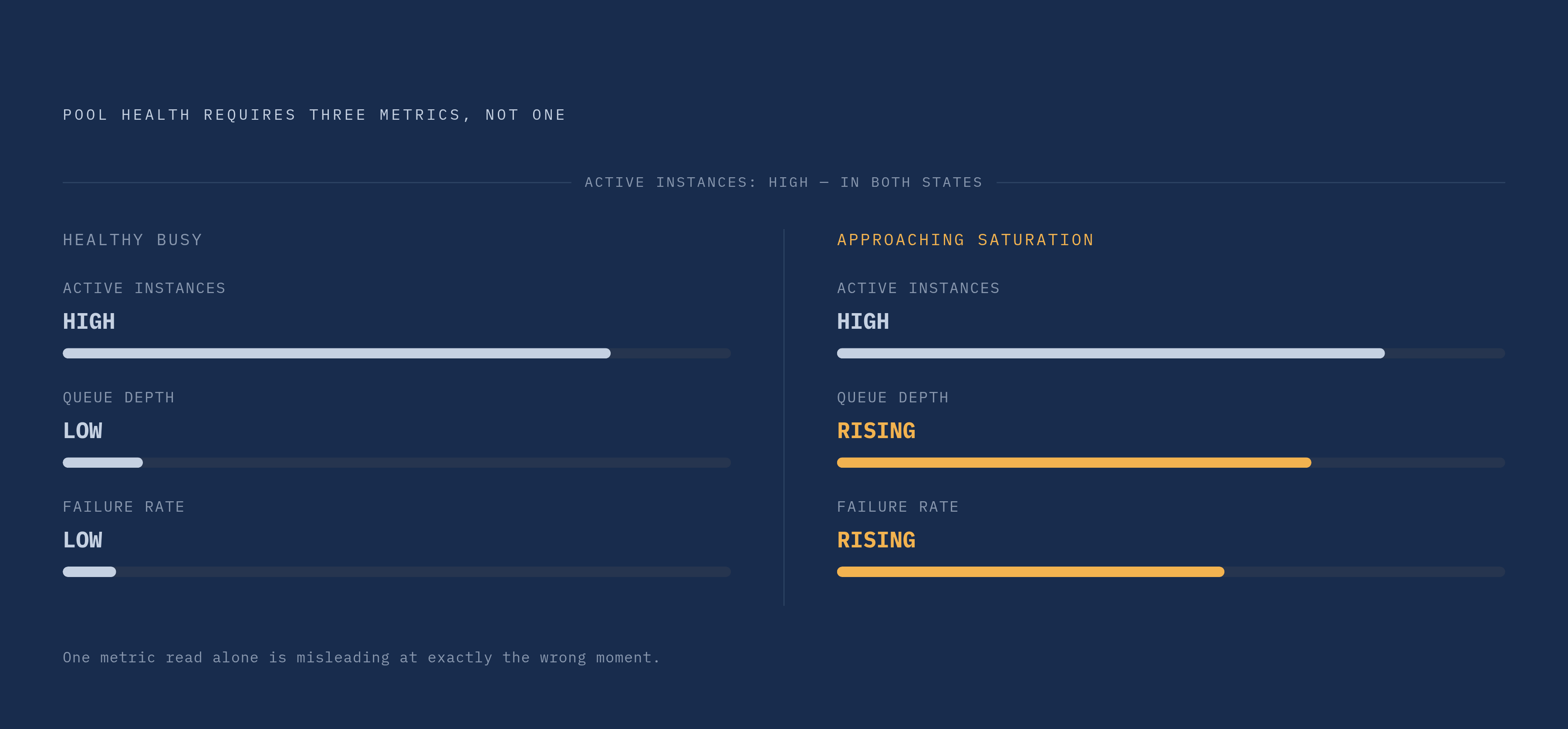
Active instance count, queue depth, and failure rate are the three metrics that together describe pool health; any one in isolation masks what the others reveal. High active instance count with low queue depth and low failure rate is a healthy, busy pool. The same active instance count with rising queue depth and rising failure rate is a pool approaching saturation. Each metric recontextualizes the others, which means dashboards that surface only one or two of them tend to tell a misleading story at the exact moment it matters most.
Docker containers provide job-level isolation and crash recovery; the control logic for managing containers, assigning tasks, and cleaning up dead sessions must still be written explicitly. Kubernetes provides scheduling and restart primitives; pool management logic above that layer is the engineer's responsibility. The scaffolding is real and valuable. It is not a substitute for the logic.
Deployment topology: self-hosted versus cloud browser pools
Self-hosting a browser pool means owning every layer described above. Sizing, lifecycle policy, routing coordination, failure recovery, container management: each becomes ongoing platform work. Docker and Kubernetes provide scaffolding; the operational logic is not built in. For teams with the DevOps capacity to operate each layer, self-hosting is viable and cost-effective. For teams without that capacity, it accumulates as invisible debt until an incident makes it visible.
Cloud browser pools, sometimes called Browser-as-a-Service, integrate via WebSocket CDP endpoint. Connecting through Puppeteer or Playwright over that endpoint changes the URL, not the mental model. The same architectural questions apply; the cloud provider answers them on your behalf. The practical benefit shows up most clearly in burst scaling, where session capacity can expand faster than resizing a virtual machine pool allows.
The cost gap is real. A low-cost VPS hosting a self-managed pool represents a small fraction of the monthly cost of a commercial cloud browser provider at equivalent session volume, with analyses from 2026 suggesting differences on the order of ten to thirty times. Browserbase processed over fifty million browser sessions in its first full year of operation, from 2024 to 2025, which illustrates the scale of market demand for managed browser infrastructure. Steel offers an open-source alternative for teams that want a browser layer they can examine and extend without a commercial dependency.
The topology decision is ultimately a staffing question. A team that can reason clearly about each layer and staff the operational work accordingly may find self-hosting more cost-effective and more controllable. A team that cannot is not choosing between cheap and expensive; it is choosing which kind of cost it is better positioned to absorb.
Anti-detection as a pooling concern, not an afterthought
Fingerprinting operates at the session level. Canvas rendering, WebGL output, installed fonts, hardware concurrency values: each instance presents a distinct fingerprint to the target environment. The failure mode is not presenting a recognizably automated fingerprint. It is presenting a randomized fingerprint that changes on every request, which is itself an anomaly signal. Sessions need distinct, consistent identities. Randomization per request is the wrong instinct, and it is a surprisingly common one.
Tools such as Multilogin can randomize over twenty-five fingerprint parameters across sessions, creating profiles that appear indistinguishable from regular user traffic. But fingerprint assignment belongs to the session provisioning step. Applied per-request, it produces exactly the inconsistency it is meant to prevent, because detection systems are tracking behavioral patterns across time, not just parameter values at a single moment.
Proxy affinity recurs here with additional significance. Each session's network identity, the IP address and geolocation its requests arrive from, must be coherent with its browser fingerprint. A session presenting a US-geolocated browser profile but routing through a data center IP in a different region presents mismatched signals that are straightforward to detect. The router must enforce this consistency, which means proxy binding must be part of the session state the router tracks. The routing layer and the anti-detection layer share state; treating them as separate concerns is where the inconsistency enters.
Cloud browser pools derive detection-resistance partly from their operational cadence: rotating instances on a schedule, distributing load across multiple configurations, managing browser health as a fleet concern rather than a per-session concern. The pool's lifecycle and rotation policies are themselves a detection-resistance mechanism. This is underappreciated. Engineers tend to focus on fingerprint parameters and overlook the behavioral envelope the pool's operational patterns create.
Warm-up patterns, where a session performs normal browsing behavior before executing its assigned task, reduce anomaly signals associated with sessions that arrive at a target page with no prior activity. This belongs to the session initialization phase, enforced as part of the lifecycle policy. When it is left to individual task implementations, it is inconsistently applied, and inconsistent application produces the same fingerprint inconsistency that per-request randomization produces. The consistency problem recurs at every layer for the same underlying reason.
Anti-detection is not a feature you add to a pool. It is what the pool's sizing, routing, and lifecycle decisions either produce or undermine, and the fingerprint parameters you configure are only as stable as the operational behavior supporting them.