Selenium vs Playwright for Serverless Test Environments
Playwright's architecture solves serverless cold-start problems Selenium cannot fix.

Selenium's communication model is built on HTTP. Every command the client sends to the browser travels over the WebDriver protocol: the client dispatches a request, waits for a response, then dispatches the next one. Sequential, stateless per call. This shapes everything downstream.
Selenium also requires external binaries. Chromedriver, geckodriver, msedgedriver: each must be version-matched to the installed browser on the host machine. In environments where you do not control the OS image directly, that version coordination becomes a recurring manual obligation rather than a solved problem. Selenium handles only browser control; the test runner, assertion library, and reporter are separate concerns that teams wire together independently. The flexibility is real, and so is the fragmented dependency surface.
Playwright's model differs at the transport layer. It opens a persistent WebSocket connection to the browser for the life of the session, using the Chrome DevTools Protocol for Chromium and its own protocol for WebKit. No per-command HTTP round-trips; the channel stays open.
The driver model is different by design as well. Playwright installs pinned, compatible browser engine versions as part of the package itself, with no external binaries to coordinate. Script and browser are version-compatible by construction. Built-in actionability checks execute before every interaction: before a click fires, Playwright confirms the element is visible, stable, and enabled. This eliminates the explicit wait scaffolding Selenium requires teams to build and maintain. The test runner, assertions, tracing, and reporting all ship with the package.
These architectural differences carry no inherent quality judgment. They are the structural conditions that determine what happens when you drop either framework into a serverless runtime. But what if those structural conditions matter far more than the feature checklists teams typically compare?
How Cold Starts and Container Size Limits Hit Each Framework Differently
When a serverless function spins up from zero, it pulls the container image, initializes the runtime, and launches the browser before the first test command can execute. Every megabyte of image size adds latency at that step. The latency does not configure away; it follows directly from the startup sequence.
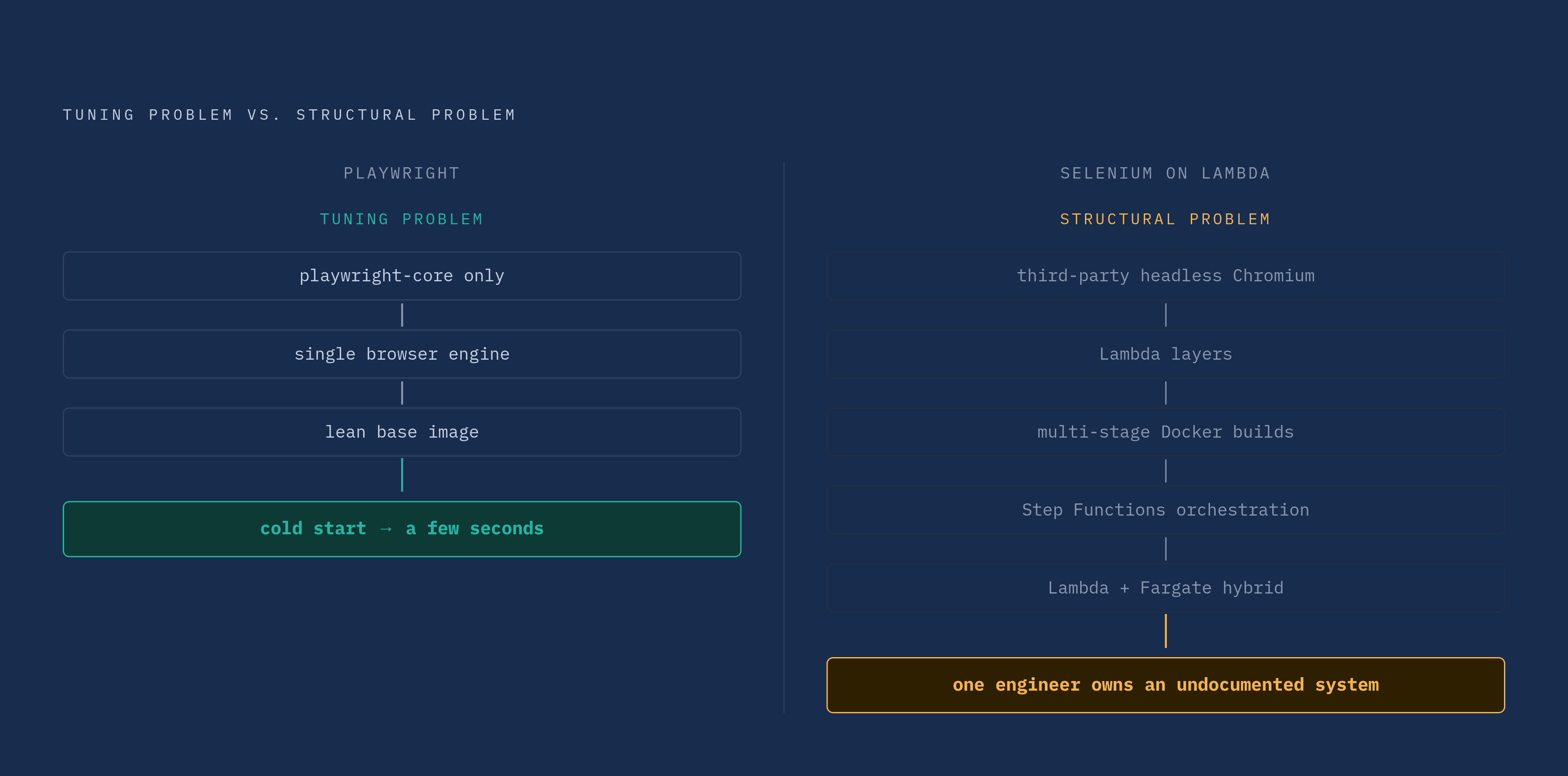
Playwright's bundled browsers increase container image size materially. The established mitigation is to use playwright-core rather than the full package, bundle only the browser engine you actually need, and build from a lean base image. Google Cloud Run's own guidance reflects this approach: keep images small, and cold starts compress to a few seconds. This is a tuning problem, and tuning problems are solvable.
Selenium's container size situation is structurally different. Bundling Chrome with a Lambda function as a zip deployment exceeds Lambda's size limits, and the browser requires dynamic libraries that Lambda's base environment does not include. The bundling approach is effectively unworkable without significant workarounds.
That workaround path is well-documented in the community, which is itself telling. The standard approach involves Lambda-compatible headless Chromium binaries packaged as Lambda layers, and those are not official Chrome builds. They are third-party binaries that track browser releases with lag, introducing a maintenance dependency that simply does not exist in the Playwright model. AWS's own reference architecture for serverless Selenium involves a multi-stage Docker build, Step Functions orchestration, and a combination of Lambda and Fargate: a substantial infrastructure investment before a single assertion runs.
The practitioner forums are full of post-mortems about driver path resolution errors, binary size limits, and execution timeouts. These are not edge cases. They are the default experience, and I have debugged enough of them to recognize the pattern: the workarounds accrete until a single engineer quietly owns an undocumented system that everyone depends on and nobody wants to touch.
Playwright's cold-start problem is a tuning problem. Selenium's cold-start problem in Lambda is structural, a consequence of an architecture that was not designed for this execution model, and the workarounds make that visible. That raises an important question: if the workarounds themselves become a maintenance burden, has the team actually solved the problem or simply relocated it?
Ephemeral Execution and the Absence of Persistent Browser State
Serverless functions are stateless by design. When a function exits, its filesystem, in-memory state, and any open browser session are destroyed. No warm browser to reuse, no session to hand off.
Selenium's session model presupposes a long-lived WebDriver session that persists across test cases. Re-establishing that session on every cold invocation means paying the full driver handshake cost each time. On a persistent server, this cost is paid once and amortized across many tests. In Lambda, it is paid on every invocation and compounds quickly at scale.
Playwright's WebSocket model is better suited to short-lived sessions. The pattern is: connect, execute, close. The persistent channel is an advantage within a session; the session itself is designed to be lightweight to create and tear down. That is closer to how serverless functions actually behave.
Explicit waits in Selenium are also more fragile in ephemeral environments where timing is unpredictable. CPU throttling during cold starts can cause waits calibrated on a warm developer machine to fail in Lambda, because the performance profile of the runtime varies in ways a fixed timeout cannot accommodate. Playwright's actionability checks adapt to actual element state rather than fixed durations, which holds up better when the underlying execution environment is inconsistent.
State that teams might otherwise cache between sessions, including cookies, authentication tokens, and local storage, must be re-established on every serverless invocation regardless of framework. Playwright's context API makes programmatic state setup explicit and scriptable, surfacing the problem clearly rather than letting it fail silently.
The absence of a persistent browser grid also means there is no Selenium Grid to route test traffic. Each invocation is fully self-contained. Playwright was designed to operate that way. Selenium was not.
Where Playwright Fits Cleanly Into Serverless Infrastructure and Where It Still Strains
The closest thing to a native fit is Google Cloud Run: stateless containers that spin up on demand, run the test job, and shut down automatically. Scale-to-zero behavior eliminates idle compute costs between jobs, which is the cost model serverless is supposed to deliver.
AWS Lambda is workable with Playwright, though the configuration is non-trivial. Container image deployment rather than zip, careful memory tuning, and Chromium variant selection are established patterns in the community. Playwright draws over 45 million monthly npm downloads, and that ecosystem has produced base images, configuration templates, and documented deployment patterns specifically for serverless targets.
Parallel execution without a grid is another clear fit. Playwright runs parallel tests natively; in a serverless context, each parallel invocation is an independent, fully isolated function rather than a shared resource competing for grid capacity. No Selenium Grid to design, provision, or maintain.
Where Playwright strains in serverless is real and worth stating plainly. Bundled browsers are large. Teams running many parallel cold-start invocations will feel startup latency unless images are carefully pruned using playwright-core and pre-built base images. That approach mitigates the problem rather than eliminating it. Memory is the other ceiling: running multiple concurrent browser instances is memory-intensive, and per-function memory caps in Lambda or Cloud Run enforce that limit at the infrastructure level rather than degrading gracefully.
It is also worth considering what happens when a team scales beyond what self-managed serverless can comfortably handle. For large test suites or sustained concurrency, self-managed serverless Playwright eventually hits ceilings that infrastructure configuration alone cannot resolve.
When Self-Managed Serverless Isn't Enough and What Browser-as-a-Service Platforms Add
The degradation pattern is consistent: as concurrent session requests increase, self-hosted infrastructure starts to crack. Crashed containers, stalled scripts, resource exhaustion. Each headless browser is memory-intensive, the ceiling is per-machine or per-function, and there is no elasticity beyond what the platform caps allow.
Browser-as-a-service platforms address this by separating code execution from browser rendering. The test script runs in CI or locally, sends commands over a WebSocket to a remotely managed browser, and receives DOM data and screenshots back. Because Playwright's architecture is WebSocket-native, this integration is nearly transparent from a code perspective. More importantly, it moves the memory and compute cost of running Chrome off the Lambda function or Cloud Run container entirely.
Several platforms have established patterns worth understanding in a serverless context.
Browserless controls concurrency through a workers setting; each session runs on dedicated cloud infrastructure with least-connected load balancing and full session teardown, including temporary files and cache, on completion.
Hyperbrowser is oriented toward high-volume workloads, capable of managing thousands of simultaneous browsers, with built-in stealth mode and CAPTCHA handling that covers agentic and scraping use cases alongside testing.
Browserbase runs tens of millions of sessions monthly, scales to hundreds of concurrent sessions, and is designed for minimal code changes from existing Playwright scripts, reducing migration friction.
BrowserStack Automate is worth naming specifically for teams with a mixed Selenium and Playwright investment: it supports both frameworks simultaneously and integrates with Jenkins, Travis CI, CircleCI, and GitHub Actions. For organizations that have not completed a migration, or do not intend to, BrowserStack offers a path that does not force a binary choice.
Consumption-based BaaS pricing, paying for concurrency used rather than idle grid capacity, aligns with the serverless cost model teams are already operating under. Maintaining a warm grid that charges whether or not tests are running undermines the economic premise of serverless.
Selenium is compatible with some managed grid offerings, including BrowserStack and Sauce Labs. These are hosted grid models, not serverless-native BaaS; the connection model and session lifecycle differ from what Playwright's WebSocket approach enables. That distinction matters when evaluating whether a platform actually solves the cold-start and resource cap problems or simply relocates the infrastructure burden to a different vendor's bill.
What the Cost and Maintenance Gap Looks Like in Practice for Teams Choosing Between the Two
One vendor analysis from 2025 put per-test-cycle cost at approximately $347 for Selenium versus $289 for Playwright when accounting for creation, maintenance, and execution. Vendor cost analyses rarely come from disinterested parties, and these figures should be treated as directional rather than authoritative. What they point toward is real: the gap is driven primarily by maintenance overhead, not execution cost. Why exactly does this happen? The answer lies not in execution speed but in how much ongoing human attention each framework demands.
Framework-based testing, per the same analysis, contributes to roughly 23% of release delays attributable to test maintenance. That cost lives outside the testing budget line and surfaces in release velocity, often invisibly until a team is trying to explain a sprint that went sideways.
The maintenance burden for Selenium in a non-serverless environment is already substantial: driver version matching on every browser update, manual wait calibration, coordinating a test runner, assertion library, and reporter stack independently. In a serverless environment, those obligations compound. Lambda layer updates when headless Chromium binaries release, Step Functions orchestration logic, multi-stage Docker build pipelines: each is an additional maintenance dependency with its own release cadence and its own failure mode. The people who end up owning those failure modes are usually not the ones who made the original framework decision. That asymmetry is worth sitting with before the architecture is finalized.
Playwright's pinned browser versions, built-in waits, and integrated toolchain compress the maintenance surface. Fewer moving parts to update, fewer integration points where a version mismatch can quietly break a suite.
For teams with existing Selenium investments in non-serverless environments, the calculus is less straightforward. The cost of migration must be weighed against the operational overhead of maintaining the workarounds that keep Selenium functional in Lambda or Cloud Run. Suite size, team bandwidth, and how much of the existing investment is transferable all factor in, and none of those variables are universal.
Playwright's adoption metrics, over 74,000 GitHub stars versus Selenium's 32,000, and more repositories actively using Playwright than Selenium, suggest the framework has crossed the threshold where talent availability and community pattern density are no longer meaningful risk factors in the decision.
AI-Assisted Browser Automation and Where the MCP Layer Fits Into Serverless Test Infrastructure
In 2025, Microsoft introduced Playwright MCP, a Model Context Protocol server that allows AI agents running on models like Claude or GitHub Copilot to issue browser automation commands through Playwright. The test framework becomes the execution layer for agentic workflows. Multiple alternative implementations appeared within months, each making different trade-offs on scope, network access, and security posture.
The security dimension is the one teams most consistently underestimate until their infosec function gets involved. An MCP server with full network access means an AI agent driving browser automation can reach internal metadata endpoints, company wikis, or cloud provider instance roles. Security teams have begun scrutinizing and blocking configurations with that exposure profile, sometimes retroactively after a proof-of-concept has already been demonstrated to stakeholders. That conversation is not easy to walk back.
Some managed Playwright MCP implementations run the browser on isolated external infrastructure rather than the operator's network. The browser physically cannot reach internal endpoints; network isolation is the default behavior rather than an opt-in configuration. For teams where infosec approval is a gating requirement, that architecture starts with the smallest attack surface.
For serverless test environments specifically, the operative question is: where does the browser run when an AI agent is driving it? The same container size, cold start, and resource cap constraints that apply to human-authored test scripts apply here. Network-isolated, managed browser infrastructure pairs naturally with agentic workflows in serverless environments precisely because it offloads the browser compute and provides a defined security perimeter.
Selenium has no equivalent MCP ecosystem. The AI-assisted testing layer is, at this moment, a Playwright-specific development. Teams choosing a framework for serverless testing today are implicitly deciding whether their infrastructure will be capable of supporting AI-driven test generation and execution as those workflows mature.
How to Make the Framework Decision Given an Actual Serverless Environment and Team Context
The decision is not Playwright versus Selenium in the abstract. It is which framework's constraints fit the specific serverless platform, team size, and existing investment.
Several signals point consistently toward Playwright: greenfield projects with no existing suite to migrate, primary execution targets in Lambda or Cloud Run, parallel execution requirements without the budget or appetite for Selenium Grid, AI-assisted test generation on the roadmap, a CI/CD pipeline that is already containerized. Each of these independently favors Playwright; in combination, the argument against becomes difficult to sustain.
Selenium remains viable in specific circumstances. An existing Selenium suite that is large, stable, and running well in a non-serverless environment carries real migration cost, and if that suite does not need to run in Lambda or Cloud Run, the pressure to migrate is lower than the Playwright community's enthusiasm might suggest. Teams with regulatory or organizational requirements around specific browser drivers or test toolchains may have constraints that override architectural preferences. Organizations with substantial investment in BrowserStack or Sauce Labs, particularly those running mixed Selenium and Playwright suites simultaneously, are well advised to weigh migration carefully; BrowserStack Automate's support for both frameworks gives those teams a path that does not require forcing the decision before they are ready.
The failure mode that shows up most often in framework selection is evaluating the framework in isolation from the execution environment. Selenium is a mature, capable tool. Playwright is also a mature, capable tool. The question that actually matters for serverless is which one was designed for the execution model you are deploying into and which one requires you to build the execution model around its constraints. That question does not have the same answer in every organization, but it is the right place to start.