Headless Browser Security Considerations
Automated bots now outnumber human web traffic, forcing security teams to rethink defenses.

How automated traffic has shifted the threat baseline
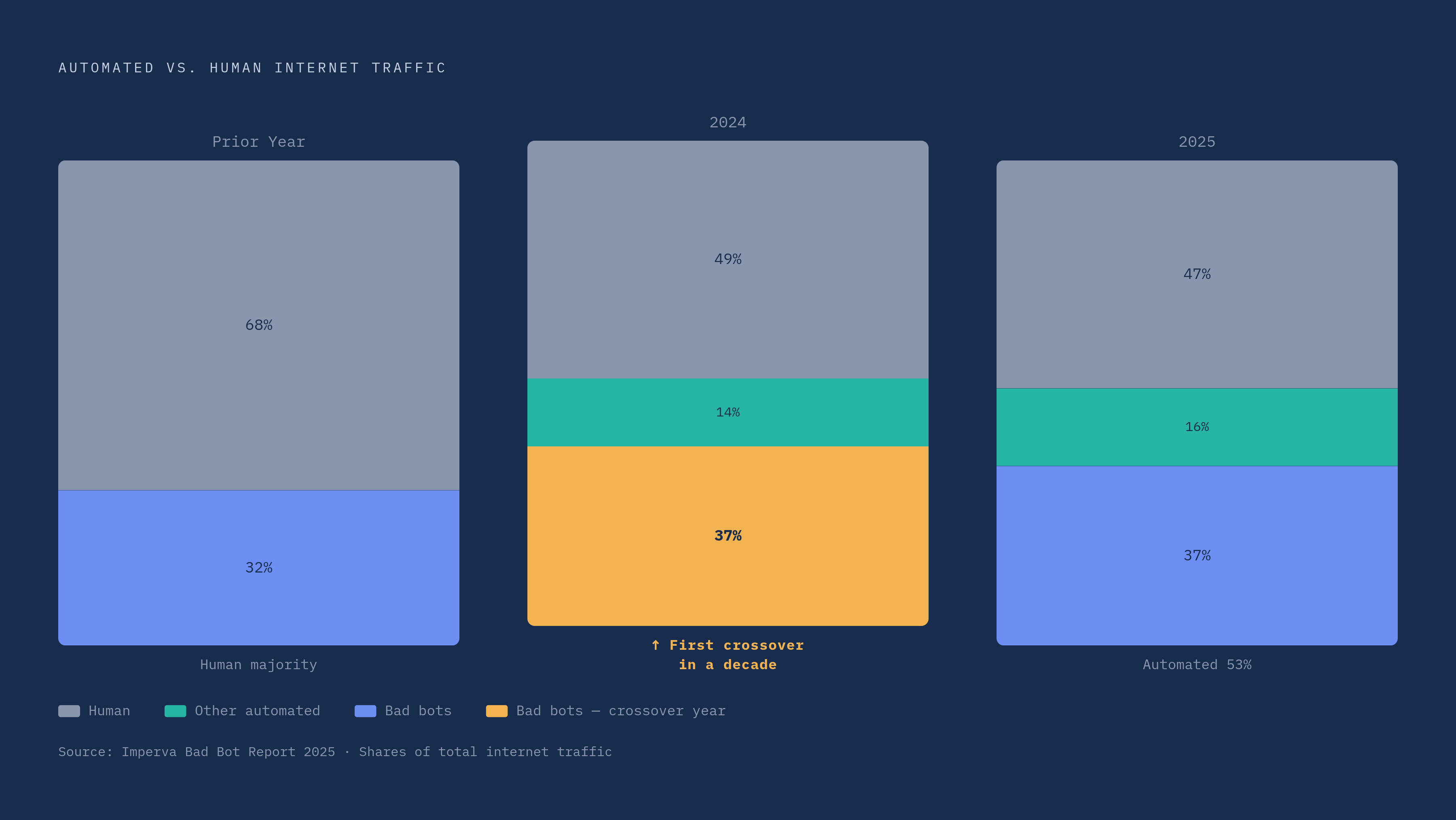
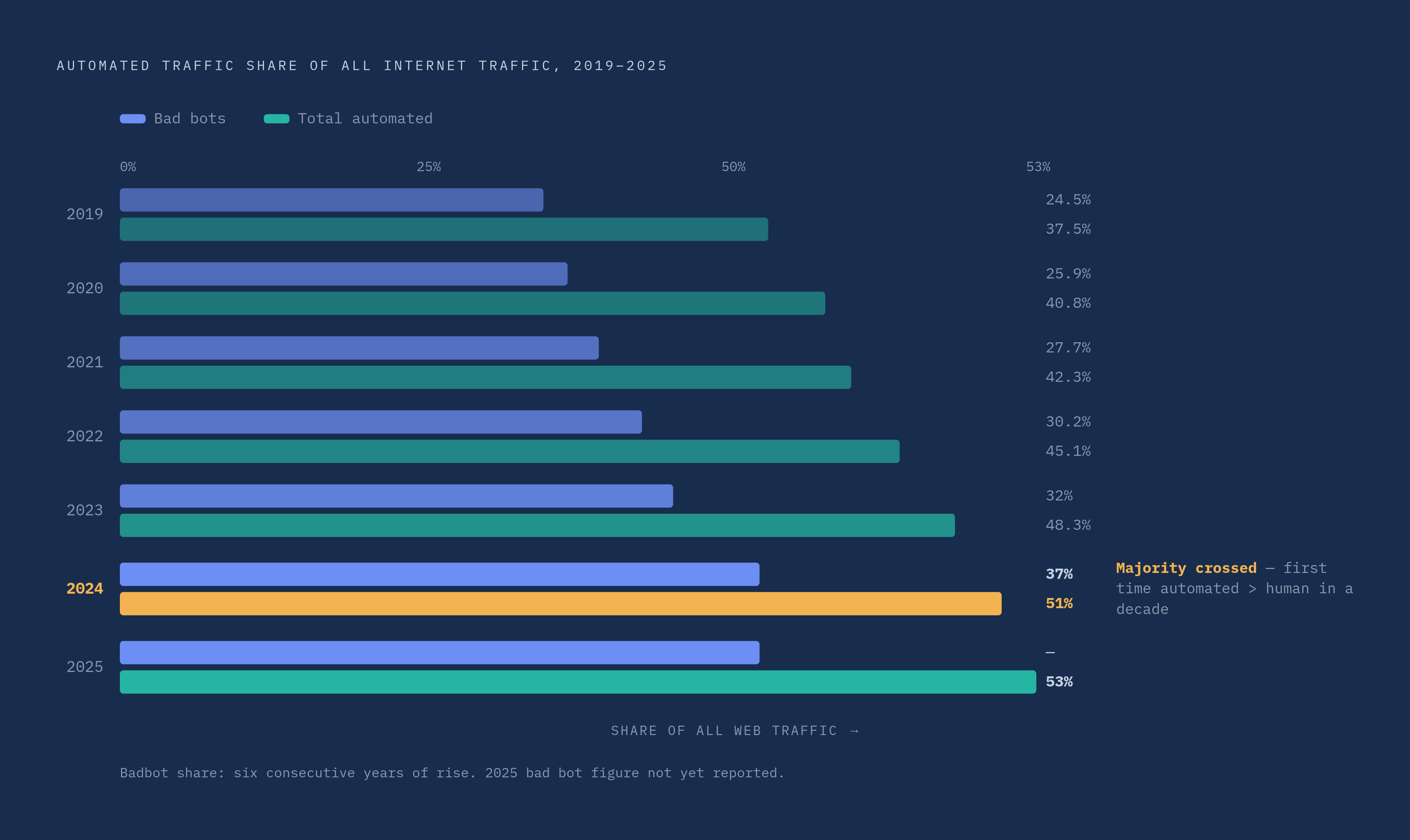
The baseline shifted in 2024, and most security teams are still catching up to what that actually means operationally. For the first time in a decade, automated traffic surpassed human activity, accounting for 51% of all web traffic per the Imperva Bad Bot Report 2025, with 2025 figures now at 53%. Bad bot traffic specifically rose for the sixth consecutive year, reaching 37% of all internet traffic in 2024, up from 32% the prior year. These are not statistical fluctuations. They reflect a structural change in who, or what, is actually using the web.
The accelerant becomes obvious once you've watched detection queues fill with traffic that passes every browser check. Large language models dramatically lowered the technical barrier to building convincing headless-based bots. Writing evasion scripts, adapting them when detection methods change, generating CAPTCHA-bypass logic: none of that requires the specialized knowledge it once did. Imperva researchers observed more than 10,000 unique IP addresses daily performing scraping, carding, and credential attacks that required JavaScript evaluation. That is not a niche threat population, and the problem looks nothing like it did three years ago.
Which raises a genuinely uncomfortable question. If this is already the baseline, what does a security posture designed for the old normal actually protect against? Most detection architectures were built for a threat environment that no longer exists.
The vulnerabilities you introduce when you deploy a headless browser yourself
The most persistent mistake in self-deployed headless setups is treating the browser as a contained, bounded tool. It is not. It is a full browser runtime with network access, file system access, and significant process privileges. Configuration shortcuts taken during rapid development tend to stay in production, and they compound quietly.
The --no-sandbox flag is the canonical example. Disabling the renderer process sandbox eliminates the primary containment layer between compromised renderer code and the host operating system. On Linux, running Chrome as root effectively requires this flag, so teams accept it without much deliberation, often without registering what they've given up. The sandbox is not decorative. Removing it means whatever happens inside the renderer can reach the host directly.
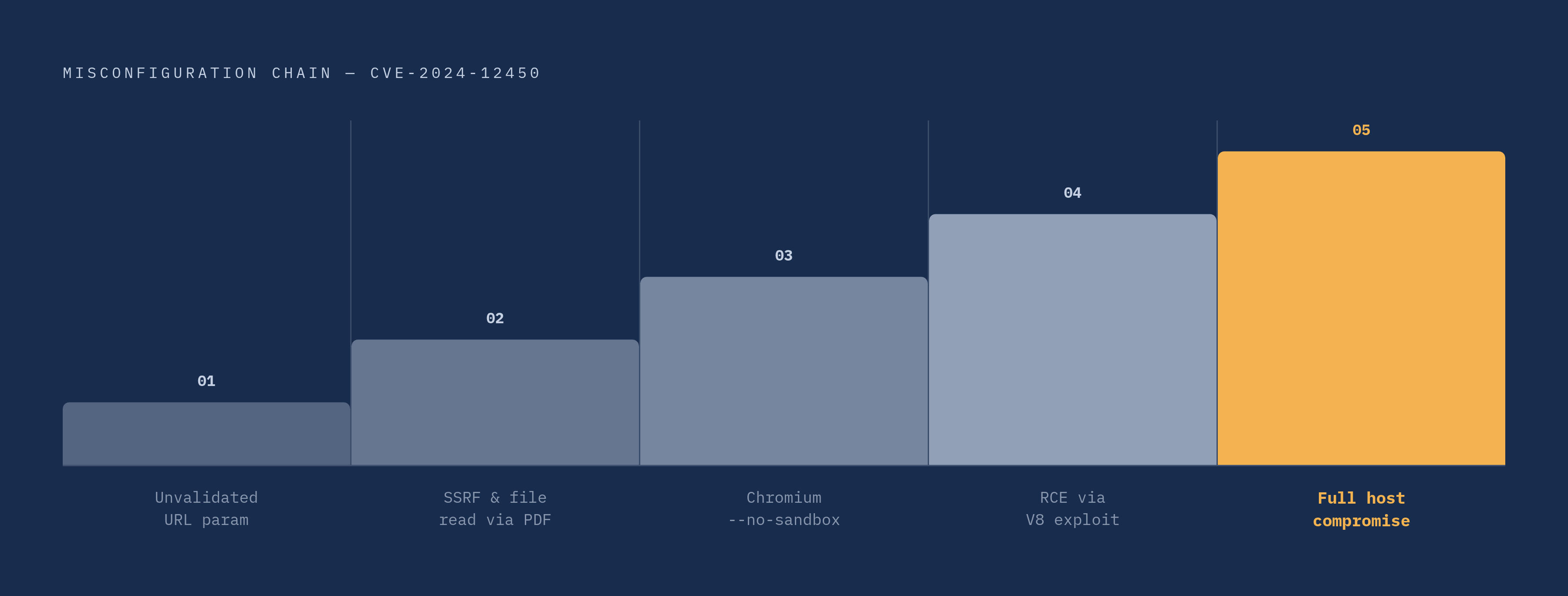
CVE-2024-12450, identified in infiniflow/ragflow 0.12.0, shows how these choices stack in practice. Unfiltered URL parameters enabled server-side request forgery and arbitrary file reads through generated PDFs. The underlying Chromium version was outdated and running --no-sandbox, which opened a path to remote code execution via known V8 vulnerabilities. Each misconfiguration was individually bad. Together they created a path from a URL parameter to full host compromise. Worth noting: even if the sandbox had been enabled and Chromium current, the unvalidated URL parameter was the original entry point. Hardening the container doesn't substitute for validating input, and conflating those two things is a mistake I've seen made more than once.
The remote debugging port is its own problem. Chrome DevTools Protocol, when bound to a network-accessible port, carries no authentication, no token, no TLS. Whoever reaches that port has full programmatic control of the browser, including access to file:// paths. As Chrome's App-Bound Encryption tightened cookie access through the filesystem, attackers pivoted toward remote debugging as a cookie-extraction vector. Chrome 136 responded by restricting --remote-debugging-port when pointed at the default data directory, but that protection only applies on current, patched builds.
The V8 vulnerability record doesn't inspire confidence either. CVE-2025-5419 exposed an out-of-bounds read and write in V8. CVE-2024-9122 involved type confusion in WebAssembly handling. CVE-2025-2783, an insufficient validation flaw in the Mojo IPC interface, was exploited in documented espionage campaigns in 2025, with a working sandbox bypass. That last point deserves emphasis: sandbox bypass via IPC is a reminder that sandboxing is one layer of a defense-in-depth posture, not the perimeter itself.
The practical hardening list is not exotic. Run the browser process as a non-root user in an isolated container. Avoid exposing the DevTools port to any interface you don't fully control. Pin Chromium to a patched, audited version and treat version drift as an open vulnerability. Restrict network egress from the browser process. Validate every URL before it reaches the browser's address argument. None of these is technically difficult. Teams skip them under deadline pressure, ship anyway, and rarely return.
SSRF as the headless browser's sharpest own-infrastructure edge
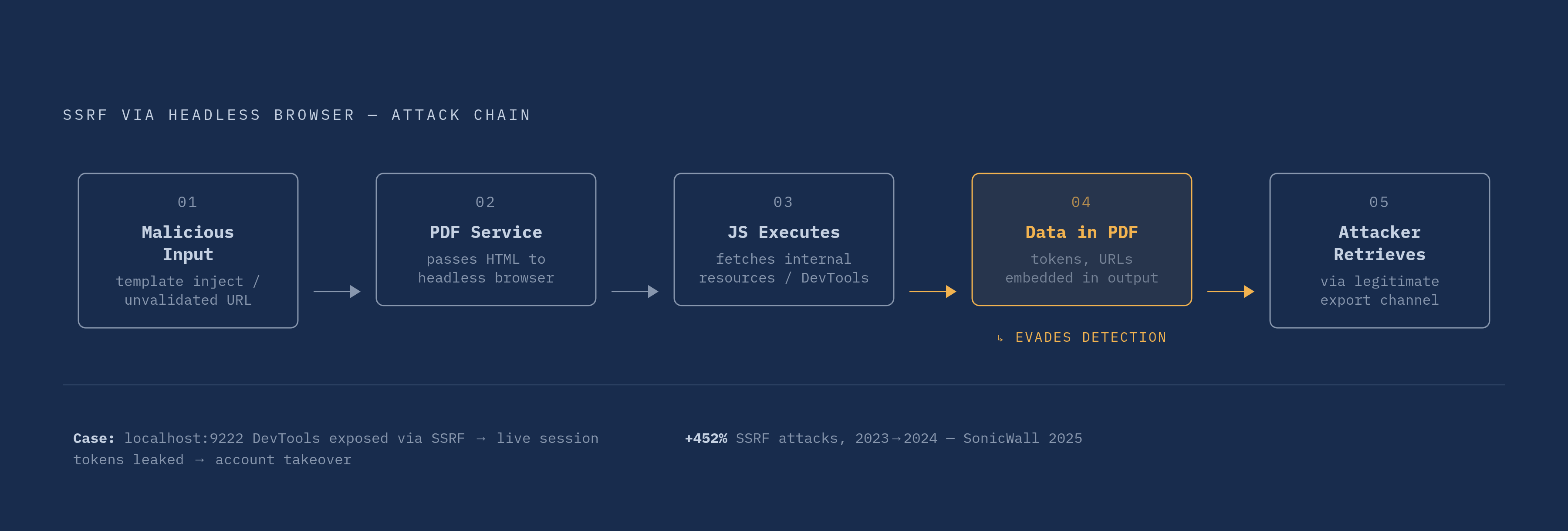
Classic server-side request forgery involves tricking a server-side HTTP client into fetching an internal resource. Headless browser SSRF is a different problem in kind, not just degree. The attacker isn't sending a bare HTTP request; they're spinning up a full JavaScript runtime inside your infrastructure, capable of multi-request sequencing, DOM parsing, and executing JavaScript against fetched content. The capability gap between the two is significant and, in my experience, consistently underestimated by teams who have dealt with SSRF before and think they understand the exposure.
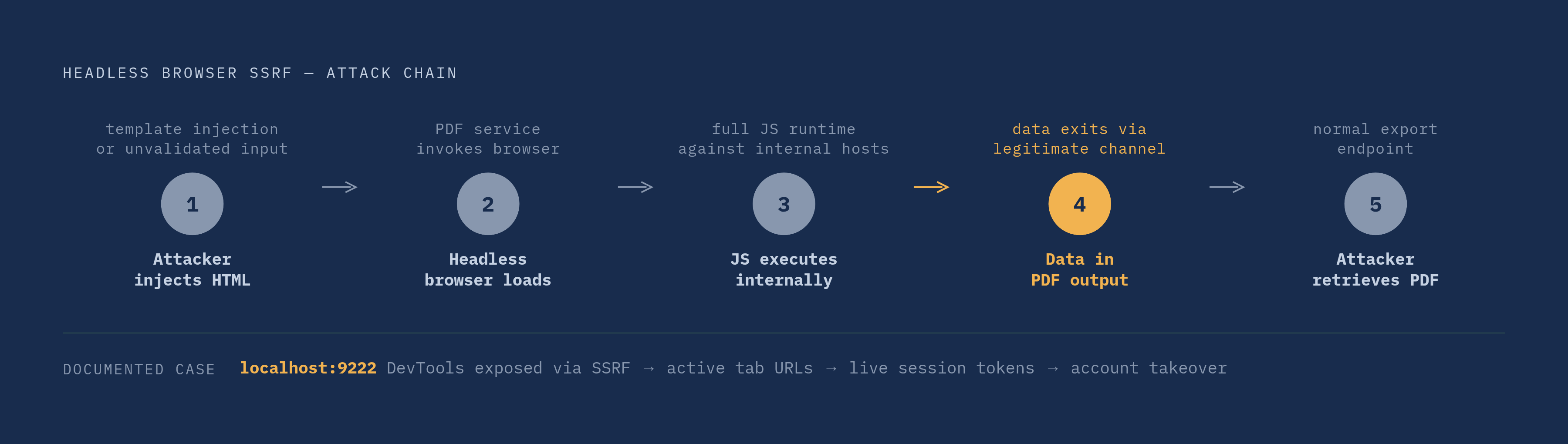
The canonical attack chain: an attacker influences HTML that reaches your PDF generation service through template injection, a rich-text input field, or an unvalidated URL parameter. The headless browser fetches that content, JavaScript executes against internal resources, and whatever is extracted surfaces in the generated PDF the attacker then retrieves. The data never leaves through an unusual channel because the PDF export is the intended channel. That's precisely what makes it difficult to catch.
A documented bug bounty case illustrates the ceiling. An exposed localhost:9222 DevTools endpoint was reachable through an SSRF vulnerability. Chrome's debugging protocol exposes a /json endpoint by default that listed active browser tabs; those tab URLs contained live session tokens. Any user who triggered a PDF export during that window was exposed to account takeover. The attack required no exotic technique, only the combination of an unvalidated URL parameter and an exposed debugging interface.
SonicWall's 2025 Cyber Threat Report documented a 452% increase in SSRF attacks from 2023 to 2024, a rise correlated with AI-powered tools that auto-identify vulnerable endpoints and generate bypass payloads. A high-capability vulnerability class combined with tooling that industrializes discovery does not remain theoretical for long.
The mitigation framing that has held up: treat the headless browser process as an untrusted network client, not a trusted internal service. Enforce outbound allowlists. Block RFC-1918 address ranges and loopback at the network egress layer. Validate user-controlled input before it reaches the browser's URL argument. These controls address the attack chain at multiple points rather than betting on a single gate.
How attackers weaponize headless browsers against your systems
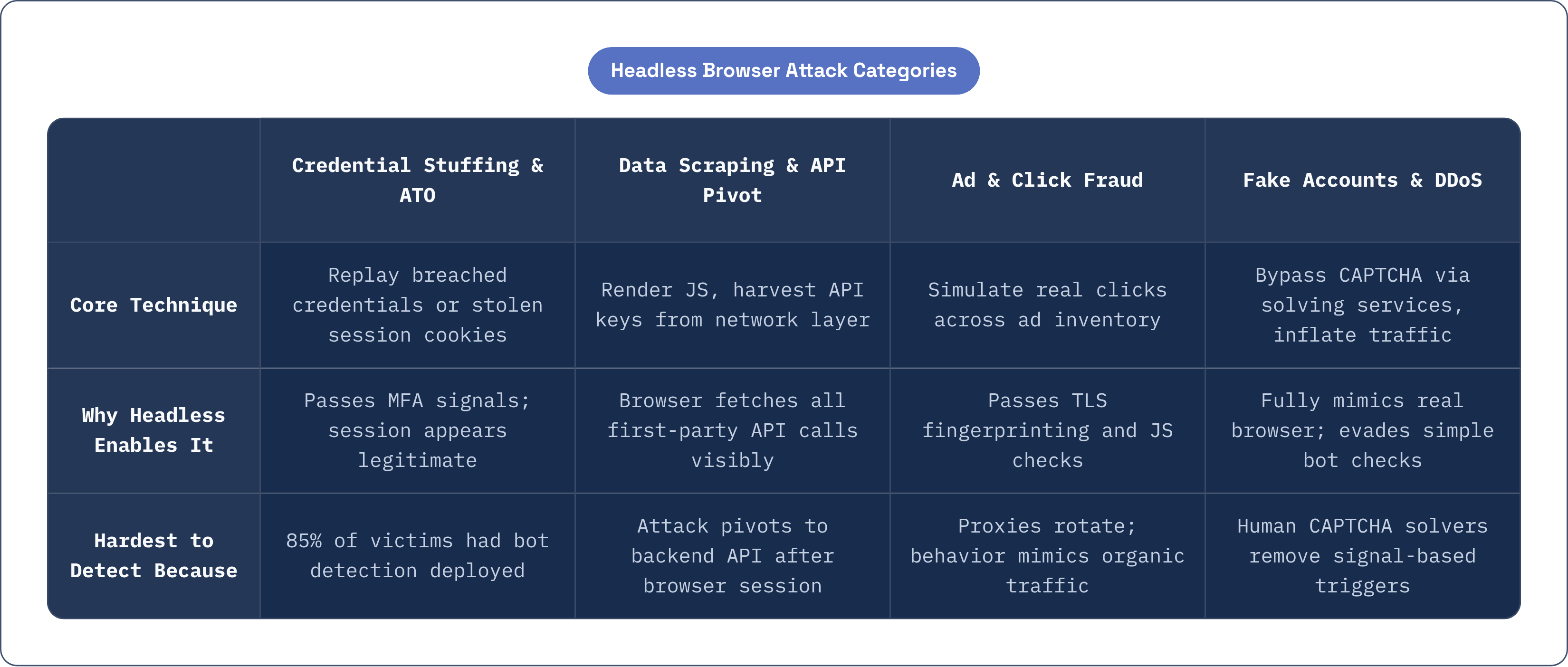
What separates headless-based attacks from commodity bot activity is the completeness of the browser simulation. A headless browser passes TLS fingerprinting checks, executes JavaScript, handles cookies and redirects, and renders single-page applications exactly as a real browser would. Simple HTTP bots fail these checks routinely. A properly configured headless bot does not, and the operational consequences of that distinction are significant.
The capability maps onto four primary attack categories: credential stuffing and account takeover, data scraping and API exfiltration, ad and click fraud, and fake account creation combined with DDoS augmentation. The web scraping market reached an estimated $1.5 to $2 billion in 2024, driven by both commercial and malicious demand, with headless browsers as its primary technical substrate. New account creation using headless mode combined with human CAPTCHA-solving services like 2Captcha costs approximately $0.77 per 1,000 CAPTCHAs solved. Cost is a negligible deterrent at those rates.
The Dress Code botnet from 2016 is an instructive reference point, even now. It ran 5,000 headless browsers on attacker-controlled infrastructure clicking advertisements, routing through compromised Android devices as proxies rotated every five seconds. It established the operational template that is still recognizable in current campaigns. The sophistication has grown considerably. The underlying logic has not.
Credential stuffing and session hijacking at headless scale
Akamai's 2024 Securing Apps report counted 26 billion credential stuffing attempts per month. That volume only makes operational sense at automation scale, and the motive is direct: credential reuse across consumer accounts remains high enough that automated testing of breached username-password pairs against high-value targets generates returns that justify the infrastructure cost.
Kasada's 2025 report sharpens the picture considerably. It recorded a 250% increase in account takeover attacks in 2024, with 6.2 million compromised accounts across 1,027 large organizations. The figure that stays with me from that data: 85% of those compromised organizations already had some form of bot detection deployed.
The reflexive response is to frame this as a tooling gap, insufficient investment in detection. That framing is too comfortable, and I don't think it holds. The 85% figure suggests the tooling existed. What failed was the architectural premise: that detection based on reported browser properties is structurally reliable against an attacker who can patch those properties. The budget wasn't the constraint.
Credential reuse is only one entry point. Stolen session cookies replayed inside a headless environment bypass MFA and IP-based alerts because the session itself appears legitimate. The browser isn't authenticating; it's presenting a valid session state acquired elsewhere. The compromise of 35 Chrome extensions across 2.6 million devices, which led to Facebook Ads account takeovers, illustrates how supply chain exposure feeds this pattern at scale, independently of leaked credential lists. Financial services accounted for 22% of all account takeover attacks in 2024 per Imperva, consistent with the intuition that session-level access carries the highest immediate conversion value in that sector.
Data scraping and the browser-to-API pivot
Data scraping via headless browser is, in concept, straightforward: mimic legitimate user behavior, render JavaScript, maintain session state, traverse pages systematically. The Parler breach remains the most documented case at scale. Sequential API endpoints were exploited through headless browser automation, extracting 70 terabytes of user data before access was closed. The attack didn't require bypassing cryptography or exploiting a code vulnerability. It required patience, automation, and rate-limiting controls that were inadequate to the volume.
The tactic that has matured more recently is what practitioners call the browser-to-API pivot, and it's more consequential than the scraping itself. A headless session against a public-facing application isn't only an attack on rendered HTML; it's access to everything the browser fetches to render that page: JavaScript bundles, inline configuration values, first-party API calls visible in the network layer. API keys embedded in client-side JavaScript, a widespread and underappreciated exposure pattern, become harvested credentials. The attacker then abandons the browser session and attacks the backend API directly, including, in documented cases, cloud service credential abuse that drains billing credits.
The defensive implication follows directly from the attack shape. Protecting public-facing HTML is necessary but not sufficient. Every API endpoint a structurally valid browser session can reach needs independent rate-limiting and anomaly detection. Session legitimacy is not evidence of human intent.
Why headless browsers are hard to detect and how attackers stay ahead
Early detection methods relied on static signals: the navigator.webdriver property set to true, specific User-Agent strings associated with headless builds, rendering discrepancies in canvas fingerprinting. Libraries like puppeteer-extra-plugin-stealth overwrite navigator.webdriver to return undefined as a baseline capability. The detection community has largely moved past treating these signals as primary. A substantial portion of deployed systems has not, which is its own problem.
The reason these patches work is structural. Static signals expose what the browser reports about itself through JavaScript-accessible APIs. Any attacker who can write a JavaScript patch can neutralize them. Chrome DevTools Protocol artifacts are harder to neutralize because they don't live in the JavaScript layer. CDP event signatures appear in the browser's performance timeline; layout and paint events fire with characteristic timing offsets that persist even after surface-level JavaScript patches. The attacker can change what properties the browser reports. Changing how CDP actually sequences events internally is a meaningfully different problem.
Behavioral signals occupy the most defensible ground available right now. Cursor motion, scroll rhythm, interaction timing: these cannot be patched at the API level because stealth tooling changes what the browser reports, not how the automation script actually moves through a page. A human scrolling through a product listing and a headless script doing the same thing interact with the DOM in measurably different ways, even when the script is explicitly randomizing delays.
Guillotine, a documented advanced evasion framework, separates the evasion layer from the automation layer entirely. It intercepts and rewrites DOM properties and JavaScript functions used to identify headless environments without automating interactions itself. The stealth and the attack script can be developed and updated independently, so detection improvements aimed at one layer don't automatically degrade the other. That architectural separation represents a genuine maturation in attacker tradecraft.
The detection gap also runs inward. Headless processes running inside your own infrastructure often have no visibility layer at all. Phantom Goblin, a documented malware strain, disguises headless browser processes as browser.exe specifically to blend into EDR process trees. An absent alert is not evidence of an absent threat.
The AI layer that amplifies risk in both directions
The consecutive years of bad bot growth are not solely a headless browser story; they are also an LLM story. Language models generate automation code, adapt scripts when detection methods change, and craft bypass payloads, lowering the expertise threshold for sophisticated attacks in ways that compound the evasion problem. Symantec researchers demonstrated this concretely, weaponizing OpenAI Operator to execute a fully automated phishing chain, an AI-driven browser agent that required minimal attacker input once the initial objective was specified.
The own-infrastructure risk from browser agents tends to get less attention than the external attack risk. That asymmetry is worth examining. An LLM paired with a headless browser inherits all the vulnerabilities described above and adds a distinct one: indirect prompt injection. CVE-2025-47241, identified in the Browser Use library, demonstrates the failure mode precisely. Lack of URL parsing and domain enforcement allowed malicious redirection and unauthorized command execution. The vulnerability was classified critical because it defeated the package's only operative security control; it was fixed in version 0.1.45, but its existence is instructive about how readily the agent layer inherits and amplifies the browser layer's exposure.
The mechanics of indirect prompt injection deserve precise attention. Malicious instructions embedded in web content, in product descriptions, customer reviews, page copy, are indistinguishable to the LLM from legitimate navigational commands. No browser engine vulnerability needs to be exploited. The attack surface is the content the agent is permitted to act on. Invisible prompt scenarios extend this further: instructions rendered invisible to human reviewers through white text or CSS hidden elements remain fully legible to the LLM processing the DOM. This bypasses both browser security controls and human audit simultaneously.
Teams that have invested heavily in browser configuration hardening should note what this implies. Those controls remain necessary. They do not address an attack that never touches the browser's security boundaries, only the content the agent is authorized to read and act upon. For browser agent deployments, the perimeter is not the browser configuration. It is the scope of content the agent treats as authoritative.
Building a security posture that covers both sides
The hardening checklist for own-infrastructure deployments converges on consistent principles, none of which are technically exotic. Run headless browsers as non-root users inside isolated containers. Avoid exposing the DevTools port to any externally reachable interface. Pin Chromium to an audited version and treat version drift as an open vulnerability. Enforce network egress allowlists from the browser process rather than relying solely on network-level controls. Validate all user-controlled input before it reaches the URL argument.
For PDF and screenshot services specifically, the risk surface is concentrated enough to warrant additional controls: a URL allowlist, blocked RFC-1918 address ranges and loopback at egress, Content-Type validation on fetched resources, and network isolation from internal segments the service has no operational reason to reach.
Monitoring requires an instrumentation layer most teams haven't built. EDR rules should flag browser processes without a corresponding user session. Network monitoring should surface unusual outbound connections originating from a rendering process. Phantom Goblin's use of process name spoofing is instructive here: the attacker's goal is to look like expected behavior, and detection built on static process names fails asymmetrically against an adversary who knows exactly what expected behavior looks like.
Defending against headless attacks on your systems means moving the detection anchor from signal-based to behavioral. Interaction timing, session graph anomalies, and protocol-level CDP artifacts represent the most defensible detection surface available right now. JavaScript-accessible properties like navigator.webdriver are unreliable as primary signals; whatever lives in a JavaScript-accessible API can be patched by the attacker. Signals derived from how the browser actually executes, rather than what it reports, are considerably harder to spoof.
API protection cannot assume that a structurally valid browser session implies a human user. Rate-limiting and anomaly detection on API endpoints need to operate independently of the browser layer. The browser-to-API pivot breaks the assumption that session legitimacy correlates with human intent, and architectures built on that assumption have a gap worth examining honestly.
For browser agent deployments, treat the agent's permission scope as an attack surface in its own right. Sandbox what content the agent can treat as authoritative. Implement URL allowlists at the agent level, not only at the browser configuration level. CVE-2025-47241 established that domain enforcement is a security control; its absence is a vulnerability, not an oversight.
The headless browser is simultaneously infrastructure you deploy and a threat vector aimed at what you've built. Most security architectures have absorbed one half of that reality. Getting comfortable with both, at the same time, is the actual work.