Playwright vs Cypress for AI Agent Testing
Playwright's architecture makes it faster, more reliable, and AI-friendly at scale.

As of mid-2026, Playwright sits at roughly 52 million weekly NPM downloads; Cypress is at approximately 7.8 million. The State of JS 2025 survey recorded Playwright satisfaction at 91% against Cypress at 72%. Playwright job postings rose sharply year-over-year in 2025. These figures get cited often, usually to end conversations rather than start them.
They are more interesting as residue than as argument. Each number is the downstream consequence of a decision some team made under real pressure, often after something broke in production. The more useful question is not which tool is winning but what problems drove the switching decisions, because those problems recur across organizations with uncomfortable regularity.
The architecture explains most of the pattern. Cypress executes inside the browser's JavaScript event loop, which gives it direct DOM access during local development but pins it to a single process. Playwright runs outside the browser, communicating via the Chrome DevTools Protocol for Chromium and equivalent protocols for Firefox and WebKit. That out-of-process design is not a bolt-on feature; it is the load-bearing premise from which almost every other meaningful difference follows. Isolated browser contexts, multi-origin flows, protocol-level network interception, genuine parallelization: all of it is a structural consequence of where the tool sits relative to the browser. So is nearly every limitation Cypress teams eventually run into.
Performance and parallelization at CI scale
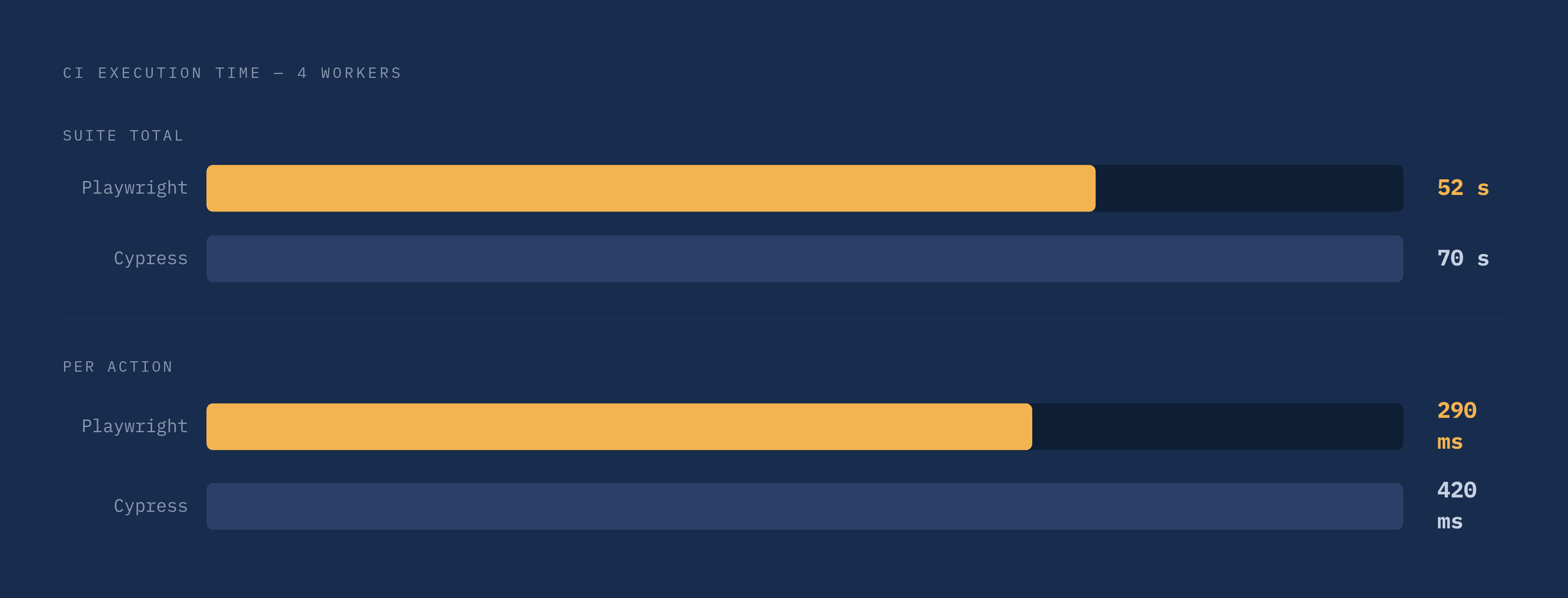
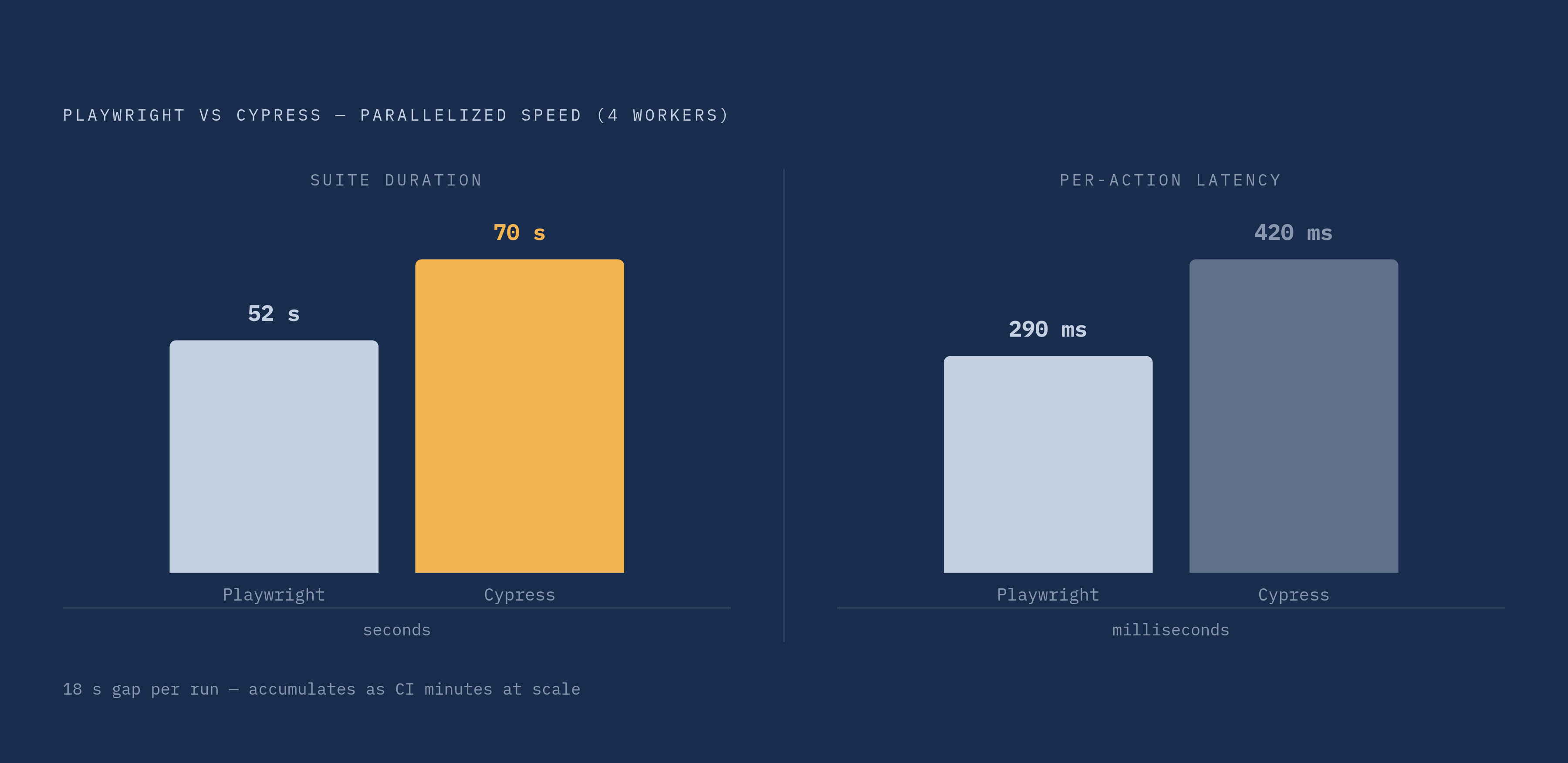
Independent benchmarks from LambdaTest, QA Wolf, and TestSigma show Playwright completing identical suites faster in sequential execution and pulling further ahead under parallelization. With four workers, Playwright finishes the same work in roughly 52 seconds against about 70 seconds for Cypress. At the per-action level, Playwright averages around 290ms against Cypress's 420ms. That gap sounds negligible until you run 500 tests with 20 actions each, at which point the arithmetic accumulates into meaningful saved minutes per CI run.
The connection model accounts for most of this. Playwright holds persistent WebSocket connections to browser debugging protocols; every action is a single message with no HTTP overhead and no driver intermediary. Cypress carries startup overhead of roughly five to seven seconds per run to bundle, inject, and proxy before any test logic executes. Playwright's parallelism is native and process-based. Cypress's parallelism depends primarily on its paid Cloud Dashboard, which introduces both a cost line and a vendor dependency that tends to be underweighted during initial evaluation.
These pressures rarely arrive one at a time. A team I worked alongside had reached a point where their CI runs exceeded 45 minutes. That was the complaint, but when we actually pulled the thread, Cypress Cloud was running about $600 a month and they had an OAuth popup flow they simply could not test. The CI time was the presenting symptom. By the time a team is seriously debating migration, they are usually looking at several failures converging, not one.
Beyond raw speed, analysis across more than 300 test suites found that Playwright produced substantially fewer flaky tests than Cypress. Flakiness does not show up in throughput benchmarks, but it carries its own CI tax: a flaky test does not just consume time once, it consumes the same time twice, once to fail and once to investigate what turned out to be nothing.
Browser coverage and language support as silent risk factors
Playwright supports Chromium, Firefox, and WebKit natively. Cypress's Safari support remains experimental and, notably, relies on Playwright's own WebKit binary to function. Safari holds roughly 18% of global browser market share; Firefox accounts for another three to four percent. Testing only against Chromium leaves a meaningful share of user traffic unexamined.
The counterargument is familiar: Chromium coverage is sufficient for most teams. That may be true for your users, or it may be true until it isn't. I have seen the "sufficient" assumption hold for years and then fail spectacularly on a Safari-specific rendering bug that affected a payment flow. The gap between "probably fine" and "verified" tends to close in the worst moments.
Language support diverges in a similar way. Playwright covers JavaScript, TypeScript, Python, Java, and C#. Cypress is limited to JavaScript and TypeScript. For backend-heavy or polyglot organizations, that constraint is not a minor inconvenience; it forces separate toolchains or JavaScript rewrites of test logic that already exists in another language.
Both gaps compound specifically in AI agent contexts. Agents generating cross-browser tests, or agents operating inside Python-based machine learning pipelines, hit Cypress's ceiling faster and more visibly than human-authored workflows do. Agent-generated test volume is simply higher, and tolerance for per-test workarounds is effectively zero at that volume.
Why AI tools generate better Playwright tests by default
The core problem is syntactic. Playwright uses standard JavaScript async/await. Cypress uses a custom command queue built on an internal asynchronous system that does not resemble ordinary JavaScript in its chaining behavior. Large language models are trained on enormous quantities of standard async/await code; they generate it reliably because it is the dominant pattern in the JavaScript ecosystem. Cypress's chaining syntax is idiomatic to Cypress, not to the broader corpus those models learned from.
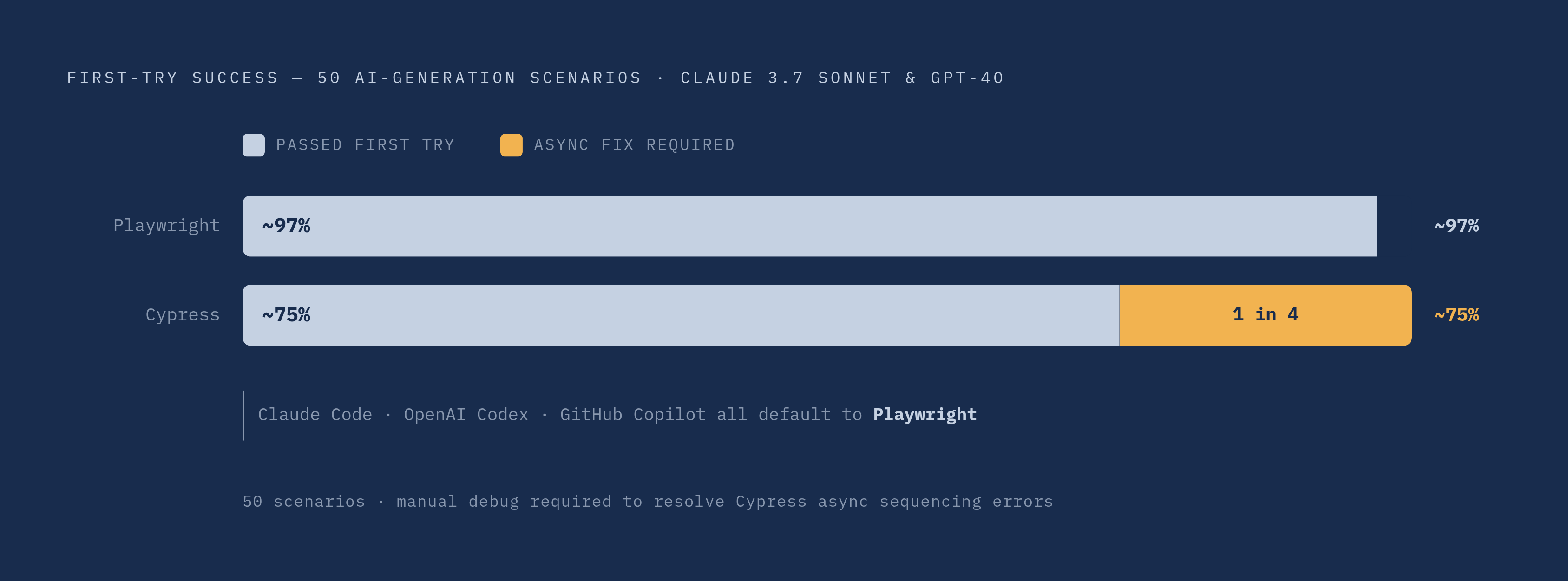
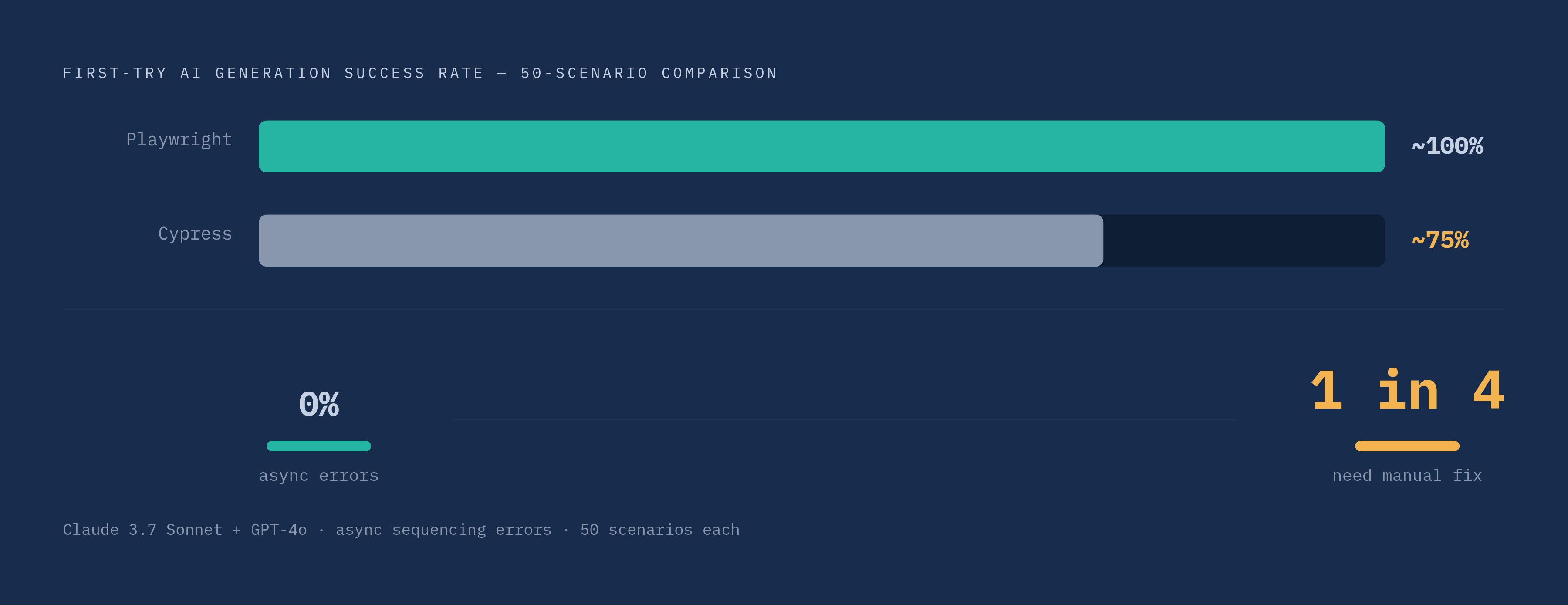
Tested comparisons using Claude 3.7 Sonnet and GPT-4o across 50 scenarios found Playwright achieving high first-try success rates with minimal async errors, against Cypress showing meaningfully lower success and substantially higher async error rates. The rough picture is that close to one in four AI-generated Cypress tests required manual debugging to resolve async sequencing errors. That failure rate substantially erodes the productivity gain that motivated AI test authoring in the first place. Claude Code, OpenAI Codex, and GitHub Copilot all default to generating Playwright tests when given a choice. That is a revealed preference, not a marketing position.
The stakes of that error rate have risen. Hashnode's 2026 State of Vibe Coding report found that 46% of new production code is AI-generated; Sonar's 2026 State of Code found that 96% of developers do not fully trust AI-generated code, yet fewer than half verify it before committing. An elevated async error rate in AI-generated Cypress tests lands inside a workflow environment where verification is already inconsistent. The errors that matter most are the ones that go unexamined.
If your team is among those who do verify before committing, the calculus shifts somewhat, but not completely. The cost does not disappear; it relocates from production failures to manual review time. That is a better outcome, though not the same as eliminating the problem entirely.
Playwright MCP: giving AI agents structured browser control
Anthropic introduced the Model Context Protocol in late 2024 as an open standard for letting large language models communicate with external tools through a structured interface. Microsoft's official Playwright MCP server connects any MCP-capable client, including VS Code, Cursor, Claude Desktop, and Windsurf, to a real Playwright-controlled browser.
The critical design choice is that agents interact via structured accessibility tree snapshots: ARIA roles, labels, navigation hierarchy. Not screenshots, not pixel inference. The agent reasons from semantic structure rather than visual appearance, grounding its understanding of page state in the same representation that assistive technology uses. The action vocabulary is deliberately narrow: navigate, click, type, snapshot. Every action executes through the real Playwright engine against a real browser. The constraint is the point; it keeps agent behavior predictable and auditable.
GitHub Copilot Coding Agent has Playwright MCP built in by default. When asked to implement a feature or fix a bug, it uses Playwright MCP to open the browser, navigate to the relevant state, and verify the result before surfacing it to the developer. Cypress has no equivalent official MCP integration as of mid-2026. The architectural constraints described earlier make a comparable integration structurally difficult rather than merely unprioritized. That distinction matters when you are evaluating a roadmap.
The token cost tradeoff in MCP-driven agent workflows
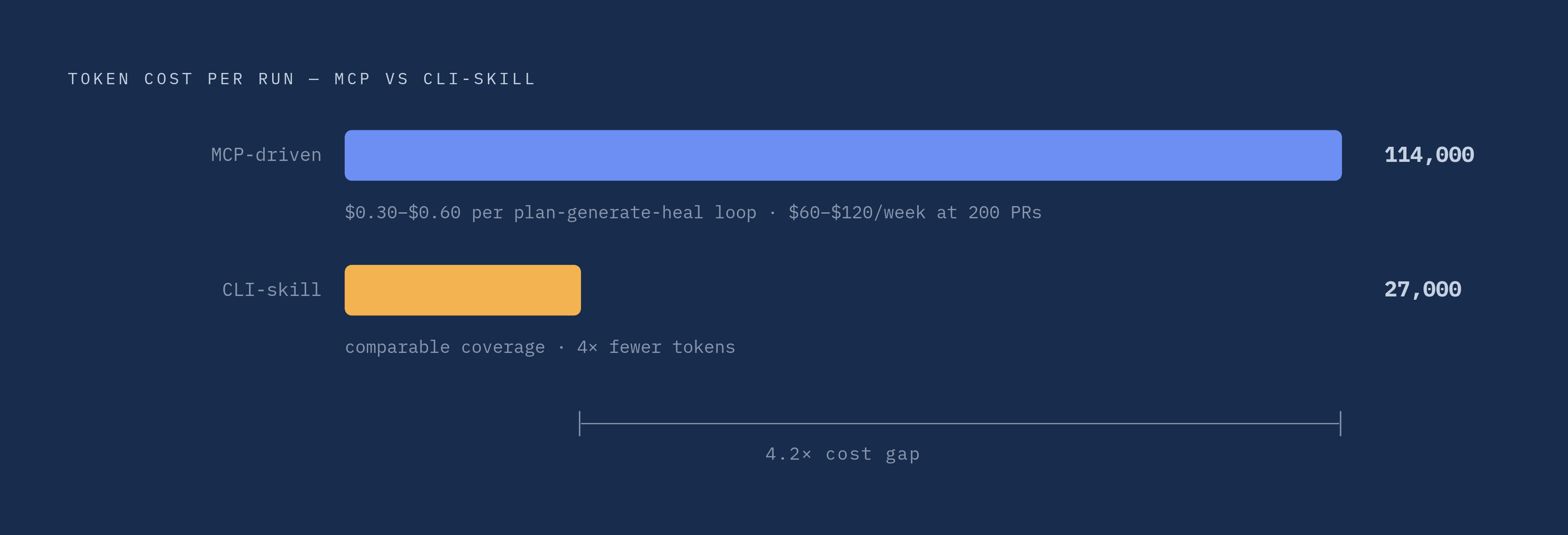
MCP-driven reasoning carries real costs. Analysis from Currents.dev found that MCP-driven runs consumed roughly 114,000 tokens per test, while CLI-skill workflows came in around 27,000 tokens for comparable coverage. When an agent is executing an existing, validated test rather than iteratively reasoning about page state, the CLI-skill pattern can be more than four times cheaper.
A full plan-generate-heal loop for a medium application costs roughly $0.30 to $0.60 in LLM tokens. For teams running 200 pull requests per week with healing on every run, that compounds to $60 to $120 per week in LLM costs. Manageable for many organizations, but not trivial, and it scales with workflow frequency in ways that most infrastructure costs do not.
MCP and leaner CLI patterns are not competing answers to the same question; they address different problems. MCP belongs when an agent needs to explore, reason about, or verify UI state it has not previously encountered. Batch execution of already-validated tests belongs to the leaner pattern. Knowing which mode a given workflow actually warrants requires someone who understands both the token economics and the test lifecycle, and in most organizations that expertise does not yet sit in a defined role. Teams are largely working this out as they go.
Playwright Agents (v1.56 onward) and what "agentic test automation" actually means in practice
Released with Playwright v1.56 in October 2025, the Playwright Agents system introduced three components: a Planner that explores the application and produces a Markdown test plan, a Generator that transforms that plan into Playwright test files, and a Healer that executes the suite and auto-repairs failing tests. Subsequent releases extended the system: v1.58 shipped a token-efficient CLI for batch execution, and v1.59 added browser.bind() for MCP interoperability and page.screencast for video receipts from agent runs.
The system genuinely accelerates test creation and locator maintenance. It is not an autonomous quality engineer, and treating it as one will cost you.
Context window caps cause agents to lose track of early steps in long flows. Two identical prompts can produce slightly different code across runs. Agents understand DOM structure but not business logic; they can verify that a checkout flow completes without errors, but they cannot determine whether it behaves correctly according to the product specification. Complex UI redesigns still require human intervention to realign test intent with new page structure. None of this is a reason to dismiss the tooling; it is a reason to scope it correctly.
The working mental model I keep returning to, drawn from watching these systems in production rather than reading about them, is something like a constrained co-pilot: capable, often impressively so, and requiring an experienced human to define the boundaries. That framing holds up better under actual production conditions than either the breathless launch coverage or the reflexive skepticism that tends to greet new automation capabilities.
Cypress shipped its own response in late 2025: cy.prompt() for English-language test authoring and self-healing selectors through Cypress Cloud. These are real capabilities. They are also positioned within the same paid-dashboard infrastructure that constrains Cypress's parallelization story, which means any honest evaluation has to weigh capability and cost together rather than treating them separately.
Choosing between them given what AI agent testing actually requires
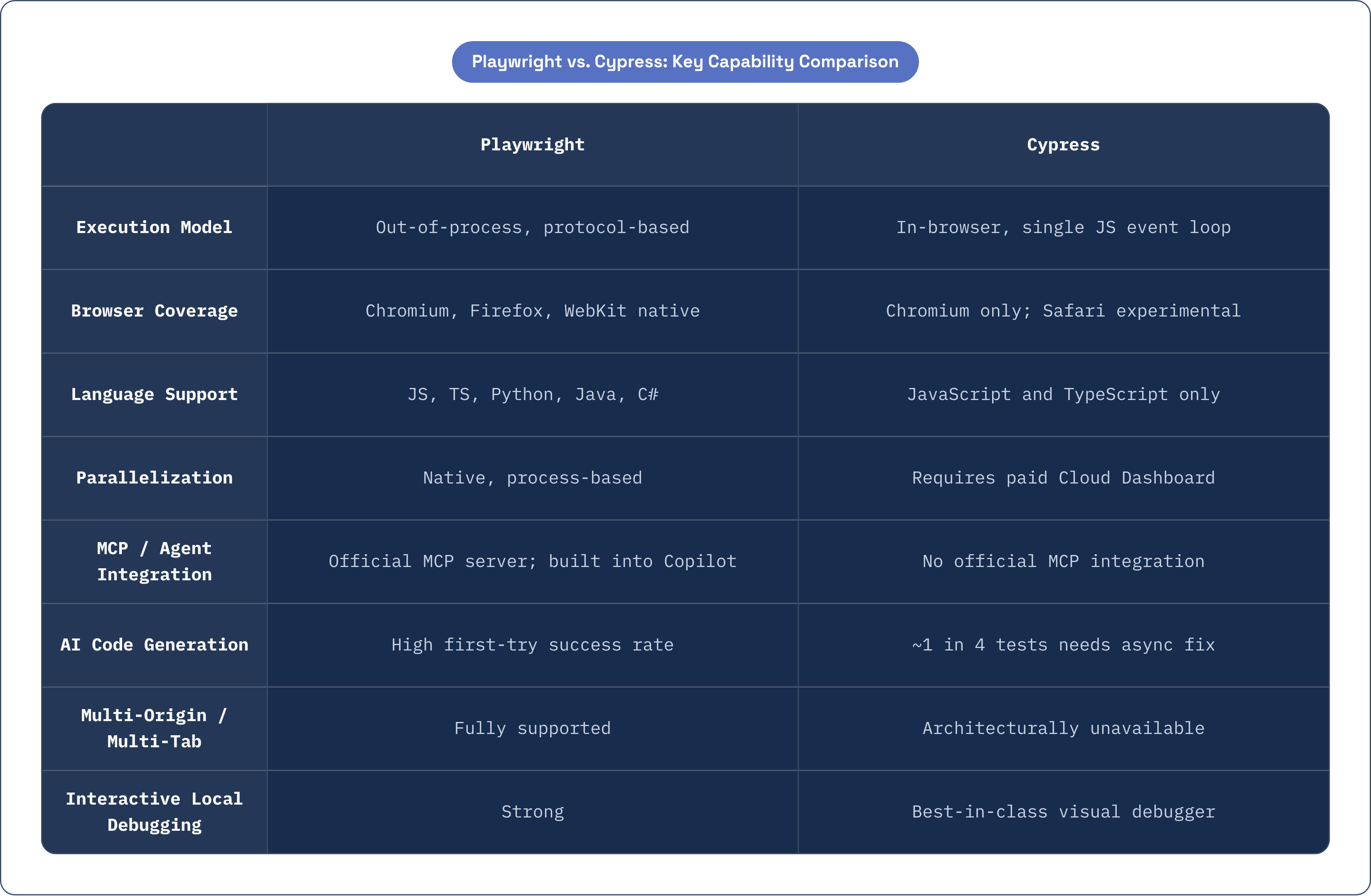
For teams building AI-heavy workflows, multi-browser coverage, polyglot codebases, or CI pipelines where parallelization cost is a genuine constraint, Playwright is the stronger default. The MCP integration, the native agentic tooling, and the superior AI generation success rates are not marginal advantages; they represent the infrastructure that agentic testing requires to function at scale.
Cypress retains genuine advantages in interactive visual debugging during local development, stable component testing, and organizations whose existing test suite is large, well-maintained, and JavaScript-only. Migration cost is real. A stable Cypress suite that does not require multi-browser coverage or AI-generated authoring is not a liability; it is an asset, and treating it as such is the rational position.
The async pattern gap is not a Cypress defect. It is a design tradeoff that was entirely reasonable before AI code generation became a primary authoring path. Tradeoffs do not age neutrally when the surrounding environment shifts, and AI authoring represents a genuine shift.
Multi-tab and multi-origin flows, common in OAuth sequences, payment redirects, and AI agent task chains that span multiple domains, are architecturally unavailable in Cypress. No configuration change or plugin resolves this, because the limitation is the in-browser execution model itself. That is a hard constraint, not a workaround problem.
For greenfield projects or new AI agent test infrastructure, the MCP integration and the Planner/Generator/Healer system tip the balance toward Playwright clearly. For teams already running stable Cypress suites without multi-browser or AI-generation requirements, the migration calculus depends heavily on how rapidly AI authoring is actually entering the workflow. The first-try success rate differential becomes concrete quickly for developers who are already routing half their test authoring through a language model. For a team not yet doing that, the number stays abstract, and abstract numbers rarely justify migration costs on their own.