serverless browser services with edge-native cold-start advantages
V8 isolates eliminate cold starts by replacing containers with lightweight sandboxes.
Cold starts exist because, before a serverless platform can run a single line of code, it first has to build an entire machine. Before a function touches the request that triggered it, the platform has to allocate memory, mount a filesystem, set up a network namespace, and get a language runtime running, and that is true whether the underlying tech is a microVM like the Firecracker system behind AWS Lambda or a container model like the one Azure Functions uses. None of those steps is optional, and none of them can run in parallel with the others in a way that erases the delay. Each one depends on the last: there is no filesystem to mount until memory is allocated, no runtime to start until the network namespace exists.
That sequence appears to users as a cold start, anywhere from a hundred milliseconds to well over a second depending on runtime weight and payload size. It is the structural cost of choosing a container or a microVM as the unit of execution, paid every time a function wakes from idle. Platforms have built real engineering around hiding that cost: provisioned concurrency keeps instances warm on standby, snapshot-based starts resume a process from a saved memory image instead of booting fresh, and warm-pool heuristics try to predict demand before it arrives. All three reduce how often a user hits a cold path, but none of them touches the initialization chain itself. They trade idle compute spend, money paid to keep something running that nobody is using yet, so that the next request has a better chance of landing on something already warm.
Developers running these systems in production describe the resulting experience in fairly specific terms: latency that swings unpredictably depending on how many dependencies a runtime has to load, a practical lock-in to whichever vendor's event loop a function was written against, and a geography problem where every user outside the function's home region pays for the network round-trip on top of whatever cold-start tax is already there. That last point turns out to matter as much as the cold start itself, and it gets its own treatment further into this piece. For now, the more immediate question is simpler: what happens if, instead of trying to boot the container faster, a platform removes the container as the unit of execution?
How V8 isolates work as an execution primitive
A V8 isolate is not a faster container. A V8 isolate solves it by not being a container at all; none of the OS-level initialization chain described above ever has to run. An isolate is a sandboxing primitive built on the same idea Chrome uses to keep browser tabs apart, but Chrome itself does that separation with OS-level renderer processes, not V8 isolates. What an isolate gives a platform is a JavaScript execution context with its own heap and its own garbage collector, with no memory shared between one isolate and the next, and startup measured at under 5 milliseconds.
The reason that number is possible, rather than just impressively small, comes down to what the isolate skips. There is no OS process to spawn. There is no filesystem to mount. There is no network namespace to configure. Code can start running almost the moment a request shows up, because the thing receiving the request was never shaped like an operating system in the first place. The architecture built around this looks different from a regional cloud deployment too: a request lands on a global anycast network, gets routed to whichever isolate or small managed runtime sits nearest, and only reaches an origin server when the edge genuinely cannot compute the answer on its own.
None of this comes free of constraints, and the constraints are specific enough to matter when choosing where a given workload belongs. Isolates run against Web-standard APIs rather than the full Node.js ecosystem, they carry CPU time limits on a per-request basis, and they are the wrong fit for anything long-running, CPU-intensive, or heavy on filesystem access. The honest way to frame the decision is as a trade: Node compatibility and long CPU runs get exchanged for latency, geographic reach, and pricing that scales per request rather than per provisioned instance. It is a workload-specific call, applicable only where that workload fits, not a blanket upgrade over every other model of serverless compute.
WebAssembly arrives at a similar outcome from a different angle. Wasm does not sandbox a JavaScript heap. It compiles functions down to a portable binary format that runs close to native speed, and because it needs no full language runtime underneath it, cold starts run sub-millisecond and the memory footprint is far smaller than a Docker container's. Academic work on Wasm-based serverless runtimes backs this up with harder numbers: replacing Docker with a Wasm runtime cuts cold-start latency sharply on both single-board computers and server-class machines, and shrinks memory footprint by more than fivefold.
The performance gap in production when isolates replace containers
Isolates start faster by design, but when real traffic hits them, how much does that design advantage actually move the needle? Zylos Research's analysis found that edge functions cut cold-start time by roughly nine times over traditional serverless, and once a function is warm, it still executes roughly twice as fast.
In the pkglog.com guide's comparison table, Cloudflare Workers delivers effectively zero cold starts for HTTP, but Lambda@Edge can take anywhere from tens of milliseconds to over a second, depending on bundle size and invocation path. That range matters because it shows the container model is not failing uniformly. Smaller bundles and simpler invocation paths bring the number down, but the architecture still carries the underlying initialization chain no matter how well you tune it.
None of this makes isolate-based edge compute a universal replacement for everything currently running as a container or a microVM, and the limits deserve as much attention as the gains. The gap is decisive for workloads that live on the request path: API middleware, authentication checks, A/B test routing, geo-routing, rate limiting, and header manipulation all depend on shaving milliseconds off a response because the user is sitting there waiting for it. The gap stops mattering for cron jobs, long-running batch work, video transcoding, and anything that needs sustained CPU time past what a per-request limit allows, and those workloads still belong on container-based or regional compute. Alphonso Labs draws the same line from the operator's side: edge functions typically carry execution time limits, so CPU-intensive work keeps living on traditional compute regardless of how fast the edge has gotten. The honest reading of the benchmark numbers, then, is not that one model has beaten the other outright. It is that each model has a job it was built for, and the nine-times figure only means something once a workload actually sits inside the isolate's sweet spot.
Distribution as the compounding advantage: why proximity matters as much as startup time
Cold starts are only one half of the latency story; fixing them does not fix the network-distance cost that remains. A container-based function running warm in us-east-1 still has to answer a request from Tokyo, and that answer still pays the speed-of-light cost of crossing the Pacific regardless of whether the function is warm. Traditional serverless deploys to a fixed region or a small handful of them, so if you sit outside that region, you pay a physical distance tax that no amount of warm-pool tuning will shrink.
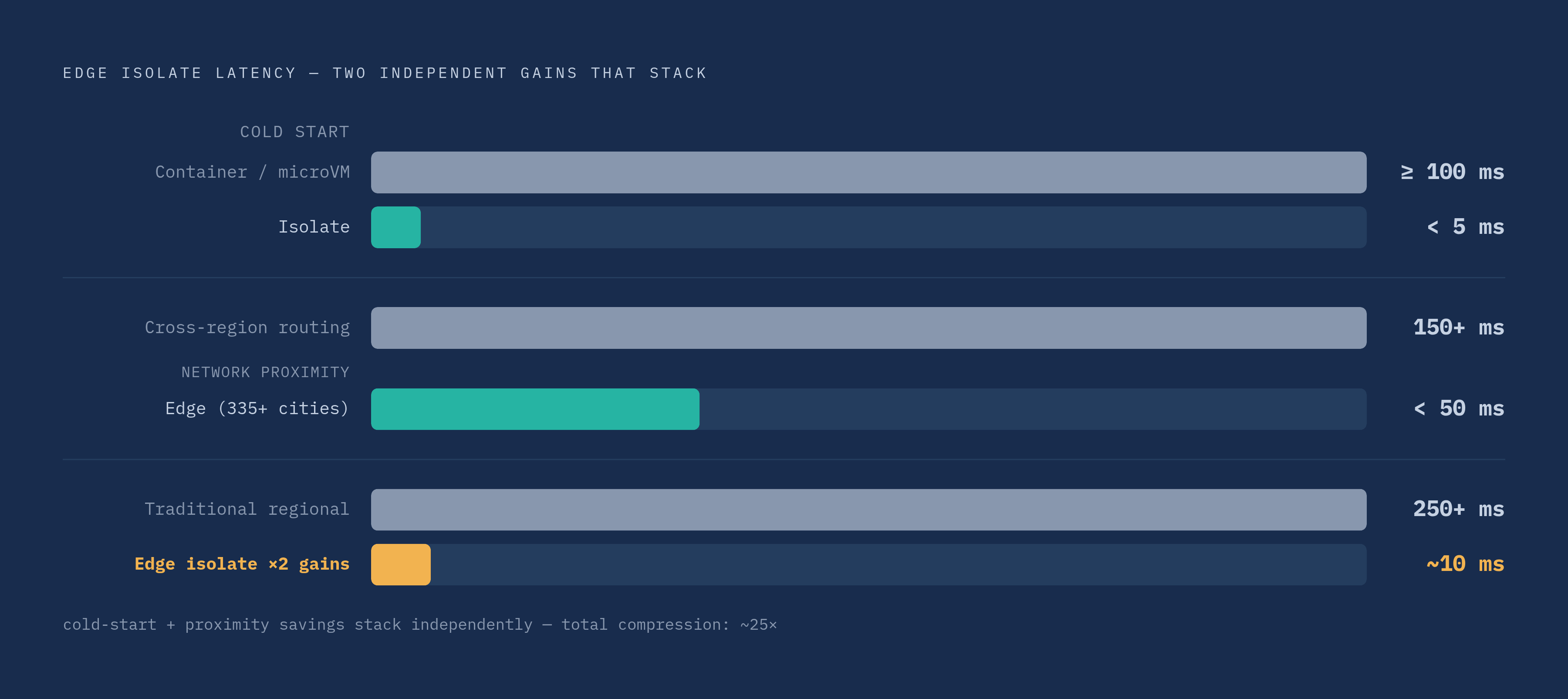
The dev.to analysis makes the contrast concrete: an API served out of a point of presence in Tokyo can answer a user in Tokyo without ever touching a server in the US, and the gains here come from two separate places rather than one. Skipping the warm-up is one win. Skipping the regional routing decision entirely is a second, independent win. Cloudflare's own network reaches most of the world's internet-connected population within 50 milliseconds across more than 335 cities, so if an isolate runs at the nearest point of presence, it sits within one round-trip of almost anyone making the request. The request path that results looks straightforward on paper: DNS resolves to the nearest point of presence, a Worker or edge function runs there, it optionally reaches into edge storage like KV or R2, and only falls back to an origin server when the answer genuinely cannot be computed on the spot.
Put the two advantages together and the result is not simply "edge is faster." Near-zero startup time removes one bottleneck, and geographic placement removes a second, unrelated one, so because they are independent, they stack rather than overlap. The combination lets edge-native applications hold response times in the single-digit to low-double-digit millisecond range, and you used to need aggressive CDN caching of static assets to get that kind of responsiveness, but you couldn't get it for anything dynamic or computed on the fly. What changes here is not just raw speed but which category of application gets to use that speed: computed, per-request logic used to be stuck with regional latency as a cost of doing business, and now it doesn't have to be.
How Cloudflare Workers implements isolate-based edge in production
Do not look at Cloudflare Workers as a product to evaluate; look at it as proof that everything described above actually runs at scale outside a research paper. It shows that isolate-based edge compute is a production primitive that can carry full application stacks, AI inference pipelines, and agentic workloads, not just small stateless functions, and benchmarks from Zylos Research put Workers substantially ahead of Lambda@Edge and standard Lambda even on warm execution, so the isolate's advantage persists into steady-state performance too.
Running stateless compute at the edge only solves part of building a real application, so the harder engineering problem has been building storage and coordination primitives that can sit next to the isolate without dragging back in the regional latency the isolate was built to avoid. D1 brings relational reads and per-tenant configuration to the edge. R2 offers object storage without egress fees, suited to assets and uploads once a request has been authenticated. KV handles eventually consistent, low-latency reads for things like feature flags and redirect maps, where a few seconds of staleness does no harm. Durable Objects give you single-leader stateful coordination tied to a specific key, and that is what makes real-time collaboration and persistent agent state possible in a way stateless edge functions alone cannot support.
The pattern that falls out of combining these pieces is what the pkglog.com guide calls fan-out reads, funnel writes: reads and lookups spread comfortably across the edge, but heavy transactional writes still tend to need a regional database, or a purpose-built edge SQL engine with known consistency tradeoffs made explicit rather than hidden. Cloudflare's internal AI engineering work offers a documented look at what this stack carries in practice: tens of millions of requests routed through AI Gateway, hundreds of billions of tokens processed, and inference served through Workers AI to thousands of internal users; the infrastructure it sells is the same infrastructure it runs on internally. Workers AI itself prices with a free tier and per-model flexibility across a catalog of more than 50 models, including Llama, Stable Diffusion, and Mistral, and Zylos Research puts the resulting cost difference against Lambda@Edge at a substantial savings for mid-sized production request volumes. During Developer Week in March 2026, Cloudflare brought Dynamic Workers into open beta, a system that executes AI-generated code inside secure isolates at startup speeds described as 100 times faster than traditional containers, and this extends the isolate model from static developer-written functions into code an agent writes and runs on the fly.
AI agents and agentic workflows at the edge
AI agents are the first genuinely new class of serverless workload since event-driven functions first appeared, and the way they execute maps onto isolate-based edge compute more naturally than it maps onto containers. A SIGOPS paper published in July 2026 argues this directly: agentic workloads fit serverless deployment schemes well, provided the platform uses pre-warming policies that keep idle resource footprint low alongside startup latency, and the near-zero startup time that isolates offer is directly valuable because agent steps fire unpredictably rather than on a predictable schedule.
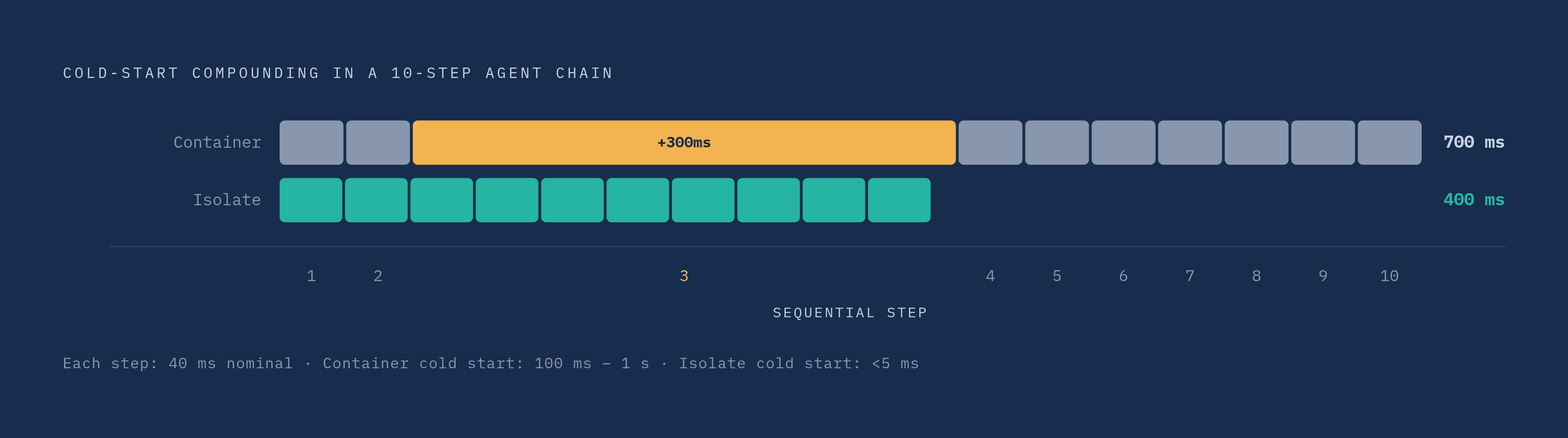
The shape of an individual agent step helps explain why. Agent chains run sequentially, so latency in any one step does not just cost that step, it multiplies across however many steps follow it in the chain. A cold start that costs 300 milliseconds on its own becomes a much bigger problem when it is the third step in a ten-step agent chain, and that compounding effect is exactly where the isolate model's microsecond-to-millisecond startup advantage pays off hardest.
Performance is not the only dimension that changes once agents enter the picture. Governance becomes a real concern too, specifically around the Model Context Protocol, or MCP, which many agents use to reach external tools. Enterprises have had limited visibility into which MCP servers their agents actually connect to, and that gap creates genuine risk if an agent ends up talking to a compromised or malicious tool provider. During Agents Week in August 2026, Cloudflare added detection and control capabilities for MCP traffic inside Cloudflare One, positioning it as the first SASE platform built to rein in MCP server sprawl by governing AI agents and human users together under one visibility layer. The AI Gateway has also expanded to support more than 14 model providers with direct Workers AI binding integration, so code execution and model inference can run on the same global network, with no extra hop out over the public internet between an agent's execution environment and the model it is calling. Workers AI's public catalog now includes large models built with agent use cases in mind, including Kimi K2.6 and real-time voice models, all reachable through the same unified inference layer.
The same structural logic that explained cold starts in the first place ties this back to the rest of the piece. Containers were never built to start in microseconds, and agent chains cannot afford to wait while one does. The isolate model's advantage was never only about shaving milliseconds off a single HTTP response; it turns out to matter just as much, maybe more, once the workload is a chain of model calls where every delay gets paid several times over before the agent finishes its task.