Python Web Scraping Libraries for AI Agent Pipelines
Separate your web scraping into three isolated layers to diagnose failures and cut token waste.
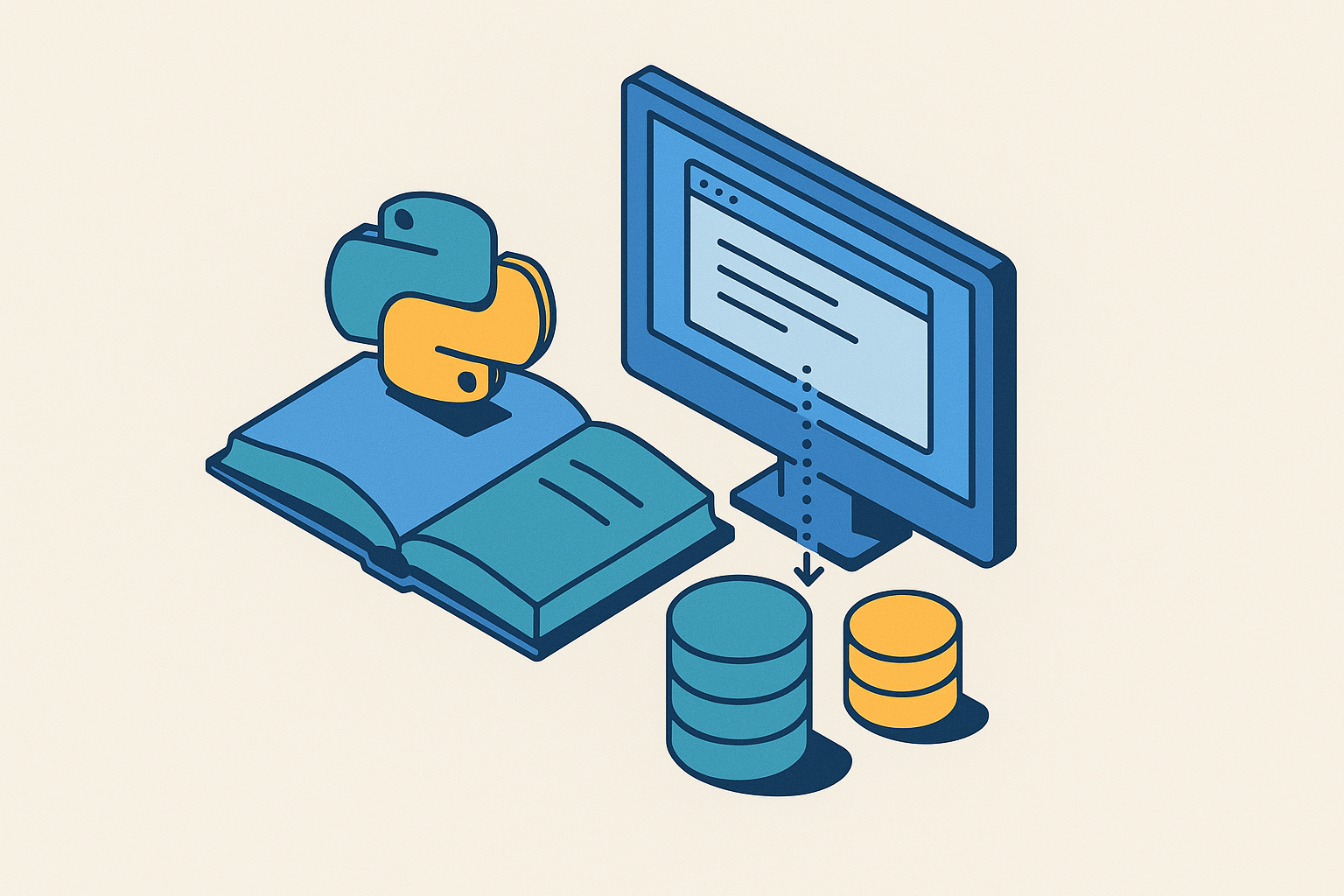
These are not tiers in a hierarchy. They are distinct problem domains with different success criteria, different failure modes, and different consequences when they go wrong.
The three layers are distinct problem domains with different success criteria. Data ingestion crawls at volume; its success criteria are throughput, coverage, and deduplication, and when it fails it creates coverage gaps in the vector store: phantom documents that were never fetched. Structured extraction converts already-fetched content into schema-conformant JSON or Markdown for deterministic downstream use; when it fails, downstream agent actions receive garbage the model still acts on, producing hallucinations or type errors. Dynamic rendering executes JavaScript and clears login walls so the fetched content represents what a human user actually sees; when it fails it produces ghost pages, responses that look like successful fetches but contain none of the real content, and nothing downstream can be trusted until that problem is solved. Most frameworks bundle all three and obscure which one is failing, which is where the trouble starts: a rendering failure surfaces as a parser error, a parser failure passes garbage to the model, and the root cause traces back to a layer the team never isolated.
Data ingestion crawls known or semi-known site structures at volume. Its success criteria are throughput, coverage, and deduplication. Intelligence is not required here; reliability is.
Structured extraction pulls specific fields from already-fetched content into schema-conformant JSON or Markdown that a downstream agent or data pipeline can act on deterministically. The success criterion is output precision.
Dynamic rendering executes JavaScript, navigates login walls, and interacts with single-page applications so that the fetched content represents what a human user actually sees. Nothing downstream can be trusted until this problem is solved.
Most AI scraping frameworks bundle all three layers and obscure which one is failing. This is where the trouble starts. When rendering fails, the parser reports it, but the actual problem was one layer below. When the parser chokes on malformed HTML, extraction returns garbage the model still receives. When raw HTML bypasses extraction entirely and flows straight to the LLM, token costs balloon and latency follows. The model is not the bottleneck at that point; input preparation is.
The pipeline role also determines what kind of failure surfaces upstream. Ingestion failures create coverage gaps in the vector store: phantom documents that were never fetched. Extraction failures produce hallucinations or type errors in downstream agent actions. Rendering failures produce ghost pages, responses that look like successful fetches but contain none of the content a user would actually see.
These failure signatures are distinct enough that diagnosing them requires knowing which layer broke. But what if a team never built that diagnostic clarity in the first place? Teams that treat the three roles as interchangeable lose that clarity entirely. The agent replans, the model hallucinates, the vector store accumulates gaps, and the root cause traces back to a fetch that never delivered a real page. I have watched this pattern recur often enough that I now consider layer confusion the default explanation until proven otherwise.
Static-Site Ingestion at Scale: Where Scrapy and BeautifulSoup Still Earn Their Place
The ingestion layer's only job is throughput and coverage. LLM calls have no business here, and that boundary deserves to be defended.
Scrapy
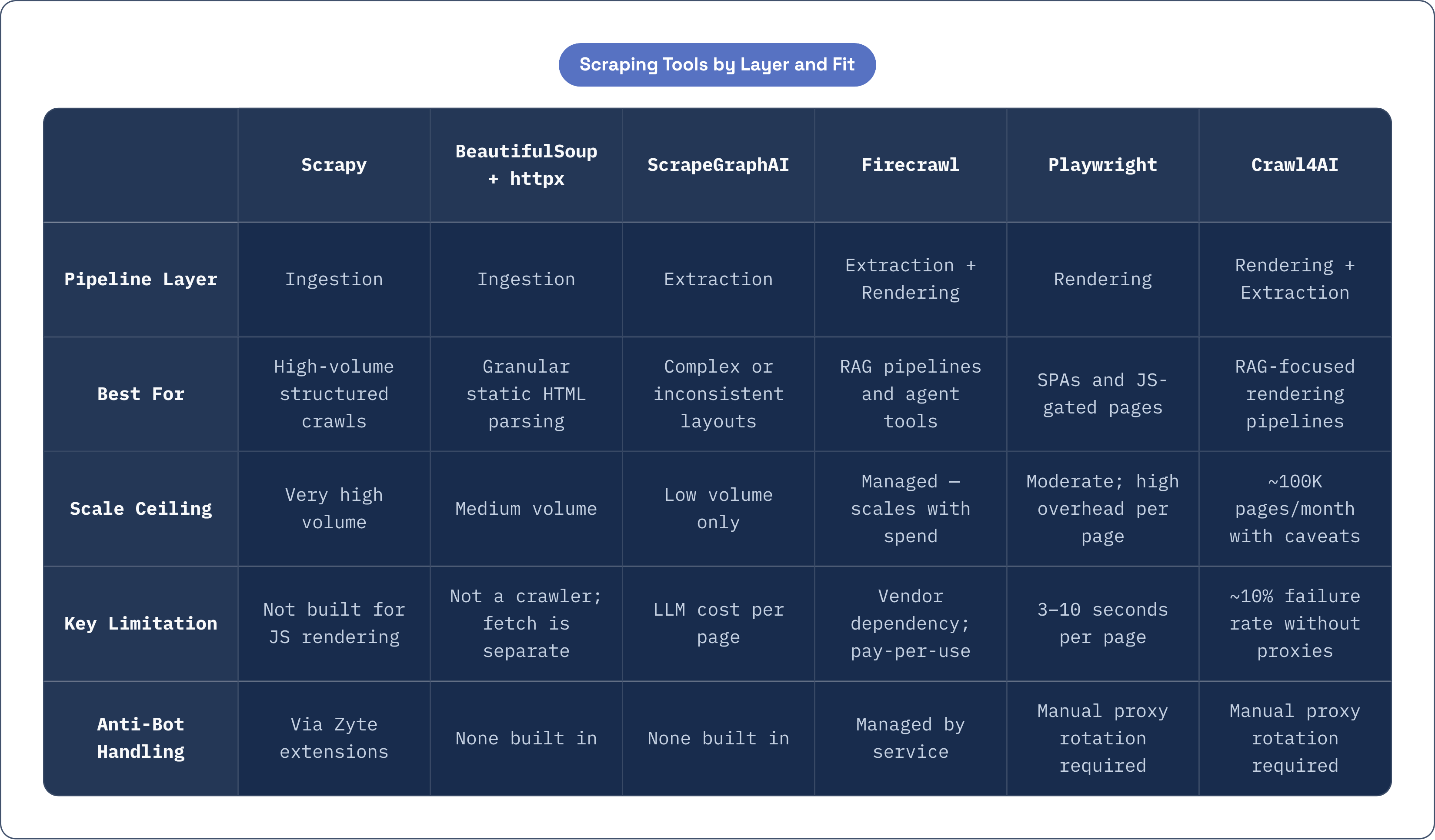
Scrapy remains the right default for high-volume, structured crawls of known sites. It scaffolds a full project: spiders, settings, items, and pipelines stay organized as the crawler grows, which matters when a team is maintaining dozens of spiders across a production system. Built-in concurrency, retry logic, and rate limiting handle the plumbing that teams otherwise rebuild from scratch. The Zyte extension ecosystem adds browser rendering, monitoring, and anti-ban capability as opt-in layers. The core stays fast; capability is added where a specific site demands it. A team can scaffold a Scrapy spider with Claude Code or GitHub Copilot and have something production-ready without starting from nothing.
Where Scrapy fits: recurring crawls of sites with stable HTML structure, high page volumes where browser overhead would be prohibitive, pipelines where cost predictability matters. When JavaScript rendering, login walls, or aggressive bot detection appear, that is the signal to move to the rendering layer, not to contort Scrapy into something it was not built to be.
BeautifulSoup
BeautifulSoup is correct when you want granular, explicit control over what gets extracted from known, static HTML. It is not a crawler. It pairs with httpx or requests for fetching; the combination is the tool, not BeautifulSoup alone. It suits raw HTML pipelines where the fetch problem is already solved and the developer wants to own the parsing logic precisely.
Async HTTP with asyncio and httpx
For ingestion pipelines that do not need a full framework, semaphore-controlled concurrency with asyncio and httpx is a lean and effective pattern. Starting at 10 to 15 concurrent requests and tuning from there, combined with exponential backoff on 429 responses and a per-URL retry limit, keeps the pipeline moving without hammering rate limits. This is the right level of tooling for lower-volume ingestion where Scrapy's project scaffolding is overhead rather than asset.
Structured Extraction: Matching the Tool to How Deterministic the Output Needs to Be
Output format is a pipeline contract. The choice between clean Markdown, structured JSON, and schema-based extraction determines what the downstream agent or data pipeline can actually do with the result, and the consequences of getting it wrong compound quickly.
Clean Markdown serves context windows, RAG ingestion, and LLM readability. It preserves document structure without HTML noise. Structured JSON serves data pipelines, recurring analytics, and deterministic downstream agent actions where a type error is a breaking failure. Schema-based extraction, where the LLM is constrained to output a specific object shape, reduces hallucination surface by narrowing the model's output space. These are not interchangeable preferences; they reflect different downstream requirements.
ScrapeGraphAI
ScrapeGraphAI uses LLMs and graph logic to construct scraping pipelines for websites and local documents across XML, HTML, JSON, and Markdown formats. It connects to OpenAI, Groq, Azure, Gemini, MiniMax, and Ollama, so model choice stays with the team. It is well-suited to sites where the layout is complex, inconsistent, or poorly documented, and where writing and maintaining manual selectors is not a productive use of engineering time. It is the wrong tool for high-volume ingestion; LLM calls per page make it expensive at scale. Reserve it for the extraction step after a page is already fetched.
Firecrawl
Firecrawl is an API-first extraction service built for AI application pipelines. Its endpoints handle the spectrum from simple single-page scrapes to autonomous research workflows. The /interact endpoint allows clicking, typing, and navigating before extracting, which collapses the rendering and extraction layers into one managed API call for cases where that is the cleaner abstraction. MCP integration makes it callable directly from an agent's tool registry without custom glue code.
Firecrawl is the clearest default when a team is building RAG pipelines or autonomous agents and does not want to manage browser infrastructure. You pay for reliability rather than engineer it. That is a reasonable trade at certain organizational scales, and an unreasonable one at others.
Jina Reader
A single call to r.jina.ai/<url> returns Markdown. No API key required for basic usage. The ceiling is equally clear: no crawling, single pages only, no anti-bot bypass. Protected sites return errors, not content. Useful for rapid prototyping and personal projects, not for production pipelines that need coverage guarantees.
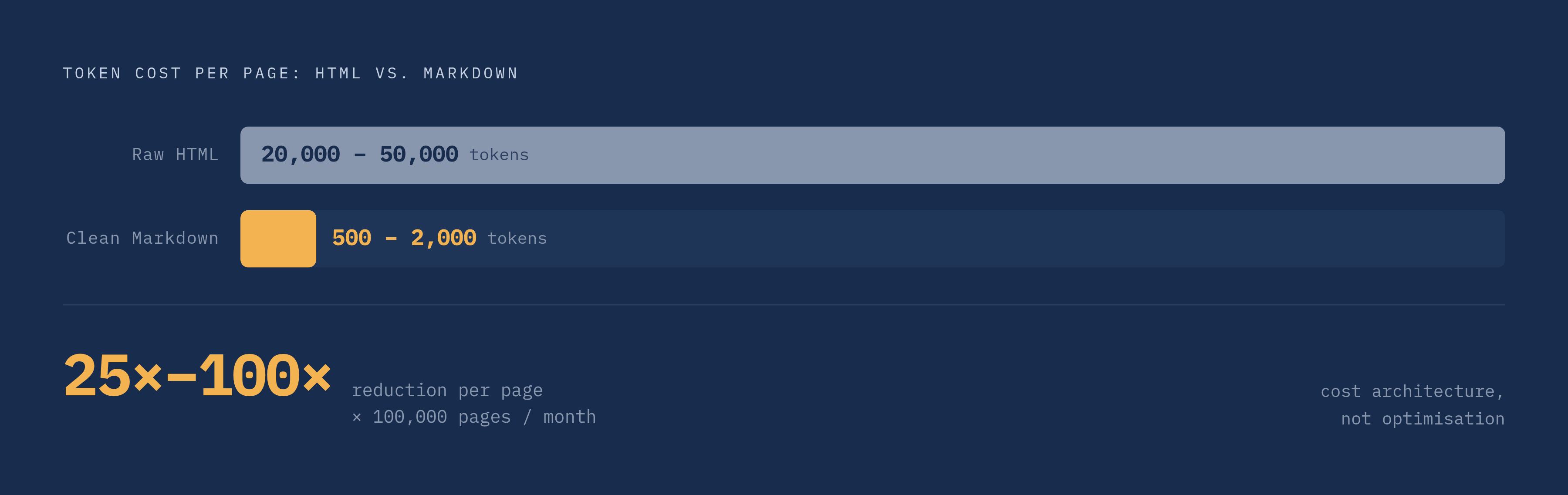
The extraction layer is where token economics are controlled. Stripping scripts, styles, navigation, and footer boilerplate before the model sees the content is not an optimization at production scale; it is what keeps inference costs from growing faster than usage does. A typical webpage returned as raw HTML runs between 20,000 and 50,000 tokens. The same page converted to clean Markdown sits between 500 and 2,000 tokens. That reduction multiplies across every agent invocation, every reasoning step, every RAG retrieval. It is also worth considering what that gap compounds to at scale: a pipeline processing 100,000 pages per month is not facing a minor efficiency question but a fundamental cost architecture decision.
Dynamic Rendering: What Goes Wrong When the Page the Server Sends Isn't the Page the Agent Needs?
The rendering problem is upstream of everything else. Until JavaScript executes, anti-bot checks pass, and the response represents what a human user actually sees, nothing downstream can be trusted. It is not a parsing problem, not an extraction problem. It is an access problem, and conflating it with the other two is expensive.
Playwright
Playwright is the production default for browser automation in Python agent pipelines. Full browser execution handles SPAs, lazy-loaded content, and JavaScript-gated pages. Its async-native design makes it composable with asyncio-based ingestion pipelines, which matters when rendering is one step in a larger workflow rather than the entire workflow.
The performance cost is real. Traditional browser rendering runs roughly 3 to 10 seconds per page compared to 0.5 to 2 seconds for HTTP. Reserve Playwright for pages where rendering is genuinely required. Using it reflexively for every fetch is a throughput tax that accumulates.
Crawl4AI
Crawl4AI runs Playwright for rendering, converts output to Markdown, and includes chunking helpers designed for RAG pipelines. Its GitHub star count, exceeding 60,000 as of this writing, is a meaningful community signal for an open-source tool.
The production caveat deserves scrutiny. Its out-of-the-box success rate sits at 89.7 percent without residential proxies configured. That raises an important question: what does the missing 10.3 percent actually cost a pipeline that depends on completeness? Those are missing chunks in the vector store — not for individual pages, but for the cumulative integrity of whatever the vector store is meant to represent. Total cost of ownership at 100,000 pages per month comes to roughly $485 or more once compute, proxies, and engineering time are factored in. That number belongs in any build-versus-buy evaluation of the rendering layer.
Browser Use and Stagehand
These tools are correct when the agent needs to navigate, click, or fill forms as part of task execution, not merely render and extract. Anthropic's and OpenAI's Computer Use capabilities occupy similar territory for novel UIs where neither structured selectors nor scripted navigation will work.
AI agents operating as rendering, extraction, and action systems run between 10 and 60 seconds per page. That is appropriate for low-volume operations under roughly 50,000 pages per month, frequently changing layouts, or diverse site structures across thousands of unique HTML schemas. At higher volumes, the economics shift decisively toward more targeted tooling.
How Fetch Reliability and Bot Detection Change the Tool Selection Calculus
The library is not the bottleneck when the site actively blocks the request. The fetch never completes, and the pipeline reports a parser or extraction failure that masks the real cause. Engineering teams spend real time tuning parsing logic for sites that are simply blocking their IP range. I have seen it happen, more than once, at organizations that should have known better.
Why exactly does this happen? Bot detection operates on signals the library cannot control: IP reputation, TLS fingerprinting, browser behavior patterns, request timing, header ordering. These are network and identity problems. Crawl4AI's 89.7 percent baseline success rate illustrates the gap. The missing 10.3 percent is almost entirely a network and identity problem, not a parsing one.
The implications for library selection are specific. Scrapy with Zyte extensions handles anti-ban and proxy management as opt-in layers, keeping the core crawler separate from the access layer. Firecrawl and similar managed APIs abstract the access problem entirely. Self-managed Playwright requires explicit proxy rotation, user-agent management, and CAPTCHA handling. That operational overhead must be budgeted explicitly, not assumed away in the initial architecture review.
For AI agent pipelines specifically, the agent's retry and replan logic can mask persistent fetch failures in a particularly expensive way. The agent looks busy. Inference budget burns. The pipeline makes no progress. The problem required infrastructure intervention, not more reasoning.
MCP-integrated scraping services, including Firecrawl, Apify, Bright Data, Olostep, and ScraperAPI, are relevant here. They handle access and anti-bot as a managed service and expose a clean tool interface to the agent. The agent calls a tool, receives content, and has no need to know how the fetch happened. That abstraction is valuable precisely because it keeps the access problem out of the agent's reasoning loop.
One security consideration that teams routinely underweight: ungoverned agent-driven fetch requests, where agents call arbitrary URLs without access controls, create a data exfiltration surface. The same access-control discipline applied to human web traffic applies to agent traffic.
Matching Orchestration Framework to Scraping Tool Without Creating Hidden Coupling
Orchestration frameworks, LangChain, LangGraph, CrewAI, AutoGen, LlamaIndex, call scraping code from inside an LLM-driven plan. They provide graphs, state management, planners, and a tool registry. The scraping library is a tool the agent invokes, not part of the orchestration logic itself. Keeping that distinction clean in a codebase is harder than it sounds, and the failure mode when you do not is subtle.
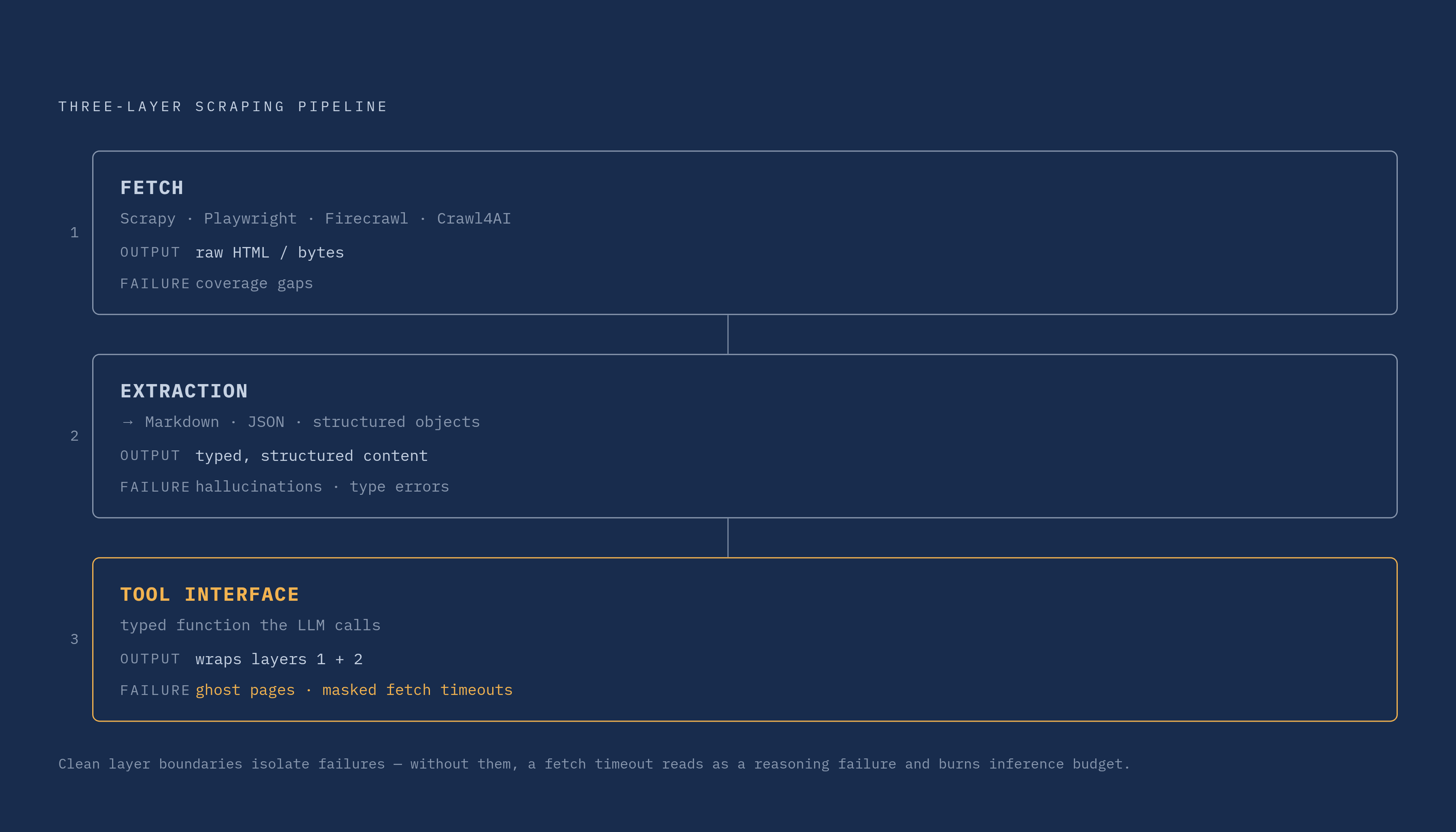
When the scraping library and the orchestration framework are too tightly integrated, a library failure surfaces as an agent reasoning failure. The framework's retry logic kicks in. Inference budget burns. The actual problem was a fetch timeout.
The pattern that avoids this is a three-layer separation. The fetch layer, whether Scrapy, Playwright, Firecrawl, or Crawl4AI, returns raw or lightly processed content. The extraction layer converts that content into the format the orchestration framework expects: Markdown, JSON, or structured objects. The tool interface is the function the LLM calls, wrapping both layers and returning a typed result. When something fails, the failure signature tells you which layer broke. That diagnostic clarity is worth the engineering discipline required to maintain it.
MCP is becoming the standardization layer for this interface. Firecrawl, Apify, and others now expose MCP-compatible scrapers. The agent calls a standardized tool interface; the scraping implementation lives behind the server. Swapping providers does not require rewriting agent logic.
The MCP security consideration is not hypothetical. Security researchers identified prompt injection and poisoned tool vulnerabilities in April 2025. In a pipeline where an agent's tool registry includes a web scraper, a malicious page can attempt to inject instructions through the scraped content. Output sanitization before content reaches the LLM context is not optional.
For multi-agent deployments, containerizing scraper functions independently, a Dockerized MCP server with the scraper deployed to Kubernetes, means scraping infrastructure scales and fails independently of agent reasoning infrastructure. A Playwright instance that crashes does not take down the planner. A rate-limit event does not propagate into the orchestration graph as an ambiguous reasoning error. What feels like over-engineering at prototype scale becomes the thing that makes the system debuggable when it is running in production and something breaks at 2 a.m.
The throughput of a mature pipeline, the reasoning quality of its agents, the reliability of its RAG retrieval: all of it traces back to decisions made at the library selection level. Those decisions deserve at least as much rigor as model selection. Possibly more, because they are less reversible.