WebMCP Protocol Explained
A browser standard that lets webpages expose their functionality as structured tools for AI agents.
WebMCP, short for Web Model Context Protocol, is a proposed browser-level web standard that lets any webpage declare its capabilities as structured, callable tools for AI agents. Its creator, Alex Nahas, a former Amazon backend engineer, describes it simply: "Think of it as MCP, but built into the browser tab."
While running internal agents against web UIs at Amazon in early 2025, Alex Nahas kept hitting the same wall: authentication. Browser sessions carry auth context that server-side agents cannot access without building a separate, parallel credential system from scratch. That friction led him to build MCPB, an earlier project designed to address the problem directly, which eventually evolved into WebMCP.
Nahas got there by running internal agents against web UIs at Amazon in early 2025. He was using Anthropic's MCP and kept hitting the same wall: authentication. Browser sessions carry auth context that server-side agents cannot access without building a separate, parallel credential system from scratch. That friction produced MCPB, an earlier project he built to address the problem, which eventually evolved into WebMCP.
The institutional trajectory matters here as much as the origin story. Google and Microsoft co-authored the spec, with the Chrome and Edge teams driving it. The W3C Web Machine Learning Community Group formally accepted the spec in September 2025, and the protocol was officially announced on February 10, 2026, with an early preview available in Chrome. That co-authorship is the clearest signal this is not a single-vendor experiment. Cross-browser adoption is the implied trajectory, though browser vendors have co-authored proposals that stalled before ratification, and that history deserves acknowledgment.
WebMCP is currently a W3C Community Group Draft, not a ratified standard. The API surface will likely change. Implementations built today should expect iteration.
What problem with browser authentication led to WebMCP's creation?
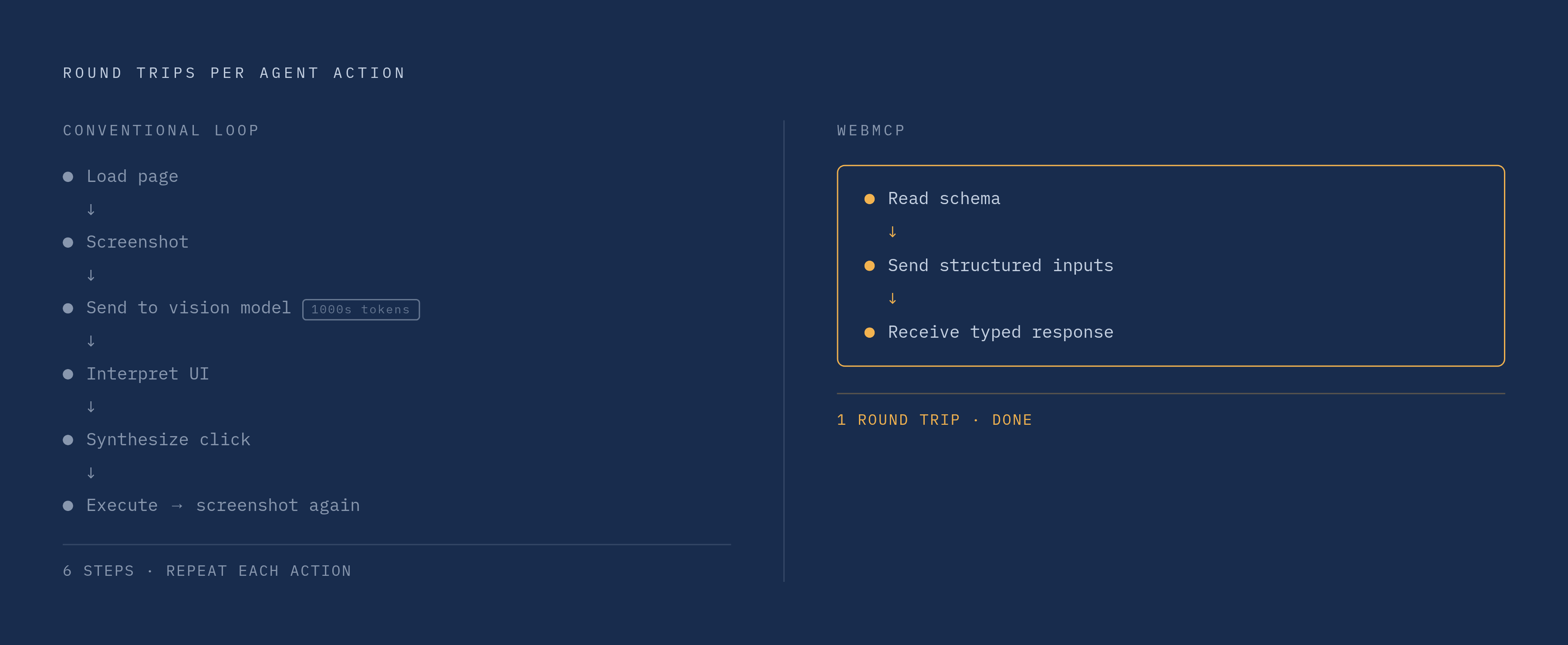
The conventional agent browsing loop is expensive in ways that compound. Load a page, take a screenshot, send that screenshot to a vision model, interpret the UI, identify interactive elements, synthesize a click target, execute, wait for the page to respond, screenshot again. Vision pipelines can cost thousands of tokens per interaction. HTML parsing is cheaper but brittle: a site redesign can silently break an entire automation without any warning signal.
But what if the efficiency problem is almost a distraction from the deeper one? Agents are being forced to infer intent that was never meant to be inferred, because it was meant to be understood. The developer who built a flight search form knew exactly what it did. They wrote the validation logic, the field constraints, the error states. That semantic knowledge lives inside the application. It simply was never surfaced in a form an agent could consume.
WebMCP's core shift is to stop treating the webpage as a visual surface to be decoded and start treating it as an API the agent can query directly. Instead of the agent piecing together what a site can do, the site declares it. A WebMCP tool call completes in a single round trip: the agent reads the schema, sends structured inputs, receives a typed response. That looping, screenshot-to-screenshot inference cycle collapses. The efficiency holds only if the declared schema accurately reflects what the site actually does, which is now a maintenance burden the developer owns.
The analogy worth reaching for: just as REST APIs let machines consume what humans built for browsers, WebMCP lets agents consume what developers built for human users, without requiring a rebuild. Web applications already hold business logic, user state, and authenticated context. WebMCP exposes what is already there.
How WebMCP works technically
The entry point is the navigator.modelContext API, which is how agents query a page and how pages register tools client-side, without a separate server.
Three structural components underpin the protocol. Discovery: a standard mechanism for an agent to ask what a page can do, with the site responding with a list of available tools such as searchFlights or submitApplication. JSON Schemas: each tool carries an explicit definition of its required inputs and expected outputs, removing inference from the equation. State: a shared context that keeps the agent informed of which tools are available in real time as the user navigates, so the tool surface updates as the page changes.
In practical terms, web pages using WebMCP function as in-page MCP servers, implementing tools that expose client-side logic and DOM interaction rather than server-side APIs.
Two implementation paths exist for developers. The declarative API uses HTML attributes, specifically toolname and tooldescription, added to existing form elements. A restaurant reservation form is the canonical example in the spec. The lift is minimal; no JavaScript required. The imperative API uses JavaScript to register tools and their parameter schemas programmatically, which suits complex, dynamic interactions where a stable API surface matters more than simplicity. Neither path requires a backend change. Both run entirely client-side. The history of web standards adoption suggests the lowest-friction path drives actual uptake, and the declarative option is about as low-friction as a web standard gets.
How WebMCP relates to Anthropic's MCP — and where it doesn't replace it
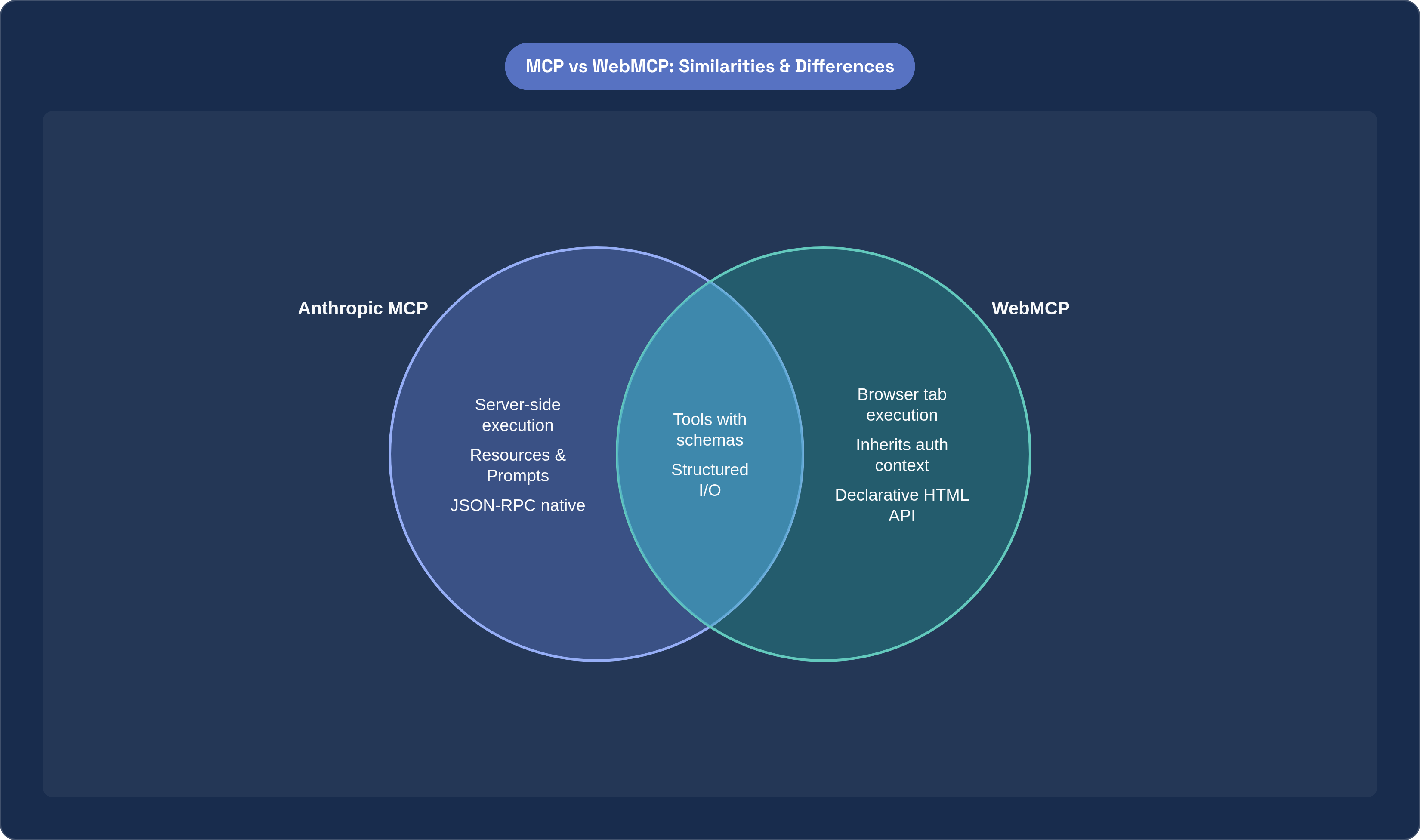
Anthropic published MCP in November 2024 as an open standard for connecting AI applications to external systems via JSON-RPC, operating server-side. WebMCP extends that conceptual model into the browser. The shared lineage is explicit: same framework of tools with schemas, structured inputs and outputs, the same vocabulary. The execution environment is different.
MCP runs on a separate server. WebMCP runs inside the browser tab and inherits the page's existing authentication context. That inheritance is precisely what makes WebMCP useful for interactions requiring live user state, dashboard access, or any browser-held credential a server-side agent cannot obtain without rebuilding the entire auth layer.
WebMCP currently diverges from its parent in several concrete ways: it does not natively follow JSON-RPC; the webpage itself acts as the server, initializing when an agent lands on it; and the spec presently handles tool calling only. MCP's concepts of resources and prompts are absent. That raises an important question: whether that absence becomes a meaningful limitation depends largely on whether those concepts are incorporated before adoption reaches a critical threshold.
The practical segmentation between the two is cleaner than the conceptual overlap might suggest. Traditional MCP fits headless backend operations, document access, structured data sources. WebMCP fits dashboard interactions, customer-facing UI, anything requiring live user state or browser-held auth. A single product may use both. To expose the same capabilities through a traditional MCP server that WebMCP handles natively, you would need to rebuild the logic server-side, wire up a separate auth layer, and maintain both indefinitely. That is not a theoretical cost; it is the cost teams are currently paying.
The security model WebMCP ships with
The spec is explicit about what it is not trying to do: fully autonomous, headless operation is a non-goal. WebMCP is designed for collaborative browsing, where the user remains present. That design choice shapes the entire security architecture.
The browser acts as mediator. A page does not grant agents access directly; the browser intermediates and prompts users before agents execute sensitive operations. Baseline protections built into the spec include same-origin policy enforcement, CSP integration, and an HTTPS requirement for secure contexts.
The tiered action model is where this gets operationally interesting. Sensitive tool calls require human-in-the-loop confirmation. Read-only tools can be marked to bypass that prompt, allowing agents to gather information freely while still gating consequential actions. The SubmitEvent.agentInvoked flag allows existing form handlers to detect whether a submission originated from an agent or a human, enabling logging, validation branching, and audit trails without restructuring the application.
Restricting agents to explicitly declared tools rather than the full DOM limits exposure if a malicious site attempts to manipulate agent behavior. It also creates a different surface. A malicious site that declares harmful tools with convincing descriptions shifts the attack vector from DOM manipulation to schema manipulation. The integrity of the schema becomes a trust boundary, and the current spec does not fully address how that boundary gets enforced or verified.
It is also worth considering that there is no mechanism yet for discovering which websites expose WebMCP tools without actually visiting them. A .well-known/webmcp manifest is listed as future work. Until it lands, discovery is reactive rather than proactive, which is a real operational constraint for agents that need to plan across many sites before visiting any of them.
Where WebMCP stands today and what adoption realistically looks like
As of February 2026, WebMCP is live behind a feature flag in Chrome 146, available in Chrome Canary. Microsoft co-authored the spec, which strongly implies Edge support will follow, though no formal timeline has been announced. Firefox and Safari have issued no public signal. Broader browser support is plausible by mid-to-late 2026, though the draft status of the spec makes any firm projection unreliable.
The W3C Community Group Draft designation means institutional backing for standardization without a frozen API surface. Developers building against it now are, in effect, participating in the refinement process. Given the co-authorship and the institutional weight behind it, that participation carries more signal than it typically would with an early-stage draft.
The practical adoption path is more accessible than most emerging web standards. Sites with existing HTML forms can start with the declarative API immediately, minimal lift, immediate agent-compatibility. More complex applications adopt the imperative JavaScript API. Neither path requires a backend change.
Adoption dynamics here follow a familiar two-sided pattern. WebMCP only becomes broadly useful when both agents support tool discovery and sites register tools. Early movers on the site side will be discoverable and callable before the rest of the web catches up. For sites with complex, high-value interactions, that asymmetry creates a concrete incentive to move early; they stand to capture disproportionate agent traffic when agent-side support matures.
What WebMCP means for the infrastructure powering AI agents
WebMCP resolves the browser-side interface problem. It does not resolve the agent infrastructure problem. The agent invoking those tools still needs to be built, deployed, and secured somewhere, and its infrastructure requirements are the same as they have always been.
The MCP ecosystem that WebMCP extends is already running in production. Remote MCP servers, persistent agent state, and auth delegation are the infrastructure layer that browser-native tool calling depends on. WebMCP's single-round-trip efficiency is preserved only if the agent itself is not bottlenecked by cold starts or distant compute. Persistent, stateful sessions matter because agents interacting with multi-step web workflows cannot be stateless; a checkout flow does not tolerate context loss between steps.
Auth delegation surfaces a specific tension worth naming. WebMCP inherits the browser's auth context for client-side operations, but the agent infrastructure behind it needs its own OAuth layer for any backend operations that run outside the browser session. These are complementary requirements, not competing ones, but they require explicit architecture decisions that are easy to defer and painful to retrofit.
As agents gain the ability to invoke tools across many websites, centralized visibility into which tools are being called, by which agents, under what policies, becomes a genuine operational requirement. This is not a security nicety; it is the condition under which enterprise operators can actually sanction broad agent deployment. Cloudflare, an internet infrastructure and DDoS-protection provider running serverless compute across 330-plus data centers worldwide, offers remote MCP infrastructure including the McpAgent SDK class, hibernation for stateful sessions, and MCP Server Portals for centralized policy and DLP, addressing exactly this layer. Agents built on it can call WebMCP tools client-side while their backend operations remain auditable and governed.
WebMCP is a browser protocol, not an agent platform. It is a well-designed, institutionally credible answer to a problem that has frustrated everyone who has built agents against live web applications. But how does this affect our original promise? What it cannot do is substitute for the execution environment, the state management, or the governance layer that production agents require. Those remain the builder's problem.