Front-End Testing Tools Compared
Most teams need multiple tools to catch different bugs at different testing layers.
Front-end testing tools don't compete on a single axis. They solve different problems at different layers of what's usually called the testing pyramid, and choosing one without understanding which layer it occupies is how teams end up with either false confidence or a CI pipeline that takes an hour to turn green. This piece walks through the major tools, layer by layer: Jest at the base, Cypress and Playwright and Selenium in the middle, visual regression and AI-assisted tools filling gaps the functional layer leaves open, and low-code platforms for teams without dedicated automation engineers.
Most mature teams I've seen run somewhere between three and five tools to cover the full surface. Unit tests catch logic errors. End-to-end tests catch integration failures between services. Visual tests catch the layout shift that every one of your functional assertions will happily ignore because the button still fired the right event, it just moved four pixels to the left and now overlaps the nav bar on mobile. Treating "front-end testing" as one box to check, one tool to buy, is a common mistake, and it usually surfaces the hard way, in production, after a release everyone was confident about.
How the testing pyramid maps to execution environment
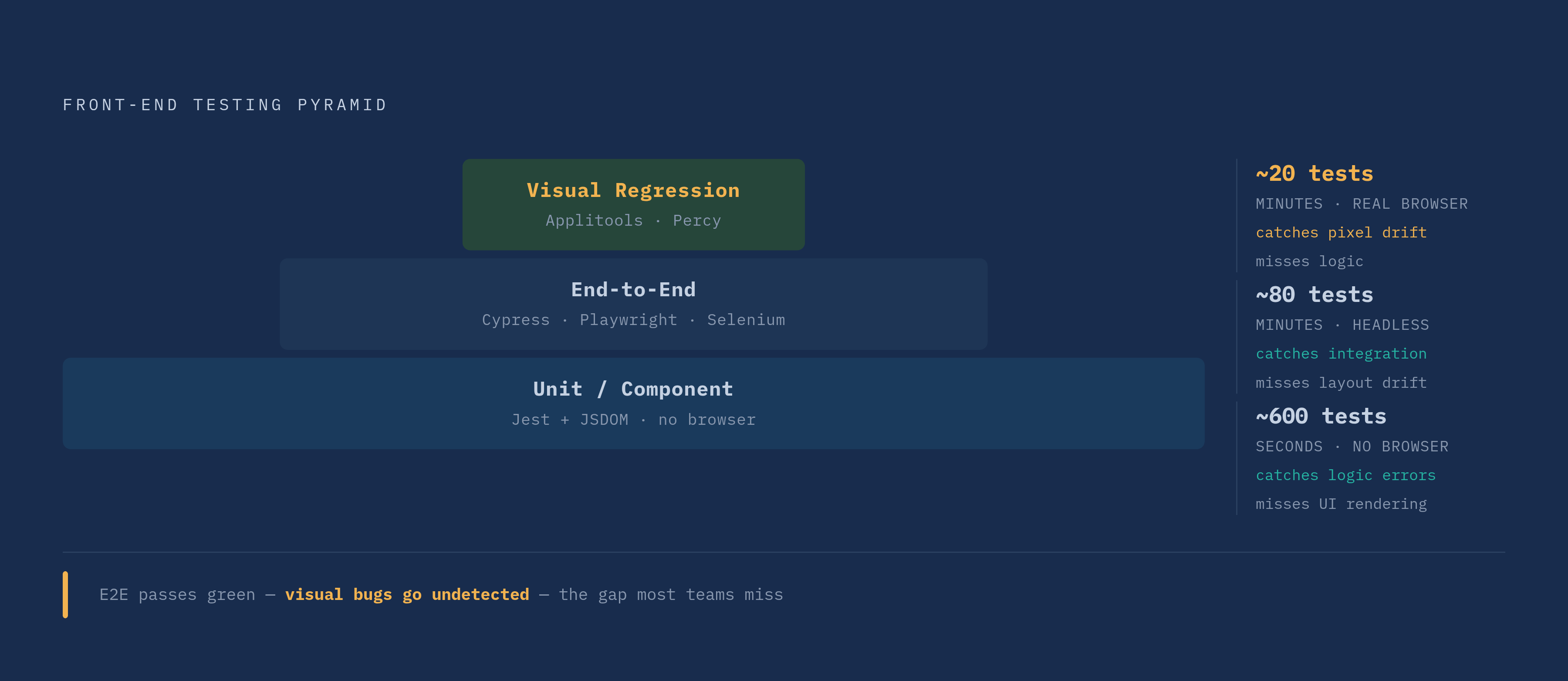
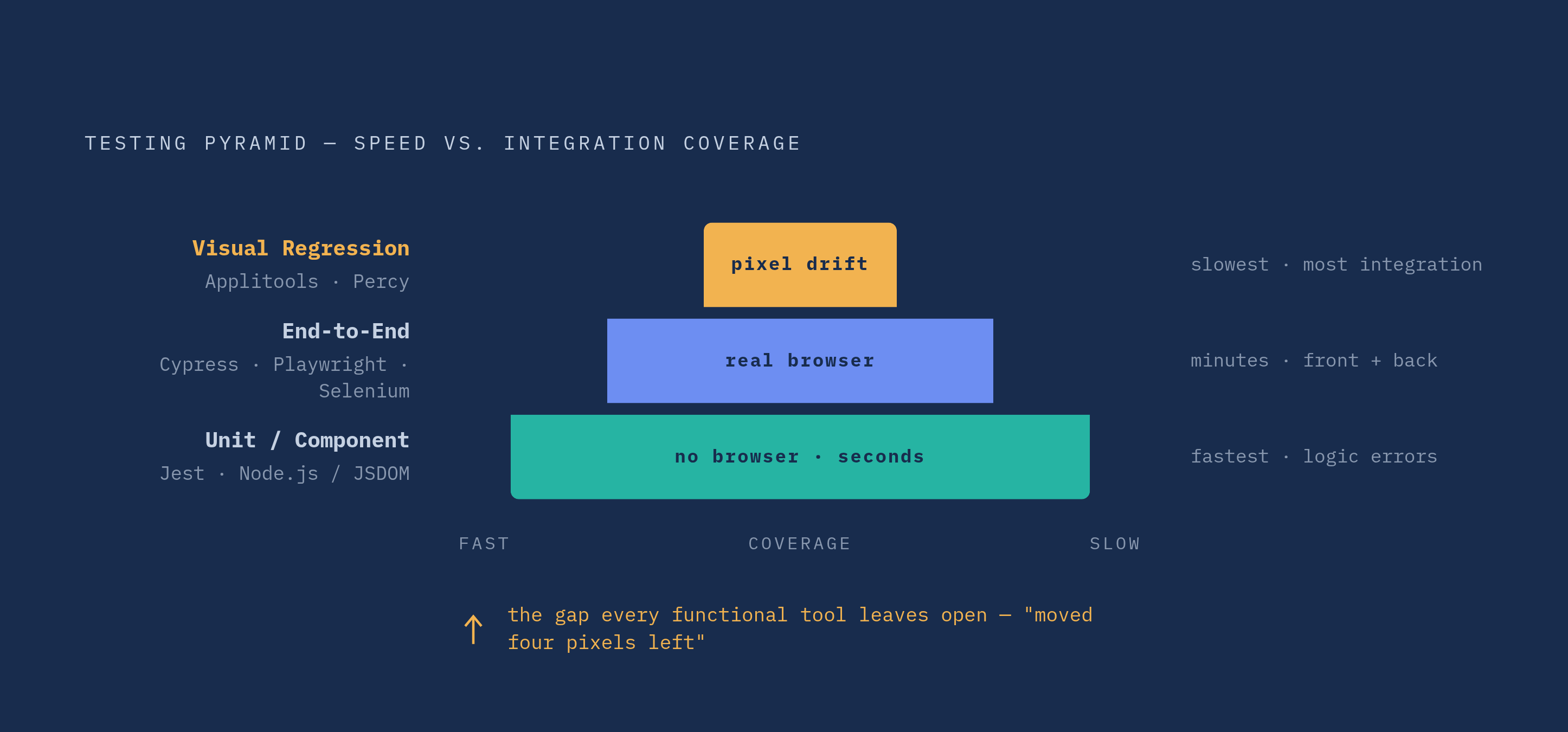
Here's the part that gets skipped in most tool comparisons: where a test actually runs determines what it can see.
Unit and component tests run inside Node.js against a virtual DOM, usually JSDOM. No browser opens. Results come back in seconds because there's no rendering engine, no network stack, nothing to boot up. End-to-end tests launch a real or headless browser and drive the actual running app, which is slower but is also the only layer capable of catching the bugs that happen when your front end and back end disagree about a contract. Visual regression tests usually ride alongside or on top of an E2E run, comparing snapshots rather than asserting behavior, which means they add coverage without duplicating what the functional test already checked.
This is where the "why not just write E2E tests for everything" instinct runs into trouble. An E2E suite with 50 tests feels manageable. Run them sequentially on one CI runner. Fine. But that same suite at 500 tests, still running sequentially, can eat an hour of pipeline time on every single commit, and now your team is either skipping tests before merge or waiting an hour to find out they broke something. The standard enterprise fix is parallelization, usually through Kubernetes or a dedicated test orchestration layer, splitting the suite across multiple machines so it finishes in minutes instead of an hour. That works, but it's infrastructure a five-person startup often can't justify building or maintaining. So the pyramid is a direct constraint on what your CI bill and your feedback loop actually look like.
Unit and component testing: Jest and the JavaScript-native baseline
Jest is the default for a reason. It's fast, it needs no browser, and it plugs into React Testing Library, Vue Test Utils, and similar wrappers so you can test how a component renders and behaves without ever spinning up Chrome.
The feedback loop is the fastest of any layer in this whole pyramid, and that speed compounds. A developer running Jest locally gets an answer in seconds, which means they actually run the tests before pushing instead of hoping CI catches it later. TypeScript support is native, mocking is built in, snapshot testing is one function call away, and it integrates cleanly with GitHub Actions, GitLab CI, or Jenkins without much configuration.
JSDOM simulates enough of the DOM API to render components and check output, but layout, actual CSS rendering, and cross-browser quirks are entirely invisible to it. Jest also can't tell you anything about integration failures between your front end and your API; it's testing your components and functions in isolation, by design. Snapshot tests deserve a specific warning here: they're trivially easy to write and deceptively easy to let rot. A large snapshot diff that nobody reviews carefully becomes a rubber stamp, and rubber-stamped snapshots defeat the entire purpose of the test.
So when is Jest enough on its own? Pure logic libraries, utility functions, stateless components with no browser-specific behavior. The moment your app depends on real rendering, real browser APIs, or a flow that spans multiple pages, Jest becomes necessary but not sufficient. It's the base of the pyramid, not the whole structure.
Cypress: the developer-experience benchmark for JavaScript-first teams
Cypress made a deliberate architectural choice that shaped everything about how it feels to use: it runs inside the browser rather than driving it from the outside, the way Selenium does. That choice is why debugging in Cypress feels different, almost immediate, compared to older tools.
The feature developers bring up most often when they switch from Selenium is time-travel debugging: you can step backward through the commands in a failed test and see the actual DOM snapshot at each point. That alone has probably saved more engineering hours than any other single feature in this space, because flaky test debugging is usually a guessing game, and Cypress removes a lot of the guesswork.
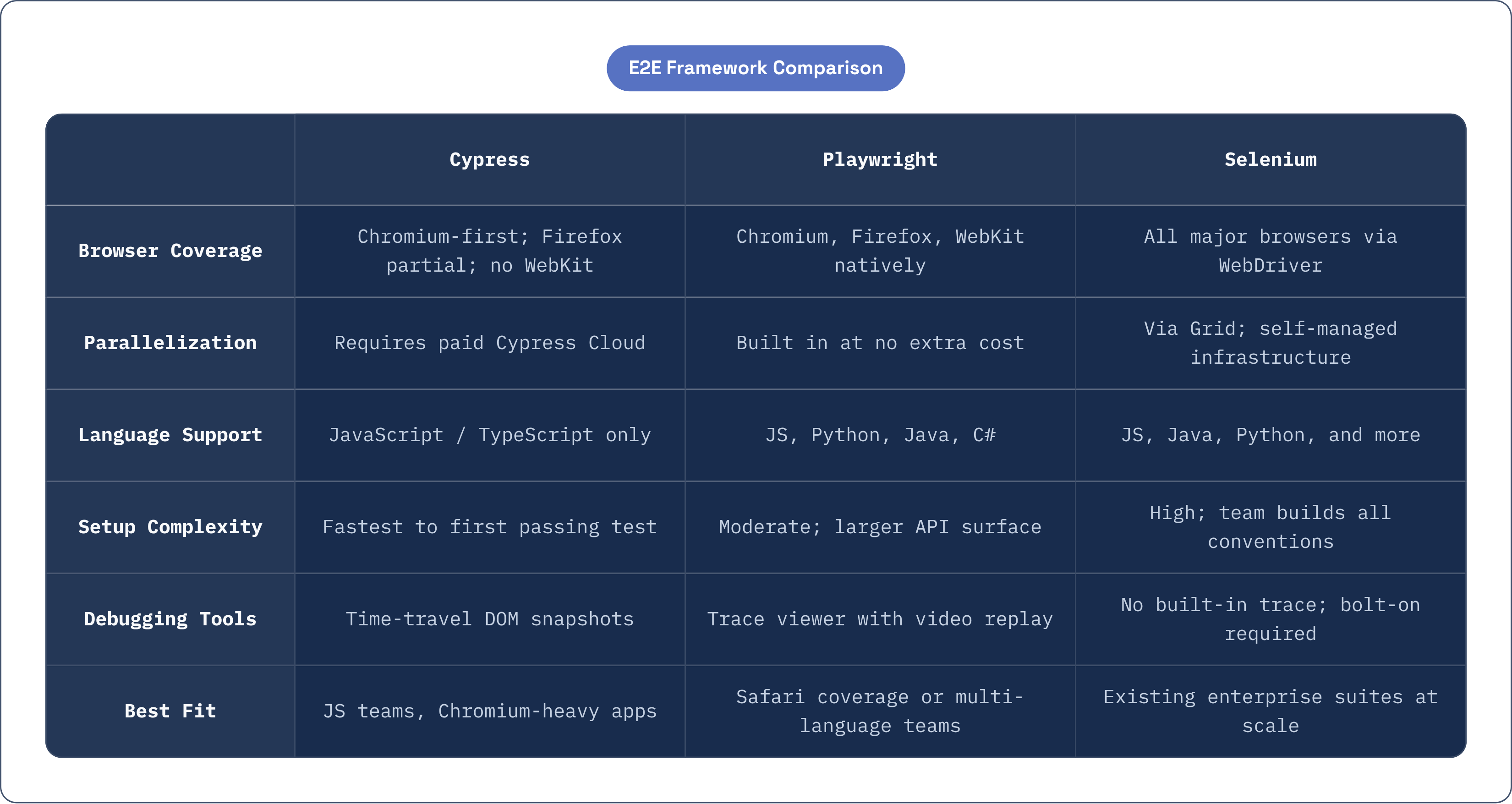
Cypress's browser focus is primarily Chromium. Firefox support exists, but Safari and WebKit coverage lags noticeably behind what Playwright offers, and for teams with a meaningful Safari user base, that's not a minor footnote. Setup, though, is genuinely the fastest of any E2E framework for a JavaScript or TypeScript team; you can go from install to a passing test faster here than almost anywhere else. The documentation and plugin ecosystem are strong too. The catch comes at scale: the open-source Cypress runner executes tests sequentially by default, and parallelization requires Cypress Cloud, a paid product that, starts at a monthly fee. For a team that's already Chromium-heavy and prioritizes a smooth authoring experience over broad browser coverage, Cypress remains a strong, arguably the strongest, choice.
Playwright: cross-browser coverage and the trade-off on setup complexity
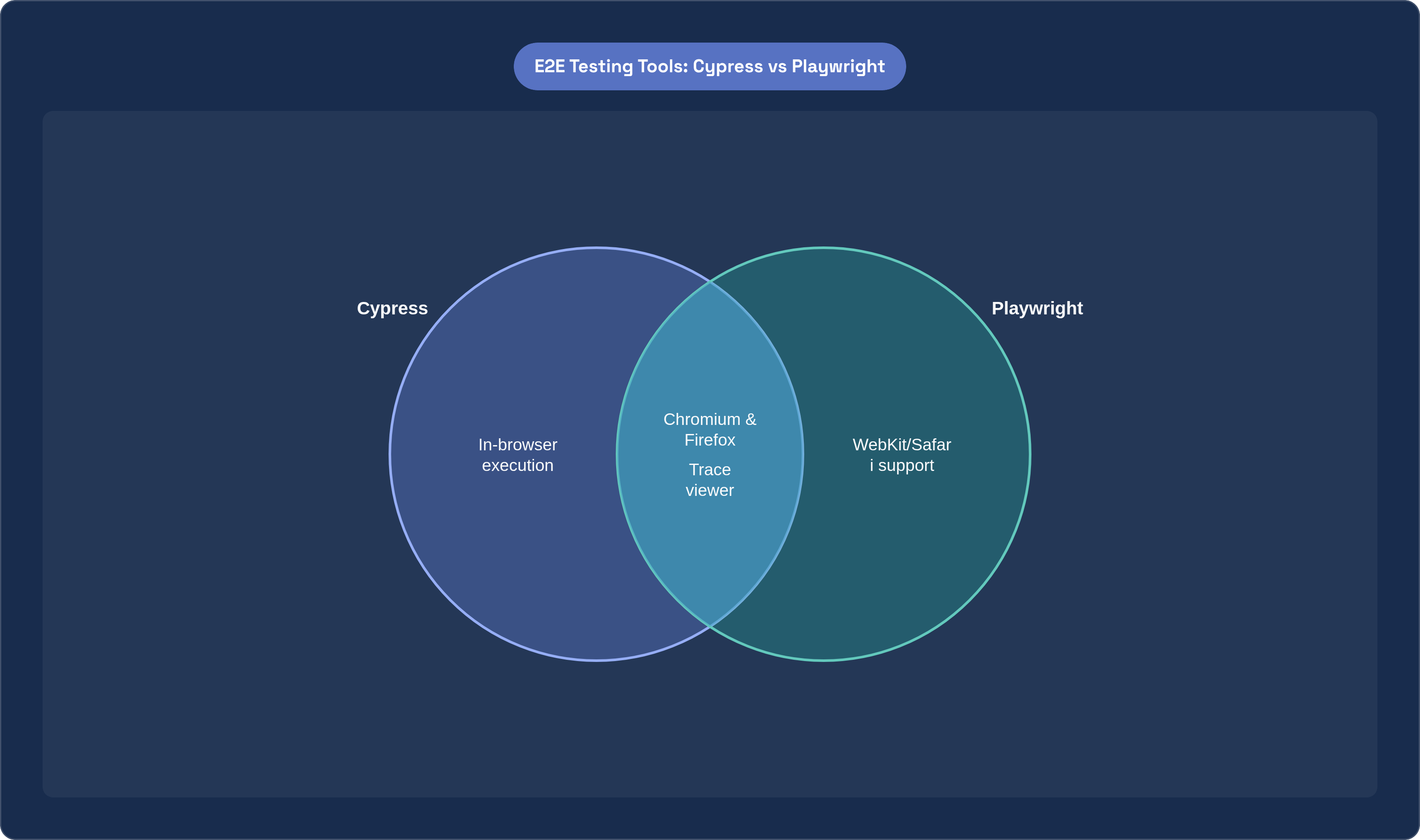
Playwright, built by Microsoft and open source, drives Chromium, Firefox, and WebKit from one API. It's the only major E2E framework offering genuine Safari coverage without bolting on a third-party service to get there.
The adoption numbers back up what a lot of teams have noticed anecdotally. The State of JS 2025 survey put developer satisfaction with Playwright at 91%, with 45.1% adoption among QA professionals, making it the fastest-growing UI automation framework by that measure. Part of that growth comes from what's included at no extra cost: built-in parallelization, a trace viewer that gives you video replay, DOM snapshots, and network logs for every run, all without a paid cloud tier sitting behind the good stuff. Playwright also isn't locked to JavaScript; it supports Python, Java, and C# as well, which matters for organizations where the QA team doesn't live exclusively in the JavaScript ecosystem.
None of that comes free of trade-offs. Playwright's setup takes more deliberate configuration than Cypress does, and the API surface is larger, which means a steeper climb for someone writing their first E2E test. It's a less opinionated tool, and less opinionated means more decisions land on the team rather than the framework. Choose Playwright over Cypress when Safari coverage actually matters to your user base, when your test authors work in more than one language, or when you want parallel execution without paying for a cloud add-on to get it.
Selenium: the ecosystem incumbent and when its flexibility is worth the overhead
Selenium is still the most widely deployed browser automation infrastructure in large enterprises, and that's largely a function of history: it's been around longer than Cypress or Playwright, it supports Java, Python, JavaScript, and more, and huge swaths of existing QA infrastructure are built on WebDriver and Grid.
Grid is genuinely valuable at scale. It lets you parallelize across machines, operating systems, and browser versions, and for an enterprise that already runs this infrastructure, ripping it out to switch tools is often not worth the disruption. The real trade-off with Selenium comes down to convention. Selenium gives you maximum flexibility and essentially no opinion about how to structure your tests. Page object models, retry logic, reporting, CI wiring: none of that comes bundled. Your team builds and maintains all of it.
That's the overhead. There's no built-in visual testing, no built-in trace viewer comparable to Playwright's; every one of those capabilities requires bolting on a separate library or service. Flakiness management tends to require more manual work here than with the newer tools. So when is Selenium still the right call? Teams with an existing suite at scale, where the cost of migration outweighs whatever developer-experience gain a switch might bring. Organizations whose testers work in Java or Python and have no interest in adopting a JavaScript-native tool. But for a brand-new project with no legacy suite to protect, or a team where flakiness is visibly slowing down releases, it's worth asking honestly whether Selenium's flexibility is buying you anything you actually need.
Visual regression testing: the coverage gap functional tools leave open
Here's a question worth sitting with for a second: your E2E suite says every test passed. Does that mean the app looks right?
That gap is exactly what visual regression testing exists to close. Cypress, Playwright, and Selenium can all confirm that clicking a button triggers the right function call or navigates to the right page. None of them, out of the box, will tell you that the button rendered in the wrong color, that a modal is now four pixels off from where the design system says it should be, or that two elements are quietly overlapping on a narrow viewport. Those are visual bugs, and assertion-based testing is structurally blind to them unless someone writes explicit pixel-level checks, which get expensive to maintain fast.
Applitools uses AI-driven visual comparison to check text, images, menus, and layout across viewports, and it's designed to sit on top of an existing Cypress or Playwright suite rather than replace it. Percy, from BrowserStack, takes a snapshot-based approach integrated directly into CI, flagging visual diffs for a human to review before a merge goes through. The argument for the AI-assisted approach over old-school screenshot diffing comes down to false positives: a plain pixel diff will flag a test failure over a minor, visually irrelevant DOM change, and teams that live with that noise long enough start ignoring the tool altogether. Applitools' comparison algorithm is built specifically to reduce that noise and hold up better against dynamic content.
Visual testing earns its keep fastest on design-system-driven products, where pixel drift is a brand problem as much as a bug, and on any app juggling complex responsive layouts across a lot of viewports. If your team ships UI changes often enough that manual visual QA has become the bottleneck, that's usually the signal it's time. Worth repeating: visual testing complements functional E2E tests. A mature QA program runs both.
AI-assisted testing tools and what the pass-rate benchmarks actually show
AI-assisted testing tools promise to speed up test creation, cut down on maintenance when the UI shifts underneath you, and improve overall signal quality. The underlying value proposition, stated plainly, is reducing how many QA engineers you need to cover a given amount of surface area.
TestSprite is a good example of where this category is heading: an AI-first platform that handles test planning, generation, execution, debugging, and reporting through natural-language prompts, wired directly into the IDE via an MCP Server integration. TestSprite's own published analysis claims it boosted pass rates from 42% to 93% after a single iteration, outperforming test code generated directly by GPT, Claude Sonnet, and DeepSeek. That's a striking number, and it's worth taking seriously as a directional signal about where AI-assisted test generation is capable of going.
It's also worth being honest about where that number comes from: it's the vendor's own benchmark, and independent replication across different codebases has not been publicly established. Treat it as a data point about potential, not as a guarantee that'll hold on your specific app with your specific edge cases.
What these tools do reliably well: generating a solid first draft of tests from a spec or user story, and self-healing selectors, meaning the test adjusts automatically when the DOM changes instead of breaking outright and demanding a manual rewrite. For lean teams without a dedicated test engineer, that second capability alone can be the difference between having coverage and not. What they don't yet handle reliably is judgment. Complex business-logic assertions that require real domain knowledge still need a human who understands the product. And distinguishing a genuine regression from an intentional product change, when a test suddenly fails, is still fundamentally a human call.
None of this is fringe anymore, either. AI tool use in engineering workflows has been climbing fast: McKinsey tracked regular generative AI use rising from 65% in 2024 to 71% in 2025 across business functions. AI-augmented testing is riding that same wave, moving from experimental to mainstream in a pretty short window.
Enterprise and low-code testing platforms for teams without dedicated automation engineers
Some teams don't have an engineer who wants to write and maintain Playwright scripts, and pretending otherwise just leaves coverage gaps that nobody catches until it's too late. That's the gap codeless and low-code platforms exist to fill.
Katalon offers a unified workspace spanning web, API, and mobile testing, covering planning, authoring, execution, management, and reporting in one place instead of forcing a team to stitch together separate tools for each phase. ACCELQ takes a fully codeless approach to automation, and it's the right call specifically when a team genuinely lacks scripting depth and doesn't have the bandwidth to climb the Playwright or Selenium learning curve. Ranorex fits best with enterprise teams whose testing needs cross over from web into desktop or mobile workflows; it combines low-code authoring with reusable modules and repository-based object management, which is useful when testers and developers both need to contribute without sharing a common scripting language.
The maintenance argument here is real, not just marketing. Wiring together Jest, Playwright, a visual testing tool, and a CI reporting layer creates its own integration overhead, and a single-vendor platform trades away some flexibility in exchange for dramatically less operational complexity to manage. The costs run the other direction too, though: less control over custom assertion logic, a real risk of vendor lock-in since your tests live in a proprietary format rather than version-controlled code, and generally a higher per-seat cost than open-source tools. If onboarding a new QA contributor to write competent Playwright tests takes weeks rather than days, that's usually the signal that a low-code platform's productivity gain is worth the flexibility you're giving up.
What good CI integration actually requires from any testing tool
A pass or fail result by itself is close to useless at two in the morning during a release. What you actually need in that moment is screenshots, video replay, logs, and trace data, all available immediately the moment a test fails, not buried in a log file you have to dig for.
Every tool covered in this piece should plug into GitHub Actions, GitLab CI, or Jenkins without demanding heavy custom scripting to make it work. That's an underrated selection criterion; plugin availability and documentation quality don't show up in a feature comparison chart, but they determine how much of your team's time gets burned on plumbing instead of on actual test coverage.
Parallelization is the question that decides whether any of this holds up at scale. Sequential test runs on a single CI runner work fine for a small suite, and then they don't, somewhere past a few hundred E2E tests, and that breaking point arrives faster than most teams expect. Whatever tool you pick from this comparison, ask the parallelization question early. It's a lot cheaper to answer before your pipeline takes an hour than after.