Behavior Driven Development in Browser Test Automation
BDD aligns developers, testers, and business stakeholders before code gets written.
Behavior Driven Development gets filed under "testing technique," and that classification is a little off. The tests are a byproduct. The real product is agreement between people who'd otherwise go build the wrong thing, very efficiently. This piece looks at how that plays out in browser test automation specifically: the Given-When-Then structure that keeps scenarios readable, the Cucumber-plus-Playwright pairing most new projects reach for now, and the spots where teams quietly lose the thread along the way.
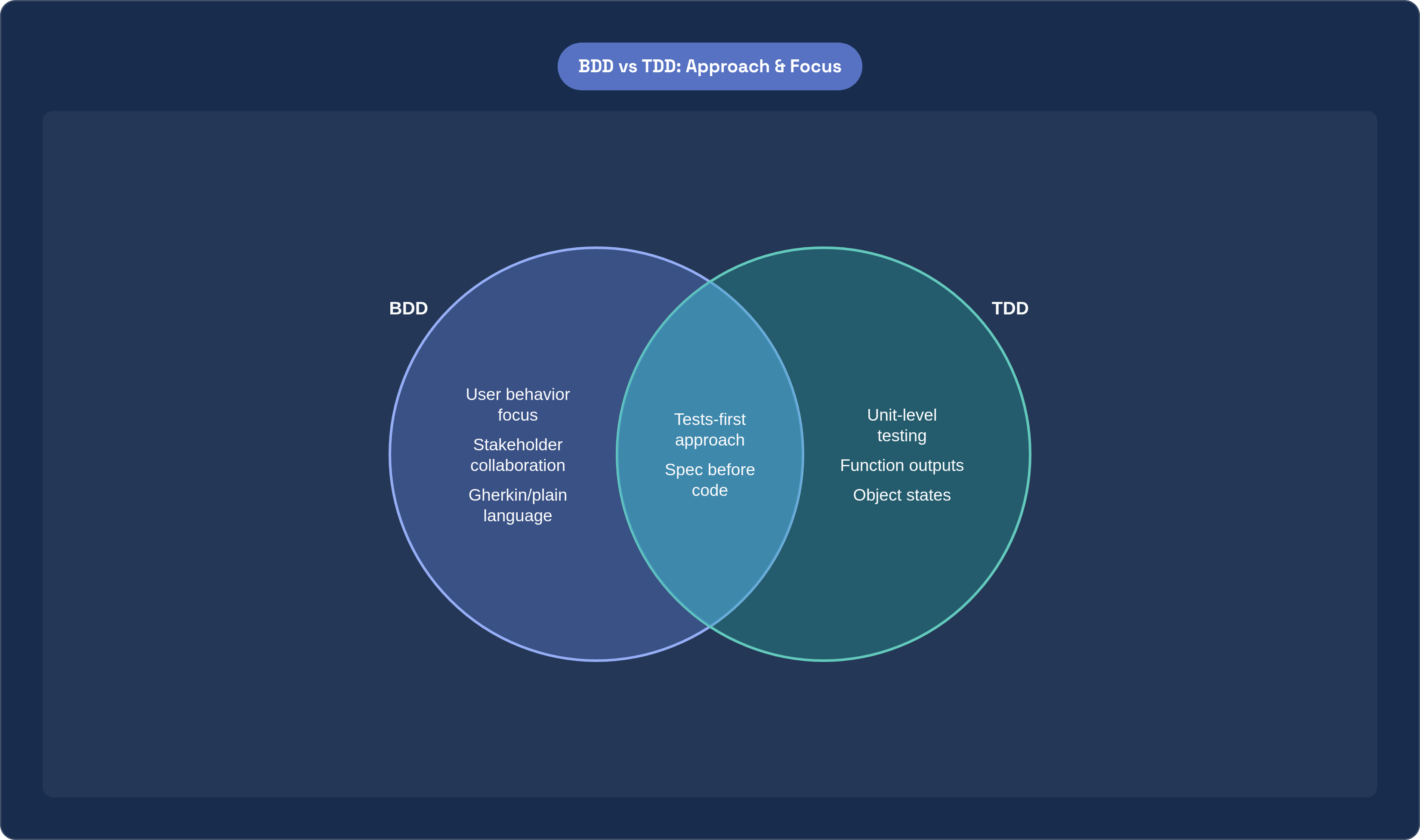
BDD starts from how a user actually experiences the system, written as concrete examples instead of abstract requirements. Developers, testers, and business stakeholders agree on a shared vocabulary before anyone writes code. Compare that to Test Driven Development, which also writes tests first but at the unit level, checking function outputs and object states rather than describing what a person sees and clicks in a browser. A BDD scenario reads like a short story about behavior. A TDD test reads like a contract between two functions.
The mechanism meant to keep this honest has a name: the Three Amigos. A product owner shows up with the goal, a developer shows up knowing what's actually feasible in the time available, and a tester shows up already suspicious about what breaks. Before development starts, the three of them work through the scenarios that define "done," and misunderstandings get caught on a whiteboard instead of three sprints later in a bug report filed against production.
People get this wrong all the time. BDD is the collaboration; Cucumber, Gherkin, and the rest of the tooling only exist to write down what that collaboration produced. Treat it as something QA owns while everyone else waits for a green checkmark, and the whole practice has already slipped away from you.
How Gherkin turns agreed behavior into executable specification
Gherkin is the plain-language format for recording what came out of a Three Amigos conversation: specific enough that a computer can run it, plain enough that a product manager can read it without a glossary open in another tab. Most technical formats pick one audience and write for that audience alone. Gherkin doesn't get that luxury, and it shows in nearly every design choice underneath it.
The structure is Given-When-Then. Given sets the starting state, When names the action under test, Then states the outcome that proves it worked. "Given a user is logged in, When they click 'logout,' Then they are redirected to the login page and their session is ended." Nobody needs a computer science degree to follow that. There's also nothing vague enough in it to argue about six weeks later, which is sort of the point.
Scenarios live inside feature files, one feature per file, several scenarios inside each one covering a distinct slice of behavior. That organization matters more than it sounds like it should, because the feature file becomes the one place anyone on the team goes to find out what a piece of functionality is actually supposed to do.
Why does this fit browser testing so well? Browser tests are about things a person can see: a click, a page load, a field filling in, a confirmation message showing up. That's exactly the altitude Gherkin was built for. It stays at screen level instead of dropping into HTTP status codes or database rows.
There's a discipline baked into this that's easy to overlook. Write a vague scenario, something like "the system works correctly," and it falls apart the moment a Three Amigos review actually starts, because nobody agrees on what "correctly" means in Given-When-Then terms. That failure happens in a meeting, not in a broken pipeline three weeks from now, which is a much cheaper place for it to happen. Gherkin also handles repetition reasonably well: Background steps declare a shared precondition once for the whole file, and Scenario Outlines with Examples tables run the same behavior against a table of inputs instead of retyping three lines twenty times over.
Where Cucumber sits in the BDD tool landscape and why it became the default
Cucumber's job is narrow. It reads Gherkin feature files and connects each line to a step-definition function written in whatever language the team already codes in. Official support covers Java, Ruby, JavaScript, Python, Scala, Kotlin, and Go, and close cousins exist outside that list too: SpecFlow for C#, Behave for Python. The same feature file could, in principle, drive any of these without a word of it changing.
How dominant is it in practice? At a handful of test automation conferences in recent years, informal polling of working practitioners consistently puts Cucumber ahead of every other BDD framework by a wide margin, well clear of names like Serenity BDD, JBehave, or FitNesse. Most teams aren't really choosing between BDD frameworks. They're choosing between Cucumber and no BDD tooling at all.
Cucumber never touches the browser itself. That job goes entirely to whatever engine gets wired in underneath: Selenium, Playwright, Cypress, sometimes a runner like TestNG or JUnit sitting under all of it. That split, language-and-structure on one side, execution on the other, is deliberate, and it's a big part of why Cucumber has outlived several generations of browser automation tools without needing a rewrite. There's an open-source core plus a commercial layer around it (Cucumber Studio, sometimes marketed as BDD Studio) for teams that want shared editing and reporting dashboards. Most teams, in my experience, get by fine on the open-source core alone and never touch the commercial layer.
Choosing the browser automation engine to pair with Cucumber
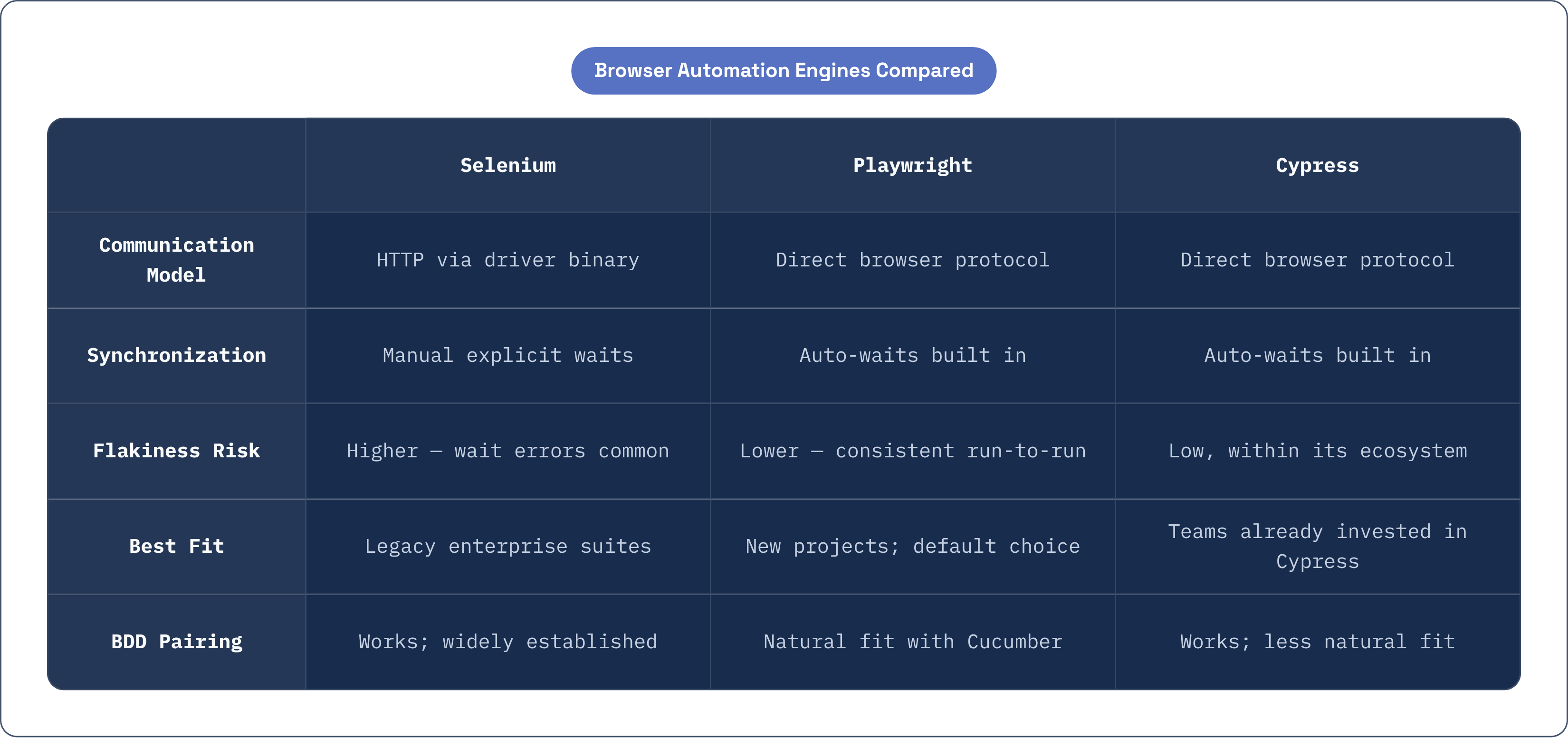
Three tools dominate this decision in practice: Selenium, Playwright, and Cypress. Each pairs with Cucumber fine, but the differences between them are real enough to decide how much of an engineer's week goes to chasing flaky failures instead of shipping features.
Selenium runs on the W3C WebDriver protocol. Every command travels as an HTTP request to a browser-specific driver binary, which translates it into an actual browser action, and that round-trip costs time. Across a suite with hundreds of scenarios, it adds up to real minutes on every single run. Selenium still shows up constantly in enterprise job listings, partly because so much test code already exists in it, partly because two decades of ecosystem depth doesn't just vanish. But its weak spot is well known by now: synchronization is manual. Someone has to write explicit waits telling Selenium to pause until an element shows up or a page finishes loading, and getting that wrong is one of the most common causes of flaky tests anywhere in the industry.
Playwright takes a different route. It talks to the browser directly, no driver binary sitting in between, which makes it faster and a lot more consistent run to run. It also auto-waits for elements before interacting with them, which removes a good chunk of the flakiness Selenium suites fight constantly. Developer satisfaction surveys over the past couple of years have shown Playwright pulling well ahead of Cypress, and job postings mentioning Playwright have grown fast, faster than almost any other category in QA hiring. I've seen a migration case study or two (Tymon Global's, documented by Alphabin, sticks in my head) where switching an older framework over to Playwright cut execution time by roughly 40% and flaky failures by more than half. A migration like that on a mid-sized suite usually runs two to four months. Teams leaning on AI-assisted migration tooling have trimmed that timeline down some, though I'd treat any exact percentage on that with a grain of salt. For Java shops specifically, Java plus Playwright plus Cucumber has become a well-supported, increasingly recommended stack: Cucumber owns the feature files, Playwright drives the browser.
Cypress still earns its following, fair enough. The developer experience is strong and the local feedback loop is fast, which matters a lot mid-sprint when you just want to see if the thing you wrote works. But its satisfaction numbers have slipped against Playwright's lately, and cross-browser support has historically lagged behind. Pairing it with BDD works. It's just a less natural fit than Cucumber and Playwright together.
Underneath all three sits one shared enemy: flakiness. A reasonable chunk of automated test failures, something like a fifth to a third depending on whose numbers you trust, come down to instability in the test itself rather than an actual bug in the software being tested. Framework choice moves that number directly, which is why this decision deserves more thought than "whatever the team already knows how to use." Selenium is still defensible for legacy enterprise suites with years of test code sitting behind them. Playwright is the right default for anything new. Cypress fits teams already deep in its ecosystem and genuinely happy there.
Writing scenarios that stay maintainable as the application grows
Scenarios that look great on day one rot fast if nobody thinks about structure ahead of time. The single most useful fix, borrowed from traditional test automation, is the Page Object Model applied to BDD step definitions. The rule: step definitions never hold raw element locators. Push those into page object classes instead, so when a button's CSS selector changes, one file gets touched instead of fifty step definitions scattered across the suite.
That gives you three clean layers. Gherkin describes behavior in plain language, step definitions translate that language into calls on page object methods, and page objects own the selectors and the actual browser interactions. Each layer does exactly one job.
The most common mistake, and I mean the most common by a wide margin, is writing scenarios that describe implementation instead of behavior. "When the user clicks the submit button and the POST request returns 200" versus "When the user submits the registration form." The first one breaks the moment the button's label changes or the backend swaps POST for something else. The second describes what a person actually does, and it survives whatever changes underneath it.
Scenario bloat sneaks in quietly too. A scenario should test one behavior, not a whole workflow chained end to end. Six When steps in a row is usually a sign a feature is missing its own file and got folded into something bigger than it should be. Scenario Outlines with Examples tables handle data variation cleanly, running the same Given-When-Then against a table of inputs instead of repeating the same prose five times. Tags like @smoke, @regression, @wip let a team run a fast slice of the suite on every push instead of the whole thing every single time.
As the application grows, keeping Gherkin current becomes real, ongoing work, not a one-time cost you pay and forget. Teams that treat feature files as living documentation, updating them the moment requirements shift, stay in reasonable shape. Teams that don't end up with a stack of scenarios describing behavior the app quietly stopped having months ago. The fix isn't really a tooling problem, if I'm honest. The product owner who wrote a scenario originally is usually the person who notices it's gone stale, so building that check into the Three Amigos habit matters more than any automated safeguard ever will.
The collaboration gap — where BDD implementations commonly break down
Here's a pattern I've watched play out more times than I'd like: teams adopt Cucumber for test automation, not for behavior specification. They write Gherkin after the code already exists, wrapping it around tests already built rather than using it before development to shape what gets built in the first place. Getting that order backward quietly defeats the entire point, and it happens more often than the BDD literature really wants to admit.
What actually gets lost when engineers write feature files alone, after the fact? The plain-language layer stops being a communication tool and turns into a translation chore, something engineers write for other engineers to read later. Stakeholders never look at it, because there's nothing left to weigh in on; the decisions already got made in code. The collaboration BDD is supposed to depend on just never happens.
Worth being honest about a real limit here. Gherkin can't be written freely by literally everyone on a team, no matter how good the intentions are. Non-technical stakeholders read scenarios and push back on them without much trouble. But writing syntactically correct Gherkin, keeping steps reusable, avoiding duplication across files, still takes practice and a bit of taste. That's fine, and it's not really a flaw in the method. The goal was never universal authorship. It was shared review and shared understanding of what "done" actually means.
Skip that review and you get what people sometimes call BDD in name only: Cucumber step definitions mapping to technical implementation details nobody outside engineering would recognize. All of Cucumber's syntax, none of BDD's actual practice. A few signs give it away fast. Feature files get updated only by QA, never by anyone else. Scenarios reference elements by technical ID instead of the label a user actually sees on the screen. And the clearest tell of all: hand a scenario to the product owner, ask if it matches what they originally asked for, and watch them shrug.
The fix isn't complicated, even if it takes some discipline to actually hold onto over time. Make Three Amigos a formal gate with a real definition of ready: no story enters a sprint without a feature file all three roles have reviewed and agreed on. Skip that step and the tooling stops mattering, no matter how well it's built.
How AI assistance is changing scenario authoring and test maintenance
AI has landed in a few specific, genuinely useful spots inside BDD workflows. It can draft Gherkin from a user story or a set of acceptance criteria, which takes the edge off the blank-page problem that sometimes stalls a Three Amigos session before it even gets moving. It can flag edge cases nobody thought to write down. It's also getting decent at self-healing step definitions, noticing a UI locator changed and updating it rather than just failing and waiting for someone to notice on Monday morning.
How much of the marketing around this actually holds up, though? Vendors like to cite big numbers, faster test creation, large cuts to maintenance effort, and some of that is probably real for the right team in the right context. But a recent academic paper looking at agent-generated tests found something worth sitting with: the sheer volume of tests an autonomous coding agent writes has no meaningful effect on whether it actually solves the underlying task. Quality and specificity of a scenario matter far more than how many got produced. That finding should change how teams evaluate these tools. More generated scenarios isn't automatically more coverage, and treating it that way is how a team ends up with a huge test suite that catches nothing new.
Agentic QA platforms are moving fast regardless of how the research shakes out. Tools like ACCELQ target BDD workflows directly with AI-driven scenario generation and self-healing tests, and analyst firms have started renaming whole categories, shifting language from "continuous automation testing" toward "autonomous testing platforms." That renaming tells you something about how seriously the shift is being taken, even if the substance underneath is still catching up to the label.
None of it removes the need for a person in the loop, and I don't think it ever will. An AI-authored Gherkin file that no stakeholder ever read defeats the entire point of BDD, no matter how clean the syntax underneath looks. AI's best role here is speeding up the grind of authoring and maintenance alongside the Three Amigos conversation, working with that conversation rather than around it. A generated scenario is a draft worth reviewing. It is never a spec worth accepting on faith, and teams that treat it that way tend to find out the hard way.
Running BDD suites in CI/CD and keeping pipelines fast and reliable
Feature files live in source control alongside application code, so every commit can trigger scenario runs against a deployed environment or a browser spun up fresh inside CI. That's the whole point of putting BDD in a pipeline at all: specification and verification travel together instead of slowly drifting apart from each other.
Tags make this workable instead of painful. Scenarios tagged @smoke run on every push, a fast gate measured in minutes. Scenarios tagged @regression run less often, on merge to main or overnight on a schedule. Skip that split and teams drift toward not running the full suite at all, because it takes too long to justify running constantly, which more or less defeats the reason for having a suite in the first place.
Parallelization changes the math substantially. Playwright natively runs tests across multiple browsers and workers at once, so a suite that would take hours running sequentially on Selenium often gets restructured to finish in a fraction of that time. Reporting matters too: Cucumber spits out JSON and HTML reports that plug straight into CI dashboards, so a business stakeholder can check pass and fail counts without ever opening a raw log file.
Security deserves a real mention here, because it gets skipped constantly and shouldn't be. CI/CD pipelines running browser automation usually hold credentials for test environments, access to staging APIs, and sometimes data sitting uncomfortably close to production. The same Zero Trust principles that govern production, identity-based access, least-privilege secrets, no automatic trust just because a request came from inside the network, apply just as much to the test runner. Cloud browser grids from providers like BrowserStack and Sauce Labs help here too, cutting out the drift that comes from running tests on whatever machine happens to be free that day, and giving every run the same conditions no matter where the CI job actually executes.
Supply chain risk belongs in this conversation as well. Attacks targeting CI/CD pipelines have grown sharply in recent years, and test dependencies, Cucumber itself, Playwright, the driver binaries under Selenium, are all part of that chain whether teams think of them that way or not. Pin versions, audit updates, and run dependency changes through some kind of review process before they land. None of that is glamorous work. Skipping it is how a test pipeline quietly turns into an attack surface nobody thought to watch.
Putting a working BDD browser test stack together
For a team starting fresh today, the stack that makes sense is Cucumber for the Gherkin layer, Playwright as the execution engine, and whatever language the team already codes in: Java, JavaScript or TypeScript, Python. It's well-supported, actively maintained, and it's the combination that keeps scoring highest in current practitioner satisfaction, though obviously weigh that against your own team's actual constraints rather than taking my word for it.
The order matters as much as the tools do, maybe more. Start with a Three Amigos session and a written feature file before anyone touches a step definition; the scenario functions as the specification from the outset, not an afterthought bolted on later. Build step definitions against page objects, never against raw selectors scattered through the codebase. Wire the suite into CI on day one, with a @smoke tag running on every push, so fast feedback becomes a habit early instead of something retrofitted once the suite has already gotten unwieldy. Bring AI-assisted authoring in once that manual workflow is solid and the team actually trusts it: an accelerant sitting on top of that foundation, not a replacement for it.
Teams already running a Selenium suite face a different math problem entirely. The flakiness numbers and the execution-speed gains make a real case for moving to Playwright, and case studies like Tymon Global's suggest the payoff can be substantial when it works. But a migration is real work, typically two to four months for a mid-sized suite, and it deserves an honest cost-benefit conversation. Not a decision made purely on whichever framework happens to win this year's satisfaction survey.