End-to-End Testing Best Practices
Catch cross-system failures that unit and integration tests miss.
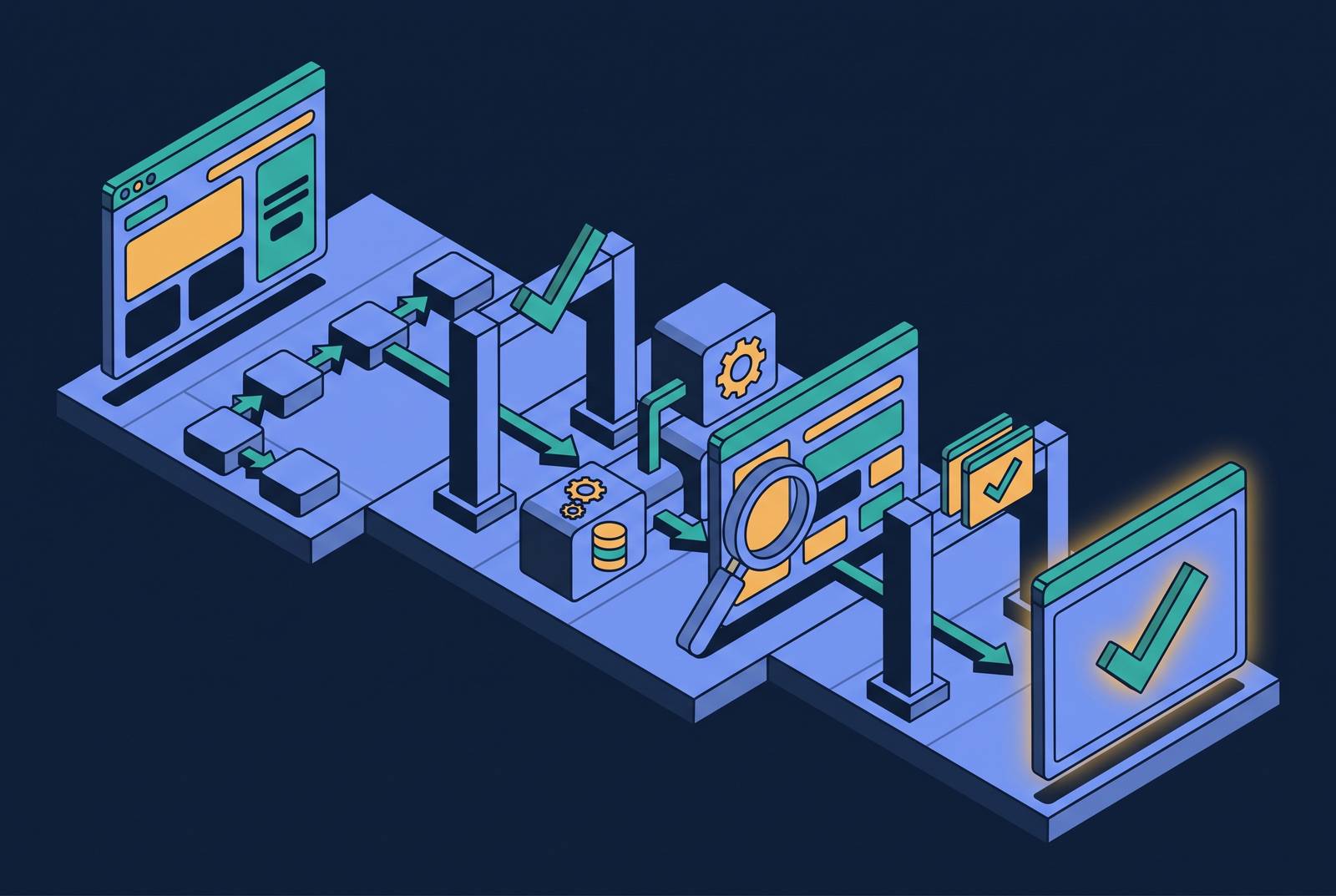
End-to-end testing simulates a real user moving through an entire application: clicking through a UI, hitting backend services, writing to a database, calling out to a third-party API, all in one continuous run. That's the whole pitch, and it's also the whole problem. E2E tests catch failures that appear only when every layer of a system talks to every other layer at once; that cross-layer dependency is what makes them slow, fragile, and expensive to keep working as an app grows. This piece lays out what it actually takes to build and keep an E2E suite worth trusting, from picking the right tests to run, to the environments they run in, to how a team knows the suite is still doing its job years later.
Unit tests check a function. Integration tests check that two services talk correctly under controlled conditions. Neither catches what happens when five systems interact under real, messy, production-like conditions, and that gap is bigger than most teams assume. Research out of the University of Illinois found that at least 20% of severe failures in cloud applications trace back to cross-system interaction failures, and for open-source applications, the number climbs to 37% of reported issues. That's a substantial share of reported issues, not a rounding error. That's more than a third of bugs living in the seams between systems, exactly where unit and integration tests don't look.
Picture a checkout flow where the cart service, the payment gateway, and the order database each pass their own tests in isolation but break the moment a payment confirmation arrives a few hundred milliseconds later than the order database expects. Or an authentication handoff that works perfectly against a mocked identity provider but falls apart when the real provider is slow under load. Or a microservice contract mismatch, where service A sends a field the way it always has and service B recently started expecting it formatted differently, and no single service's test suite has any way of knowing.
The testing pyramid puts E2E at the top for a reason: fewer tests, broader scope, higher value per test. It's an additional checkpoint beyond the unit tests forming the base, not a substitute for them. It's the last checkpoint confirming the whole assembled system actually delivers what it promises. And the cost of skipping that checkpoint is not symmetric. A broken checkout flow caught in a pre-release run costs a developer twenty minutes. The same bug reaching production costs revenue, support tickets, and a measurable hit to user trust; a burndown chart doesn't record that cost, but revenue reports, support queues, and customer churn do.
Why E2E tests are fragile, and why that gets worse at scale
The tests that matter most are also the tests hardest to keep working. That tension arises because the tests providing the most value are the same tests that break most easily as the system changes, since both depend on the same cross-system connections.
UI brittleness is the most visible source. A selector tied to a CSS class or a page-structure position breaks the instant a designer changes padding or a developer renames a component, even though nothing about the actual business logic moved. Timing adds a second layer of pain: network latency, animations, lazy-loaded content, and device speed differences all introduce non-determinism, so the same test can pass on one run and fail on the next for no reason related to the code being tested.
Shared environments make it worse. When multiple developers or CI pipelines point at the same staging database, one person's test run can quietly corrupt another's. That's how "works on my machine" turns into a running joke instead of an edge case, and it's also how one environment's configuration diverges from another's until a deploy exposes the difference. Leftover data from a previous test run is one of the most common root causes of E2E failure in microservices environments specifically, because state that one test leaves behind becomes the state another test unknowingly depends on, or trips over.
Scale doesn't just add more of these problems, it multiplies them. In a microservices setup, one team updating an internal API can cascade failures through E2E tests owned by three other teams who had no idea the change was coming. Multiplying that across a dozen services turns the failure surface from a list of bugs into a maze with no map.
The organizational cost is that people stop trusting the suite once it starts failing for reasons unrelated to real bugs, and no dashboard tracks that erosion of trust. Once a suite starts failing for reasons unrelated to real bugs, people stop trusting it. Failures get labeled "flaky," dismissed, and re-run until green. At that point the suite has stopped functioning as a safeguard and started functioning as noise, which is arguably worse than having no suite at all, because it creates the illusion of coverage without the substance of it. Every section that follows is built around countering one of these four failure modes directly.
Choosing which workflows to test end-to-end
The most common mistake is writing too many E2E tests. It's writing too many of them, treating E2E as the default way to verify anything works, and ending up with a suite that duplicates what unit and integration tests already cover, only slower and less reliable.
Before writing a single E2E test, ask one question: does this workflow failing cause damage that no lower-level test would catch? If the answer is no, the test belongs somewhere else in the pyramid.
Practical selection comes down to a few criteria. Core business flows come first: checkout, onboarding, authentication, whatever path a user must complete for the product to deliver its value. Flows crossing service or team boundaries come next, since that's where integration risk concentrates and where unit tests structurally cannot see the whole picture. A simple risk matrix helps sort candidates: likelihood of failure multiplied by severity of user impact gives a rough priority score, and anything already covered thoroughly by solid integration tests becomes a candidate for removal rather than duplication.
Smallness is the constraint to hold onto deliberately. A tight, intentional E2E suite runs faster, stays easier to maintain, and earns more trust from the team than a sprawling one ever will. Quality of coverage beats quantity of tests, every time. In practice, that usually means landing on somewhere between five and ten critical user journeys, each with a clear, written reason for why it belongs in the suite and not somewhere cheaper.
Building test environments that behave like production
Shared staging environments fail in predictable ways: configuration drifts out of sync with production, teams collide over scheduling, and dependencies on third-party state nobody controls introduce failures that have nothing to do with the code under test.
The pattern replacing shared staging is the ephemeral preview environment, spun up fresh for each pull request and torn down once the run finishes. Each PR gets its own full stack, services, databases, message brokers, configured to match production rather than approximate it. That kills cross-team environment conflicts at the root, since no two PRs are ever touching the same instance of anything. Heading into 2026, this pattern has moved from experimental to mainstream as infrastructure automation tooling matures and the setup cost drops.
Mirroring production actually means something specific. It means using real or sandboxed versions of external dependencies, payment processors, identity providers, rather than mocks that quietly hide the exact integration behavior E2E testing exists to catch. It means matching runtime configuration, environment variables, and network topology as closely as the infrastructure allows. And it means seeding the database to a known, consistent state before the run starts, not hoping whatever's left over from the last run happens to be harmless.
None of this works if it's a manual step someone has to remember to trigger. Every code change should kick off an environment spin-up and E2E run automatically, folded into CI/CD rather than sitting off to the side as a gate developers only pull when they remember to. Done right, the ephemeral environment model solves two of the four fragility sources from the earlier section at once: shared-environment conflicts and test data contamination, because there's no shared environment left to contaminate.
Managing test data so environment state never decides whether a test passes
Synthetic data that's too clean hides real bugs. Field lengths that never vary, characters that are always plain unaccented text, relationships between records that never get weird, none of that resembles what actual users type into actual forms, and tests built on it can pass cleanly while missing exactly the edge cases that production will expose within a week.
Copying production data over isn't the fix either. It raises privacy and compliance exposure immediately, and it introduces its own instability, since production state isn't the same from one run to the next, which defeats the point of a repeatable test.
Test Data Management practices split the difference. Synthetic data should structurally mirror production: same field types, same cardinality, same relationship constraints, just without real user information attached. The database gets seeded to a known baseline before a test run starts, not reset piecemeal between individual tests within that run. Tests should create the data they need rather than leaning on records some earlier test happened to leave behind, and test data should stay isolated per environment, something the ephemeral environment model handles almost automatically.
In a microservices setup, this gets more specific. Service A's test can't assume service B's database sits in any particular state, so each boundary between services needs its own explicit data contract check rather than an implicit assumption carried over from how things used to work. Generating that data by hand doesn't scale past a handful of services. AI-assisted data generation is starting to earn a place there, producing diverse, edge-case-covering datasets straight from a schema definition and cutting out a lot of the manual curation that used to eat a QA engineer's week.
Writing tests that don't break when the UI changes for unrelated reasons
Most brittle UI tests share one root cause: the selector is anchored to how the page is built rather than what the page means to a user. A CSS class name, an element's position in the page structure, an auto-generated ID, none of those are stable, and none of them have anything to do with whether the feature actually works.
The fix is picking selectors that express intent instead of structure. ARIA roles and labels describe what an element does for the person using it, which tends to survive redesigns that gut the underlying markup. Explicit test-only attributes, commonly written as data-testid, exist purely to give a test something stable to grab onto regardless of styling changes. Visible text works too, for anything whose label isn't going to change on a whim, since the words a user reads tend to outlast the internal class names a developer picks.
Timing needs the same discipline. Fixed sleep commands, waiting five seconds and hoping the page caught up, are one of the most reliable ways to introduce flakiness into a suite. Condition-based waits, where the test waits for an element to actually be visible and interactive before acting on it, remove that guesswork. Frameworks like Playwright and Maestro build these intelligent waits in by default now, which is one less anti-pattern a team has to police manually.
Wrapping the UI in a page object or component model pays off here too. One layer of code knows how to click the checkout button or fill the login form; the tests themselves just call that layer without knowing or caring what the underlying markup looks like. When the UI changes, one file gets updated instead of forty scattered test files. Tests written against implementation details need constant babysitting. Tests written against user intent tend to survive a redesign without anyone touching them.
Selecting a framework that matches the platform and team rather than defaulting to the most popular option
There's no universal best framework, only the one that fits a given platform, language, and team's existing workflow. Treating framework choice as a popularity contest is how teams end up fighting their own tooling for a year before admitting the mismatch.
For web, Playwright covers Chrome, Firefox, and WebKit, supports JavaScript, Python, Java, and C#, runs tests in parallel, and builds intelligent waits in from the start. It's free and open-source, and for teams needing solid cross-browser coverage, it's the strongest all-around pick available today. Cypress sticks to JavaScript and TypeScript and to one major browser engine's family plus Firefox and Electron, but its real-time visual Test Runner and automatic screenshots and video on failure make debugging noticeably faster, especially for single-page apps built on modern frameworks. It runs on a free tier with paid cloud plans above that. Selenium remains the most flexible and broadly supported option across browsers and languages, though it demands more setup and maintenance than either of the newer tools, making it the sensible choice mainly for teams with an existing Selenium investment they're not ready to walk away from.
On mobile, Maestro uses a YAML-based declarative syntax and covers native Android (Views, Jetpack Compose) and iOS (UIKit, SwiftUI) alongside React Native, Flutter, and web, with flakiness handling and intelligent waits built in. It's free and open-source to run locally, with cloud execution priced per concurrent device, around $250 a month for Android or iOS, or $125 a month for web, and Maestro Studio adds a visual, no-code way to build tests with some AI-assisted features layered on top. Appium covers Android and iOS along with native, hybrid, and mobile web, without requiring changes to app code, and it's free and open-source, though it comes with more setup complexity in exchange for that flexibility.
For API and service-layer coverage, Postman remains the widely used choice for testing workflows and validating contracts, and StepCI offers a lighter, open-source option built for slotting into CI pipelines without much overhead. For teams needing real device coverage rather than emulators, BrowserStack provides access to a cloud of real devices and browsers.
As a rough heuristic: mobile-first teams lean toward Maestro or Appium, web teams needing multi-browser coverage lean toward Playwright, teams wanting tight JavaScript integration with strong visual debugging lean toward Cypress, and API contract coverage in any stack points toward Postman or StepCI.
Integrating E2E tests into CI/CD without letting them become the pipeline bottleneck
A slow or flaky E2E suite that blocks every merge creates its own kind of gravity: developers start looking for ways around it, and once bypassing the suite becomes normal, the suite has lost its purpose.
Parallelization is the first and most direct fix. Independent test scenarios can run across multiple runners simultaneously, and most current frameworks, Playwright, Cypress, Maestro Cloud among them, support this natively. Partitioning tests by feature area rather than alphabetically keeps the parallel buckets roughly balanced in run time, so one runner isn't sitting idle while another chokes on the slowest fifth of the suite.
Not every test needs to sit on the critical path either. The short list of critical business flows identified earlier deserves a hard gate, blocking merge until it passes. The broader regression suite can run asynchronously after merge, raising an alert on failure without holding up deployment. That split alone removes most of the pressure that turns a useful suite into a bottleneck.
Flaky tests need active triage, not tolerance. Tracking failure rate per test, rather than a binary pass/fail, reveals which tests are actually unreliable versus which caught a real bug once. Persistently flaky tests get quarantined: pulled from the hard gate, flagged, and prioritized for a rewrite or removal, because a flaky test is a bug in the test itself, not a fact of life to shrug off. Letting flaky tests pile up unaddressed leads a team to stop trusting the whole suite, echoing the trust erosion described earlier.
Ephemeral environments tie directly into this. Spinning up a fresh environment per PR means parallel CI runs don't collide over shared state, which is what makes aggressive parallelization safe in the first place rather than just fast. A suite that runs quietly in the background and reports reliably earns trust and gets used. A suite that blocks pipelines unpredictably gets disabled, one exception at a time, until nothing is left running.
Keeping a growing test suite from decaying into a maintenance liability
Left alone, a test suite only grows. New features add new tests, nobody removes the old ones, and within a couple of years the suite is carrying dead weight: tests for features that no longer exist, tests that duplicate each other through different entry points, tests that fail for reasons nobody remembers and everyone's stopped investigating.
Pruning needs to be scheduled, not reactive. Reviewing the suite on a cadence tied to release cycles, rather than only when something breaks, catches tests that outlived the feature they were written for. Tests for deprecated flows get removed. Tests now redundantly covered by a lower-level integration test get removed too. Overlapping tests hitting the same underlying path through slightly different entry points get merged into one.
Ownership matters more as team count grows. Every E2E test needs a named owner, a specific team or person accountable for its health, especially for tests that cross service boundaries in a microservices architecture. Shared responsibility for a cross-team workflow test has a way of becoming nobody's responsibility the first time it breaks at an inconvenient hour.
Treating the suite as infrastructure, not an afterthought, changes behavior. A failing E2E test gets triaged with the same urgency as a production alert rather than left open for a sprint. New features ship with E2E coverage for their critical path built in from the start, not bolted on weeks later once someone remembers. Some organizations formalize this with a center-of-excellence model: a centralized group holding automation expertise, setting standards, reviewing new tests before they enter the suite, and training teams on shared conventions, which keeps the suite from splintering into a dozen inconsistent styles as more teams contribute to it.
Measuring whether the E2E suite is doing its job
A suite that's green every day isn't automatically a healthy one. Without measurement, there's no way to tell a suite that's passing because the product is solid from a suite that's passing because it stopped checking anything meaningful months ago.
Failure rate per test, tracked over time rather than glanced at once, shows which tests are catching real regressions and which are just noisy. Time-to-detection matters too: how long between a bug landing in the code and an E2E test catching it, since a slow feedback loop delays release decisions and lets a bug travel further into the pipeline before anyone notices. Flake rate deserves its own ongoing metric, separate from raw failure rate, because conflating the two erodes trust in the results.
Check coverage of critical paths against the actual list of core business flows identified earlier, since suites tend to drift over time toward covering whatever's easy to test rather than whatever matters most. And escaped defects, bugs that made it to production despite a passing E2E suite, are maybe the sharpest signal available: every one is a direct data point on where the suite's coverage has a gap, and tracking them over time turns the suite from a static artifact into something that actually improves.
None of these numbers mean much in isolation. Read together, though, they answer the only question that matters for a suite this expensive to build and maintain: is it still doing the job it was built for, or has it quietly become something the team runs out of habit.
Sources
- Best Practices for End-to-End Testing in 2026 | Bunnyshell
- End-To-End Testing: 2026 Guide for E2E Testing
- Automated End to End Testing: A Complete Guide for Modern QA Teams
- End-to-End Testing for Microservices: 2026 Guide | Bunnyshell
- What is End To End (E2E) Testing: Tools & Example | BrowserStack
- ibm.com
- k2view.com