Machine Learning Techniques for Web Scraping
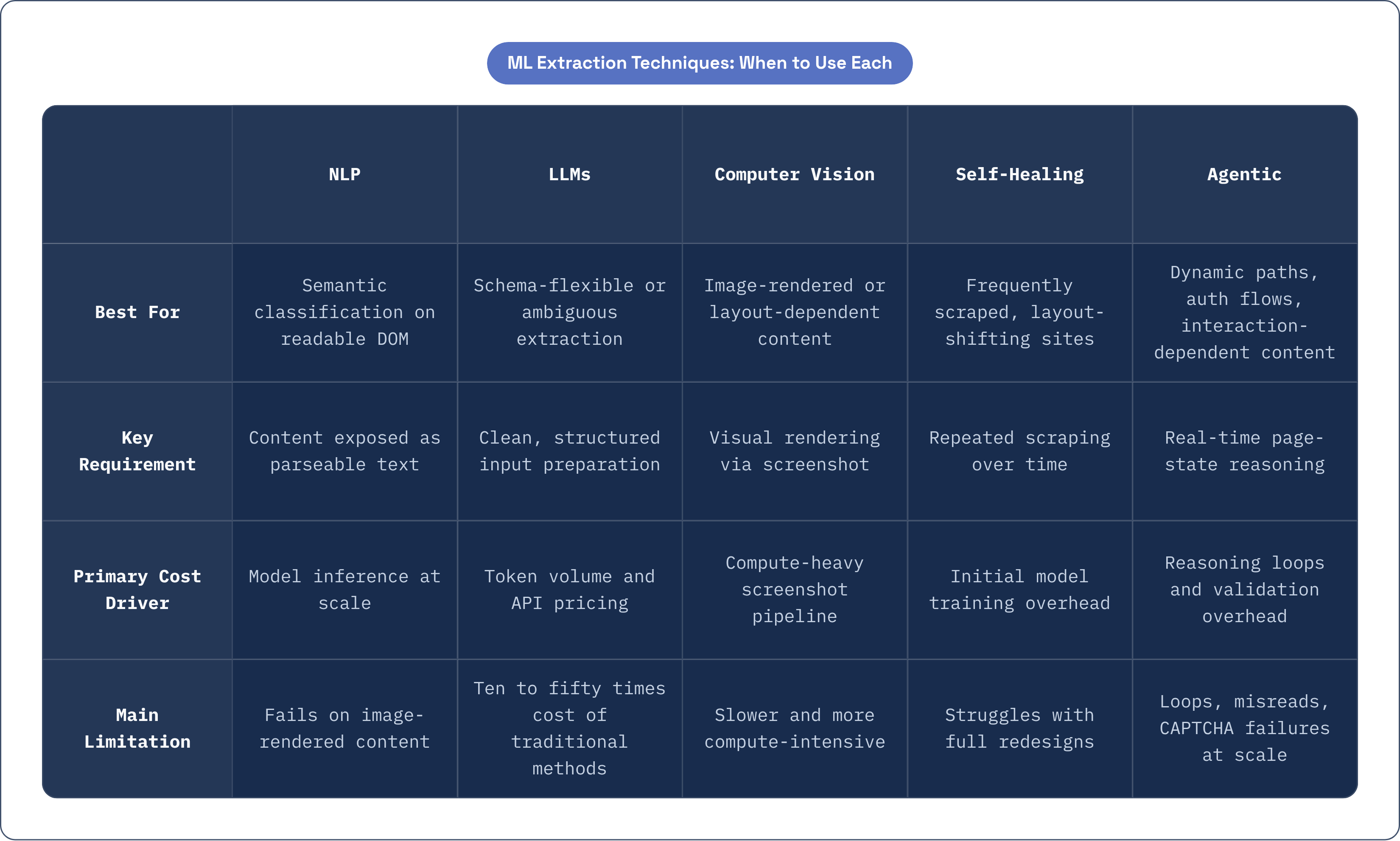
LLMs and computer vision extract meaning where selectors fail, but at ten times the cost.
## How NLP Turns Unstructured Page Text into Structured Data Rule-based scrapers extract strings. NLP extracts meaning. That gap sounds minor until you're debugging a system that confidently classifies "Apple" as produce because nobody told it about earnings calls. The canonical disambiguation example is deliberately simple; the underlying problem is not. A CSS selector matches a pattern. It does not resolve ambiguity, weight context, or generalize to sentences it has never encountered. The NLP tasks most relevant to scraping are named entity recognition, sentiment classification, topic detection, and intent extraction. Each relies on the same learned capability: the model has internalized statistical associations between tokens and semantic categories across enormous training corpora, which lets it generalize to text it has never seen. You can write a selector for a specific element on a specific page. But capturing every way a human being expresses dissatisfaction with a product? No rule covers that. A sentiment classifier trained on sufficient data can. Microsoft Research's MarkupLM narrows the problem further by joint pre-training on both page text and HTML markup. The model learns that a product description inside an `
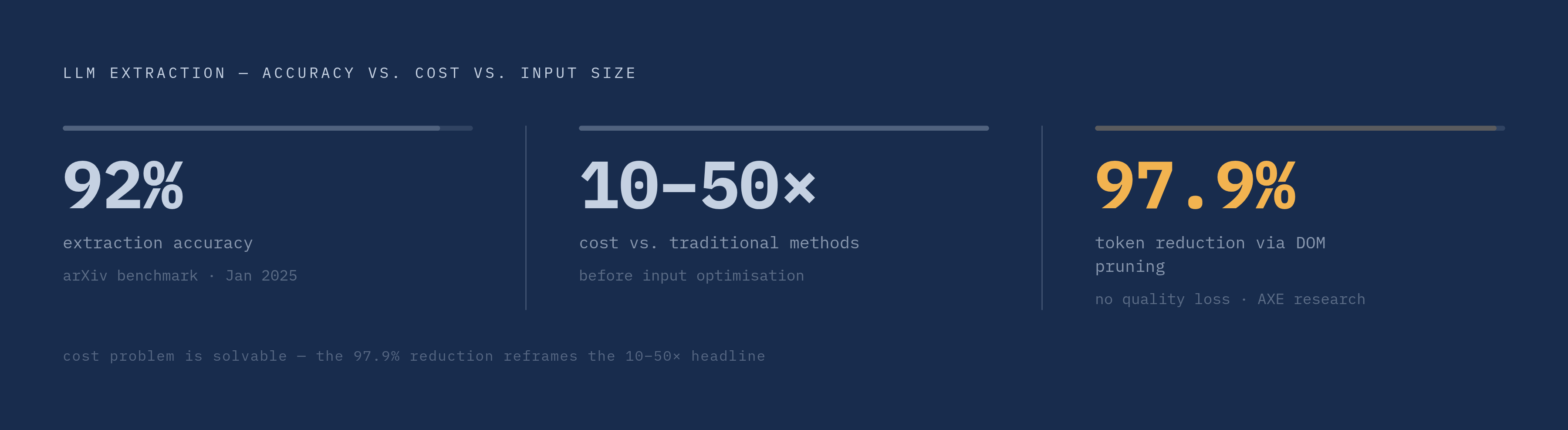
` carries different semantic weight than the same phrase nested in a ``. Structure and language become jointly interpretable signals rather than separate concerns. That architecture, treating meaning and markup as a unified training target, is what lets a single model generalize across product pages, forum threads, and news articles without requiring separate selector logic for each format. None of this addresses content that never enters the DOM as parseable text: prices rendered as images, specifications embedded in product photography, data living inside canvas elements, binary payloads injected dynamically before render. A language model working on DOM text cannot reach any of it. That failure mode is not a quirk of a few adversarial sites; it describes a meaningful and growing portion of the commercial web. NLP is a powerful layer for pages where it can operate, and it is simply the wrong layer for pages where it cannot. ## What LLMs Add to Extraction and Where They Hit Their Limits A 2026 Springer systematic review found that eighty-four percent of LLM-related scraping publications appeared in 2024 and 2025. The enthusiasm and skepticism both circulating in practitioner communities are probably miscalibrated because the research base is genuinely that new. A January 2025 arXiv benchmarking paper reported approximately ninety-two percent extraction accuracy for LLM-based approaches. That reads well until the cost figure appears: ten to fifty times the cost of traditional methods, depending on model size and API pricing. Any honest evaluation has to start there, not with the accuracy number in isolation. The NEXT-EVAL 2025 benchmark found F1 scores above 0.95 are achievable, but only when input arrives at the model properly formatted. The bottleneck is no longer the model's comprehension. It is the extraction layer's ability to prepare clean, structured input before the model ever sees the page. Dropping a raw HTML blob into a prompt and expecting reliable output is a reasonable first experiment; it is not a production strategy, and teams that treat it as one tend to learn that lesson expensively. Input format has measurable, predictable effects on extraction quality. Flat JSON produces the strongest extraction accuracy, reaching F1 of 0.9567 in benchmark conditions. Clean Markdown performs better for retrieval-augmented generation pipelines because it preserves structural context while remaining token-efficient. The AXE research paper demonstrated that DOM pruning, stripping boilerplate HTML before sending content to a model, cut token usage by 97.9% without degrading extraction quality. At production volume that figure is not a benchmark curiosity; it is a direct operating cost lever, and ignoring it is a choice to pay for noise. Fine-tuning at smaller model scales has also proven more viable than early field assumptions suggested. The ScrapeGraphAI-100k dataset, nearly 94,000 schema-balanced examples drawn from nine million production events, showed a 1.7 billion parameter fine-tuned model closing a substantial portion of the accuracy gap relative to a thirty billion parameter baseline on structural extraction tasks. Bigger models are not the answer in every case. Better training data often is, and the teams still chasing parameter count while their training sets remain thin are, in my observation, solving the wrong problem. LLMs earn their cost premium on tasks requiring semantic understanding, schema flexibility, or generalization across pages with unpredictable structure. But what if you deployed them as a drop-in replacement for every CSS selector? That is a reliable way to spend significantly more money solving problems that simpler methods already handle. ## Computer Vision for Pages Where the DOM Tells You Nothing Useful Some pages are simply opaque to any text-based extraction method because the meaningful content never enters the DOM as parseable strings: e-commerce product images with embedded specifications, infographics, price tags rendered as image files, dashboards where data lives inside chart elements rather than table cells. Parsing the DOM more cleverly on these pages produces nothing useful because the data is not there to parse. The visual approach sidesteps this by treating the page the way a human viewer does: capture a screenshot, pass it to a vision-language model, read what is rendered rather than what the markup exposes. In practice, this often means pairing a headless browser like Playwright with an object detection model such as YOLO to locate and classify visual page elements, extracting price, rating, and discount information from e-commerce pages that have no consistent HTML structure to rely on. Diffbot operates at production scale using a combination of computer vision and NLP to classify pages by type automatically, whether product listing, news article, or organizational profile, and to structure extracted content into a queryable Knowledge Graph. No manually defined selectors per site. The system applies learned visual and linguistic patterns to each page it encounters, making explicit what DOM-only methods assume away: that structure and meaning can often be inferred together from visual and textual signals without requiring a human to define the mapping in advance. Vision models are slower and more computationally intensive than DOM parsing. A screenshot-based extraction pipeline at high volume costs meaningfully more than an equivalent XPath-based one. I've seen teams reach for visual extraction prematurely, before confirming that HTML-based methods genuinely fail, and the compute bills are instructive. Visual extraction belongs in the toolkit for cases where HTML-based methods fail outright, and its natural home is in multimodal pipelines where visual output is one of several concurrent extraction streams rather than the only one. ## Self-Healing Scrapers That Adapt When Page Layouts Change A self-healing scraper is not a scraper that never breaks. It is one that detects when it has broken and repairs itself without requiring someone to open a ticket. That distinction matters because the primary cost of conventional scraping is not the initial build; it is the maintenance. Developers in practitioner communities like r/webscraping report that ten to fifteen percent of scrapers break in any given week, not from bugs in their own code, but because a target site renamed a class, restructured its DOM, or moved an element. Teams spend roughly twenty percent of their time building scrapers and eighty percent keeping existing ones running. That ratio is exhausting, and anyone who has managed a scraping team at scale knows the feeling of shipping a new extractor while three older ones are silently failing. Neural network-based extraction addresses this by learning page layouts rather than encoding fixed selectors. ScraperAPI reports their neural-network extractor achieves approximately ninety-five percent accuracy on previously unseen sites, implying meaningful generalization across structural variation. When a CSS selector stops resolving, the model detects the drift, identifies the structurally equivalent element in the new configuration, and updates its mapping. The maintenance math is directionally compelling even as a rough estimate. Traditional scraping teams reportedly spend more than sixty percent of their time in break-fix mode; AI-assisted self-healing systems reduce that burden by roughly forty percent. What actually changes is the nature of the work. Engineers stop repairing broken selectors and start validating data quality, investigating genuine anomalies, and building extraction logic for new targets. Self-healing handles incremental layout changes well: elements shuffling within a recognizable structural framework. Complete redesigns that alter the underlying content hierarchy rather than just the visual presentation can exceed what any model reconciles automatically. Practitioners who treat self-healing as a maintenance-free guarantee will encounter cases that prove otherwise. The technology changes the ratio of that work, not the existence of it. ## Agentic Scrapers That Navigate and Reason Rather Than Just Extract The meaningful architectural difference between a traditional scraper and an agentic one is not what it extracts; it is how it decides what to do next. A traditional scraper executes a predetermined sequence of instructions. An agentic scraper observes the current page state, forms a plan, executes a step, evaluates the result, and adjusts before proceeding. The path through the site is not fixed in advance; it is reasoned through in real time. This is the architecture that actually addresses the hard failure modes. Multi-step authentication requires recognizing a login form, populating credentials, handling a multi-factor prompt, and establishing a valid session before any target content is reachable. Paginated results require detecting pagination controls, determining how many pages are relevant, and navigating them in sequence. Dynamically loaded content requires recognizing that a page is not yet fully rendered, triggering additional loads through scrolling or interaction, and then extracting from the updated DOM. A scraper executing predetermined selectors cannot handle any of these reliably. An agent reasoning about page state can, at least under conditions that are reasonably well-defined. Modern scraping APIs have operationalized this at the product level. Firecrawl's `/interact` endpoint allows a practitioner to specify a goal in natural language and then generates and executes the necessary browser interactions, no XPath or CSS selectors required. The cost case at enterprise scale is notable. One company reportedly replaced fifteen manual scrapers with an AI-driven agentic system, reducing first-year costs from $4.1 million to $270,000 while raising data accuracy from seventy-one percent to ninety-six percent, as cited by GPTBots in 2026 via tendem.ai. Numbers of that magnitude warrant scrutiny before they drive architectural decisions, but even a fraction of that improvement would justify serious consideration. Agentic systems introduce failure modes that conventional scrapers do not. Agents can enter loops on ambiguous page states, misinterpret a confirmation dialog, or fail to recognize that a CAPTCHA has appeared mid-session. These are real concerns at scale, which is why human-in-the-loop validation on high-stakes extraction tasks reflects the current state of what these systems handle reliably rather than excessive caution. A 2025 research paper titled "Internet 3.0: Architecture for a Web-of-Agents" envisions autonomous agents replacing DOM parsing with protocol-driven machine-to-machine data exchange, bypassing interfaces designed for human eyes entirely. The timeline is speculative; the direction it points is less so. ## Multimodal Scraping When Content Spans Text, Images, and Layout Simultaneously Some pages distribute meaning across several channels at once, and no single extraction method captures all of it. A product catalog page might embed specifications inside photography. A financial dashboard might pair chart images with adjacent text labels that only resolve correctly in relation to the chart's visual structure. A social media feed might interleave text posts, image content, and engagement data in a layout where spatial relationships carry interpretive weight. Text extraction alone misses the images; visual extraction alone misses the semantic relationships in the text; DOM parsing misses whatever was never written into the markup. You can spend a surprising amount of time convincing stakeholders that these are not edge cases before the data quality problems make the argument for you. Multimodal scraping agents combine language understanding, visual parsing, and action execution in a single reasoning loop. The agent interprets the user's goal linguistically, reads the page's visual layout as rendered, and issues browser commands accordingly. Puppeteer Vision is one named implementation of this pattern, chaining these three layers to handle pages that no single-modality approach addresses adequately. Downstream demand for multimodal output is growing alongside the tooling. A 2024 BrowserCat survey found that sixty-five percent of companies already pipe scraped data directly into AI projects. As those downstream consumers increasingly include multimodal models, extraction outputs that fuse structured text, image references, and layout context carry more value than text alone. It is worth considering what signal is being discarded when a scraper delivers only strings to a multimodal model, often without the team realizing the downstream consumer could have used the richer output. The current state of multimodal tooling is considerably less standardized than pure-text LLM pipelines. Integration work is higher, the field is moving quickly, and choices that look reasonable today may look different within a year. Practitioners entering this space should expect to assemble components rather than purchase a unified solution, and should budget for that integration overhead honestly. ## The ML Arms Race Between Scrapers and Anti-Bot Systems Anti-bot detection is not a static filter. It is a continuously retrained classifier. Modern systems score every incoming request by examining the IP address, TLS handshake, browser fingerprint, HTTP headers, mouse movement patterns, and behavioral signals, then weighing those against distributions learned from enormous volumes of genuine human sessions. DataDome, as one example, scores each request against patterns learned from billions of data points in under two milliseconds, fast enough to block a request before any scraping logic executes. Systems like this report bot detection accuracy above ninety-five percent. The evasion side has adapted accordingly. Advanced scrapers deliberately simulate imperfect human behavior because mechanical precision is itself a detection signal. Real users hesitate, mistype, move their mice imprecisely, scroll at irregular speeds. A scraper that executes with perfect consistency stands out against distributions learned from genuine human sessions even if every individual action appears superficially human. Randomized mouse paths, deliberate pauses, occasional interaction errors are engineering decisions, not oversights. The first time you watch a technically flawless scraper get blocked within seconds while a sloppier simulation sails through, the lesson sticks. ML-assisted CAPTCHA solving handles image and audio formats using optical character recognition and classification models. Newer behavioral CAPTCHAs score the quality of a user's interaction pattern across an entire session rather than at a single challenge point, which requires full interaction simulation to defeat and represents where detection has genuinely moved the frontier. The challenge is no longer a discrete puzzle to solve; it is a continuous performance to maintain. Bright Data's Web Unlocker addresses this environment at the product level by using ML to dynamically select bypass strategies and apply customized browser fingerprint configurations on a per-request basis. The fingerprinting becomes adaptive rather than fixed, responding to what detection systems are testing for at any given moment. Each side trains on signals the other generates. Evasion techniques that work reliably today become training data for detection systems, which improve their classifiers, which force evasion to evolve. One might argue that static evasion configurations can hold if they are sophisticated enough — but practitioners who build them and expect them to last are misreading the environment. ## Choosing the Right ML Technique for the Extraction Task at Hand These techniques do not form a hierarchy in which each successive layer supersedes the one before. They address different problems, and most production systems compose two or more of them rather than selecting one exclusively. Knowing which layer applies where, and what each layer costs in compute, latency, and ongoing maintenance, is the actual work. Four decision axes organize the selection: content type, page dynamism, scale and cost tolerance, and how frequently target sites change their layouts. NLP alone is sufficient when target pages are structurally stable, expose content as readable DOM text, and the extraction challenge is semantic rather than navigational. Review archives, news feeds, and forum threads typically meet these conditions. When schema flexibility is high or extraction targets are semantically ambiguous across structurally varied pages, LLMs earn their cost premium, provided input preparation is treated as a first-class engineering problem. DOM pruning and structured input formatting are not optional optimizations at this layer; they are what makes LLM-based extraction economically defensible at scale. Computer vision is worth the compute overhead when meaningful content is image-rendered or layout-dependent in ways DOM parsing cannot address. Self-healing justifies its complexity when the same sites are scraped frequently over extended periods, because the maintenance savings compound. A team scraping a hundred sites daily cannot absorb weekly manual selector repairs; a self-healing system that absorbs incremental layout drift changes that calculus substantially, though it does not eliminate it. Agentic scrapers become necessary when the extraction path itself is dynamic, requiring navigation through authenticated sessions, multi-step forms, or interaction-dependent content loads. They introduce new failure modes and carry real compute costs, which is why human validation on high-stakes outputs is a design requirement rather than a precaution. Multimodal scraping is appropriate when the downstream consumer is itself a multimodal model, or when the data product must fuse text, image content, and layout context into a single coherent output. The web was never a uniform target, but the variance has grown considerably. The practitioners I've watched struggle most are the ones who assumed their initial technique would scale to every case they'd encounter, and budgeted accordingly. Durable scraping architectures are built with that heterogeneity accounted for from the start.