How Agentic Workflows Run on Serverless Infrastructure
Agents need discrete, retryable steps with durable state to run cost-effectively on serverless.
Agentic workflows run well on serverless infrastructure when the agent’s goal outlives the compute that advances it. The architectural task is to turn an unpredictable reasoning process into discrete, retryable steps, with durable state between them. That separation makes event-driven execution a natural fit, but production agents also need isolation, spending limits, and geographic placement designed around their work.
Why agentic workflows break traditional server assumptions
A shopping assistant that compares watches may need more than a single backend request to answer. It must interpret the shopper’s goal, plan tool calls, query the backend, and use the results to refine its response. Its completion time is unknown when it starts. To a developer, what looks like one user interaction is a sequence of dependent operations whose length emerges during execution.
That shape strains the familiar synchronous server model, in which a request receives a response in milliseconds and releases its resources. A model might respond in two seconds, or it might begin a much longer multi-tool workflow. The application must keep track of an unfinished goal while reasoning and external operations move at different speeds.
Three demands follow from that uncertainty. Duration is unpredictable because the agent does not know in advance how many tool calls it will need. Reasoning is stateful because later choices depend on earlier plans, results, and the context built up so far. Each step also needs a way to recover on its own and an audit trail, since one failed tool call should not force the whole goal to restart.
The resulting mismatch concerns both resource use and correctness. Keeping compute provisioned throughout the run wastes capacity during idle waits, while terminating a process that holds the only copy of progress destroys the reasoning state. How can the system release resources without abandoning the task? That is the problem the execution model must solve.
How the agent loop maps onto an event-driven execution model
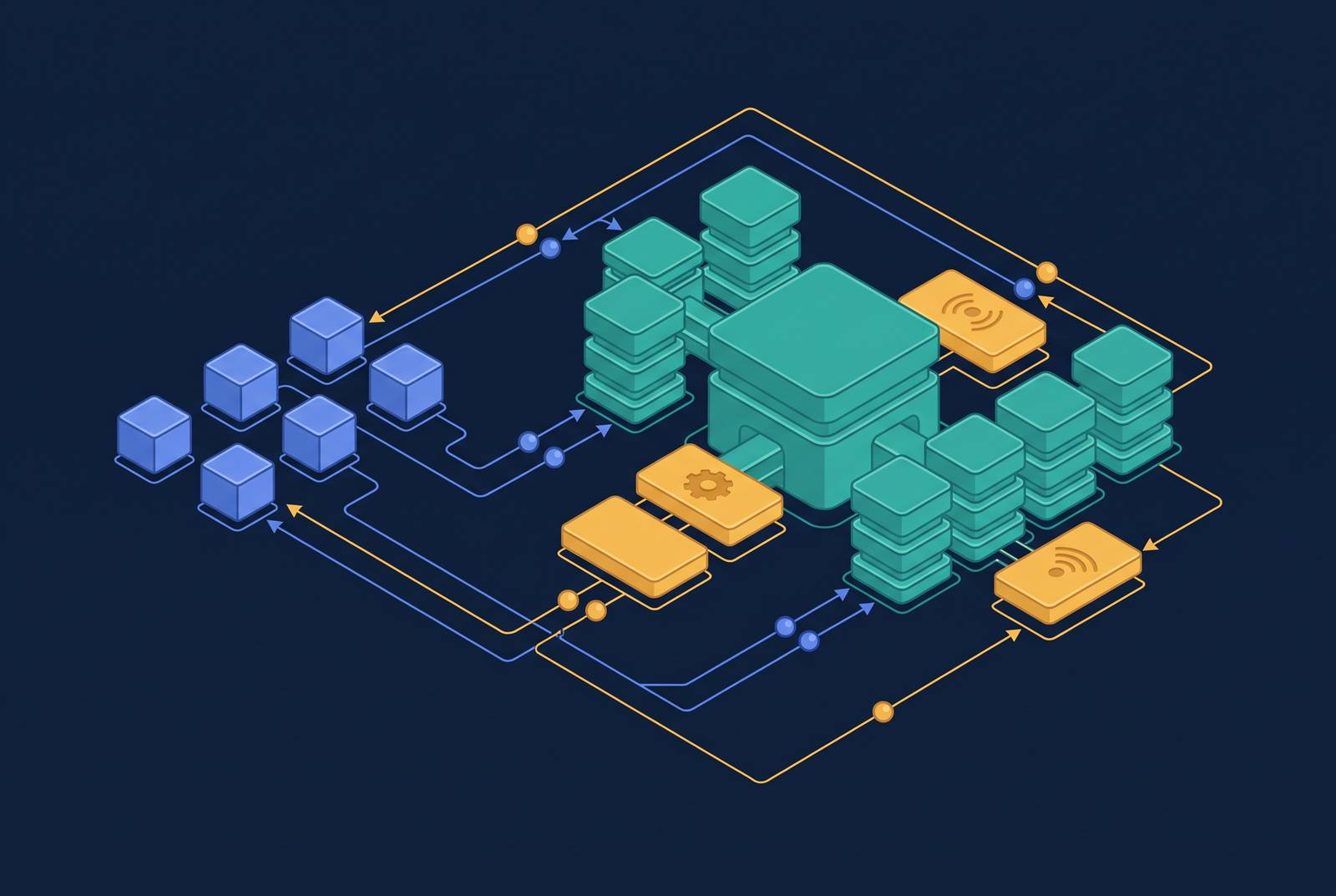
An event-driven agent loop treats the run as a reliable job. The job advances through kickoff, planning, tool execution, returning results, and safe retries. Each stage has a distinct execution boundary. The workflow can therefore continue without requiring one synchronous request to remain open throughout the agent’s work.
At kickoff, an HTTP request or queue message delivers the user’s goal to a lightweight orchestrator function. The function acknowledges receipt immediately, separating a fast initial response from the time needed to finish the task. Planning then becomes a discrete, logged event. The agent runtime interprets the objective and determines which tools to call and in what order.
Each tool call runs as a separate invocation coordinated by the agent runtime. Per-call, least-privilege identity policies limit which resources that step can use and what it can do. As reasoning progresses toward completion, results stream back to the user before the whole workflow finishes.
A timed-out tool call can retry without replaying earlier completed work, provided the step is idempotent and its progress is preserved. Async developers will recognize the underlying separation. An event triggers work, its result advances the workflow, and a failure returns control to a recovery path that preserves the run.
The compute continuity versus goal durability distinction that most architectures get wrong
The design must account for what the agent needs to keep beyond one invocation: its objective, its execution environment, or neither. These are different requirements. Compute continuity keeps a runtime alive, while goal durability preserves the objective and progress even when that runtime disappears. Mixing them up leaves capacity on standby when it is not needed or causes runs to lose context when they fail.
A single-invocation agent finishes within one ephemeral execution. It needs no external state to continue that run, so ordinary serverless functions are a suitable fit. Adding workflow durability here introduces complexity without solving a persistence requirement.
A durable-goal agent has a different boundary. Its objective and accumulated progress live in external storage, while compute appears when work is ready and releases afterward. Queues, durable execution engines, and state stores must coordinate the work so a server can shut down between steps.
A persistent-environment agent needs more than a saved plan. A coding agent that has cloned a large repository and installed dependencies may face expensive or unsafe reconstruction if its workspace disappears. Such an agent benefits from persistent or rapidly resumable execution. Its filesystem and execution context are part of the infrastructure decision.
The design-time heuristic is to identify what cannot be cheaply discarded. If only the objective and completed work must survive, external durability addresses the requirement. If rebuilding the workspace is costly or unsafe, resumable execution addresses a separate need. A three-box diagram labeled “Single-invocation,” “Durable-goal,” and “Persistent-environment” would make that distinction explicit.
How state is managed across invocations when compute is ephemeral
An ephemeral runtime provides no dependable memory between invocations. Any state required by a later step must therefore survive outside that invocation. But “agent state” is not one thing. The storage choice follows from whether the system is preserving workflow progress, evidence of tool execution, a workspace, or reasoning context.
Goal and plan state includes the original objective, the planned steps, and the record of completed work. A durable workflow store or queue preserves that progress so recovery starts after the last completed step. Tool-call records serve a complementary purpose. Full inputs and outputs, with secrets redacted, support audits and show retry logic which calls already completed.
For persistent-environment agents, the filesystem and execution context need their own preservation mechanism. MicroVM-based sandboxes can snapshot filesystem and memory state, allowing the environment to resume without repeating initialization. That distinction is especially useful for coding agents.
Reasoning context has another lifecycle. Within a run, tool results build up in the evolving context window, including the KV cache or in-context buffer, and help shape later plans. That context also needs preservation if its runtime disappears. Cross-session or long-term memory instead uses a memory layer, such as a vector store or structured memory API, retrieved when a new session starts.
Idempotency unifies these choices because recovery must not corrupt what survived. Every run and tool call needs to tolerate re-invocation after an unexpected timeout without duplicating side effects. Retry safety must therefore be part of the state design from the start.
Security isolation requirements that standard serverless was not designed to handle
Running model-generated code calls for more isolation than ordinary function execution. An adversarial prompt can induce code that attempts to exploit a kernel vulnerability and escape its container. In a shared-host environment, that can expose other customers’ workloads, credentials in host memory, or adjacent data. The consequence is a potential multi-tenant breach.
Containers share a host kernel, while microVMs give workloads separate kernels behind a hardware-enforced hypervisor boundary. An exploit against the workload’s kernel therefore faces an additional boundary before it can reach the host or other tenants. Isolation is not interchangeable across these execution models.
For agents running untrusted or model-generated code in production, the appropriate default is microVM-based execution. A sandbox does not define what an agent may legitimately request from a tool. Execution isolation and authorization solve different problems.
Least-privilege identity must consequently apply to each tool call, even when the execution environment is isolated. Bounded autonomy adds to that control by setting out what the agent may do, which resources it may use, and its rate limits and spending limits in advance. An isolated agent can still make unintended API calls or consume an unbounded budget through authorized interfaces. Isolation contains damage, while bounded autonomy constrains the actions that could cause it.
Why consumption-based billing is structurally aligned with agentic traffic patterns
A coding agent may sit idle for hours and then get many concurrent sessions when developers start their day. A server provisioned for that burst incurs a constant capacity cost through the quiet period. The traffic is intermittent, but the bill is not. Consumption-based compute aligns spending with execution.
The mismatch grows when infrastructure is sized for peak concurrency. Capacity that protects responsiveness during a burst can remain lightly used for much of its lifetime. Elastic serverless execution instead expands as sessions arrive and releases compute as work subsides. Under consumption-based pricing, idle time incurs no compute charge, although the workflow still needs its durable state.
What unit makes that spending understandable? Cost per inference, cost per agent run, and cost per task each show a different part of what the workload costs. They also support workload-level budget limits and anomaly alerts. Teams can then use cost to guide their work each day, without waiting for the monthly bill to see what they have spent.
That visibility needs an enforcement mechanism because an agent can generate its own continuing demand. An unbounded loop can keep invoking tools and reasoning steps indefinitely. Consumption pricing charges for that behavior.
The engineering requirement is therefore consumption pricing paired with per-agent cost limits. Maximum steps, elapsed-time limits, and spending bounds set how much work the system will allow before a run starts. These controls make paying for autonomous activity predictable enough for production.
How globally distributed compute changes latency and data-locality trade-offs for agents
The ability to scale from zero also changes the economics of geographic placement. The system can serve users across regions without keeping idle compute in each location. Pay-per-use compute makes distribution compatible with intermittent demand. The placement decision can then follow the workflow’s users and data rather than only the utilization of a central server pool.
For an interactive agent, network distance affects how quickly streamed results reach the user. A user in Frankfurt waiting on compute in a single US-based data center experiences a geographic delay that a nearby user does not. Compute placement remains part of perceived responsiveness.
Data locality adds a separate constraint. When regulated or regionally restricted data must be processed in the same jurisdiction, choosing a location solely for proximity to the user is insufficient. What happens when the user is far from where the data may be processed? A globally distributed network provides placement options, but the architecture still has to respect the data’s processing boundary.
The design goal is proximity to both users and data wherever those requirements can be satisfied together. Rather than treating geography as a later optimization, distributed serverless makes execution location part of the workflow design. Distributed gateways or WAFs can also enforce authorization, rate limits, and bounded-autonomy rules before traffic reaches origin infrastructure.
Governance, observability, and stop conditions as first-class production requirements
A well-architected agent loop without governance is an autonomous system with no circuit breaker. Compute can scale as needed, state can survive failures, and generated code can stay isolated while the agent still does unintended work. Those mechanisms do not define acceptable operation. Governance must connect the agent’s authority, its observable actions, and its stopping rules from the outset.
The production checklist begins with an audit trail for every tool call. Its inputs, outputs, calling-agent identity, and timestamp make a multi-step failure reconstructable, with secrets redacted from the recorded data. Observability must link those calls to the run they are part of. A record of the initial HTTP request cannot explain a failure several tool calls later.
Each run also needs a stopping rule set when it is created. Maximum steps, wall-clock time, and a spending limit bound execution without waiting for human intervention after a loop has run away. These limits also give cost monitoring an operational consequence. An alert identifies unusual spending, while a stop condition constrains how far it can continue.
Identity and autonomy complete the production requirements. Per-call authorization limits what each tool call can do, bounded autonomy sets what the agent is allowed to do, and per-agent cost limits cap how much it can spend. Together with isolation and durable, retry-safe state, they make it possible to release compute without releasing control. These are the minimum conditions for trustworthy autonomous operation.