End-to-End Testing Tools Evaluation Criteria
Script maintenance costs, not features, should drive your tool choice.

How the market for these tools is shifting in 2026
Choosing an end-to-end testing tool locks in a cost structure for years, and most teams pick it the way they pick a coffee machine: based on the demo, not the maintenance bill. That's the mistake this piece argues against. Industry data from the World Quality Report and TestGuild Enterprise Research puts script maintenance at 40 to 70% of total automation spend, and that share does not shrink on its own. It grows with every release, every UI change, and every integration a team bolts onto the product afterward.
The cause is structural. Applications change constantly, locators break, and workflows shift underneath the tests meant to guard them. Each change triggers a repair cycle, and that cycle compounds once a suite grows into the hundreds or thousands of test cases. Google's internal data, presented at ICST 2024, found that 84% of CI test failures traced back to flaky tests rather than real bugs, and each manual flakiness investigation runs about $5.67 in engineering time against close to nothing for an automated rerun. That cost multiplies across a thousand-test suite until the number stops looking like a rounding error.
So the tool a team picks today is a bet on how much of that 40 to 70% tax gets absorbed by software versus by people, and that bet plays out over years, not sprints. Get the architecture wrong and no amount of clever test design fixes it later. That's the argument this piece makes, and it's why architecture gets its own section below rather than a line item on a checklist.
Test automation as a category is valued at $24.25 billion in 2026 and is projected to reach $84.22 billion by 2034, a 16.84% compound annual growth rate. A vendor landscape growing that fast will not look the same in three years, and a platform picked purely for its current feature set needs to survive that maturing. Plenty of tools that looked sharp in a 2023 demo already look thin next to what has shipped since.
Most teams are not starting from zero either. Some 72% of organizations already run some level of test automation, and 58% plan to grow coverage by more than 30% this year. The real decision most teams face is not which tool to adopt from scratch, but what to build on top of what already exists.
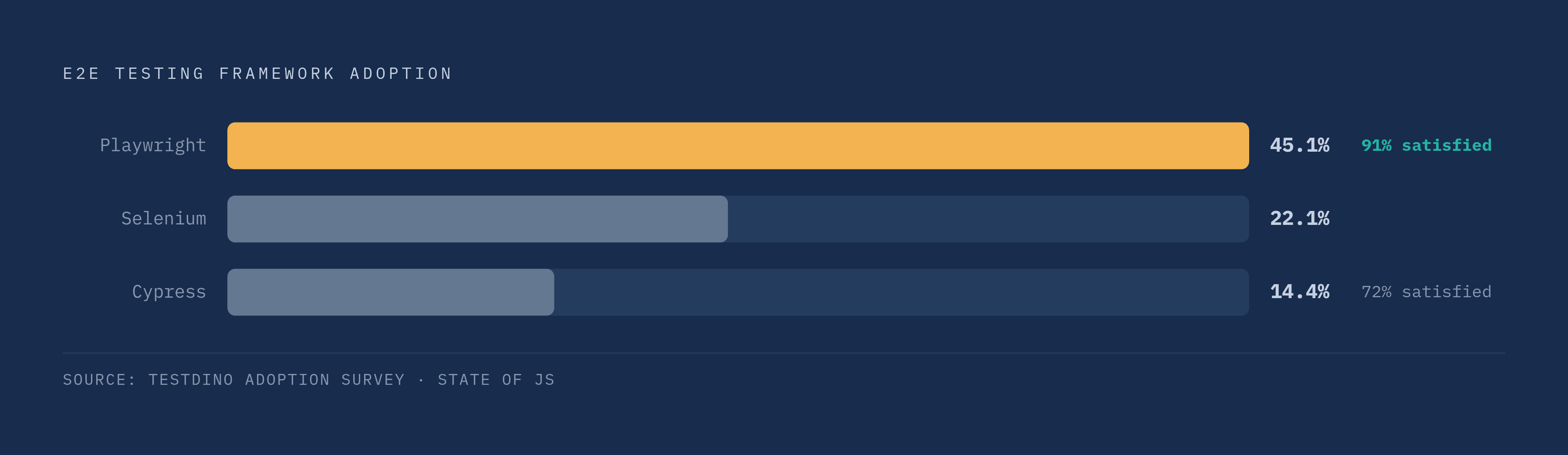
Framework preference has moved, and moved hard. Playwright now holds 45.1% adoption among QA practitioners, a figure from TestDino's adoption survey, ahead of Selenium at 22.1% and Cypress at 14.4%. The State of JS survey put Playwright satisfaction at 91% against Cypress at 72%, the widest gap ever recorded between the two tools. None of that makes Selenium obsolete: ThinkSys reports that over 31,000 companies still actively use it. It has simply stopped being the default starting point for new projects, and that's a different kind of decline than irrelevance.
Layered on top of all this sits a new formal category: AI-augmented testing. Gartner's Market Guide for AI-Augmented Software-Testing Tools, published in February 2024, projected that 80% of enterprises will fold AI-augmented testing into their engineering toolchains by 2027, up from just 15% in early 2023. That's a fast climb for any category, and it explains why the 2026 default setup for a lot of teams looks layered rather than clean: legacy Selenium suites kept alive, new coverage written in Playwright, and a layer of AI-driven self-healing sitting above both. Evaluation criteria built today have to account for that mess rather than pretend teams are choosing one tool in isolation.
The nine-parameter framework for structured E2E tool evaluation
A 2026 evaluation consensus breaks the decision into nine parameters: platform versus framework architecture, time to first test, who can author tests, the maintenance model, CI/CD integration, full-stack coverage, language support, pricing, and three-year total cost of ownership. Running the comparison against this list, rather than against whoever gave the flashiest demo, is what keeps the decision honest.
Architecture comes first because it's the most consequential binary in the whole decision, consequential enough to earn its own section further down. Flag it for now and move to what follows from it.
Time to first test is a good early filter. Platforms tend to get a team running its first real test within days. Frameworks ask for weeks, sometimes months, of infrastructure work: driver setup, CI wiring, reporting scaffolding, all before a single test executes.
Who can author tests decides whether coverage scales with headcount or gets stuck behind a small group of automation engineers. Codeless and low-code authoring open the door to QA analysts, business analysts, and manual testers who understand the workflow but don't write code. Code-only tools keep authorship narrow, but they give the engineers who do write the tests full control over structure and execution.
The maintenance model is where that 40 to 70% figure from the opening actually gets decided. Managed self-healing, the kind platforms build in, catches broken locators and adjusts automatically. Manual repair, the default under a framework, means a person opens the failing test, figures out what changed in the UI, and rewrites the selector by hand. That cost difference stops being theoretical once run across a few hundred tests.
CI/CD integration is more than whether a plugin exists. It's whether the tool triggers on a pull request, reports results inside the merge interface engineers already use, and can actually block a merge on failure, rather than generating a report nobody opens.
Full-stack coverage asks whether the tool reaches web, mobile, desktop, API, and database layers, or stops at the browser. Technology breadth is a baseline requirement: an E2E tool has to support whatever application types are actually running in production. For an enterprise running ERP software next to a custom web front end, that single factor can rule a tool out entirely, no matter how good everything else looks.
Language support decides whether existing test scripts carry forward and whether engineers can contribute to test code without switching languages mid-task. Pricing models vary sharply: some vendors charge per parallel test run, others per user seat, and the math shifts a lot moving from a 50-test suite to a 500-test suite. Deployment flexibility, cloud SaaS versus self-hosted, also decides whether a regulated industry can use the tool.
The ninth parameter, three-year total cost of ownership, puts everything else in perspective. Forrester's Total Economic Impact research documents test automation delivering a 4.5x return on investment over three years, with an average payback period of 13 months. Measure any licensing quote against that benchmark before signing anything.
Two of these nine parameters carry more weight than the rest combined: architecture and the maintenance model. Both deserve a closer look before any specific product gets compared.
Platform vs. framework: the architecture decision that sets your cost structure
A platform and a framework are not two flavors of the same purchase. They call for different teams, different timelines, and they produce entirely different cost curves over the following three years. Most vendor comparisons skip past this and jump straight to feature checklists, and that gets the order backwards: architecture decides what the checklist even means.
A platform bundles the authoring interface, cloud execution infrastructure, reporting, CI/CD connectors, and test management into one product. Onboarding takes days, not months, because none of that infrastructure needs building from scratch.
A framework, by contrast, is a set of libraries and APIs. Engineers use it to build automation themselves, deciding test structure, execution model, and parallelization on their own terms. That gives a team full technical control, but every piece of that control has to be built, and then kept running, by the team itself, indefinitely.
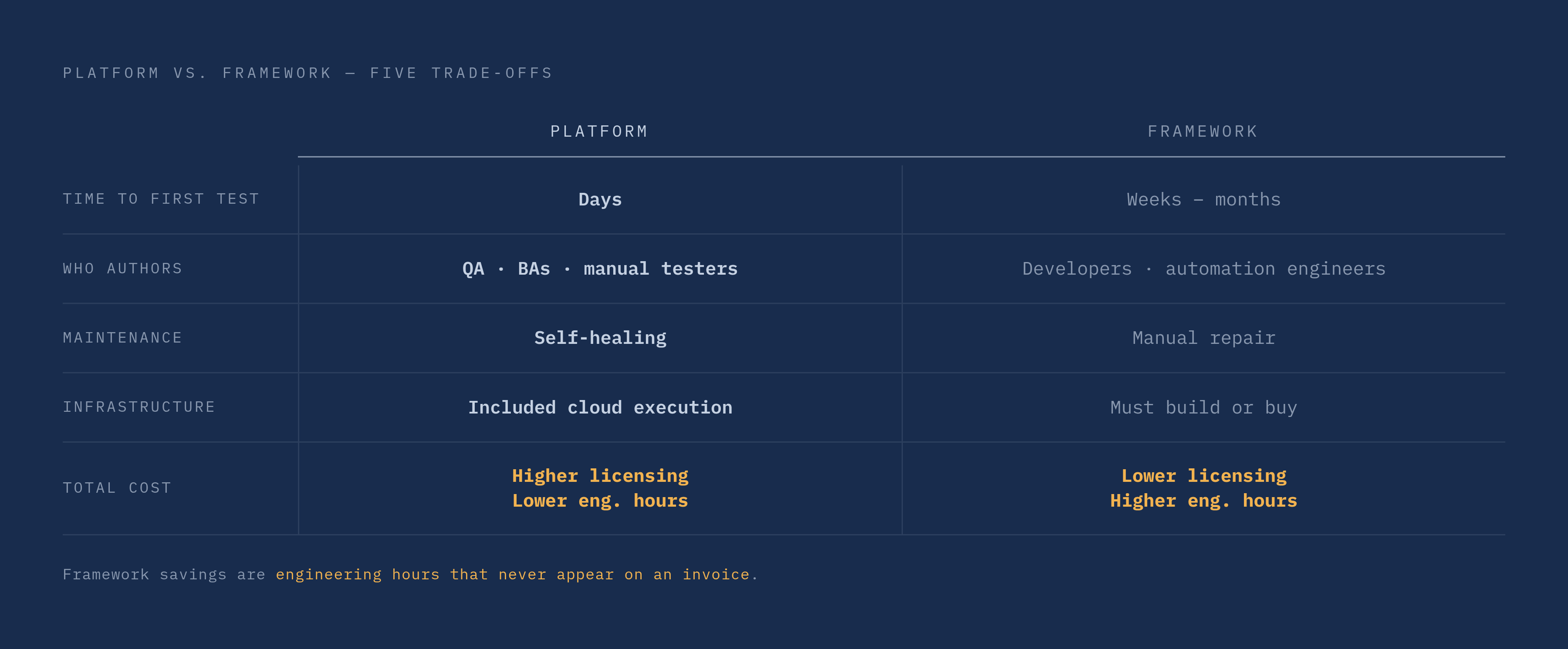
Laid side by side, the differences are stark. Time to first test: platforms take days, frameworks take weeks to months. Who authors tests: platforms open the door to QA, business analysts, and manual testers alongside developers, while frameworks stay limited to developers and automation engineers. Maintenance: platforms handle it through self-healing, frameworks leave it manual and owned entirely by the team. Infrastructure: platforms include cloud execution as part of the package, frameworks require it built or bought separately. Total cost of ownership: platforms run higher on licensing but lower on engineering hours, frameworks flip that, cheap to license but expensive in engineering time.
Open-source licensing costs nothing up front, but that fact gets treated, wrongly, as though it settles what the whole effort costs. The license fee is a small fraction of the real bill. The real cost is the engineering hours needed to build, run, and repair a framework-based suite month after month, and that bill comes due whether or not it ever shows up on an invoice. A team that picked Selenium for the zero license fee often discovers, well into the effort, that a meaningful share of engineering time goes purely toward keeping the suite green. That's what the framework was always going to cost. That's what the framework was always going to cost, just paid in a currency nobody put on the purchase order.
Most enterprise teams in 2026 don't pick one side cleanly, and the ones that try usually regret it. A framework still earns its place for the complex, bespoke scenarios where engineers genuinely need full control over execution. A platform earns its place for the broader coverage that business-side testers and QA analysts can own without writing code. Coverage speed matters, but so does what that coverage is actually proving, and that question is where the framework runs into its limits.
What "full coverage" means: functional completeness vs. production readiness
End-to-end testing, by definition, checks that every part of a system, front end, back end, integrations, and databases, works correctly from a user's first click to the final result. That's the textbook version. It leaves out whether "works correctly" under test conditions has anything to do with "works correctly" in production, and that gap is where a lot of teams get burned.
A functional E2E test proves a workflow completes under test conditions, a real result, but a narrow one. That's a real result, but a narrow one. It does not prove the workflow survives 10,000 people hitting it at once, a carrier route degrading mid-session, or transaction volume tripling during a processing window, as ir.com's 2026 guide points out.
That gap stays invisible until the day it isn't. A system that passes acceptance testing and functional E2E testing has been proven to work. It has not been proven to survive its busiest day, and those are two different claims that get conflated constantly in test reports that management reads as interchangeable.
Ir.com draws a useful line here: application E2E testing validates that a UI-to-database workflow completes as expected, full stop. Real-time systems E2E testing goes further, validating performance under real conditions, at real concurrency, across multiple vendors, over degraded network links, where the pass condition is not just completion but completion correctly at production volume.
For teams running unified communications, contact center, or payments infrastructure, this gap isn't academic. A browser automation script can confirm a checkout button works exactly once. It can't show whether a hundred concurrent sessions get a clear connection through an IVR system, or whether a payment gateway holds up when load triples without warning. Those are different failure modes entirely, and a tool built for the first won't catch the second no matter how many browsers it can spin up in parallel.
So when weighing coverage as a criterion, ask the tool one direct question: does it prove functional correctness alone, or can it also measure concurrency, jitter, latency, error rate, drop rate, and recovery time under load? Those are different capabilities, and a vendor that only does the former shouldn't get credit for the latter just because its marketing page uses the word "performance."
Reporting depth matters just as much as raw coverage. A plain pass or fail result is close to useless at two in the morning during a release rollback. Useful reports carry screenshots, video replays, logs, and trace data that turn "it failed" into "here is exactly where and why it failed."" Parallel execution capacity is worth checking too: how many tests can actually run at once, and does the tool support headless execution to cut runtime inside a CI pipeline where every minute adds up.
Concurrency and load are hard problems, but they're at least well-understood ones, with decades of testing theory behind them. The harder coverage problem heading into 2026 is newer, and it breaks the entire assertion-based model most E2E tools were built on.
Why conventional E2E testing breaks on AI agents
Some 57% of organizations already run multi-step agent workflows in production, and 16% have pushed further into cross-functional AI agents spanning multiple teams. Another 81% plan to expand into more complex agent use cases in 2026. That adoption curve is steep, and conventional E2E testing wasn't built for what it's now being asked to test.
The mechanism that breaks works like this. Traditional assertion-based tests check output against an exact expected string. AI agent outputs are non-deterministic, so two correct answers can be phrased completely differently, and a test written to match an exact string fails on a response that is entirely right, just worded another way. Asking an agent to summarize a support ticket twice will likely produce two different, both-correct summaries. A string match fails both. No amount of retrying the test fixes this, because the test itself is asking the wrong question.
The governance data around this makes the urgency clear. A Harness survey found 77% of large organizations claim a complete inventory of the AI agents running in their systems, but only 44% run active discovery tooling to verify that inventory is accurate. Even more telling: 74% say they trust testing to catch failures before release, yet just 19% have an automated gate that actually blocks a bad release from shipping. That's a wide gap between confidence and control, and it isn't visible in a planning meeting. It appears in an incident report six months later.
That gap raises costs, and it becomes visible in outcomes. Gartner predicts that more than 40% of agentic AI projects will get canceled by 2027, and points partly to the inability to systematically evaluate agents once they're deployed. A separate practitioner study, surveying 306 practitioners across 20 case studies spanning 26 domains, found that 70% of production agents rely on prompting off-the-shelf models rather than custom-trained ones, and 74% depend primarily on human evaluation to judge quality. Reliability remains the top challenge teams report, and it isn't close.
Evaluating agents properly takes a different kind of harness than what E2E testing has traditionally used. That harness needs tasks (the actual test cases), graders (the scoring logic that judges output quality), transcripts (the full trace of what the agent did, not just what it returned), and outcomes (a verifiable measure of success). Evaluation also has to run on multiple dimensions at once: task success, safety compliance, format adherence, and reasoning quality. One method gaining real traction here is LLM-as-a-Judge, which uses a separate model to automate quality scoring at scale, catching faithfulness and completeness problems without a human reading every single agent response by hand.
Cadence matters as much as method. A workable pattern runs golden tests on every pull request, a fuller evaluation daily or whenever something significant changes, and a comprehensive evaluation weekly or ahead of every release. On the infrastructure side, check whether a testing tool connects to a governance layer for prompt management and cross-provider cost control, since AI agent calls routed through a distributed network edge that also hosts that governance layer can avoid extra round-trip latency between the test runner and the model. For observability once agents are live, MLflow offers drift detection, hallucination monitoring, and audit trails, while LangSmith and Arize Phoenix serve as dedicated observability options built for the agentic stack specifically.
Platforms worth evaluating in 2026
The tools below are complete environments: authoring, execution infrastructure, CI/CD connectors, and reporting all come included. Most of them check the same nine boxes on paper, so the real differences are visible in coverage scope, how maintenance actually gets handled day to day, and pricing once a suite scales past a few hundred tests.
ACCELQ runs a codeless architecture that covers web, API, mobile, desktop, and mainframe inside a single end-to-end test scenario, with no code required at any layer. Its maintenance model centers on reusable business process components: when one component changes, the update propagates automatically across every test flow that uses it, instead of someone hunting down and fixing each broken reference by hand. ACCELQ's own 2025 customer data reports cost savings of over 70% compared to conventional tooling. Its AI layer, ACCELQ Autopilot, uses agentic automation where a QA team describes a business process in plain terms and the tool generates the test coverage itself. It fits enterprise teams running something like Salesforce next to SAP, or Workday alongside a custom web application, where no open-source framework matches that coverage scope without a heavy custom engineering lift.
Tricentis Tosca takes a model-based approach, decoupling tests from hard-coded element locators by abstracting the application into reusable modules, with an optional Business Flow Designer for mapping end-to-end business processes visually. That abstraction is what lets business-side contributors, people who understand the process but not the underlying technology, participate directly in test authoring. It deploys both on-premises and in the cloud, and pricing runs on an enterprise licensing model with a correspondingly high total cost of ownership; exact figures require contacting Tricentis directly. It suits organizations with an established continuous testing program already built around existing Tosca investment, less so a team starting from zero.
Mabl offers an AI-native SaaS platform built around self-healing and low-code authoring, aimed at teams that want AI-driven maintenance without taking on a full enterprise platform's scope or price tag.
Weighed against the nine-parameter framework and the architecture decision that shapes it, none of these three is a universal right answer, and treating the choice as a popularity contest defeats the purpose of running the framework. A team must decide how much of that 40 to 70% maintenance cost to absorb through engineering hours versus through a managed platform, and how much coverage, across web, mobile, load, and now AI agents, the application actually needs before anyone can honestly call a release safe.