Scaling Headless Browsers With Kubernetes
Headless browsers demand deliberate Kubernetes architecture, not just more replicas.
Scaling headless browsers on Kubernetes is not a matter of running more replicas and hoping the scheduler figures out the rest. It requires deliberate choices about resource sizing, session isolation, crash recovery, network posture, and now, increasingly, how an AI agent's unpredictable clicking pattern gets treated differently than a scripted test suite. This piece walks through that architecture layer by layer, starting with what a headless browser actually is and ending with what changes when the thing driving the browser is a language model rather than a QA engineer.
A headless browser is a programmable runtime. It renders pages, executes JavaScript, manages authenticated sessions, and holds state, all without a visible window, and all inside a container that someone else's orchestration system controls. Chromium's "new headless" mode, introduced in 2023 and made the default in Chromium 132, matters here because it shares its code path with desktop Chrome rather than running a stripped-down fork. The old headless mode was removed entirely in Chromium 132. That distinction is not trivia: it means the browser workloads running in production clusters today behave like real Chrome, rendering bugs and all, which is both good news for fidelity and bad news for anyone who assumed headless meant lightweight.
Three frameworks dominate how teams drive these browsers. Puppeteer stays Chromium-focused. Playwright spans Chromium, Firefox, and one other rendering engine, and its @playwright/mcp package now exposes browser automation as Model Context Protocol tools, a signal that testing infrastructure and AI agent tooling are converging on the same primitives. Selenium remains the incumbent, particularly in enterprises with existing Grid investments. Each maps to Kubernetes differently, and that mapping decision shapes almost everything downstream.
Packaging a browser into a Docker container solves real problems: job-level isolation, a predictable environment, compatibility with CI/CD pipelines. What it does not solve is crash detection, pool scaling, or timeout enforcement. Those have to be written by hand, usually as brittle shell scripts wrapping a fixed pool of VMs that sit idle most of the day and require someone to notice, manually, when a browser process hangs. Kubernetes exists to close exactly that gap. And the sizing math that governs the whole fleet starts with a basic fact: headless Chrome idles around 200 to 512 MB of RAM, while an interactive session with real tab content, images, scripts, ads, can run anywhere from 512 MB to 2 GB depending on which sites the browser visits.
Core architecture of a browser fleet on Kubernetes
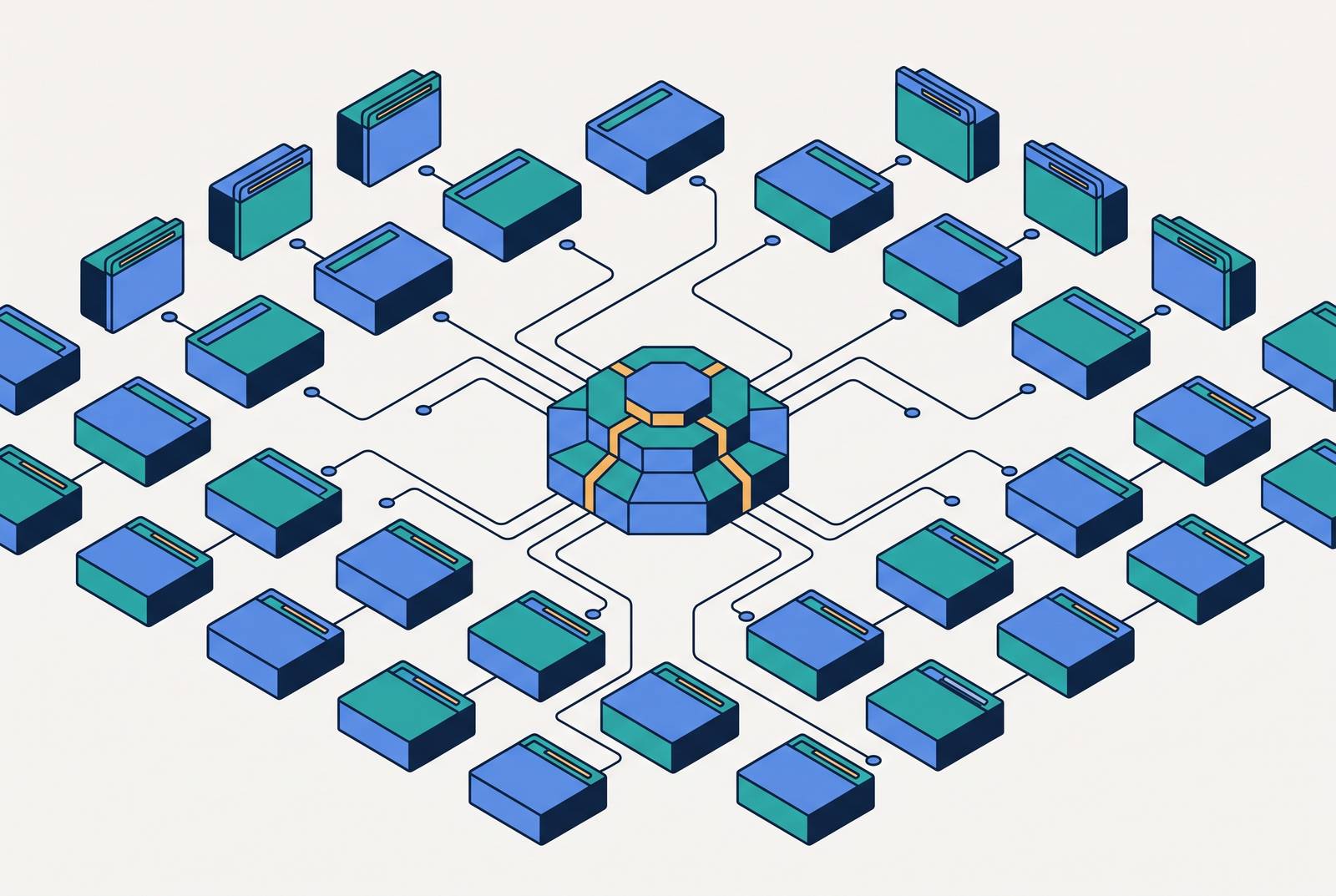
Start with namespace isolation. Putting browser workloads in a dedicated namespace, something like browser-workloads, keeps resource quotas and network policies scoped to just this fleet rather than bleeding into the rest of the cluster's traffic and budget. From there, the pod manifest carries the weight: CPU and memory requests and limits, environment variables controlling max concurrent sessions and preboot flags, and a security context that deserves more attention than it usually gets.
Chrome's sandbox model creates a real tension with Kubernetes' least-privilege defaults. The safe baseline looks like runAsNonRoot: true, allowPrivilegeEscalation: false, and dropping all capabilities. But Chrome's own sandbox typically wants SYS_ADMIN added back in to function correctly. Teams that drop this without a workaround (running --no-sandbox, or configuring a user namespace) either lose Chrome's process isolation guarantees or end up debugging cryptic crashes at 2 a.m. Neither is a good trade, so this decision deserves to be made explicitly rather than defaulted into.
The image landscape has settled into a handful of well-worn choices. browserless/chrome covers headless API use cases for Puppeteer and Playwright. selenium/standalone-chrome and selenium/standalone-firefox package Selenium Grid as single-node, all-in-one images. kasmweb/chrome adds visual browser streaming through KasmVNC with WebRTC support, useful when a human needs to actually watch a session. zenika/alpine-chrome strips things down to a minimal headless Chromium build, and ghcr.io/browserless/chromium offers an open-source path for teams that want the Browserless pattern without the commercial layer.
Above the pods sits the service layer: typically a LoadBalancer service fronting the browser pool, plus a separate NodePort service reserved for VNC debug access, kept off the main traffic path. ConfigMaps handle browser flags, extensions, and preferences centrally, so a flag change doesn't require rebuilding and redeploying an image. PersistentVolumeClaims come into play only when sessions need to survive pod restarts, cookies and localStorage that must persist across a crash or a rolling update.
For teams standing up Selenium specifically, the Helm chart path is well-documented: helm install selenium-grid selenium/selenium-grid with autoscaling turned on, Chrome and Firefox nodes running side by side, and a LoadBalancer hub tying it together. Playwright's path into a Kubernetes-hosted grid looks different: it connects over a remote browser control protocol endpoint rather than launching a browser locally, which matters for how connection pooling and retries get built into the client code.
One architectural property makes horizontal scaling actually tractable across all of this: statelessness. If a browser pod holds no session state that another pod needs to know about, replicas can be added or removed without a synchronization problem. That property is what every autoscaling strategy in the next section depends on.
Autoscaling browser pods: HPA, KEDA, VPA, and where each fits
The default instinct is to reach for the standard Kubernetes scaling mechanism built around CPU and memory, but that instinct falls short here. HPA reacts to CPU and memory. Browser workloads spike on queue depth, on how many jobs are waiting to be picked up, not on how hot the CPU runs. A large queue of pending scrape jobs might sit on pods reporting comfortable CPU numbers right up until latency collapses. HPA also can't scale below one replica, which rules out an idle fleet costing nothing.
None of that makes HPA useless. It still functions as a floor, a reactive layer handling CPU and memory replica counts underneath whatever primary signal drives the fleet. But it isn't the control loop that should be making the real decisions.
That role belongs to KEDA. KEDA extends the autoscaling model to external event sources: Kafka consumer lag, SQS queue depth, the length of a Redis list, a Prometheus query result, HTTP request rate, even cron schedules. It ships with more than 60 scalers covering these sources, which means the fleet can scale on the metric that actually reflects demand, jobs waiting, rather than a proxy metric that only loosely correlates with it. The bigger unlock is scale-to-zero. Idle browsers cost real money, somewhere in the $0.02 to $0.05 per browser-hour range for self-hosted compute, and a fleet that can drop to zero replicas when nothing is queued turns that idle cost into nothing at all. KEDA's Cron scaler adds a second pattern: pre-warming pods ahead of a known traffic spike, a scheduled report run at 6 a.m., say, so the fleet isn't cold-starting Chrome processes right when the response-time target clock starts. KEDA 2.19, released February 2026, added file-based authentication for ClusterTriggerAuthentication along with new Kubernetes resource scalers, extending how these trigger sources authenticate against the cluster.
VPA solves a different problem: right-sizing. Given that headless Chrome's memory footprint swings from 200 MB to 2 GB depending on what it's rendering, guessing a fixed request-and-limit for every pod means either wasting memory on the light sessions or having the heavy ones killed for exceeding their memory limit. VPA's historical weakness was that adjusting a pod's resources meant killing and recreating it, a disruptive operation for anything mid-session. That obstacle is gone: In-Place Pod Resizing went GA in Kubernetes 1.35 (December 2025), and VPA's InPlaceOrRecreate mode can now live-adjust a running pod's resources without a restart. That changes VPA from a batch-job tool into something usable on live browser fleets, provided it's understood as a sizing mechanism, not a scaling one.
Knative is an optional layer above all of this. It graduated as a CNCF project on October 8, 2025, and it adds scale-to-zero, request-based routing, and eventing on top of raw Kubernetes, appealing to teams that want browser jobs to behave like function invocations rather than long-running deployments. Separately, Kubernetes SIG Apps introduced an Agent Sandbox CRD in March 2026, a new abstraction built specifically for singleton, stateful agent workloads. The Kubernetes community looked at how AI agents actually use compute, continuously, statefully, unpredictably, and decided the existing pod and deployment primitives didn't fit well enough to leave alone.
GPU acceleration deserves a mention as a specialized case rather than a default. Headless Chromium doesn't get hardware acceleration out of the box. One documented deployment, Musixmatch running Remotion on Kubernetes with NVIDIA drivers enabled, achieved a 2x speed-up in video rendering by turning GPU support on. That's relevant for WebGPU workloads and cloud rendering pipelines. It is not something a standard scraping fleet needs to reach for.
Session isolation, crash recovery, and the failure modes teams overlook
Isolation at the pod level sounds simple until MAX_CONCURRENT_SESSIONS gets set too aggressively. Each pod should carry its own IP, through proxy rotation, its own cookie jar, and its own browser fingerprint. Push too many concurrent sessions onto a single pod and that isolation starts leaking, sessions interfering with each other in ways that are hard to reproduce and harder to debug after the fact.
Kubernetes auto-restarts pods that fail, but that restart is only as good as the probes configured to detect failure. A liveness probe that just checks whether the Chrome process is still running will miss the far more common failure mode: a browser that's alive but wedged, a CDP endpoint that stopped responding while the process itself sits there consuming memory. Probes built for browser workloads need to check CDP responsiveness specifically, not process uptime, or the fleet ends up running "healthy" pods that can't actually do anything.
Timeout enforcement is not something Kubernetes gives for free. A session that hangs, waiting on a page that never finishes loading, an infinite redirect loop, consumes its slot in the pool indefinitely unless the application layer explicitly kills it after some threshold. That threshold has to be written into the automation code itself; the orchestrator won't infer it.
Memory behavior over the life of a pod is its own quiet failure mode. Chrome's footprint climbs with tab count and session length, gradually, the kind of growth that doesn't trip an alert until a node starts evicting pods under memory pressure. Recycling pods on a schedule, or after some fixed number of sessions served, matters just as much as recycling them on crash. A pod that never crashes but never gets recycled either is often the one quietly eating the most memory on the node.
Where sessions need to persist, cookies and localStorage surviving across agent runs, PVC lifecycle has to be managed on purpose. Volumes that never get reclaimed after a job finishes are a common and boring source of storage bloat; this doesn't appear as an incident, just a slowly rising bill.
Sandbox environments matter most for agentic workloads specifically. Giving an AI agent a headless browser, a Python interpreter, and bash inside a container walled off from host credentials and production databases means that if the agent does something catastrophic, deletes the wrong thing, gets prompt-injected into a bad action, only the disposable container is lost. The isolation and recovery requirements here are the same whether the browser is being driven by a CI pipeline or a language model. Stagehand is a useful case in point. It started as AI-native browser agent automation and is now also used for generating tests, so the infrastructure underneath doesn't need to know or care which use case is running on a given day.
Network security posture for browser fleets: egress control, bot mitigation, and Zero Trust
Browser pods carry a dual threat model that's easy to underweight. They consume external content, which makes them an egress risk (what happens when a scraped page tries to exfiltrate something, or redirects to a malicious payload), and they serve automation APIs, which makes them an ingress risk too. Most teams harden one side and forget the other.
On the egress side, browser pods should not have unrestricted outbound access by default. Kubernetes NetworkPolicy resources can restrict egress to an allow-list of domains or network address ranges, which limits the blast radius if a scraped page or an agent's navigation decision tries to reach somewhere it shouldn't. Proxy rotation is the standard pattern for avoiding rate limits and IP bans, each pod routing through its own IP, but the cost model here is not trivial. At roughly $15 per GB with traditional proxy providers, and a single page load on a heavy React or Next.js site pulling 5 to 10 MB, a batch of 1,000 pages can run up around $150 in proxy transfer alone. That cost should be modeled before it raises a surprise line item in the budget.
Bot detection has moved well past blocking based on network address. Modern anti-bot systems fingerprint browser behavior itself, mouse movement patterns, timing between actions, canvas rendering quirks, not just the network origin of the request. That means stealth configuration, fingerprint randomization, and CAPTCHA handling need to be designed into the fleet from the start, not patched on after a target site starts blocking traffic.
Remote Browser Isolation flips the security use case around. Instead of protecting the fleet from the web, RBI protects an employee's device from the web: rather than opening a suspicious link directly on an endpoint, the user browses through a remote browser pod, and any malware, zero-day exploit, or phishing page executes inside that isolated pod, never touching the actual device.
The fleet's own control plane needs the same discipline. Browser pool APIs, debug endpoints like VNC and CDP, and session management interfaces have no business being reachable from the public internet. Zero Trust access policies, gating exactly who and what can reach these endpoints, are practical for a team of any size now, not a capability reserved for large enterprises with dedicated security staff. And screenshot APIs, PDF generation endpoints, and link preview services deserve a WAF with bot management sitting in front of them, because these are exactly the kind of high-value, easily-abused endpoints that attract automated exploitation. That's core architecture, not optional hardening added after an incident.
Managed alternatives exist for teams that would rather not own this surface. Browser Run, previously called Browser Rendering, offers Live View, human-in-the-loop controls, CDP access, session recordings, and concurrency limits reported at four times higher than typical self-hosted setups, aimed specifically at AI agent workloads. That's a real option to weigh against the engineering cost of building and maintaining the security posture described above.
The real cost of running a self-hosted browser fleet at scale
Start with utilization, because it's the number that actually determines whether self-hosting pays off. Self-hosted Chrome on Kubernetes runs somewhere between $0.02 and $0.05 per browser-hour in compute. At 100% utilization across a 1,000-browser fleet, that's $480 to $1,200 a day. But that math assumes every browser is doing useful work every hour of every day, and most fleets are nowhere close to that. Idle time, not the per-hour rate, is what actually drives the bill up.
That's why KEDA's scale-to-zero capability, covered above as an operational feature, doubles as the single biggest cost lever available. The economic argument and the architectural argument are the same argument here: idle browsers cost money, event-driven autoscaling removes the idle time, and the savings appear directly on the invoice.
Proxy data transfer needs its own line in the budget, separate from compute. At $15 per GB and 5 to 10 MB per page load on a heavy site, 1,000 pages runs about $150 in transfer costs alone, a number that scales linearly and can quietly dwarf compute spend on scraping-heavy workloads.
For teams weighing managed options against self-hosting, Browserless publishes tiers from $25 a month at the Prototyping level up to $350 a month at Scale, with concurrency and session length pushing costs higher above the listed tiers. Self-hosting Browserless on alternative infrastructure providers can run as low as €9 a month per server, with no per-unit fees, no session limits, and no shared resources to contend for, a meaningfully different cost shape for teams with steady, predictable volume.
GKE Autopilot is a middle path: a serverless Kubernetes experience priced on actual resource consumption rather than provisioned capacity, giving teams Kubernetes semantics without owning cluster management directly.
Self-hosting gives the deepest control over scaling behavior, network policy, and unit cost, but it demands real engineering time to run and keep running. Most teams below some volume threshold don't need to own that stack, and the premium a managed service charges over raw compute is the price of not needing to. Above that threshold, though, the math flips, and the engineering investment in a self-hosted fleet starts paying for itself. Where exactly that threshold sits depends on session volume, team size, and how much the engineering hours are worth doing something else, which is a calculation every team has to run for itself rather than borrow from a case study.
AI agents driving browsers in production: what changes at the infrastructure layer
Browser automation stopped being a niche testing concern once AI agents started driving it in production. A 2025 McKinsey survey found 88% of organizations using AI regularly, up from 78% in 2024, with 62% experimenting with or actively using AI agents. That shift changes what "browser fleet" means: the thing clicking through a page is no longer a deterministic script following a fixed selector path but a model making a judgment call about what to click next, and the infrastructure underneath has to accommodate that uncertainty.
What LLM-driven browsing needs, that scripted automation mostly doesn't, breaks down into a short list rather than a long one. Persistent authenticated sessions that survive across agent runs, so the agent doesn't have to re-authenticate every time it starts up. Graceful recovery when the agent navigates somewhere unexpected, since an LLM can click a link a QA script never would. Session recordings, so a human can go back and actually see what the agent did when something goes wrong. And human-in-the-loop controls for the steps where the agent's confidence, or the stakes of the action, don't justify letting it proceed unsupervised.
The agent platform landscape has moved fast enough that benchmark scores are worth citing precisely rather than describing loosely. Browser Use, an open-source framework, reports an 89.1% success rate on the WebVoyager benchmark across 586 diverse web tasks, currently the strongest open-source result on that measure. OpenAI's Operator, built on a Computer-Using Agent model trained on top of GPT-4o with supervised learning and reinforcement learning on GUI interaction, scored 87% on WebVoyager and 58.1% on the harder WebArena benchmark, and reached full ChatGPT integration on July 17, 2025. Google's Project Mariner, built on Gemini 2.0, scored 83.5% on WebVoyager, expanded to Google AI Ultra subscribers at I/O 2025, and was being integrated into the Gemini API and Vertex AI for developers as of that same event, before the standalone product was shut down on May 4, 2026. Skyvern, which specializes in form-filling and multi-step workflows without requiring hand-written selectors, posted an 85.8% WebVoyager score as of August 2026 and has drawn around 23,000 GitHub stars. Vercel Agent Browser, an open-source CLI with a Rust core and a Node fallback, has around 42,500 GitHub stars as of the same date.
Two platforms are built specifically for the production concerns above, not benchmark performance. Browserbase focuses on persistent sessions, session recordings, and session management across agent runs, purpose-built for agents operating continuously rather than in one-off test runs. Steel targets agents that need to stay logged into applications over time, with persistent cookies, automatic sign-in, JavaScript rendering, proxy support, stealth configuration, and CAPTCHA handling built in rather than bolted on afterward.
All of this circles back to the Agent Sandbox CRD mentioned earlier, which Kubernetes SIG Apps introduced in March 2026. Its existence is itself the argument: continuous, coordinated AI agent workloads don't map cleanly onto the short-lived pod model that Kubernetes was built around, and the community's response has been to build a new primitive rather than force the old one to stretch. Infrastructure teams adopting agentic browser workflows have good reason to track how that abstraction develops, because it's likely to become the pattern the rest of this piece's architecture eventually gets rebuilt around.